
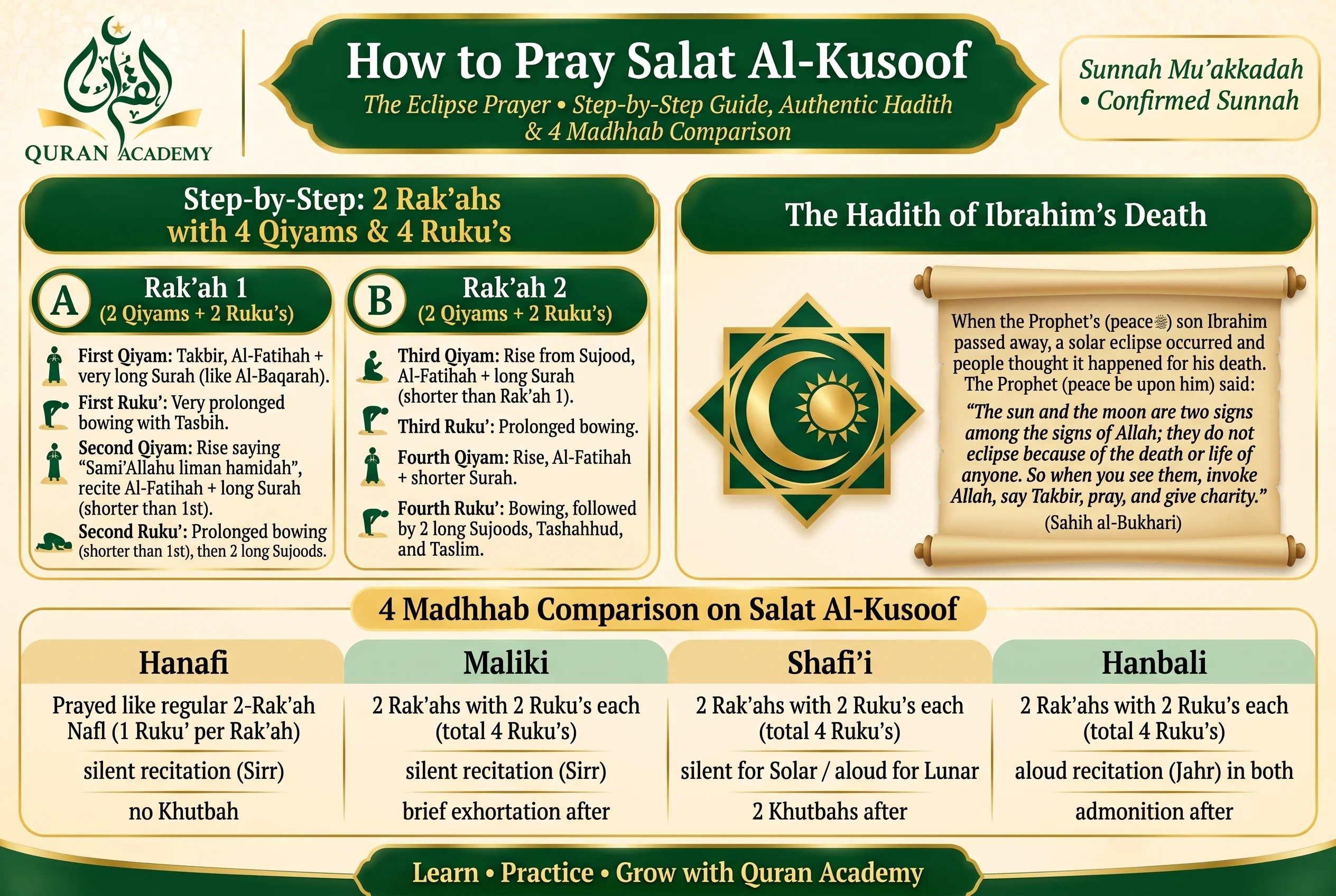
✦ Quick Answer & Key Takeaways: How to Pray Salat Al-Kusoof
Learning how to pray Salat Al Kusoof (كَيْفِيَّةُ صَلَاةِ الْكُسُوفِ وَالْخُسُوفِ — the Solar and Lunar Eclipse Prayer) prepares every Muslim to respond to one of Allah's most awe-inspiring cosmic signs with humble prayer, Quran recitation, and charity! Commanded by Prophet Muhammad (ﷺ) in Sahih al-Bukhari (1044) and Sahih Muslim (901): « إِنَّ الشَّمْسَ وَالْقَمَرَ آيَتَانِ مِنْ آيَاتِ اللَّهِ، لَا يَنْكَسِفَانِ لِمَوْتِ أَحَدٍ وَلَا لِحَيَاتِهِ، فَإِذَا رَأَيْتُمْ ذَٰلِكَ فَادْعُوا اللَّهَ وَكَبِّرُوا وَصَلُّوا وَتَصَدَّقُوا », Salat Al-Kusoof is an emphasized confirmed Sunnah (Sunnah Mu'akkadah) across all four Sunni schools. According to the majority (Maliki, Shafi'i, and Hanbali), it is a unique 2-Rak'ah prayer in which EACH Rak'ah contains TWO standings (Qiyam), TWO Quran recitations, TWO bowings (Ruku'), and TWO prostrations (Sujood)—totaling 4 Ruku's and 4 Sujoods across the 2 Rak'ahs (while the Hanafi school prays it as 2 regular Rak'ahs). In our 1-on-1 Online Islamic Studies, Fiqh & Quran Program, students master every special Sunnah Salah with certified Al-Azhar scholars!
- The Unique "2 Rak'ahs = 4 Ruku's" Formula: After rising from the 1st Ruku' in each Rak'ah saying Sami'allaahu liman hamidah, do NOT go down to Sujood—stay standing, recite Surah Al-Fatihah + a second Surah, perform a 2nd Ruku', rise, and THEN go down to Sujood!
- Descending Length Rule (Al-Bukhari 1052): Qiyam #1 is longest → Qiyam #2 is shorter → Qiyam #3 is shorter → Qiyam #4 is shortest (and the same for the 4 Ruku's)!
- How Is It Called? (Sahih al-Bukhari 1045): Zero Adhan and zero Iqamah—only the call: « الصَّلَاةُ جَامِعَةٌ » (As-Salaatu Jaami'ah)!
- Prayed in Mosque OR Alone at Home: Valid for both men and women in congregation or individually at home during the eclipse window!
In the 10th year after the Hijrah (632 CE)—as we saw in our Prophet Muhammad (ﷺ) Seerah Timeline for Kids—the Prophet's beloved infant son Ibrahim passed away in Madinah, and tears flowed from the Prophet's blessed eyes. On that exact same morning, the sun darkened in a solar eclipse over Madinah! Immediately, the people began whispering in amazement: "The sun itself has eclipsed in grief over the death of the Prophet's son Ibrahim!"
Think about that moment for a second: if anyone had ever been an impostor seeking worldly prestige, they would have remained silent and let people believe the sky darkened for their son. Instead, the Messenger of Truth (ﷺ) hurried to Al-Masjid An-Nabawi, led the longest, most awe-inspiring prayer the Companions had ever witnessed, and then stood on the pulpit to demolish superstition forever—declaring that the sun and the moon are two mighty signs of Allah that never eclipse for the death or birth of any human being, but rather Allah uses them to awaken fear and remembrance of the Day of Resurrection in the hearts of His servants (as described in Surah Al-Qiyamah 75:7–9: فَإِذَا بَرِقَ ٱلْبَصَرُ ﴿٧﴾ وَخَسَفَ ٱلْقَمَرُ ﴿٨﴾ وَجُمِعَ ٱلشَّمْسُ وَٱلْقَمَرُ ﴿٩﴾)! Completing our series of special Sunnah prayers—alongside Salat Al-Eid, Salat Al-Janazah, Salat Al-Istikharah, Salat Ad-Duha, Salat Al-Witr, and Tahajjud—this complete guide breaks down How to Pray Salat Al-Kusoof Step by Step, the 4 Madhhab Comparison Chart, what a latecomer (Masbooq) does if they miss the first Ruku', and the 6 Sunnah Deeds During an Eclipse.
- 1. Step-by-Step Guide: How to Pray Salat Al-Kusoof (The 2-Rak'ah, 4-Ruku' Prophetic Method!)
- 2. Master Fiqh Chart: Solar (Kusoof) vs. Lunar (Khusoof) Across the 4 Sunni Madhhabs
- 3. Three Practical Scenarios: Joining Late (Masbooq), Praying at Home & If the Eclipse Ends Mid-Prayer
- 4. The 6 Prophetic Sunnah Deeds During a Solar or Lunar Eclipse (Sahih al-Bukhari 1044)
- 5. Four Essential Tajweed Rules in the Quranic Eclipse Verses (Surah Al-Qiyamah 75:7–10!)
- 6. Frequently Asked Questions (FAQs)
1. Step-by-Step Guide: How to Pray Salat Al-Kusoof (The 2-Rak'ah, 4-Ruku' Method!)
Narrated by Mother of the Believers 'Aishah (RA) and 'Abdullah ibn 'Abbas (RA) in Sahih al-Bukhari (1044 & 1052) and Sahih Muslim (901), the Prophetic method followed by the majority of scholars (Maliki, Shafi'i, and Hanbali schools) consists of 2 Rak'ahs in which every single Rak'ah has TWO standings (Qiyam) and TWO bowings (Ruku')! Follow the two Rak'ahs side by side below:
Step-by-Step Sequence of Rak'ah 1
- Intention & Opening Takbeer: Intend in your heart to pray Salat Al-Kusoof, say "Allahu Akbar", and read the opening Dua (Istiftah).
- 1st Standing (Qiyam #1 — Longest!): Recite Isti'adhah, Basmalah, Surah Al-Fatihah, and a long Surah (or several Surahs from Juz Tabarak / Juz Amma) out loud.
- 1st Bowing (Ruku' #1 — Longest!): Say "Allahu Akbar" and bow into a long Ruku', glorifying Allah with Subhaana Rabbiyal-'Adheem many times.
- 2nd Standing (Qiyam #2 — DO NOT GO TO SUJOOD!): Rise from Ruku' #1 saying "Sami'allaahu liman hamidah, Rabbanaa wa lakal-hamd", fold your hands on your chest again, and recite Surah Al-Fatihah a 2nd time + a second Surah (slightly shorter than Qiyam #1)!
- 2nd Bowing (Ruku' #2): Say "Allahu Akbar" and perform a 2nd long Ruku' (slightly shorter than Ruku' #1).
- Rise & Perform 2 Long Sujoods: Rise from Ruku' #2 saying Sami'allaahu liman hamidah..., then go down for two long prostrations (Sujood) with a sitting in between, and stand up for Rak'ah 2!
Step-by-Step Sequence of Rak'ah 2
- 3rd Standing (Qiyam #3): Recite Surah Al-Fatihah + a Surah (slightly shorter than Qiyam #2).
- 3rd Bowing (Ruku' #3): Say "Allahu Akbar" and bow into Ruku' #3 (slightly shorter than Ruku' #2).
- 4th Standing (Qiyam #4 — DO NOT GO TO SUJOOD!): Rise from Ruku' #3 saying "Sami'allaahu liman hamidah, Rabbanaa wa lakal-hamd", stay standing, and recite Surah Al-Fatihah a 4th time + a Surah (slightly shorter than Qiyam #3)!
- 4th Bowing (Ruku' #4): Say "Allahu Akbar" and perform Ruku' #4.
- Rise & Perform 2 Long Sujoods: Rise from Ruku' #4 saying Sami'allaahu liman hamidah..., and go down to the floor for two long prostrations (Sujood).
- Final Tashahhud, Salawat & Salam: Sit for the final Tashahhud, send Salawat upon the Prophet (ﷺ), make heartfelt Dua, and give Salam to the right and left! *(If in the mosque, the Imam then delivers a reminder Khutbah after the prayer!).*
2. Master Fiqh Chart: Solar (Kusoof) vs. Lunar (Khusoof) Across the 4 Sunni Madhhabs
Just as we compared the four schools in our guides to Salat Al-Eid and Traveler's Prayer (Qasr & Jam'), here is how the Hanafi, Maliki, Shafi'i, and Hanbali schools explain the rulings of Salat Al-Kusoof and Salat Al-Khusoof:
| Fiqh Point | Shafi'i & Hanbali Schools | Maliki School | Hanafi School |
|---|---|---|---|
| 1. Structure of Each Rak'ah | 2 Rak'ahs with 2 Qiyams & 2 Ruku's per Rak'ah (= 4 Ruku's total) based on the Hadiths of 'Aishah and Ibn 'Abbas (RA) in Bukhari & Muslim! | 2 regular Rak'ahs (1 Qiyam & 1 Ruku' per Rak'ah) with prolonged recitation, Ruku', and Sujood (based on the narration of Abu Bakrah RA). | |
| 2. Loud (Jahri) vs. Silent (Sirri) Recitation | • Hanbali & Investigative View (Ibn Taymiyyah): Loud (Jahri) in BOTH Solar and Lunar eclipses (as proven in Sahih al-Bukhari 1065 that the Prophet ﷺ recited out loud in the Solar Eclipse prayer!). • Shafi'i: Silent in daytime Solar eclipse; Loud in nighttime Lunar eclipse. |
Silent in daytime Solar eclipse; Loud in nighttime Lunar eclipse. | Silent (or Imam's choice) in Solar eclipse; individual at home in Lunar eclipse. |
| 3. Congregation for Lunar Eclipse (Khusoof) | Sunnah in Congregation for BOTH Solar & Lunar eclipses (and also valid individually at home!). | Congregation in the mosque for Solar eclipse; prayed individually at home for Lunar eclipse. | Congregation in the mosque for Solar eclipse; prayed individually at home for Lunar eclipse. |
| 4. Post-Prayer Sermon (Khutbah) 🏆 | Sunnah! After finishing the prayer, the Imam delivers a sermon reminding people of the Hereafter, repentance, and charity (Sahih al-Bukhari 1044). | Recommended exhortation/reminder after prayer without formal Khutbah conditions. | No formal Khutbah; the Imam makes Dua facing the Qiblah or addressing the congregation until the eclipse clears. |
3. Three Practical Scenarios: Joining Late (Masbooq), Praying at Home & If the Eclipse Ends
Here are the clear answers to the three most common Fiqh questions worshippers face during an eclipse:
- 1. What If You Join the Imam Late (After the 1st Ruku' of Rak'ah 1)?
In the Maliki, Shafi'i, and Hanbali schools, the first Ruku' of each Rak'ah is the obligatory pillar (Rukn), whereas the second Qiyam and second Ruku' are a confirmed Sunnah. Therefore:
• If you catch the Imam in the 1st Ruku' of Rak'ah 1, you have caught the entire 1st Rak'ah!
• If you arrive during the 2nd Qiyam or 2nd Ruku' of Rak'ah 1 (having missed the 1st Ruku'), follow the Imam immediately, and after he gives Salam at the end of the prayer, stand up and make up 1 full Rak'ah (with its 2 Qiyams and 2 Ruku's)! - 2. Can Sisters, Mothers, or Workers Pray Salat Al-Kusoof Alone at Home?
Yes, 100%! Whether a mother is at home with her children (and she can even lead her children in congregation at home!) or you live far from a mosque holding the prayer, you pray the exact same 2 Rak'ahs (with 4 Ruku's and 4 Sujoods) at home—and if you haven't memorized long Surahs, you may either hold your Mushaf or Open Our Online Uthmani Quran Explorer on your phone/stand during prayer, OR repeat the Surahs you know from The 10 Shortest Surahs! - 3. Do We Pray Based on Astronomical News If Clouds Block the Sky, and What If the Eclipse Clears Mid-Prayer?
• Must Be Visually Sighted (Or Happening Above Your City): Because the Prophet (ﷺ) tied the prayer to « فَإِذَا رَأَيْتُمُوهُمَا » ("So when you see them..."), you do NOT pray for an eclipse happening on the other side of the globe that is not visible in your region!
• If the Eclipse Finishes While You Are Still Praying: Complete the remainder of your 2 Rak'ahs lightly at a normal pace and give Salam; if you finish the prayer before the eclipse clears, stay seated making Dhikr, Istighfar, and Dua until the sun or moon is completely bright again (you do NOT repeat the Eclipse Prayer a second time!).
4. The 6 Prophetic Sunnah Deeds During a Solar or Lunar Eclipse (Bukhari 1044 & 1059)
Even if a sister is on her monthly cycle (as we covered in our guide on Reading Quran & Dhikr During Your Period) or someone is unable to stand in prayer during the eclipse, notice that Prophet Muhammad (ﷺ) commanded 6 distinct acts of worship across the authentic Hadiths in Sahih al-Bukhari (1044, 1054, & 1059):
- 🤲 1. Performing Salat Al-Kusoof (فَصَلُّوا — "So pray!").
- 🤲 2. Making Heartfelt Dua (فَادْعُوا اللَّهَ — "Invoke Allah!").
- 🤲 3. Saying Takbeer & Dhikr (وَكَبِّرُوا / فَاذْكُرُوا اللَّهَ — "Magnify and remember Allah!").
- 🤲 4. Seeking Forgiveness — Istighfar (فَاسْتَغْفِرُوا — "Seek forgiveness!" — Bukhari 1059), just as we learned in our Surah Nuh Istighfar Guide!
- 🤲 5. Giving Charity — Sadaqah (وَتَصَدَّقُوا — "And give charity!") to extinguish Allah's displeasure and help the needy.
- 🤲 6. Seeking Refuge From the Torment of the Grave (Sahih al-Bukhari 1050): At the end of his Eclipse sermon, the Prophet (ﷺ) commanded the believers to seek refuge in Allah from the punishment of the grave (just as we do in the 4 Refuges Before Salam and by reciting Surah Al-Mulk every night!).
Mastering the Crisp Qalqalah in the Eclipse Verses of Surah Al-Qiyamah (75:7–11)!
One of the most moving Surahs to recite in Salat Al-Kusoof is Surah Al-Qiyamah (Chapter 75), which directly mentions the lunar eclipse in Verses 7–9: فَإِذَا بَرِقَ ٱلْبَصَرُ ﴿٧﴾ وَخَسَفَ ٱلْقَمَرُ ﴿٨﴾ وَجُمِعَ ٱلشَّمْسُ وَٱلْقَمَرُ ﴿٩﴾! And right before it in Verse 1 (لَا أُقْسِمُ = Laaa uqْsimu) and Verse 27 (وَقِيلَ مَنْ ۜ رَاقْ = Raaqْ), the silent Qaaf (قْ) is the strongest of the 5 Qalqalah (Echoing) letters (ق ط ب ج د)! Watch Senior Instructor Ustadhah Yasmeen Gamal demonstrate Qalqalah on our Quran Academy YouTube Channel:
Struggling to Perfect Your Recitation?
Join 1,250+ students mastering the Quran 1-on-1 with our Verified Al-Azhar Graduates. Flexible US, UK, Canadian & Australian schedules starting at $8/hr.
Book a Free Evaluation Class →- Mid-Word Bounce on "Uqْsimu" + Stop Bounce on "Raaqْ": Articulate every Qaaf with elevation and echo!
- 1-on-1 Live Coaching: Beautify your prayer recitation with Al-Azhar scholars!
5. Four Essential Tajweed Rules in the Quranic Eclipse Verses (Surah Al-Qiyamah 75:7–12)
Open our Online Uthmani Quran Explorer to Surah Al-Qiyamah (75:7–12) and Surah Fussilat (41:37 — the Sajdah verse of the Sun and Moon!), and apply these four Tajweed rules from our 1-on-1 Online Tajweed Course:
- 1. Sun Letter "Ash-Shams" vs. Moon Letter "Al-Qamar" Side by Side (75:9 & 41:37):
As we mastered in our Laam Shamsiyyah & Laam Qamariyyah Guide, notice that the very names of the two rules—Shamsiyyah (Sun) and Qamariyyah (Moon)—appear together in وَجُمِعَ ٱلشَّمْسُ وَٱلْقَمَرُ (75:9) and لَا تَسْجُدُواْ لِلشَّمْسِ وَلَا لِلْقَمَرِ (41:37): merge the Sun Laam completely into the Sheen of ٱلشَّمْسُ (Ash-Shamsu), and pronounce the Moon Laam clearly on وَٱلْقَمَرُ (Wal-Qamaru)! - 2. Heavy Raa on Stop vs. Light Raa on Stop Across Verses 7 to 12 of Surah Al-Qiyamah:
Applying our Ahkam Al-Raa Guide and An-Nabr (Vocal Stress) Guide, look at the breathtaking contrast when stopping at the end of Verses 7–12 of Surah Al-Qiyamah:
• Verses 7, 8, 9, 10, & 12: ٱلْبَصَرْ (Al-Basarْ), ٱلْقَمَرْ (Al-Qamarْ), ٱلْمَفَرّْ (Al-Mafarrّْ — with Nabr!), and ٱلْمُسْتَقَرّْ (Al-Mustaqarrّْ — with Nabr!) all have a Fatha before the Raa → 100% Heavy Raa (Tafkhim) on stop!
• Verse 11: كَلَّا لَا وَزَرَ → وَزَرْ (Wazarْ = Heavy) vs. Verse 2 (ٱلنَّفْسِ ٱللَّوَّامَةِ) and مُسْتَمِرّْ (Light)! - 3. Light "Kha-" vs. Heavy "Kha-" & Keeping Seen Light in "Wa Khasafal-Qamar" (75:8):
Using our Heavy & Light Letters Guide and Lahn Jali vs. Lahn Khafi Guide, in وَخَسَفَ ٱلْقَمَرُ (Wa Kha-sa-fal-qamar), elevate the heavy Khaa' (خَ), then immediately drop your tongue to a smiling, 100% Light Seen (سَ) and Faa (فَ)—never let the Khaa' turn the Seen into a heavy Saad ("Khasafa" with ص ❌)! - 4. Applying Position #1 of An-Nabr on "Al-Mafarrّْ" (75:10) & "Al-Mustaqarrّْ" (75:12):
Following our Makharij al-Huruf, Sifaat al-Huruf, Rules of Madd, Noon Sakinah Rules, Meem Sakinah Rules, Rules of Waqf, Hamzatul Wasl vs. Qat', 4 Special Words of Hafs, 7 Alifs in the Quran, Idgham Mutamathilayn, Mutajanisayn & Mutaqaribayn, and 10 Qira'at guides, press firmly with Nabr when stopping on the doubled Raa of أَيْنَ ٱلْمَفَرّْ (75:10) and إِلَىٰ رَبِّكَ يَوْمَئِذٍ ٱلْمُسْتَقَرّْ (75:12)! Test your Tajweed accuracy right now on our Free 3-Minute Tajweed Quiz!
Pair this Eclipse Prayer guide with our complete library of Fiqh, Seerah, and Quranic Arabic guides: Newborn Baby Sunnahs & 'Aqeeqah Rules, The 10 Promised Paradise, Story of Musa & Al-Khidr, 4 Stories of Surah Al-Kahf for Kids, 50 Most Common Arabic Roots, Arabic Pronouns Chart, Harf Al-Jarr Prepositions, Singular, Dual & Plural, Verbs in Quranic Arabic, Surah Al-Qalam, Surah Al-Muzzammil, Surah Al-Qadr, 99 Names of Allah, and 30-Day Quran Khatmah Schedule in our Online Hifz Program (using our Smart Hifz Planner)! Meet our Al-Azhar Certified Tutors, enroll your child in our 1-on-1 Kids Quran Classes with our Printable Kids Star Chart, and read how families across the US, UK, Canada, and Australia rate our teachers on our Verified Student & Parent Reviews Page.
6. Frequently Asked Questions (FAQs) About Salat Al-Kusoof (Eclipse Prayer)
1. How do you pray Salat Al-Kusoof (the Eclipse Prayer) step by step?
According to the majority of scholars (Maliki, Shafi'i, and Hanbali schools, based on the Hadith of 'Aishah and Ibn 'Abbas RA in Sahih al-Bukhari 1044 & 1052), Salat Al-Kusoof is 2 Rak'ahs, but EACH Rak'ah has TWO standings (Qiyam), TWO Quran recitations, TWO bowings (Ruku'), and TWO prostrations (Sujood)—totaling 4 Ruku's and 4 Sujoods across the 2 Rak'ahs! In the Hanafi school, it is prayed as a standard 2-Rak'ah prayer with 1 Ruku' and 2 Sujoods per Rak'ah.
2. What is the difference between Kusoof and Khusoof in Islamic Fiqh?
In classical Arabic and Hadith usage, Kusoof (الكسوف) and Khusoof (الخسوف) can be used interchangeably for both eclipses; however, jurists commonly specify Kusoof Ash-Shams (كسوف الشمس) for a Solar Eclipse and Khusoof Al-Qamar (خسوف القمر — as in Surah Al-Qiyamah 75:8: "Wa khasafal-qamar") for a Lunar Eclipse.
3. Can you pray Salat Al-Kusoof alone at home, or must it be in congregation at the mosque?
While praying Salat Al-Kusoof in congregation at the mosque (called with the phrase "As-Salaatu Jaami'ah" without Adhan or Iqamah) is the primary Prophetic Sunnah, all four Sunni schools agree that it is completely valid and rewarding for men and women to pray Salat Al-Kusoof individually at home if they cannot reach the mosque!
4. What happens if you join the Imam after he has already finished the first Ruku' of a Rak'ah in Salat Al-Kusoof?
In the Maliki, Shafi'i, and Hanbali schools, because the first Ruku' of each Rak'ah is the foundational pillar (Rukn) while the second Ruku' is an added Sunnah/feature, if a latecomer (Masbooq) misses the FIRST Ruku' of a Rak'ah and only catches the second Ruku', they have missed that Rak'ah and must make it up (with its 2 Ruku's) after the Imam gives Salam!
5. Why did Prophet Muhammad (ﷺ) lead Salat Al-Kusoof on the day his young son Ibrahim passed away?
In 10 AH, on the exact day the Prophet's infant son Ibrahim passed away, a solar eclipse occurred in Madinah and people said: "The sun eclipsed because of the death of Ibrahim!" Instead of using the coincidence to claim false miracle status, Prophet Muhammad (ﷺ) immediately led the Eclipse Prayer and proclaimed Truth (Sahih al-Bukhari 1044): "Indeed, the sun and the moon are two signs among the signs of Allah; they do not eclipse for the death or life of anyone! So when you see them, invoke Allah, say Takbeer, pray, and give charity!"
Stand in Prayer With Long, Melodious Quran Recitation!
Memorize more of the Book of Allah and perfect your Tajweed & Fiqh in personalized 1-on-1 sessions with certified male and female Al-Azhar scholars. Book your free diagnostic trial session today!
Book Your Free 1-on-1 Trial Class →