
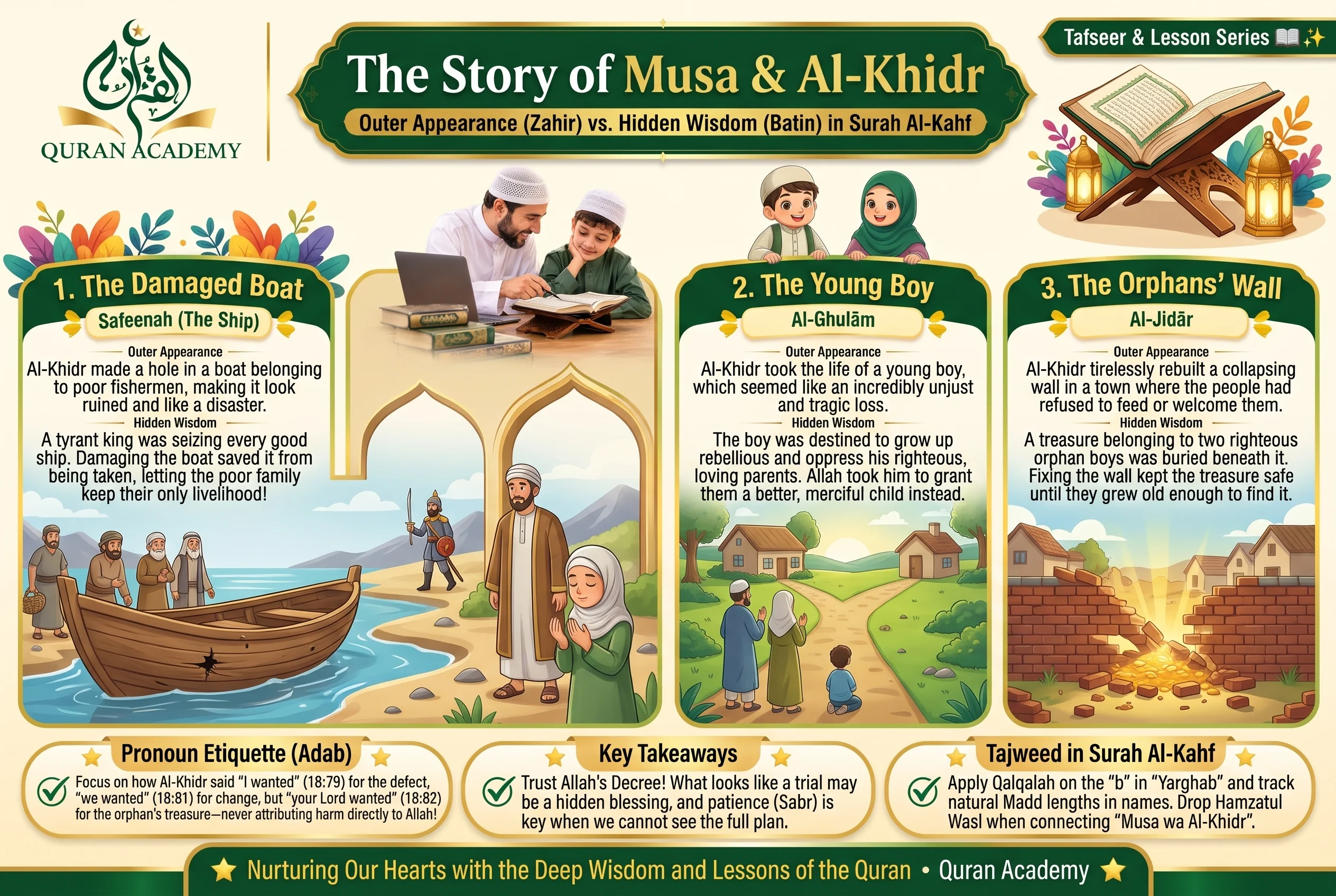
✦ Quick Answer & Key Takeaways: The Story of Musa & Al-Khidr
Exploring the story of Musa and Khidr (قِصَّةُ مُوسَىٰ وَالْخَضِرِ عَلَيْهِمَا السَّلَامُ فِي سُورَةِ الْكَهْفِ — Verses 60 to 82 of Surah Al-Kahf, Pages 300–302 of the Madinah Mushaf, and expounded in full by Prophet Muhammad ﷺ in Sahih al-Bukhari 122 & 4725) is the ultimate Quranic cure for human grief, confusion, and anxiety over Divine Decree (Al-Qadar)! When Prophet Musa (AS)—one of the five greatest Messengers of Firm Resolve—traveled with his young attendant Yusha' ibn Nun to the junction of the two seas (مَجْمَعَ ٱلْبَحْرَيْنِ) to seek knowledge from Allah's righteous servant Al-Khidr (AS), he witnessed three events that looked like tragedies on the surface—(1) Damaging a poor family's boat, (2) Taking the life of a young boy, and (3) Rebuilding a wall in a stingy town without pay—only to discover that every single decree was a hidden mercy from Ar-Rahman! In our 1-on-1 Online Islamic Studies, Tafseer & Kids Program, families study this remarkable journey to build unshakeable trust in Allah's wisdom!
- Why Did Imam Al-Bukhari Place This Story in the "Book of Knowledge"? Because when Musa (AS) was asked who was most knowledgeable on earth and forgot to say "Allahu A'lam," he immediately traveled across land and sea as a humble student to learn!
- The Golden Rule of Patience (18:68): وَكَيْفَ تَصْبِرُ عَلَىٰ مَا لَمْ تُحِطْ بِهِ خُبْرًا ("And how can you have patience with that which you do not encompass in knowledge?").
- Why Sometimes a Small Loss Saves Everything: The broken plank in the poor fishermen's boat saved their entire ship from the pirate king ahead!
- How Righteous Parents Protect Future Generations (18:82): Allah preserved the buried treasure of the two young orphans because وَكَانَ أَبُوهُمَا صَالِحًا ("and their father was a righteous man")!
Have you ever experienced a moment in life when a door you prayed for slammed shut right in front of you—a flight you missed, a job or business contract that fell through, a sudden scratch on your car, or a painful trial that made no sense at the time—and your heart whispered: "Ya Rabb, why did this happen when we were trying our best?"
In the third of the 4 Stories of Surah Al-Kahf for Kids & Families (Verses 60 to 82), Allah Almighty lifts the veil of the Unseen (Al-Ghayb) for a few moments so every believer until the Day of Judgment can see how Allah's Decree (Al-Qadar — the 6th pillar in our 6 Articles of Faith Guide!) actually works behind the scenes! Imagine being one of the poor fishermen on the morning they walked down to the beach and saw a gaping hole in their boat: to their eyes, that morning looked like a disaster; yet hours later, when the tyrant king's soldiers marched down the coast confiscating every undamaged boat and leaving theirs untouched, they fell to their knees realizing that the "damage" was the greatest rescue of their lives! Below, we trace the complete journey from Sahih al-Bukhari and Surah Al-Kahf, compare the 3 Tests in a Master Chart, uncover the Pronoun Etiquette Secret of Verses 79–82, and extract 10 Transformative Lessons along with 4 Essential Tajweed Rules.
- 1. How the Journey Began: The Salted Fish, Yusha' ibn Nun & The Sparrow on the Boat (Bukhari 4725)
- 2. Master Chart: The 3 Tests of Musa & Al-Khidr (Outer Appearance vs. Hidden Divine Mercy!)
- 3. Linguistic Miracle: Why Al-Khidr Shifted Pronouns ("I Desired", "We Desired" & "Your Lord Desired")
- 4. Ten Life-Changing Lessons From Musa & Al-Khidr on Knowledge, Parenting & Qadar
- 5. Four Essential Tajweed Rules in the Musa & Al-Khidr Passage (18:60–82)
- 6. Frequently Asked Questions (FAQs)
1. How the Journey Began: The Salted Fish, Yusha' ibn Nun & The Sparrow (Bukhari 4725)
In one of the longest, most detailed Tafseer Hadiths in Sahih al-Bukhari (122, 3401, and 4725) and Sahih Muslim (2380), 'Abdullah ibn 'Abbas and Ubayy ibn Ka'b (may Allah be pleased with them) narrated directly from Prophet Muhammad (ﷺ) the full context behind Surah Al-Kahf (18:60–82):
When Prophet Musa (AS — mentioned 136 times in the Quran!) stood delivering a sermon that made eyes overflow with tears and hearts tremble, a man asked: "O Messenger of Allah, is there anyone on the face of the earth more knowledgeable than you?" Musa (AS) replied, "No" (speaking according to what he knew as Allah's Messenger). Because he did not attribute absolute knowledge back to Allah (by saying "Allahu A'lam"), Allah revealed to him: "Yes, Our servant Khidr at the junction of the two seas has knowledge that you do not have!" Immediately, Musa (AS) asked: "O Lord, how can I find him?" Allah told him: "Carry a salted fish in a woven basket (Miktal); wherever you lose that fish, there he is!"
When Musa (AS) and his young attendant Yusha' ibn Nun retraced their footsteps to the rock where the dead fish had miraculously come back to life and burrowed into the sea, they found Al-Khidr wrapped in his garment. After boarding the boat together:
"A small sparrow (عُصْفُورٌ) came and landed on the edge of the boat, and dipped its beak once or twice into the sea. Al-Khidr said: 'O Musa! My knowledge and your knowledge, compared to the Knowledge of Allah, have not decreased from Allah's Knowledge except like the drop this sparrow took with its beak from the ocean!'
And the Messenger of Allah (ﷺ) smiled and said: « يَرْحَمُ اللَّهُ مُوسَى، لَوَدِدْنَا لَوْ صَبَرَ حَتَّى يُقَصَّ عَلَيْنَا مِنْ أَمْرِهِمَا » ('May Allah have mercy on Musa! How we wish he had been patient so that more of their story would have been narrated to us!')."
2. Master Chart: The 3 Tests of Musa & Al-Khidr (Outer Appearance vs. Hidden Mercy!)
Open our Online Uthmani Quran Explorer to Surah Al-Kahf (18:71–82) and compare what Prophet Musa (AS) saw with his eyes (judging by outward Sacred Law, Ash-Shari'ah Adh-Dhahirah) versus what Al-Khidr (AS) knew by Allah's direct revelation of the Unseen ('Ilm Al-Ghayb):
| Test & Verses | What It Looked Like on the Outside (And Musa's Reaction!) |
The Hidden Divine Mercy Behind the Scenes (Verses 79–82) |
|---|---|---|
| Test #1: The Poor Fishermen's Boat (ٱلسَّفِينَةُ • 18:71 & 79) |
The boat owners recognized Al-Khidr and carried them for free without charging a fare—yet Al-Khidr pulled out a plank and damaged the boat (خَرَقَهَا)! • Musa's Reaction (out of forgetfulness): أَخَرَقْتَهَا لِتُغْرِقَ أَهْلَهَا ("Did you damage it to drown its people?!") |
أَمَّا ٱلسَّفِينَةُ فَكَانَتْ لِمَسَاكِينَ يَعْمَلُونَ فِي ٱلْبَحْرِ... A ruthless tyrant king was stationed right ahead seizing every single sound, undamaged boat by force (غَصْبًا)! By creating a minor, easily repairable defect, Al-Khidr saved the poor family's entire source of income! |
| Test #2: The Young Boy (ٱلْغُلَامُ • 18:74 & 80–81) |
Upon leaving the boat, Al-Khidr took the life of a boy playing with other youths. • Musa's Reaction (deliberate righteous anger): أَقَتَلْتَ نَفْسًا زَكِيَّةً بِغَيْرِ نَفْسٍ ("Have you killed a pure soul who killed no one?!")—and Musa set a final condition: "If I ask you about anything after this, do not keep me as a companion!" |
وَأَمَّا ٱلْغُلَامُ فَكَانَ أَبَوَاهُ مُؤْمِنَيْنِ فَخَشِينَا أَن يُرْهِقَهُمَا طُغْيَانًا وَكُفْرًا... His two parents were devoted believers, and Allah knew that this youth was stamped with rebellion and disbelief that would overwhelm his parents' faith—so Allah willed to replace him with a purer, more merciful child! |
| Test #3 🏆: The Orphans' Wall (ٱلْجِدَارُ • 18:77 & 82) |
Hungry and tired, they entered a town whose people refused to host them as guests; yet Al-Khidr found a crumbling wall and rebuilt it upright with his own hands for free! • Musa's Gentle Suggestion: لَوْ شِئْتَ لَتَّخَذْتَ عَلَيْهِ أَجْرًا ("If you wished, you could have taken a wage for it [to buy food]!"). |
وَأَمَّا ٱلْجِدَارُ فَكَانَ لِغُلَامَيْنِ يَتِيمَيْنِ فِي ٱلْمَدِينَةِ وَكَانَ تَحْتَهُ كَنزٌ لَّهُمَا وَكَانَ أَبُوهُمَا صَالِحًا... Had the wall collapsed, the greedy townspeople would have stolen the two young orphans' buried inheritance! Because their deceased father (7th grandfather in some reports!) was righteous, Allah sent two Prophets to rebuild their wall for free! |
3. Linguistic Miracle: Why Al-Khidr Shifted Pronouns ("I Desired", "We Desired" & "Your Lord Desired")
Applying what we learned in Day 3 about Arabic Pronouns in the Quran (Dama'ir) and Past Tense Verb Conjugation, look at one of the greatest linguistic miracles of etiquette (Adab ma'a Allah) in the entire Quran across Verses 79, 81, and 82: even though Al-Khidr declared at the end that all three actions were commanded by Allah (وَمَا فَعَلْتُهُ عَنْ أَمْرِي — 18:82), look at how he changed the subject pronoun of the verb أَرَادَ (desired/willed) in each of the three explanations:
- 1. In Test #1 (Damaging the Boat — 18:79) → First Person Singular ("I Desired"):
﴿ فَأَرَدتُّ أَنْ أَعِيبَهَا ﴾ (Fa-arad-TU an a'eebahaa — "So I desired to cause a defect in it!")
Why did Al-Khidr say "I desired" instead of "Your Lord desired to damage it"? Because out of supreme reverence and manners with Allah, a righteous servant never attributes "defect/damage" (الْعَيْب) verbally to Allah Almighty—just as Prophet Ibrahim (AS) said in Surah Ash-Shu'ara (26:80): "And when I fall ill, HE heals me!" and just as the believing Jinn said in Surah Al-Jinn (72:10)! - 2. In Test #2 (Replacing the Boy With a Better Child — 18:81) → First Person Plural ("We Desired"):
﴿ فَأَرَدْنَا أَن يُبْدِلَهُمَا رَبُّهُمَا خَيْرًا مِّنْهُ ﴾ (Fa-arad-NAA — "So we desired that their Lord should replace him for them with one better!")
Combining his execution of the command with the angelic/prophetic mission leading to a merciful replacement! - 3. In Test #3 (Pure Mercy & Treasure for the Two Orphans — 18:82) → Third Person ("Your Lord Desired"):
﴿ فَأَرَادَ رَبُّكَ أَن يَبْلُغَا أَشُدَّهُمَا وَيَسْتَخْرِجَا كَنزَهُمَا رَحْمَةً مِّن رَّبِّكَ ﴾ (Fa-araada Rabbuka — "So your Lord desired that they reach their maturity and extract their treasure, as a mercy from your Lord!")
When the outcome was 100% pure goodness, maturity, treasure, and mercy, Al-Khidr attributed it entirely to Allah (Your Lord)!
4. Ten Life-Changing Lessons From Musa & Al-Khidr on Knowledge, Parenting & Qadar
Reflect with your family on these 10 practical gems from Surah Al-Kahf (18:60–82):
Struggling to perfect your Recitation?
Join hundreds of students mastering the Quran with our Verified Al-Azhar Graduates. We offer flexible 1-on-1 sessions tailored to your schedule.
Book a Free Evaluation Class →- 1. Always Attribute Knowledge to Allah ("Allahu A'lam"): No matter how many degrees or Surahs we master, human knowledge is less than a sparrow's sip from the ocean of Al-'Aleem!
- 2. Travel & Strive to Seek Sacred Knowledge (18:60): If a Messenger of the rank of Musa (AS) walked across the earth to learn three lessons, how eagerly should we attend our weekly Quran and Tajweed classes!
- 3. Mentor Youth by Bringing Them With You (18:60): Musa (AS) brought his young student Yusha' ibn Nun (لِفَتَاهُ) on his journey—training the next leader of Bani Isra'il through hands-on companionship!
- 4. Share the Same Food With Those Who Serve You (18:62): Musa (AS) said: آتِنَا غَدَاءَنَا ("Bring us *our* lunch!")—eating from the exact same basket as his young attendant!
- 5. Speak Polite, Humble Words to Your Teacher (18:66): Look at Musa's (AS) gentle question: هَلْ أَتَّبِعُكَ عَلَىٰ أَن تُعَلِّمَنِ مِمَّا عُلِّمْتَ رُشْدًا ("May I follow you so that you teach me...?")!
- 6. Excuse Someone Who Forgets the First Time (18:73): Musa (AS) said: لَا تُؤَاخِذْنِي بِمَا نَسِيتُ ("Do not hold me accountable for what I forgot!")—and Al-Khidr immediately accepted his excuse!
- 7. Sometimes a "Broken Plank" Is Allah's Protection: Whenever a small worldly plan breaks in your life, ask yourself: "What 'pirate king' ahead did Allah just save me from through this delay?"
- 8. Patience for Parents Who Lose a Child (18:80–81): Comforts grieving parents that Allah knows the unseen future and replaces their loss with eternal mercy and intercession in Paradise.
- 9. The Best Inheritance You Leave Your Children Is Your Taqwa (18:82): وَكَانَ أَبُوهُمَا صَالِحًا ("And their father was a righteous man!")—your secret prayers, halal income, and Quran recitation today will guard your children and grandchildren long after you are gone!
- 10. Good Manners Even With Stingy People (18:77): Even though the townspeople refused to feed them, Al-Khidr still served the orphans of that town for the sake of Allah!
Mastering the Crisp Qalqalah in "Abْlugha", "Majْma'a", "Huqْbaa" & "Khubْraa"!
Open Surah Al-Kahf (Verses 60 to 68) and count how many words in the opening of the Musa & Al-Khidr story contain one of the 5 Qalqalah (Echoing) letters (ق ط ب ج د): لَا أَبْرَحُ (Abْrahu), حَتَّىٰ أَبْلُغَ (Abْlugha), مَجْمَعَ ٱلْبَحْرَيْنِ (Majْma'a), حُقُبًا (with Damma; vs. لَقَدْ Laqadْ), نَبْغِ (Nabْghi — 18:64), عَبْدًا مِّنْ عِبَادِنَا ('Abْdan — 18:65), and خُبْرًا (Khubْraa — 18:68)! Watch Senior Instructor Ustadhah Yasmeen Gamal demonstrate Qalqalah on our Quran Academy YouTube Channel:
- Four Qalqalahs in Verse 60 Alone: Bounce Abْrahu, Abْlugha, and Majْma'a cleanly!
- 1-on-1 Live Coaching: Recite Surah Al-Kahf with our Al-Azhar scholars!
5. Four Essential Tajweed Rules in the Musa & Al-Khidr Passage (18:60–82)
When reciting the story of Prophet Musa (AS) and Al-Khidr on Friday, pay special attention to these four Tajweed rules from our 1-on-1 Online Tajweed Course:
- 1. The Special Word "An-saaneehu" With a Damma on the Haa' (وَمَا أَنسَانِيهُ إِلَّا ٱلشَّيْطَانُ — 18:63):
Here is a famous Ijazah exam word in Hafs 'an 'Asim! Normally, as we learned in our Arabic Pronouns Guide, when the attached pronoun ـهُ (-hu) comes after a silent Yaa (ي), its Damma turns into a Kasrah (-hi). However, in two words in the entire Quran for Imam Hafs—وَمَا أَنسَانِيهُ (Surah Al-Kahf 18:63) and عَلَيْهُ ٱللَّهَ (Surah Al-Fath 48:10)—Hafs preserves the original Damma on the Haa' (-hu) without Madd Silah: read it clearly as Wa maaa ansaanee-HU illash-shaytaanu (never "ansaanee-hi" ❌, which would be a Lahn Jali vowel error in Hafs)! - 2. Idgham Mutajanisayn (Dal Into Taa) in "Fa-arad-tu" (فَأَرَدتُّ — 18:79) & "La-ttakhadhta" (لَتَّخَذْتَ — 18:77):
Applying our Idgham Mutamathilayn, Mutajanisayn & Mutaqaribayn Guide:
• In فَأَرَدتُّ (18:79), the silent Dal (دْ) merges 100% into the Taa (تُّ): Fa-arat-tu (with zero Qalqalah on the Dal!).
• Contrast that with لَتَّخَذْتَ (18:77): in Hafs 'an 'Asim, a silent interdental ذْ (Dhal) before ت (Taa) is pronounced with CLEAR Izhar (place your tongue tip between your teeth for ذْ first, then say تَ: Lat-takhadhْ-ta)! - 3. Two Levels of Imraa vs. Nukraa: "Shay'an Imraa" (18:71) vs. "Shay'an Nukraa" (18:74):
Using our Noon Sakinah & Tanween Guide, notice the Tajweed difference between Musa's two reactions:
• In Test #1 (شَيْئًا إِمْرًا — 18:71): Tanween before Hamzah = Izhar Halqi (Shay'anْ imraa)!
• In Test #2 (شَيْئًا نُّكْرًا — 18:74): Tanween before Noon = Idgham Bighunnah for 2 beats (Shay'an-nukraa)! *(And in 18:87, Dhul-Qarnayn says **عَذَابًا نُّكْرًا**!).* - 4. Short Kasrah Without Yaa on "Tu'allimani" (18:66), "Nabghi" (18:64) & "Ta'tiyaa" (Dual):
Following our 7 Alifs in the Quran, Makharij al-Huruf, Sifaat al-Huruf, Heavy & Light Letters, Rules of Madd, Meem Sakinah Rules, Rules of Waqf, Ahkam Al-Raa, Laam Shamsiyyah & Qamariyyah, Hamzatul Wasl vs. Qat', 4 Special Words of Hafs, 10 Qira'at, An-Nabr (Vocal Stress), and 15 Sajdah Tilawah Verses guides, in أَن تُعَلِّمَنِ (18:66), مَا كُنَّا نَبْغِ (18:64), and أَن تَسْأَلَنِي (18:70, with Yaa!), do NOT stretch the short Kasrah of Tu'allimani or Nabghi into a 2-count Yaa! Test your Tajweed accuracy right now on our Free 3-Minute Tajweed Quiz!
Explore more inspiring Quranic stories, grammar, and Surah guides across our library: Surah Yusuf Story & Lessons, Surah Maryam, Surah Nuh, Surah Al-Qalam, Surah Al-Muzzammil, Surah Al-Qadr, 50 Most Common Arabic Roots, Harf Al-Jarr Prepositions, Singular, Dual & Plural (featuring Al-Bahrayni, Ghulaamayni Yateemayni, and Aboohumaa!), 99 Names of Allah, 30-Day Quran Khatmah Schedule, and 15 Etiquettes of Reading the Quran in our Online Hifz Program (using our Smart Hifz Planner)! Meet our Al-Azhar Certified Tutors, print our Printable Kids Star Chart, and read how families across the US, UK, Canada, and Australia rate our teachers on our Verified Student & Parent Reviews Page.
6. Frequently Asked Questions (FAQs) About the Story of Musa & Al-Khidr
1. Why did Prophet Musa (AS) set out to find Al-Khidr in Surah Al-Kahf?
As narrated by Ubayy ibn Ka'b (RA) from Prophet Muhammad (ﷺ) in Sahih al-Bukhari (122 & 4725), when Prophet Musa (AS) stood delivering a moving sermon to the Children of Israel, a man asked him: "Who among the people is most knowledgeable?" Musa (AS) said, "I am," without attributing absolute knowledge back to Allah ("Allahu A'lam"). Allah gently admonished him and informed him of His servant Al-Khidr at the junction of the two seas (Majma' Al-Bahrayn) who possessed specific knowledge of the Unseen that Musa had not been given.
2. Who was Al-Khidr (AS)—was he a Prophet or a righteous Wali, and why was he called Al-Khidr?
In Sahih al-Bukhari (3402), Prophet Muhammad (ﷺ) explained that he was named "Al-Khidr" (The Green One) because once he sat upon a barren, dry white patch of land, and it immediately shook beneath him and turned lush green! The strongest position among classical scholars (such as Imam Ibn Kathir and Al-Qurtubi) is that Al-Khidr was a Prophet (Nabi) granted direct revelation from Allah, because he explicitly declared at the end of the journey (18:82): "And I did not do it of my own accord (Wa maa fa'altuhu 'an amree)!"
3. What were the 3 actions of Al-Khidr and the hidden wisdom behind each one?
The 3 mysterious actions in Surah Al-Kahf (18:71–82) were: (1) Damaging the Boat (As-Safeenah): It belonged to poor fishermen working at sea, and a tyrant king ahead was seizing every undamaged boat by force—so a small defect saved their entire livelihood! (2) Taking the Life of the Boy (Al-Ghulaam): His parents were righteous believers while he was destined to grow into a rebellious disbeliever who would crush them with tyranny, so Allah willed to replace him with a purer, more merciful child. (3) Rebuilding the Orphans' Wall (Al-Jidaar): Beneath the crumbling wall in a stingy town lay a buried treasure belonging to two young orphans whose father was a righteous man, so Allah willed the wall to stand until they reached maturity!
4. What did the sparrow dipping its beak into the sea teach Musa (AS) and Al-Khidr?
Recorded in Sahih al-Bukhari (122 & 4725), while Musa (AS) and Al-Khidr were riding on the boat, a small sparrow landed on the edge of the boat and dipped its beak once or twice into the sea. Al-Khidr said to Musa (AS): "O Musa! My knowledge and your knowledge, compared to the Knowledge of Allah, have not decreased from Allah's Knowledge except like what this sparrow took with its beak from the ocean!"
5. Why did Al-Khidr use "I desired", "We desired", and "Your Lord desired" in Verses 79–82?
In a masterpiece of Quranic Arabic etiquette (Adab with Allah): (1) When speaking of damaging the boat (18:79), Al-Khidr attributed the apparent defect to himself alone: "I desired to cause a defect in it (Fa-aradtu an a'eebahaa)"; (2) When speaking of replacing the boy with a righteous child (18:81), he used the plural: "So we desired (Fa-aradnaa)"; and (3) When speaking of pure mercy and extracting the orphans' treasure (18:82), he attributed it entirely to Allah: "So your Lord desired (Fa-araada Rabbuka)!"
Seek Sacred Knowledge Just Like Prophet Musa (AS)!
Experience live 1-on-1 Quran recitation, Tafseer reflection, and Islamic Studies with certified male and female Al-Azhar scholars for yourself and your children. Book your free trial session today!
Book Your Free 1-on-1 Trial Class →