
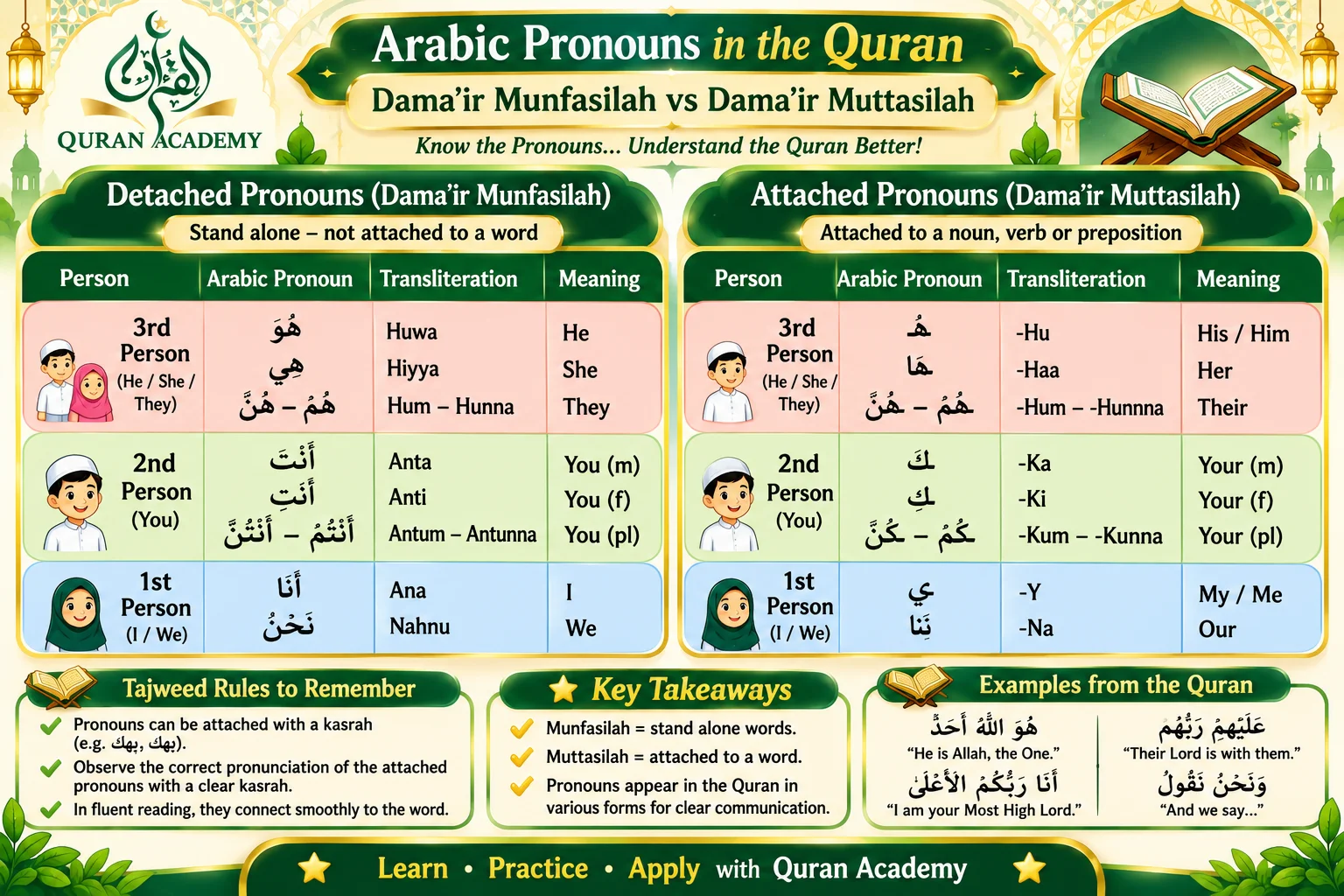
✦ Quick Answer & Key Takeaways: Arabic Pronouns in the Quran Chart
Mastering the Arabic pronouns in the Quran chart (الضَّمَائِرُ الْمُنْفَصِلَةُ وَالْمُتَّصِلَةُ فِي الْقُرْآنِ الْكَرِيمِ — Ad-Dama'ir) unlocks over 25% to 30% of every single line in the Mushaf! When you combine these 14 pronouns with the 50 Most Common Three-Letter Arabic Roots and our Top 50 High-Frequency Quranic Words, you will recognize the meaning of more than two-thirds of the words you recite in Salah! In Quranic Arabic, pronouns divide into two simple families across 14 grammatical slots: (1) Detached Subject Pronouns (ضَمَائِرُ مُنْفَصِلَةٌ) that stand alone as independent words (like هُوَ، هُمْ، أَنْتَ، أَنْتُمْ، أَنَا۠، نَحْنُ), and (2) Attached Suffix Pronouns (ضَمَائِرُ مُتَّصِلَةٌ) glued onto the end of nouns, verbs, and prepositions (like ـهُ، ـهُمْ، ـكَ، ـكُمْ، ـي، ـنَا). In our 1-on-1 Online Quranic Arabic & Tajweed Program, adults and kids memorize all 14 slots in 5 minutes using the Al-Azhar 14-Finger Hand Method!
- Why 1 Word in Arabic = 3 Words in English: Because Arabic glues the pronoun onto the word, رَبُّنَا (Rabbu-naa = "Our Lord"), خَلَقَكُمْ (Khalaqa-kum = "He created you all"), and عَلَيْهِمْ ('Alay-him = "Upon them") are each written as one single word!
- The 3-Role Attached Pronoun Secret: On a Noun = Possessive (his/your/my); on a Verb = Object (him/you/me); on a Preposition = Object of Preposition!
- Why "Iyyaaka" in Surah Al-Fatihah (1:5): Placing the detached object pronoun إِيَّاكَ *before* the verb means "You ALONE we worship!"
- 4 Direct Tajweed Connections: Pronouns govern the Oval Zero on أَنَا۠, Madd Silah on ـهُۥ / ـهِۦ, and Meem Sakinah rules on ـهُمْ / ـكُمْ!
Open any page of the Holy Quran—starting with Surah Al-Fatihah (1:5–7) and Ayatul Kursi (2:255)—and count how many pronouns appear in just a few seconds of recitation: إِيَّاكَ (You alone), ٱهْدِنَا (guide US), عَلَيْهِمْ (upon THEM), لَا إِلَٰهَ إِلَّا هُوَ (none has the right to be worshipped except HE), لَا تَأْخُذُهُۥ (neither overtakes HIM), لَّهُۥ مَا فِي ٱلسَّمَاوَاتِ (to HIM belongs...), عِندَهُۥ (with HIM), بِإِذْنِهِۦ (by HIS permission), أَيْدِيهِمْ (THEIR hands), and خَلْفَهُمْ (behind THEM)! In Ayatul Kursi alone, pronouns appear 16 times in a single verse!
Why do beginners in Quranic Arabic sometimes struggle to spot these pronouns at first glance? Because in English, pronouns are always written as separate words ("his book," "our Lord," "He created them"), whereas in Arabic, possessive and object pronouns are 1-or-2-letter suffixes glued directly onto the end of the word! Once your eye learns to recognize those attached endings, you will never confuse Rabbee ("my Lord") with Rabbanaa ("our Lord") or Rabbukum ("your Lord") again—and your Quran memorization (Hifz) will become twice as accurate! Below, we break down the 14-Finger Hand Chart, the Master Comparison Table of Detached vs. Attached Pronouns, the 3 Grammar Roles of Attached Pronouns, and the 4 Tajweed Rules they trigger.
- 1. The Al-Azhar "14-Finger Hand Method": Why Arabic Has 14 Pronoun Slots
- 2. Master Chart: All 14 Detached & Attached Pronouns in the Quran (With Examples)
- 3. The 3-in-1 Secret: How Attached Pronouns Work on Nouns vs. Verbs vs. Prepositions
- 4. Two Famous Tafseer Questions: Why "Iyyaaka" in Al-Fatihah & Why Does Allah Say "We" (Nahnu / Innaa)?
- 5. Four Essential Tajweed Rules Triggered by Quranic Pronouns
- 6. Frequently Asked Questions (FAQs)
1. The Al-Azhar "14-Finger Hand Method": Why Arabic Has 14 Pronoun Slots
Look at the palm of your right hand! Every finger on your hand (pinky, ring, middle, and index) has 3 segments (phalanges), and your thumb has 2 segments: (4 fingers × 3 segments) + 2 thumb segments = 14 segments! In our 1-on-1 Kids & Beginners Quranic Arabic Classes, teachers map all 14 Arabic pronouns directly onto the 14 segments of your right hand in 30 seconds:
• Pinky (Masculine 1, 2, 3+): Huwa, Humaa, Hum
• Ring (Feminine 1, 2, 3+): Hiya, Humaa, Hunna
• Middle (Masculine 1, 2, 3+): Anta, Antumaa, Antum
• Index (Feminine 1, 2, 3+): Anti, Antumaa, Antunna
• Bottom Thumb Segment: Ana (I — M/F)
• Top Thumb Segment: Nahnu (We — M/F)
2. Master Chart: All 14 Detached & Attached Pronouns in the Quran
Open our Online Uthmani Quran Explorer and compare every Detached Subject Pronoun (ضَمِيرٌ مُنْفَصِلٌ) side by side with its corresponding Attached Suffix Pronoun (ضَمِيرٌ مُتَّصِلٌ) on the noun رَبّ (Rabb — Lord) and the particle إِنَّ (Inna — Indeed):
| Person & Number | Detached Pronoun (Subject) | Attached Suffix | Quranic Examples (On Noun / Verb / Particle) |
|---|---|---|---|
| PART 1: THIRD PERSON (الْغَائِبُ — HE / SHE / THEY) | |||
| 1. He / It (1 Masc.) ⭐ | هُوَ (Huwa — 481x) | ـهُ / ـهِ (-hu / -hi) | قُلْ هُوَ ٱللَّهُ أَحَدٌ (112:1) • رَبُّهُۥ (his Lord) • إِنَّهُۥ (Indeed He) • بِهِۦ (with him/it). |
| 2. They Both (2 Masc.) | هُمَا (Humaa) | ـهُمَا (-humaa / -himaa) | إِذْ هُمَا فِي ٱلْغَارِ (9:40) • رَبُّهُمَا (their Lord) • أُعِيذُكُمَا / عَلَيْهِمَا. |
| 3. They All (3+ Masc.) ⭐ | هُمْ (Hum — 444x) | ـهُمْ / ـهِمْ (-hum / -him) | وَأُولَٰئِكَ هُمُ ٱلْمُفْلِحُونَ (2:5) • رَبُّهُمْ (their Lord) • عَلَيْهِمْ (upon them — 1:7). |
| 4. She / It (1 Fem.) ⭐ | هِيَ (Hiya — 64x) | ـهَا (-haa) | سَلَامٌ هِيَ (97:5) • رَبُّهَا (her Lord — 99:5) • فِيهَا (in it/her) • تَلَاهَا (91:2). |
| 5. They Both (2 Fem.) | هُمَا (Humaa) | ـهُمَا (-humaa) | كِلْتَا ٱلْجَنَّتَيْنِ آتَتْ أُكُلَهَا... وَفَجَّرْنَا خِلَالَهُمَا نَهَرًا (18:33). |
| 6. They All (3+ Fem.) | هُنَّ (Hunna) | ـهُنَّ / ـهِنَّ (-hunna) | هُنَّ لِبَاسٌ لَّكُمْ (2:187) • وَجَعَلَ ٱلْقَمَرَ فِيهِنَّ نُورًا (71:16). |
| PART 2: SECOND PERSON (الْمُخَاطَبُ — YOU / YOU ALL) | |||
| 7. You (1 Masc.) ⭐ | أَنْتَ (Anta — 81x) | ـكَ (-ka) | لَا إِلَٰهَ إِلَّا أَنْتَ سُبْحَانَكَ (21:87) • رَبُّكَ (your Lord — 93:3) • لَكَ (for you). |
| 8. You Both (2 M/F) | أَنْتُمَا (Antumaa) | ـكُمَا (-kumaa) | أَنْتُمَا وَمَنِ ٱتَّبَعَكُمَا (28:35) • فَبِأَيِّ آلَاءِ رَبِّكُمَا تُكَذِّبَانِ (55:13)! |
| 9. You All (3+ Masc.) ⭐ | أَنْتُمْ (Antum — 135x) | ـكُمْ (-kum) | وَلَا أَنْتُمْ عَابِدُونَ (109:3) • رَبُّكُمْ (your Lord) • ٱلسَّلَامُ عَلَيْكُمْ. |
| 10. You (1 Fem.) | أَنْتِ (Anti) | ـكِ (-ki) | قَدْ جَعَلَ رَبُّكِ تَحْتَكِ سَرِيًّا (Surah Maryam 19:24 — "your Lord placed beneath you")! |
| 11. You Both (2 Fem.) | أَنْتُمَا (Antumaa) | ـكُمَا (-kumaa) | إِن تَتُوبَا إِلَى ٱللَّهِ فَقَدْ صَغَتْ قُلُوبُكُمَا (Surah At-Tahrim 66:4). |
| 12. You All (3+ Fem.) | أَنْتُنَّ (Antunna) | ـكُنَّ (-kunna) | وَقَرْنَ فِي بُيُوتِكُنَّ (Surah Al-Ahzab 33:33 — "in your homes"). |
| PART 3: FIRST PERSON (الْمُتَكَلِّمُ — I / WE) | |||
| 13. I / Me / My (1 M/F) ⭐ | أَنَا۠ (Ana — 68x) | ـي / ـنِي (-ee / -nee) | إِنَّنِي أَنَا ٱللَّهُ (20:14) • رَبِّي (Rabbee — MY Lord) • ٱهْدِنِي (Guide ME — on verbs: -nee!). |
| 14. We / Us / Our 🏆 | نَحْنُ (Nahnu — 86x) | ـنَا (-naa) | نَحْنُ نَقُصُّ عَلَيْكَ (12:3) • رَبَّنَا (Rabbanaa — OUR Lord) • ٱهْدِنَا (Guide US — 1:6)! |
3. The 3-in-1 Secret: How Attached Pronouns Work on Nouns vs. Verbs vs. Prepositions
Here is the single most helpful grammar rule in Quranic Arabic & Tafseer: the exact same attached suffix (like ـكُمْ = -kum or ـنَا = -naa) translates into English in three different ways depending on whether it is glued onto a Noun (ٱسْم), a Verb (فِعْل), or a Preposition/Particle (حَرْف):
- Role 1 — Glued Onto a NOUN = Possessive ("My / Your / His / Our / Their"):
Whenever an attached pronoun is glued onto a Noun, it shows ownership/possession (Mudaf Ilayh):
• كِتَابُهُۥ (Kitaabu-hu) = His book • دِينُكُمْ (Deenu-kum — 109:6) = Your religion • رَبِّي (Rabb-ee) vs. رَبَّنَا (Rabba-naa) = My Lord vs. Our Lord (as in our 40 Rabbana Duas Guide!). - Role 2 — Glued Onto a VERB = Direct Object ("Me / You / Him / Us / Them"):
Whenever that exact same suffix is glued onto a Verb, it represents the person receiving the action (Maf'ool Bihi):
• خَلَقَكُمْ (Khalaqa-kum — 2:21) = He created you all!
• رَزَقْنَاهُمْ (Razaqnaa-hum — 2:3) = We provided for them!
• ٱهْدِنِي (Ihdi-nee) vs. ٱهْدِنَا (Ihdi-naa — 1:6) = Guide me vs. Guide us! *(Notice why 1st person singular adds a protective Noon **نِي [-nee]** on verbs: to protect the verb's final vowel from being pulled down by the Yaa!).* - Role 3 — Glued Onto a PREPOSITION / PARTICLE = Object of Preposition / Subject of "Inna":
• On Prepositions: لَهُۥ (La-hu = for him), لَكُمْ (La-kum = for you all), مِنْهُمْ (Min-hum = from them), عَلَيْهِمْ ('Alay-him = upon them), فِيهَا (Fee-haa = in it)!
• On إِنَّ / أَنَّ (Inna / Anna = Indeed): إِنَّهُۥ (Inna-hu = Indeed he/it), إِنَّكُمْ (Inna-kum = Indeed you all), إِنَّنَا / إِنَّا (Inna-naa / Innaa = Indeed we)!
4. Two Famous Tafseer Questions: Why "Iyyaaka" in Al-Fatihah & Why Does Allah Say "We" (Nahnu / Innaa)?
Every student of the Quran—and every parent answering their child's questions—should know the crystal-clear answers to these two essential pronoun questions:
Struggling to perfect your Recitation?
Join hundreds of students mastering the Quran with our Verified Al-Azhar Graduates. We offer flexible 1-on-1 sessions tailored to your schedule.
Book a Free Evaluation Class →- 1. Why Does Surah Al-Fatihah (1:5) Say "Iyyaaka Na'budu" Instead of "Na'buduka"?
As we explained in our Surah Al-Fatihah Tafseer & Tajweed Guide, if you attach the suffix ـكَ (-ka) to the end of the verb and say "Na'budu-ka," it simply means "We worship You" (which in grammar does not grammatically rule out worshipping something else alongside). To express 100% exclusive monotheism (Al-Qasr wal-Ikhtisas), Arabic moves the object pronoun BEFORE the verb—and because a suffix like "-ka" cannot stand in thin air at the start of a sentence, Arabic places it onto the detached object carrier إِيَّا (Iyyaa-): إِيَّاكَ نَعْبُدُ وَإِيَّاكَ نَسْتَعِينُ ("You ALONE we worship, and You ALONE we ask for help!"). - 2. Why Does Allah Almighty Sometimes Use "I" (أَنَا۠) and Sometimes "We" (نَحْنُ / إِنَّا) in the Quran?
As we affirm in our 5 Pillars of Islam & 6 Articles of Faith Guide, Allah Almighty is Absolute One (Al-Waahid Al-Ahad — Surah Al-Ikhlas 112:1). In eloquent classical Arabic, the plural pronoun نَحْنُ / إِنَّا / نَا (We / Our) is the Plural of Majesty and Grandeur (نون العظمة والتعظيم):
• Whenever a verse speaks of Tawheed, worship, or intimate closeness in Dua, Allah always uses the Singular ("I / Me"): إِنَّنِي أَنَا ٱللَّهُ لَا إِلَٰهَ إِلَّا أَنَا فَٱعْبُدْنِي (20:14) and فَإِنِّي قَرِيبٌ أُجِيبُ دَعْوَةَ ٱلدَّاعِ إِذَا دَعَانِ (2:186)!
• Whenever a verse speaks of cosmic power, sending down the Quran, or acts executed through His noble angels, Allah uses the Royal Plural of Majesty ("We"): إِنَّا أَنزَلْنَاهُ فِي لَيْلَةِ ٱلْقَدْرِ (97:1) and إِنَّا نَحْنُ نَزَّلْنَا ٱلذِّكْرَ وَإِنَّا لَهُ لَحَافِظُونَ (15:9)!
Mastering the Mid-Word Qalqalah Before Attached Pronouns: "Razaqْnaahum" & "Khalaqْnaakum"!
Here is a fascinating connection between Arabic pronouns and Tajweed: whenever a past-tense subject suffix like ـنَا (-naa = We), ـتَ (-ta = you), or ـتُمْ (-tum = you all) attaches to a verb ending in one of the 5 Qalqalah (Echoing) letters (ق ط ب ج د), the final letter of the verb becomes silent (Sakin)—triggering an immediate Qalqalah Sughra bounce right before the pronoun! Look at رَزَقْنَاهُمْ (Razaqْ-naahum), خَلَقْنَاكُمْ (Khalaqْ-naakum), and كَسَبْتُمْ (Kasabْ-tum)! Watch Senior Instructor Ustadhah Yasmeen Gamal demonstrate Qalqalah on our Quran Academy YouTube Channel:
- Bounce Before the Pronoun: Bounce the Qaaf or Baa cleanly before pronouncing -naa or -tum!
- 1-on-1 Live Coaching: Master Quranic grammar & Tajweed with Al-Azhar scholars!
5. Four Essential Tajweed Rules Triggered by Quranic Pronouns
Every time you recite a detached or attached pronoun in the Quran, check which of these four Tajweed rules from our 1-on-1 Online Tajweed Course applies:
- 1. Dropping the Alif of "Ana" (أَنَا۠) in Continuation (The 7 Alifs Rule):
As we mastered in our 7 Alifs in the Quran (Oval Zero Rule) Guide, all 68 occurrences of the 1st-person pronoun أَنَا۠ (I) in the Quran carry the tall oval zero (۠)—meaning you drop the Alif completely when continuing (e.g., وَأَنَا۠ أَوَّلُ ٱلْمُسْلِمِينَ = Wa ana awwalul-muslimeen, 1 count on the Noon!) and pronounce the 2-count Alif ONLY if you stop directly on Anaa! - 2. Madd Silah Sughra (2 Beats) & Kubra (4–5 Beats) on "Haa' Al-Kinayah" (ـهُۥ / ـهِۦ):
Applying our Rules of Madd Guide, whenever the singular masculine attached pronoun ـهُ / ـهِ (his/him/it) sits between two voweled letters, the Uthmani Mushaf places a tiny miniature Waw (ـهُۥ) or Yaa (ـهِۦ) after it:
• Madd Silah Sughra (2 Beats): If the next word starts with any letter except Hamzah (e.g., إِنَّهُۥ كَانَ غَفَّارًا = Innahoo kaana in Surah Nuh 71:10).
• Madd Silah Kubra (4 to 5 Beats): If the next word starts with a Hamzatul Qat' (e.g., عِندَهُۥٓ إِلَّا بِإِذْنِهِۦ = 'Indahooo illaa in Ayatul Kursi 2:255, or أَنَّ مَالَهُۥٓ أَخْلَدَهُۥ in 104:3)! - 3. The 3 Lip Rules of Plural Pronouns (Meem Al-Jam' in هُمْ، أَنْتُمْ، ـكُمْ، ـتُمْ):
Using our Meem Sakinah Rules Guide, whenever a plural pronoun ends in a silent Meem (مْ):
• Before م (Meem) → Idgham Shafawi (2-beat Ghunnah): 'Alaykum-midraaraa (71:11)!
• Before ب (Baa) → Ikhfaa' Shafawi (2-beat Ghunnah): Wa yumdidkum-bi-amwaalin (71:12)!
• Before all other 26 letters → Izhar Shafawi (Crisp Meem, especially before و and ف): 'Alayhimْ wa laa (1:7) and Humْ feehaa (2:39)! - 4. Applying Nabr on "Iyyaaka" & Preserving Final Pronoun Vowels Against Lahn Jali:
Following our An-Nabr (Vocal Stress), Lahn Jali vs. Lahn Khafi, Makharij al-Huruf, Sifaat al-Huruf, Heavy & Light Letters, Noon Sakinah Rules, Rules of Waqf, Ahkam Al-Raa, Laam Shamsiyyah & Qamariyyah, Hamzatul Wasl vs. Qat', 4 Special Words of Hafs, Idgham Mutamathilayn, Mutajanisayn & Mutaqaribayn, 10 Qira'at, and 15 Sajdah Tilawah Verses guides, press firmly with Nabr on the Yaa of إِيَّاكَ, and never stretch the short Fatha of ـكَ (-ka) into a feminine or dual Alif! Test your Tajweed & Arabic skills right now on our Free 3-Minute Tajweed Quiz!
Practice spotting attached and detached pronouns across our interconnected library of Surah, Hifz, and Salah guides: Surah Al-Muzzammil, Surah Al-Qalam, Juz Tabarak 30-Day Plan, 30-Day Quran Khatmah Schedule, 15 Etiquettes of Reading the Quran, Traveler's Prayer, Salat Al-Jumu'ah, 12 Sunnah Rawatib, Salat Al-Eid, Salat Ad-Duha, Salat Al-Witr, Dua Al-Qunoot (featuring singular Ihdinee vs. plural Ihdinaa!), Duas for Anxiety & Debt, Bedtime Duas, Post-Prayer Adhkar, and Authentic Ruqyah Shariah in our Online Hifz Program (using our Smart Hifz Planner and Online Hadith Explorer)! Meet our Al-Azhar Certified Tutors, print our Printable Kids Star Chart, and read how families across the US, UK, Canada, and Australia rate our teachers on our Verified Student & Parent Reviews Page.
6. Frequently Asked Questions (FAQs) About Arabic Pronouns in the Quran
1. What is the difference between Detached Pronouns (Dama'ir Munfasilah) and Attached Pronouns (Dama'ir Muttasilah) in the Quran?
Detached Pronouns (الضمائر المنفصلة — such as Huwa, Hum, Anta, Antum, Ana, and Nahnu) stand as independent words at the beginning of a sentence to act as the subject ("He, They, You, I, We"). Attached Pronouns (الضمائر المتصلة — such as -hu, -hum, -ka, -kum, -ee, and -naa) are 1-to-2 letter suffixes glued directly onto the end of a noun, verb, or preposition!
2. How does the meaning of an Attached Pronoun change when glued to a Noun vs. a Verb vs. a Preposition?
In Quranic Arabic, the exact same attached pronoun suffix has 3 roles depending on what it attaches to: (1) Attached to a Noun = Possessive ("My/His/Your/Our," such as Rabbu-hu = "his Lord" or Rabbu-naa = "our Lord"), (2) Attached to a Verb = Direct Object ("Me/Him/You/Us," such as Razaqa-hum = "He provided for them" or Ihdi-naa = "Guide us!"), and (3) Attached to a Preposition = Object of the Preposition (such as La-kum = "for you all" or 'Alay-him = "upon them").
3. Why are there 14 pronouns in the Arabic grammar chart?
Arabic has 14 pronoun forms because it distinguishes 3 persons (3rd Person/Absent, 2nd Person/Addressed, and 1st Person/Speaker), 3 numbers (Singular [1], Dual [2], and Plural [3+]), and 2 genders (Masculine and Feminine): 6 forms for the 3rd Person (Huwa, Humaa, Hum, Hiya, Humaa, Hunna), 6 forms for the 2nd Person (Anta, Antumaa, Antum, Anti, Antumaa, Antunna), and 2 forms for the 1st Person (Ana and Nahnu).
4. What is the special detached pronoun "Iyyaa-" (as in "Iyyaaka na'budu" in Surah Al-Fatihah 1:5)?
"Iyyaa-" (إِيَّا) is the detached object pronoun carrier in Arabic! When an attached object pronoun is placed BEFORE the verb for exclusive restriction (Al-Qasr wal-Ikhtisas), it attaches to "Iyyaa-": so instead of saying "Na'budu-ka" ("We worship You"), Surah Al-Fatihah (1:5) says "Iyyaaka na'budu" ("You ALONE we worship!").
5. What are the main Tajweed rules triggered by pronouns in the Quran?
Quranic pronouns trigger 4 major Tajweed rules: (1) Dropping the Alif of "Ana" (أَنَا۠) in continuation (one of the 7 Alifs), (2) Madd Silah Sughra (2 beats) and Kubra (4–5 beats) on the singular masculine attached pronoun Haa' (-hu / -hi), (3) Meem Al-Jam' (plural -hum / -kum / -tum) rules of Ikhfaa' Shafawi, Idgham Shafawi, and Izhar Shafawi, and (4) Nabr (vocal stress) on the doubled Yaa of "Iyyaaka".
Master Quranic Arabic & Tajweed With an Al-Azhar Scholar!
Understand every verse you recite in Salah with our structured, beginner-friendly 1-on-1 Quranic Arabic and Tajweed classes taught by certified male and female Al-Azhar scholars. Book your free trial class today!
Book Your Free 1-on-1 Trial Class →