
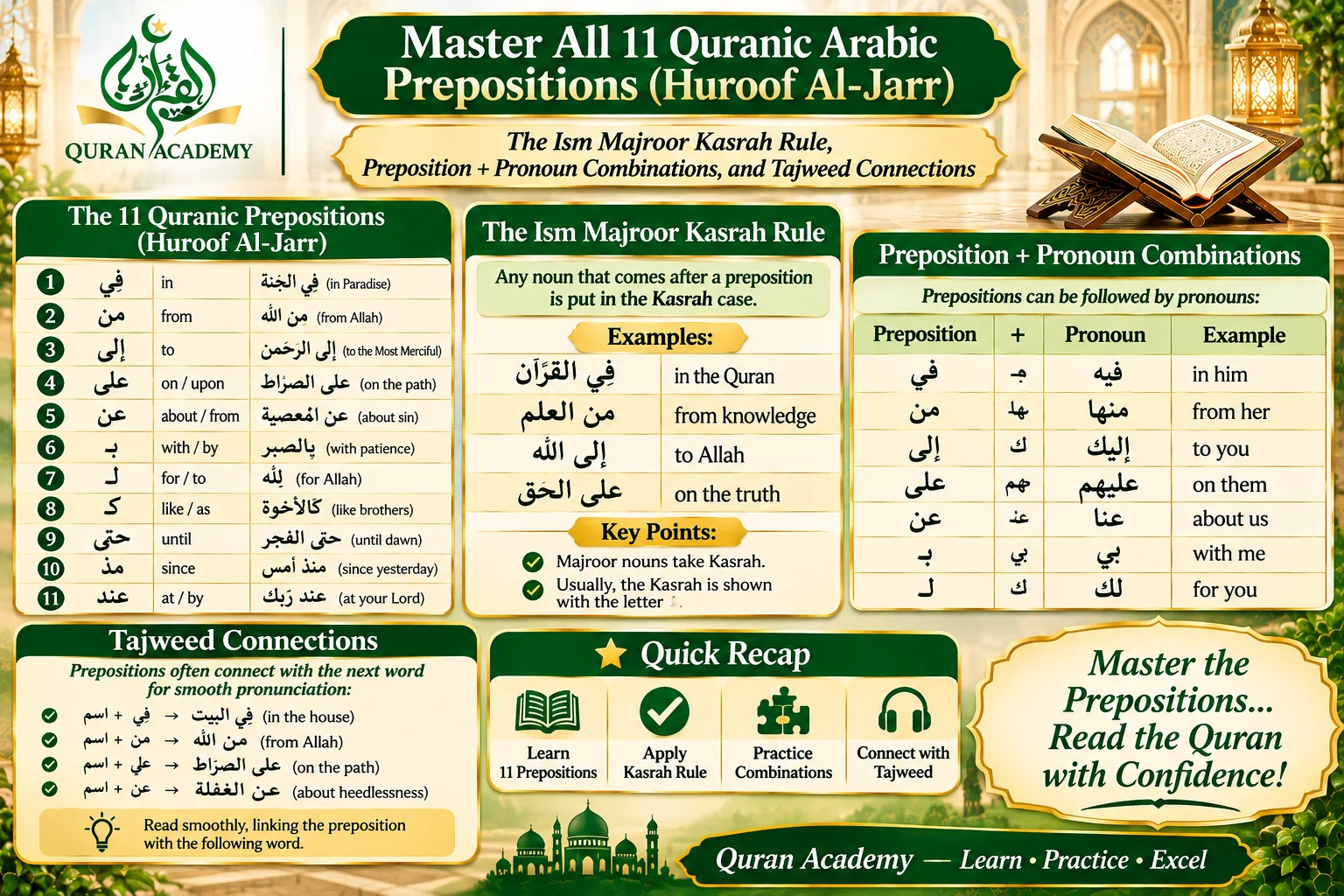
✦ Quick Answer & Key Takeaways: Arabic Prepositions (Harf Al-Jarr) in the Quran
Mastering Arabic prepositions Harf Al Jarr (حُرُوفُ الْجَرِّ فِي الْقُرْآنِ الْكَرِيمِ) gives you the golden key that links Three-Letter Quranic Roots and Arabic Pronouns (Dama'ir) into complete, meaningful sentences! Appearing over 12,000 times across the Mushaf, Huroof Al-Jarr are called "Letters of Pulling Down" because they enter exclusively upon Nouns and pull the ending vowel of the noun down into a Kasrah (ـِ) or Kasratayn (ـٍ)—a state called Ism Majroor (اسْمٌ مَجْرُورٌ)! Divided into 6 Detached Prepositions (مِنْ، إِلَىٰ، عَنْ، عَلَىٰ، فِي، حَتَّىٰ) and 5 Attached 1-Letter Prepositions (بِـ، لِـ، كَـ plus the Oath Letters وَ، تَـ), mastering these 11 tiny connectors transforms both your Tafseer comprehension and your protection from Lahn Jali vowel mistakes! In our 1-on-1 Online Quranic Arabic & Tajweed Program, students master all 11 prepositions using examples directly from Surah Al-Fatihah and Juz Amma!
- Why the Basmalah Has 4 Kasrahs in a Row: In بِسْمِ ٱللَّهِ ٱلرَّحْمَٰنِ ٱلرَّحِيمِ, the single attached preposition بِـ (Bi- — In/With) pulls Ism into a Kasrah, which pulls Allaahi, Ar-Rahmaani, and Ar-Raheemi into Kasrahs!
- 11 Prepositions = 12,000+ Quranic Occurrences: مِنْ (3,226x), فِي (1,701x), عَلَىٰ (1,445x), and إِلَىٰ (742x) appear on every single page of the Quran!
- The "Oath Waw" (وَاوُ الْقَسَمِ) in Juz Amma: Explains why وَٱلْعَصْرِ، وَٱلضُّحَىٰ، وَٱلْفَجْرِ، وَٱلتِّينِ all end with a Kasrah!
- #1 Trigger of Noon Sakinah & Madd Dropping: مِنْ and عَنْ trigger Izhar, Idgham, Iqlab, and Ikhfaa', while فِي، إِلَىٰ، عَلَىٰ drop their Madd before Hamzatul Wasl!
Have you ever wondered why the opening oaths of Juz Amma and Juz Tabarak—such as وَٱلْفَجْرِ ﴿١﴾ وَلَيَالٍ عَشْرٍ ﴿٢﴾, وَٱلشَّمْسِ وَضُحَاهَا, وَٱلْعَصْرِ, and نٓ ۚ وَٱلْقَلَمِ—all have a Kasrah (ـِ) under their final letter when you connect the verses? Or why in Surah Al-Fatihah we read ٱلْحَمْدُ لِلَّهِ رَبِّ ٱلْعَالَمِينَ with a Kasrah on Lillaahi and Rabbi, and غَيْرِ ٱلْمَغْضُوبِ عَلَيْهِمْ with a Kasrah on Al-Maghdoobi?
The secret behind every single one of those Kasrahs is one of the easiest, most rewarding rules in Quranic Arabic grammar: Huroof Al-Jarr (حُرُوفُ الْجَرِّ — Arabic Prepositions)! Once you know these 11 short particles and how they combine with our 14 Attached Pronouns Chart, you will instantly understand hundreds of prepositional phrases on every page of the Mushaf (like Minhum, 'Alayhim, Ilaynaa, Fihaa, Lahu, and Bihi) and never misread a Kasrah in Salah again! Below, we break down the Kasrah Rule of Ism Majroor, the Master Chart of all 11 Quranic Prepositions, the Preposition + Pronoun Combination Matrix, and the 5 Essential Tajweed Rules they govern.
- 1. What Is Harf Al-Jarr & How Does the "Ism Majroor" Kasrah Rule Work?
- 2. Master Chart: The 11 Most Frequent Huroof Al-Jarr in the Quran (Detached & Attached!)
- 3. The Preposition + Attached Pronoun Matrix (How Lahu, 'Alayhim, Fihaa & Minhum Are Built!)
- 4. The 3 Oath Prepositions (Huruf Al-Qasam: Wa-, Bi-, Ta-): Why "Wal-'Asri" Ends With a Kasrah!
- 5. Five Essential Tajweed Rules Triggered by Huroof Al-Jarr (Min, 'An, Fi & Bismillaah!)
- 6. Frequently Asked Questions (FAQs)
1. What Is Harf Al-Jarr & How Does the "Ism Majroor" Kasrah Rule Work?
In Arabic grammar—as defined in our Interactive Tajweed & Arabic Encyclopedia—every word in the Quran belongs to one of three parts of speech: (1) Ism (اسْم — Noun), (2) Fi'l (فِعْل — Verb), or (3) Harf (حَرْف — Particle/Connector). By default, a singular Arabic noun stands in the Nominative state with a Damma (ـُ) or Dammatayn (ـٌ) at the end (e.g., ٱلْبَيْتُ = Al-Bayt-u or مَسْجِدٌ = Masjid-un).
However, the moment one of the Huroof Al-Jarr (حُرُوفُ الْجَرِّ) steps in front of that noun, it pulls the ending vowel down from the roof of the mouth (Damma) to the bottom of the jaw—turning it into a Kasrah (ـِ) or Kasratayn (ـٍ):
- ٱلسَّمَاءُ (As-Samaa'-u) → Add فِي (Fi = In) → فِي ٱلسَّمَاءِ (Fis-Samaa'-i — with a Kasrah!)
- ٱلْأَرْضُ (Al-Ard-u) → Add مِنَ (Mina = From) → مِنَ ٱلْأَرْضِ (Minal-Ard-i — with a Kasrah!)
- صِرَاطٌ (Siraat-un) → Add إِلَىٰ (Ilaa = To) → إِلَىٰ صِرَاطٍ مُّسْتَقِيمٍ (Ilaa Siraat-in Mustaqeem-in — with Kasratayn!)
2. Master Chart: The 11 Most Frequent Huroof Al-Jarr in the Quran
You can inspect every Quranic example below in our Online Uthmani Quran Explorer. Here are the 6 Detached Prepositions (written as standalone 2-to-3 letter words) and the 5 Attached Prepositions (glued directly onto the first letter of the noun!):
| # & Preposition (Harf Al-Jarr) | Core English Meaning & Count | Famous Quranic Examples (Showing the Kasrah!) |
|---|---|---|
| PART A: THE 6 DETACHED PREPOSITIONS (حُرُوفُ الْجَرِّ الْمُنْفَصِلَةُ) | ||
| 1. مِنْ / مِنَ (Min / Mina) ⭐ | From / Of / Out of (3,226x — #1 in Quran!) |
مِن شَرِّ ٱلْوَسْوَاسِ (114:4) • مِنَ ٱلْجِنَّةِ وَٱلنَّاسِ (114:6) • خَيْرٌ مِّنْ أَلْفِ شَهْرٍ (97:3). |
| 2. فِي (Fee) ⭐ | In / Inside / Concerning (1,701x) |
فِي لَيْلَةِ ٱلْقَدْرِ (97:1) • فِي جِيدِهَا (111:5) • فِي سَبِيلِ ٱللَّهِ (2:190) • فِي ٱلدُّنْيَا (2:201). |
| 3. عَلَىٰ ('Alaa) ⭐ | On / Upon / Over (1,445x) |
وَإِنَّكَ لَعَلَىٰ خُلُقٍ عَظِيمٍ (68:4) • عَلَىٰ هُدًى مِّن رَّبِّهِمْ (2:5) • عَلَىٰ قُلُوبِهِمْ (2:7). |
| 4. إِلَىٰ (Ilaa) ⭐ | To / Toward / Until (742x) |
إِلَىٰ رَبِّكَ يَوْمَئِذٍ ٱلْمُسْتَقَرُّ (75:12) • مِّنَ ٱلظُّلُمَاتِ إِلَى ٱلنُّورِ (2:257). |
| 5. عَنْ ('An) | From / About / Away from (465x) |
عَمَّ يَتَسَاءَلُونَ ﴿١﴾ عَنِ ٱلنَّبَإِ ٱلْعَظِيمِ (78:1–2) • عَن صَلَاتِهِمْ سَاهُونَ (107:5). |
| 6. حَتَّىٰ (Hattaa) | Until / Up to (142x) |
سَلَامٌ هِيَ حَتَّىٰ مَطْلَعِ ٱلْفَجْرِ (Surah Al-Qadr 97:5 — pulls Matla'-i into a Kasrah!). |
| PART B: THE 5 ATTACHED 1-LETTER PREPOSITIONS (حُرُوفُ الْجَرِّ الْمُتَّصِلَةُ) | ||
| 7. بِـ (Bi-) 🏆 | In / With / By | بِسْمِ ٱللَّهِ (1:1) • بِرَبِّ ٱلْفَلَقِ / بِرَبِّ ٱلنَّاسِ (113:1 & 114:1) • عَلَّمَ بِٱلْقَلَمِ (96:4). |
| 8. لِـ (Li- / La-) 🏆 | For / To / Belonging to | ٱلْحَمْدُ لِلَّهِ (1:2) • لِإِيلَافِ قُرَيْشٍ (106:1) • فَوَيْلٌ لِّلْمُصَلِّينَ (107:4). |
| 9. كَـ (Ka-) | Like / As | لَيْسَ كَمِثْلِهِۦ شَيْءٌ (42:11) • كَـعَصْفٍ مَّأْكُولٍ (105:5) • كَـٱلْفَرَاشِ (101:4). |
| 10 & 11. وَ (Wa-) & تَـ (Ta-) (The Oath Prepositions!) |
"By..." (Swearing an Oath) | وَٱلْعَصْرِ (103:1) • وَٱلضُّحَىٰ (93:1) • وَٱللَّهِ (By Allah) • تَٱللَّهِ لَقَدْ آثَرَكَ ٱللَّهُ (Yusuf 12:91)! |
3. The Preposition + Attached Pronoun Matrix (How Lahu, 'Alayhim, Fihaa & Minhum Are Built!)
What happens when you glue the Attached Pronouns (-hu, -hum, -ka, -kum, -ee, -naa) that we mastered in Article 112 directly onto these prepositions? You unlock 42 of the highest-frequency two-part words in the entire Quran! Notice three phonetic adjustments in the table below:
1. لِـ (Li-) changes its Kasrah to a Fatha (لَـ = La-) before all pronouns except Lee ("for me")!
2. إِلَىٰ (Ilaa) and عَلَىٰ ('Alaa) turn their final Alif into a silent Yaa Leen (إِلَيْـ / عَلَيْـ) before pronouns!
3. The 3rd-person pronouns ـهُ، ـهُمْ، ـهُنَّ change their Damma to a Kasrah (ـهِ، ـهِمْ، ـهِنَّ) whenever preceded by a Kasrah or Yaa Sakinah (as in بِهِۦ، فِيهِ، عَلَيْهِمْ، إِلَيْهِمْ)!
| Preposition | + Him (ـهُ) | + Her/It (ـهَا) | + Them (ـهُمْ) | + You (ـكَ / ـكُمْ) | + Me / Us (ـي / ـنَا) |
|---|---|---|---|---|---|
| لِـ (For / To) | لَهُۥ (Lahu) For him |
لَهَا (Lahaa) For her/it |
لَهُمْ (Lahum) For them |
لَكَ / لَكُمْ For you / you all |
لِي / لَنَا (Lee / Lanaa) For me / For us |
| بِـ (With / In) | بِهِۦ (Bihi) With him/it |
بِهَا (Bihaa) With her/it |
بِهِمْ (Bihim) With them |
بِكَ / بِكُمْ With you / you all |
بِي / بِنَا (Bee / Binaa) With me / With us |
| فِي (In) | فِيهِ (Feehi) In him/it (2:2) |
فِيهَا (Feehaa) In it (97:4) |
فِيهِمْ (Feehim) Among them |
فِيكَ / فِيكُمْ In you / among you |
فِيَّ / فِينَا (Fiyya / Feenaa) In me / Among us |
| مِنْ (From) | مِنْهُ (Minhu) From him/it |
مِنْهَا (Minhaa) From it |
مِنْهُمْ (Minhum) From them |
مِنكَ / مِنكُمْ From you (Ikhfaa'!) |
مِنِّي / مِنَّا (Minnee / Minnaa) From me / From us (نّ!) |
| عَنْ (From/About) | عَنْهُ ('Anhu) From him |
عَنْهَا ('Anhaa) From it |
عَنْهُمْ ('Anhum) From them |
عَنكَ / عَنكُمْ From you (94:2!) |
عَنِّي / عَنَّا ('Annee / 'Annaa) From me (97 Dua!) / us |
| عَلَىٰ (Upon) | عَلَيْهِ ('Alayhi) Upon him |
عَلَيْهَا ('Alayhaa) Upon it |
عَلَيْهِمْ ('Alayhim) Upon them (1:7) |
عَلَيْكَ / عَلَيْكُمْ Upon you / you all |
عَلَيَّ / عَلَيْنَا ('Alayya / 'Alaynaa) Upon me / Upon us |
| إِلَىٰ (To / Toward) 🏆 | إِلَيْهِ (Ilayhi) To Him |
إِلَيْهَا (Ilayhaa) To it (88:17) |
إِلَيْهِمْ (Ilayhim) To them |
إِلَيْكَ / إِلَيْكُمْ To you / you all |
إِلَيَّ / إِلَيْنَا (Ilayya / Ilaynaa) To Me / To Us (88:25) |
4. The 3 Oath Prepositions (Huruf Al-Qasam: Wa-, Bi-, Ta-): Why "Wal-'Asri" Ends With a Kasrah!
Why do beginners sometimes confuse the two different uses of the letter وَ (Waw) in the Quran? Because in Arabic grammar, وَ (Wa-) has two distinct jobs:
- 1. Waw Al-'Atf (وَاوُ الْعَطْفِ — The Conjunction "And"): Simply connects two words or sentences without forcing a Kasrah!
- 2. Waw Al-Qasam (وَاوُ الْقَسَمِ — The Oath Preposition "By..."): One of the 3 Oath Prepositions (وَ، بِـ، تَـ) which acts as a full Harf Jarr—pulling the noun sworn by (Al-Muqsam Bihi) into a Kasrah! That is why every single oath opening a Surah in the Quran ends with a Kasrah: وَٱلضُّحَىٰ ﴿١﴾ وَٱللَّيْلِ (93:1–2), وَٱلْعَصْرِ (103:1), قٓ ۚ وَٱلْقُرْآنِ ٱلْمَجِيدِ (50:1), and يسٓ ﴿١﴾ وَٱلْقُرْآنِ ٱلْحَكِيمِ (36:1–2)! *(Note: In Islamic Fiqh, Allah Almighty may swear by any of His magnificent creations, whereas a human being may swear ONLY by Allah's Name—using **وَٱللَّهِ، بِٱللَّهِ، or تَٱللَّهِ**, as in Sahih al-Bukhari 2679!).*
Mastering the Crisp Qalqalah After Huroof Al-Jarr in "Birabbil-Falaqْ" & "Min Qabْl"!
Look at how Huroof Al-Jarr frame the most famous Qalqalah words in the Quran: قُلْ أَعُوذُ بِرَبِّ ٱلْفَلَقِ (Bi-Rabbil-Falaqْ — 113:1), مِن قَبْلِكَ (Min Qabْlika — 2:4), and حَتَّىٰ مَطْلَعِ ٱلْفَجْرِ (Hattaa Matْla'il-Fajْr — 97:5)! When you pause at the end of a verse on an Ism Majroor ending in one of the 5 Qalqalah (Echoing) letters (ق ط ب ج د), the Kasrah drops for stopping and triggers a resonant Qalqalah Kubra bounce! Watch Senior Instructor Ustadhah Yasmeen Gamal demonstrate Qalqalah on our Quran Academy YouTube Channel:
Struggling to perfect your Recitation?
Join hundreds of students mastering the Quran with our Verified Al-Azhar Graduates. We offer flexible 1-on-1 sessions tailored to your schedule.
Book a Free Evaluation Class →- Kasrah in Continuation, Qalqalah on Stop: Read Al-Falaq-i if connecting, and bounce Al-Falaqْ when stopping!
- 1-on-1 Live Coaching: Master Quranic Arabic & Tajweed with Al-Azhar scholars!
5. Five Essential Tajweed Rules Triggered by Huroof Al-Jarr
Because prepositions appear in almost every verse of the Quran, check how they interact with these five core Tajweed rules from our 1-on-1 Online Tajweed Course:
- 1. All 4 Noon Sakinah Rules on "Min" (مِنْ) & "'An" (عَنْ):
As we mastered in our Noon Sakinah & Tanween Guide, whenever مِنْ or عَنْ is followed by a voweled letter, it triggers: (a) Izhar Halqi before throat letters (Minْ 'ilmin, 'Anْhu), (b) Idgham before Yarmaloon (Mim-maa, Mir-Rabbihim, 'Am-man), (c) Iqlab before Baa (Mim-ba'di), and (d) Ikhfaa' Haqiqi before the 15 Ikhfaa' letters (Min-sharri, 'An-salaatihim)! And when مِنْ meets ٱلـ (Al-), it takes a helper Fatha: مِنَ ٱلْجِنَّةِ (Minal-jinnati), whereas عَنْ takes a helper Kasrah: عَنِ ٱلنَّبَإِ ('Anin-naba'i — 78:2)! - 2. Dropping the 2-Beat Madd of "Fi", "Ila" & "'Ala" Before Hamzatul Wasl:
Applying our Hamzatul Wasl & Hamzatul Qat' Guide and Laam Shamsiyyah & Qamariyyah Guide, when فِي، إِلَىٰ، or عَلَىٰ is followed by a word starting with ٱلـ (Al-), the 2-beat Madd letter at the end of the preposition drops completely in pronunciation to prevent two silent letters from colliding (Iltiqa' as-Sakinayn):
• فِي ٱلْأَرْضِ → Read as Fil-ardi (NEVER "Fee-al-ardi" ❌)!
• إِلَى ٱللَّهِ → Read as Ilallaahi!
• عَلَى ٱلْمُؤْمِنِينَ → Read as 'Alal-mu'mineen! - 3. Making the Laam of "Allah" Light After "Bi-", "Li-" & Any Ism Majroor Kasrah:
Using our Heavy & Light Letters Guide, because بِـ (Bi-) and لِـ (Li-) end with a Kasrah—and because any Ism Majroor ends with a Kasrah—whenever the Name of Allah (ٱللَّه) follows a Kasrah, its Laam is pronounced 100% Light (Tarqeeq): بِٱللَّهِ (Billaahi), لِلَّهِ (Lillaahi), بِسْمِ ٱللَّهِ (Bismillaahi), and فِي سَبِيلِ ٱللَّهِ (Fee sabeelillaahi)! - 4. How the Preposition "Li-" Visually Drops the Alif of "Al-" in the Mushaf:
Look at لِلْمُتَّقِينَ (2:2), لِلْكَافِرِينَ, and لِلْمُصَلِّينَ (107:4): when the attached preposition لِـ (Li-) joins a word starting with ٱلـ (Al-), the Uthmani script drops the silent Alif of Hamzatul Wasl visually so two Laams sit side by side! - 5. Light Raa on Stop When Pausing on an Ism Majroor Ending in Raa (Ahkam Al-Raa):
Following our Ahkam Al-Raa, Makharij al-Huruf, Sifaat al-Huruf, Rules of Madd, Meem Sakinah Rules, Rules of Waqf, 4 Special Words of Hafs, 7 Alifs in the Quran, Idgham Mutamathilayn, Mutajanisayn & Mutaqaribayn, 10 Qira'at, An-Nabr (Vocal Stress), and 15 Sajdah Tilawah Verses guides, in لَفِي خُسْرٍ (103:2 — in continuation with Verse 3: Lafee khus-rin illal-ladheena...), the Kasratayn caused by Fi makes the Raa Light in continuation, whereas stopping on Khusrْ makes it Heavy because of the Damma on the Khaa'! Test your Tajweed & Arabic skills right now on our Free 3-Minute Tajweed Quiz!
Practice spotting Huroof Al-Jarr and Ism Majroor across our interconnected library of Surah, Hifz, and Salah guides: Surah Al-Qadr (featuring Fee, Min, Bi-idhni, and Hatta!), Surah Al-Muzzammil, Surah Nuh, 30-Day Quran Khatmah Schedule, 15 Etiquettes of Reading the Quran, Traveler's Prayer, Salat Al-Jumu'ah, 12 Sunnah Rawatib, Salat Al-Eid, Salat Ad-Duha, Salat Al-Witr, Dua Al-Qunoot, Duas for Anxiety & Debt (featuring A'oodhu bika minal-hammi wal-hazan!), Bedtime Duas, Post-Prayer Adhkar, and Authentic Ruqyah Shariah in our Online Hifz Program (using our Smart Hifz Planner and Online Hadith Explorer)! Meet our Al-Azhar Certified Tutors, print our Printable Kids Star Chart, and read how families across the US, UK, Canada, and Australia rate our teachers on our Verified Student & Parent Reviews Page.
6. Frequently Asked Questions (FAQs) About Harf Al-Jarr in the Quran
1. What is "Harf Al-Jarr" (حرف الجر) in Quranic Arabic and why is it called that?
Linguistically, "Al-Jarr" (الجر) means "pulling down." In Arabic grammar, Huroof Al-Jarr (Prepositions) are particles placed strictly before Nouns that pull the ending vowel of the following noun down into the Genitive case (Al-Majroor), marked primarily by a Kasrah (ـِ) or Kasratayn (ـٍ)—such as "Bismi-llaahi" and "Minash-shaytaanir-rajeemi".
2. What are the most common Huroof Al-Jarr (Prepositions) in the Holy Quran?
The 11 primary Quranic prepositions divide into: (1) 6 Detached Prepositions: Min (مِنْ — from/of, 3,226x), Fi (فِي — in, 1,701x), 'Ala (عَلَىٰ — upon/on, 1,445x), Ila (إِلَىٰ — to/toward, 742x), 'An (عَنْ — from/about, 465x), and Hatta (حَتَّىٰ — until); and (2) 5 Attached 1-Letter Prepositions: Bi- (بِـ — by/with/in), Li- (لِـ — for/to), Ka- (كَـ — like/as), and the Oath Letters Wa- (وَ — By, as in Wal-'Asr) and Ta- (تَـ — By Allah, as in Tallaahi).
3. Can a Harf Al-Jarr (Preposition) ever enter upon a Verb in the Quran?
Never! As Imam Ibn Malik stated in his Alfiyyah, entering after a Harf Al-Jarr is one of the exclusive trademarks of a Noun (Ism). Whenever you see a word in the Quran preceded directly by Min, Fi, 'Ala, Ila, Bi-, or Li- (the preposition of ownership), you know with 100% certainty that the word is a Noun!
4. How do the prepositions "Ila", "'Ala", and "Li-" change when attached to pronouns?
When "Ila" (إِلَىٰ) and "'Ala" (عَلَىٰ) attach to a pronoun suffix, their final Alif Maqsurah turns into a silent Yaa Sakinah (Leen): "Ilay-ka" (to you), "Ilay-hi" (to him), "'Alay-kum" (upon you all), and "'Alay-him" (upon them). Similarly, when the preposition "Li-" (لِـ — with a Kasrah, as in Lillaahi) attaches to any pronoun except "-ee" (Lee), its Kasrah changes to a Fatha ("La-ka, La-kum, La-hu, La-naa, La-hum")!
5. What Tajweed rules are triggered by the prepositions "Min", "'An", and "Fi"?
The prepositions "Min" (مِنْ) and "'An" (عَنْ) end with a silent Noon Sakinah—making them the #1 source of Izhar, Idgham, Iqlab, and Ikhfaa' across two words in the Quran! Meanwhile, "Fi" (فِي), "Ila" (إِلَىٰ), and "'Ala" (عَلَىٰ) end with a 2-count Madd letter that stretches to 4–5 beats before a Hamzah (Madd Ja'iz Munfasil) and drops completely before Hamzatul Wasl (such as "Fil-ard" and "'Alal-mu'mineen")!
Unlock the Grammar & Beauty of Every Quranic Verse!
Master Quranic Arabic roots, pronouns, prepositions, and Tajweed in interactive 1-on-1 sessions with certified male and female Al-Azhar scholars. Book your free diagnostic trial session today!
Book Your Free 1-on-1 Trial Class →