
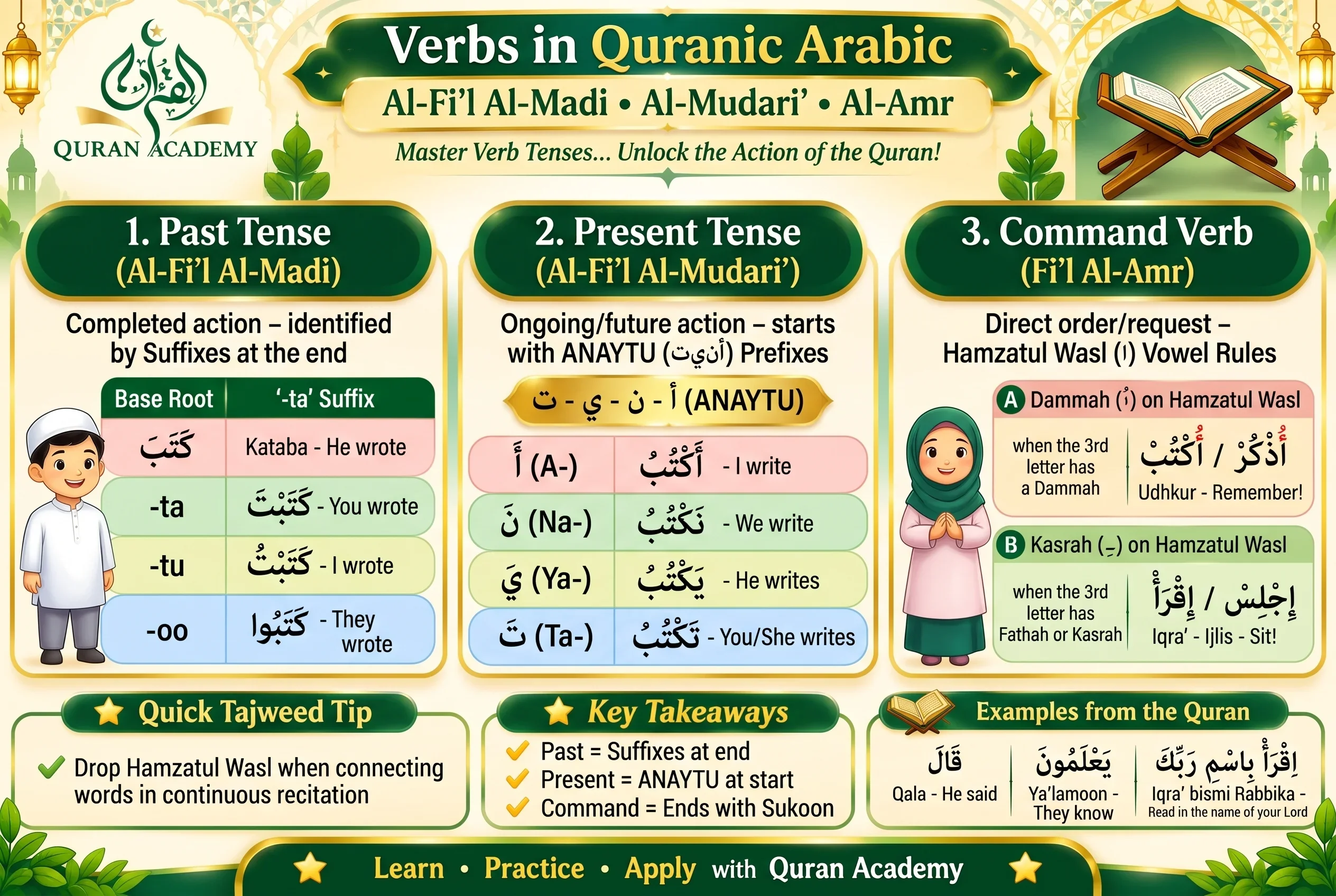
✦ Quick Answer & Key Takeaways: Verbs in Quranic Arabic Chart
Mastering our verbs in Quranic Arabic chart (الْفِعْلُ الْمَاضِي وَالْمُضَارِعُ وَالْأَمْرُ فِي الْقُرْآنِ الْكَرِيمِ) completes the 5-part Quranic Arabic foundation—showing you how any Three-Letter Arabic Root comes alive across time! Unlike English (which has 12 complex verb tenses), Quranic Arabic expresses every action through three simple verb forms: (1) Al-Fi'l Al-Madi (Past Tense — الْفِعْلُ الْمَاضِي), which adds suffixes only to the end of the root (like عَلِمَ = he knew, عَلِمُواْ = they knew); (2) Al-Fi'l Al-Mudari' (Present & Future Tense — الْفِعْلُ الْمُضَارِعُ), which always starts with one of the 4 "ANAYTU" prefixes (أ - ن - ي - ت) (like أَعْلَمُ = I know, نَعْلَمُ = we know, يَعْلَمُ = he knows, تَعْلَمُونَ = you all know); and (3) Fi'l Al-Amr (Command Verb — فِعْلُ الْأَمْرِ), which issues a direct command or Dua (like ٱعْلَمْ = Know!, ٱعْبُدُواْ = Worship!, ٱغْفِرْ = Forgive!). In our 1-on-1 Online Quranic Arabic, Tafseer & Tajweed Program, students learn to conjugate any Quranic root across all 3 tenses in under 10 minutes!
- The Visual Difference (Suffixes vs. Prefixes): Past Tense (Madi) = Suffixes at the back ONLY; Present Tense (Mudari') = One of the 4 أ-ن-ي-ت prefixes at the front (+ plural suffixes at the back)!
- How Present Becomes Future ("Sa-" & "Sawfa"): Adding سَـ (Sa-) or سَوْفَ (Sawfa) before a Present verb turns it into "will" (e.g., سَيَقُولُ / سَوْفَ تَعْلَمُونَ)!
- Why Plural Verbs End With a Silent "ـُواْ" (Alif Al-Fariqah): The round-zero Alif after قَالُواْ / آمَنُواْ / ٱعْبُدُواْ is a silent visual marker showing that the Waw is "they/you all"!
- The 3rd-Letter Rule in Command Verbs: Explains why we start ٱعْبُدُواْ (U'budoo) with a Damma and ٱهْدِنَا (Ihdinaa) with a Kasrah!
Look at two verses you recite every single day in Salah—Surah Al-Fatihah (1:5–7): إِيَّاكَ نَعْبُدُ وَإِيَّاكَ نَسْتَعِينُ ﴿٥﴾ ٱهْدِنَا ٱلصِّرَاطَ ٱلْمُسْتَقِيمَ ﴿٦﴾ صِرَاطَ ٱلَّذِينَ أَنْعَمْتَ عَلَيْهِمْ ﴿٧﴾. In just three short lines, Allah Almighty combined all three verb tenses of the Arabic language:
• Present Tense (الْمُضَارِعُ): نَعْبُدُ (Na-'budu = "We worship") and نَسْتَعِينُ (Na-sta'eenu = "We ask for help")—both starting with the prefix نَـ (Na- = We)!
• Command / Request Verb (الْأَمْرُ / الدُّعَاءُ): ٱهْدِنَا (Ihdi-naa = "Guide us!")!
• Past Tense (الْمَاضِي): أَنْعَمْتَ (An'am-ta = "You bestowed favor")—ending with the suffix ـتَ (-ta = You)!
Bringing together everything we learned in Day 3 of our Quranic Arabic series—The 50 Most Common Three-Letter Roots, Attached & Detached Pronouns, Harf Al-Jarr (Arabic Prepositions), and Singular, Dual & Plural—this complete guide gives you the Master Conjugation Chart for Past, Present, and Command verbs, shows you how Negation and Future particles work, and highlights 4 Essential Tajweed Rules on Quranic verbs.
- 1. The Big Picture: How Past (Madi), Present (Mudari') & Command (Amr) Verbs Differ at a Glance
- 2. Master Conjugation Chart: The Top 8 High-Frequency Verb Forms in the Quran
- 3. How Particles Change Verb Time: "Qad", "Sa-/Sawfa", and the 3 Negations (Maa, Laa, Lam & Lan!)
- 4. Command Verbs (Fi'l Al-Amr) in the Quran: Commands From Allah vs. Duas From Us!
- 5. Four Essential Tajweed Rules on Quranic Verbs (Hamzatul Wasl, Round Zero & Qalqalah!)
- 6. Frequently Asked Questions (FAQs)
1. The Big Picture: How Past (Madi), Present (Mudari') & Command (Amr) Verbs Differ
As defined in our Interactive Tajweed & Arabic Encyclopedia, how can a beginner tell in 2 seconds whether a Quranic verb is in the Past, Present/Future, or Command tense? Look at where the grammatical letters are attached:
Starts directly with the 1st root letter and glues the subject suffix onto the back: عَلِمَ (he knew), عَلِمَتْ (she knew), عَلِمُواْ (they knew), عَلِمْتَ (you knew), عَلِمْنَا (we knew)!
Always begins with one of 4 prefixes: أَ (I = أَعْبُدُ), نَ (We = نَعْبُدُ), يَ (He/They = يَعْبُدُ / يَعْبُدُونَ), or تَ (You/She = تَعْبُدُ / تَعْبُدُونَ)!
Addresses "You" (1) with a final Sukoon (ٱعْبُدْ، قُلْ، فَٱصْبِرْ) or "You all" (3+) by dropping the final Noon (ٱعْبُدُواْ، كُلُواْ، وَٱشْرَبُواْ)!
2. Master Conjugation Chart: The Top 8 High-Frequency Verb Forms in the Quran
While a complete Arabic grammar book lists 14 verb slots (matching our 14 Pronouns Chart), 95% of all verb occurrences in the Holy Quran use just the 8 core forms below! Look at how the root ع - ب - د ('-B-D — to worship) and غ - ف - ر (Gh-F-R — to forgive) conjugate across Past, Present, and Command:
| Subject Pronoun | 1. Past Tense (الْمَاضِي) (Suffixes Only!) |
2. Present Tense (الْمُضَارِعُ) (ANAYTU Prefixes!) |
3. Command (الْأَمْرُ) & Quranic Example |
|---|---|---|---|
| 1. He (هُوَ) ⭐ | عَبَدَ ('Abada) Root + Fatha (ـَ) |
يَـعْبُدُ (Ya-'budu) Prefix يَـ + Damma (ـُ) |
(3rd person uses لِيَعْبُدُواْ — "Let them worship," 106:3) |
| 2. She (هِيَ) | عَبَدَتْ ('Abada-tْ) Suffix ـتْ (-atْ) |
تَـعْبُدُ (Ta-'budu) Prefix تَـ + Damma (ـُ) |
Example: قَالَتْ نَمْلَةٌ (27:18 — "An ant said"). |
| 3. They All (هُمْ) ⭐ | عَبَدُواْ ('Abad-oo) Suffix ـُواْ (-oo) |
يَـعْبُدُونَ (Ya-'bud-oona) يَـ ... ـُونَ |
Example: آمَنُواْ وَعَمِلُواْ ٱلصَّالِحَاتِ. |
| 4. You (أَنْتَ — 1 M) 🏆 | عَبَدْتَ ('Abad-ta) Suffix ـتَ (-ta) |
تَـعْبُدُ (Ta-'budu) Prefix تَـ + Damma (ـُ) |
ٱعْبُدْ (U'budْ!) • ٱغْفِرْ (Ighfirْ!) Ends with a Sukoon (ـْ)! |
| 5. You (أَنْتِ — 1 F) | عَبَدْتِ ('Abad-ti) Suffix ـتِ (-ti) |
تَـعْبُدِينَ (Ta-'bud-eena) تَـ ... ـِينَ |
ٱعْبُدِي (U'bud-ee!) Ex: كُلِي وَٱشْرَبِي وَقَرِّي عَيْنًا (19:26)! |
| 6. You All (أَنْتُمْ) 🏆 | عَبَدتُّمْ ('Abat-tum) Suffix ـتُمْ (-tum) |
تَـعْبُدُونَ (Ta-'bud-oona) تَـ ... ـُونَ |
ٱعْبُدُواْ (U'bud-oo!) • ٱسْتَغْفِرُواْ Ends with plural ـُواْ (-oo)! |
| 7. I (أَنَا۠) ⭐ | عَبَدْتُ ('Abad-tu) Suffix ـتُ (-tu) |
أَعْبُدُ (A-'budu — 109:2) Prefix أَ + Damma (ـُ) |
Example: لَا أَعْبُدُ مَا تَعْبُدُونَ (Surah Al-Kafirun 109:2)! |
| 8. We (نَحْنُ) ⭐ | عَبَدْنَا ('Abad-naa) Suffix ـنَا (-naa) |
نَـعْبُدُ (Na-'budu — 1:5) Prefix نَـ + Damma (ـُ) |
Example: إِيَّاكَ نَعْبُدُ وَإِيَّاكَ نَسْتَعِينُ (Surah Al-Fatihah 1:5)! |
3. How Particles Change Verb Time: "Qad", "Sa-/Sawfa", and the 4 Negations (Maa, Laa, Lam & Lan!)
In Quranic Arabic, look at how placing one tiny particle in front of a Past or Present verb shifts its time or negates it:
- 1. "Qad / Laqad" (قَدْ / لَقَدْ) + Past Verb = "Certainly / Already Has!":
Examples: قَدْ أَفْلَحَ ٱلْمُؤْمِنُونَ (23:1 — "Certainly the believers have succeeded!") and لَقَدْ خَلَقْنَا ٱلْإِنسَانَ فِي أَحْسَنِ تَقْوِيمٍ (95:4)! - 2. "Sa-" (سَـ) or "Sawfa" (سَوْفَ) + Present Verb = Future Tense ("Will"):
Examples: سَيَجْعَلُ ٱللَّهُ بَعْدَ عُسْرٍ يُسْرًا (65:7 — "Allah WILL bring ease after hardship!") and وَلَسَوْفَ يُعْطِيكَ رَبُّكَ فَتَرْضَىٰ (Surah Ad-Duha 93:5)! - 3. The 4 Negation Particles (مَا • لَا • لَمْ • لَنْ):
• مَا (Maa) + Past Verb = "Did not" (e.g., مَا وَدَّعَكَ رَبُّكَ = "Your Lord has NOT forsaken you," 93:3).
• لَا (Laa) + Present Verb = "Does not" (or "Do not!" when silencing the end of the verb: لَا تَحْزَنْ = "Do not grieve!", 9:40).
• لَمْ (Lam) + Present Verb (with a Sukoon at the end!) = Flips Present into PAST Negation ("Did NOT")! Look at Surah Al-Ikhlas (112:3): لَمْ يَلِدْ وَلَمْ يُولَدْ ("He neither begot nor was born!").
• لَنْ (Lan) + Present Verb (with a Fatha at the end!) = Flips Present into Emphatic FUTURE Negation ("Will NEVER")! Look at Surah Al-Muzzammil (73:20): عَلِمَ أَن لَّن تُحْصُوهُ ("He knew that you would NEVER be able to count it")!
4. Command Verbs (Fi'l Al-Amr) in the Quran: Commands From Allah vs. Duas From Us!
Here is a heartwarming spiritual gem taught by classical scholars of Tafseer: the exact same grammatical form—Fi'l Al-Amr (فِعْلُ الْأَمْرِ)—has two names depending on who is speaking to whom:
Struggling to perfect your Recitation?
Join hundreds of students mastering the Quran with our Verified Al-Azhar Graduates. We offer flexible 1-on-1 sessions tailored to your schedule.
Book a Free Evaluation Class →- 👑 1. From Allah Almighty to His Servants = Command (أَمْرٌ): Such as ٱقْرَأْ بِٱسْمِ رَبِّكَ (96:1 — Read!), قُلْ هُوَ ٱللَّهُ أَحَدٌ (112:1 — Say!), وَأَقِيمُواْ ٱلصَّلَاةَ وَآتُواْ ٱلزَّكَاةَ (Establish prayer and give Zakah!), and فَٱسْجُدُواْ لِلَّهِ وَٱعْبُدُواْ (53:62 — Prostrate to Allah and worship!).
- 🤲 2. From the Servant to Allah Almighty = Supplication (فِعْلُ دُعَاءٍ): Out of reverence and etiquette with Allah, grammarians never say a worshipper "commands" Allah—when we use the imperative verb form in our 40 Rabbana Duas, we call it Fi'l Du'aa' (Verb of Supplication): ٱهْدِنَا (1:6 — Guide us!), ٱغْفِرْ لَنَا (Forgive us!), ٱرْحَمْنَا (Have mercy on us!), آتِنَا (Give us!), قِنَا (Protect us!), and هَبْ لَنَا (Grant us!)!
Why Command & "Lam" Verbs Trigger Qalqalah on ق، ط، ب، ج، د!
Because both a singular Command Verb (Fi'l Amr) and a Present Verb after لَمْ (Lam) end with an original Sukoon (ـْ = Majzoom), whenever the 3rd root letter is one of the 5 Qalqalah (Echoing) letters (ق ط ب ج د), it triggers an immediate Qalqalah bounce—even in the middle of a sentence! Look at لَمْ يَلِدْ وَلَمْ يُولَدْ (Lam yalidْ wa lam yooladْ — 112:3), وَٱسْجُدْ وَٱقْتَرِب (Wasjudْ waqْtaribْ — 96:19), and هَبْ لَنَا (Habْ lanaa — 25:74)! Watch Senior Instructor Ustadhah Yasmeen Gamal demonstrate Qalqalah on our Quran Academy YouTube Channel:
- Crisp Bounce on Majzoom Verbs: Bounce the Dal of Lam yalidْ and the Baa of Habْ lanaa cleanly!
- 1-on-1 Live Coaching: Master Quranic verbs & Tajweed with Al-Azhar scholars!
5. Four Essential Tajweed Rules on Quranic Verbs
When reciting Past, Present, and Command verbs in the Quran, apply these four Tajweed rules from our 1-on-1 Online Tajweed Course:
- 1. The 3rd-Letter Vowel Rule for Starting Command & Past Verbs With Hamzatul Wasl (ٱ):
As we mastered in our Hamzatul Wasl & Hamzatul Qat' Guide, whenever you start a verb that begins with ٱ (Hamzatul Wasl), look at the 3rd letter of the verb:
• If the 3rd letter has an original Damma (ـُ) → Start with a Damma (U-): ٱعْبُدُواْ (U-'budoo), ٱدْخُلُواْ (U-dkhuloo), ٱسْجُدْ (U-sjud), ٱنظُرْ (U-ndhur)!
• If the 3rd letter has a Fatha (ـَ) or Kasrah (ـِ) → Start with a Kasrah (I-): ٱهْدِنَا (I-hdinaa — 1:6), ٱقْرَأْ (I-qra' — 96:1), ٱسْتَغْفِرُواْ (I-staghfiroo — 71:10), ٱضْرِبْ (I-drib)! - 2. Never Pronouncing the Round-Zero "Alif Al-Fariqah" After Plural Waw (ـُواْ):
Using our 7 Alifs in the Quran (Oval Zero vs. Round Zero) Guide, every plural verb ending in ـُواْ (such as آمَنُواْ، قَالُواْ، كَفَرُواْ، فَعَلُواْ، ٱعْبُدُواْ) has a silent Alif with a perfectly round circle (ْ) on top of it. That Alif is purely a visual spelling marker (Alif Al-Fariqah) and is 100% silent both when stopping and when continuing—and if the next word starts with Hamzatul Wasl (as in وَعَمِلُواْ ٱلصَّالِحَاتِ), even the 2-count Waw Madd drops in pronunciation (read as: Wa 'ami-lus-saalihaat)! - 3. Whispering "Hams" on the Feminine Past Suffix "ـتْ" (قَالَتْ، كَانَتْ، كَوِّرَتْ، ٱنفَطَرَتْ):
Applying our Sifaat al-Huruf Guide, whenever a 3rd-person feminine singular Past Verb ends with the silent Taa of femininity (تَاءُ التَّأْنِيثِ السَّاكِنَةُ = ـتْ, as in all 12 opening verses of Surah At-Takwir 81:1–13 and Al-Infitar 82:1–4!), release a gentle whisper of air (Hams) on the Taa without bouncing it like a Qalqalah letter! - 4. Merging Past Verb Suffixes in Idgham Mutajanisayn (عَبَدتُّمْ، أَحَطتُ، بَسَطتَ):
Following our Idgham Mutamathilayn, Mutajanisayn & Mutaqaribayn, Makharij al-Huruf, Heavy & Light Letters, Rules of Madd, Noon Sakinah Rules, Meem Sakinah Rules, Rules of Waqf, Ahkam Al-Raa, Laam Shamsiyyah & Qamariyyah, 4 Special Words of Hafs, 10 Qira'at, Lahn Jali vs. Lahn Khafi, and An-Nabr (Vocal Stress) guides, now you know *why* words like عَبَدتُّمْ (Root ع-ب-د + Past suffix ـتُمْ) and بَسَطتَ (Root ب-س-ط + Past suffix ـتَ) happen: the 3rd root letter Dal or Taa' became silent right before the Past Tense suffix -ta / -tum / -tu! Test your Tajweed & Arabic mastery right now on our Free 3-Minute Tajweed Quiz!
With this guide, we have completed all 5 Quranic Arabic Grammar & Vocabulary Guides of Day 3 of Matrix 4 (Articles 111 to 115)—connecting Past, Present, and Command verbs with Surah Al-Qadr, Surah Al-Muzzammil, Surah Nuh, Surah Al-Qalam, Juz Tabarak 30-Day Plan, 99 Names of Allah, 30-Day Quran Khatmah Schedule, 15 Etiquettes of Reading the Quran, Traveler's Prayer, Salat Al-Jumu'ah, 12 Sunnah Rawatib, Salat Al-Eid, Salat Ad-Duha, Salat Al-Witr, and Tahajjud (using our Smart Hifz Planner and Online Hadith Explorer)! Meet our Al-Azhar Certified Tutors, enroll your child in our 1-on-1 Kids Quran Classes with our Printable Kids Star Chart, and read how families across the US, UK, Canada, and Australia rate our teachers on our Verified Student & Parent Reviews Page.
6. Frequently Asked Questions (FAQs) About Verbs in Quranic Arabic
1. What are the 3 types of verbs (Al-Af'al) in Quranic Arabic?
Every verb in the Holy Quran belongs to one of 3 tenses: (1) Al-Fi'l Al-Madi (الفعل الماضي — Past Tense, indicating a completed action, conjugated using suffixes only, like 'Alima = he knew, 'Alimoo = they knew), (2) Al-Fi'l Al-Mudari' (الفعل المضارع — Present/Future Tense, starting with one of the 4 ANAYTU prefixes أ-ن-ي-ت, like Ya'lamu = he knows, Ta'lamoona = you all know), and (3) Fi'l Al-Amr (فعل الأمر — Command/Imperative Verb, like I'lam = Know!, U'budoo = Worship!).
2. What are the 4 "ANAYTU" (أنيت) prefixes that identify a Present Tense Verb (Fi'l Mudari') in the Quran?
Every Present Tense Verb (Fi'l Mudari') in Arabic MUST begin with one of the 4 letters of the word أَنَيْتُ (A-N-Y-T): (1) Hamzah (أَ — "I," as in A'budu = I worship in 109:2), (2) Noon (نَ — "We," as in Na'budu = We worship in 1:5), (3) Yaa (يَ — "He/They," as in Ya'lamu / Ya'lamoona), and (4) Taa (تَ — "You/She," as in Ta'budoona = you all worship).
3. How do you turn a Present Tense Verb in the Quran into the Future Tense ("Will")?
In Quranic Arabic, the Present Tense Verb (Fi'l Mudari') turns into the Future Tense simply by placing the prefix "Sa-" (سَـ — for the near/certain future, as in "Sa-yaqoolu" = they will soon say) or the particle "Sawfa" (سَوْفَ — for the future, as in "Kallaa sawfa ta'lamoon" = No! You will surely come to know in 102:3) right in front of it!
4. What is the rule for starting a Command Verb with Hamzatul Wasl (Damma vs. Kasrah) in Tajweed?
When starting a Command Verb (Fi'l Amr) that begins with Hamzatul Wasl (ٱ), you look at the 3rd letter of the verb: (1) If the 3rd letter has an original Damma, start Hamzatul Wasl with a Damma (such as ٱعْبُدُواْ → U'budoo, ٱدْخُلُواْ → Udkhuloo, ٱسْجُدْ → Usjud); (2) If the 3rd letter has a Fatha or a Kasrah, start Hamzatul Wasl with a Kasrah (such as ٱهْدِنَا → Ihdinaa, ٱقْرَأْ → Iqra', ٱضْرِبْ → Idrib)!
5. Why is there a silent Alif with a round zero (ـُواْ) at the end of plural verbs like "Aamanoo" and "Qaaloo"?
That silent Alif after the plural Waw (called Alif Al-Fariqah — ألف الفارقة, marked in the Uthmani Mushaf with a round zero ْ above it) is written purely as a visual spelling marker to show that the Waw is a plural verb pronoun ("they" — Waw Al-Jama'ah, as in قَالُواْ and ٱعْبُدُواْ) and not part of the root! In Tajweed, that round-zero Alif is NEVER pronounced—neither when stopping nor when continuing!
Understand the Language of the Quran With an Al-Azhar Scholar!
Master Quranic Arabic roots, pronouns, prepositions, nouns, verbs, and live Tajweed in personalized 1-on-1 classes with certified male and female Al-Azhar scholars. Book your free diagnostic trial session today!
Book Your Free 1-on-1 Trial Class →