
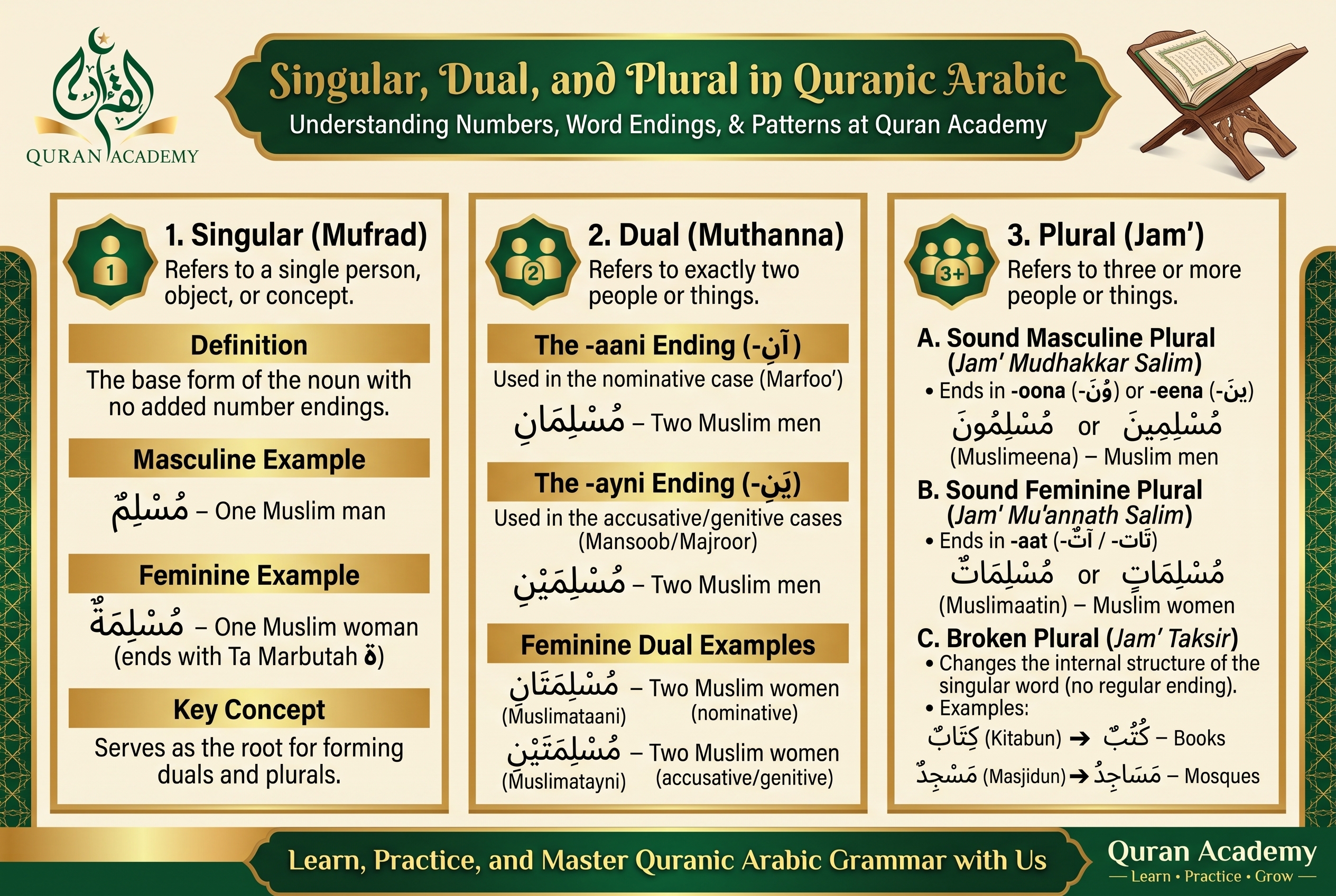
✦ Quick Answer & Key Takeaways: Singular, Dual & Plural in Quranic Arabic
Mastering singular, dual and plural in Quranic Arabic (الْمُفْرَدُ وَالْمُثَنَّىٰ وَالْجَمْعُ فِي الْقُرْآنِ الْكَرِيمِ) explains the famous rhythmic verse-endings of the Mushaf—such as ـُونَ (-oona), ـِينَ (-eena), ـَانِ (-aani), and ـَاتٍ (-aatin)! Unlike English—which jumps straight from Singular (1) to Plural (2+)—Arabic has three precise number categories: (1) Al-Mufrad (Singular = 1), (2) Al-Muthanna (Dual = exactly 2, formed by adding ـَانِ [-aani] or ـَيْنِ [-ayni]), and (3) Al-Jam' (Plural = 3 or more), which divides into Sound Masculine Plural (-oona / -eena), Sound Feminine Plural (-aatun / -aatin), and Broken Plural (Jam' Takseer, like Qalb → Quloob). In our 1-on-1 Online Quranic Arabic, Tafseer & Tajweed Program, students learn to distinguish every ending at a glance so they never mix up -oona and -eena during Hifz!
- Why "-oona" vs. "-eena" (المؤمنون vs. المؤمنين)? Both mean "the believers"! Use ـُونَ (-oona) when they are the Subject doing the action, and ـِينَ (-eena) when they are the Object or follow a Harf Jarr (Preposition)!
- The Dual "-ayni" vs. Plural "-eena" Vowel Secret: In ٱلْوَالِدَيْنِ (Al-Waali-day-ni = the TWO parents), there is a Fatha before the Yaa and a Kasrah on the Noon; in ٱلْعَالَمِينَ (Al-'Aala-mee-na = the worlds), there is a Kasrah before the Yaa and a Fatha on the Noon!
- Why "Salim" (Sound) vs. "Takseer" (Broken)? Salim keeps the singular word intact and glues an ending on; Takseer "breaks" the word open to change its inner vowels (like English foot → feet)!
- #1 Source of Madd 'Aarid lis-Sukoon: Over 70% of Quranic verses end on a Sound Plural (ـُونَ / ـِينَ), creating the melodic 2, 4, or 6-beat verse-ending pause!
Every student memorizing the Quran in our Online Hifz Program has asked this exact question: "When I reach the end of a verse, how do I remember whether the verse ends with ٱلْمُؤْمِنُونَ (-oona) or ٱلْمُؤْمِنِينَ (-eena), ٱلصَّادِقُونَ (-oona) or ٱلصَّادِقِينَ (-eena), ٱلظَّالِمُونَ (-oona) or ٱلظَّالِمِينَ (-eena)? And why does Surah Ar-Rahman end all 78 of its verses with ـَانِ (-aani)?"
When you memorize without knowing the simple grammar of Singular (الْمُفْرَدُ), Dual (الْمُثَنَّىٰ), and Plural (الْجَمْعُ), those endings feel like random guesses. But the moment you learn how Quranic Arabic builds its Duals and Plurals—building directly upon our guides to The 50 Most Common Three-Letter Roots, Attached & Detached Pronouns, and Harf Al-Jarr (Arabic Prepositions)—you will know with 100% certainty why a verse ends with -oona vs. -eena, and you will never confuse a Dual with a Plural again! Below, we break down the Master Chart of all 5 Noun Number Forms, the Dual Gems of Surah Ar-Rahman, the 10 Masculine & Feminine Plural Pairs of Surah Al-Ahzab (33:35), the Top 20 Broken Plurals in the Quran, and 4 Essential Tajweed Rules.
- 1. Master Chart: How Endings Change Across Singular, Dual & The 3 Types of Plural!
- 2. Deep Dive #1: The Dual (Al-Muthanna = 2) & How to Tell "-ayni" Apart From "-eena"
- 3. Deep Dive #2: Sound Masculine (-oona/-eena) & Sound Feminine (-aat) in Surah Al-Ahzab (33:35)
- 4. Deep Dive #3: Top 20 High-Frequency Broken Plurals (Jam' Takseer) in the Quran
- 5. Four Essential Tajweed Rules on Dual & Plural Endings
- 6. Frequently Asked Questions (FAQs)
1. Master Chart: How Endings Change Across Singular, Dual & The 3 Types of Plural!
In Article 113 (Harf Al-Jarr Guide), we saw that a singular noun has three grammatical states: Marfoo' (Subject / Default = Damma ـُ), Mansoub (Object / After Inna = Fatha ـَ), and Majroor (After a Preposition = Kasrah ـِ). Now look at how the Dual and the Sound Plurals express those exact same three states using Letters (ـَانِ / ـَيْنِ and ـُونَ / ـِينَ) instead of simple vowels:
| Number Category | 1. Subject / Default (Marfoo') |
2. Direct Object (Mansoub) |
3. After Preposition (Majroor) |
|---|---|---|---|
| 1. Singular (Al-Mufrad = 1) (الْمُفْرَدُ) |
مُؤْمِنٌ (Mu'min-un) Ends in Damma (ـُ / ـٌ) |
مُؤْمِنًا (Mu'min-an) Ends in Fatha (ـَ / ـًا) |
مُؤْمِنٍ (Mu'min-in) Ends in Kasrah (ـِ / ـٍ) |
| 2. Dual (Al-Muthanna = 2) (الْمُثَنَّىٰ — M or F!) |
مُؤْمِنَانِ (Mu'min-aani) Ends in ـَانِ (-aani) |
مُؤْمِنَيْنِ (Mu'min-ayni) Both Object & After Preposition end in ـَيْنِ (-ayni)! |
|
| 3. Sound Masculine Plural 🏆 (جَمْعُ الْمُذَكَّرِ السَّالِمُ = 3+ M) |
مُؤْمِنُونَ (Mu'min-oona) Ends in ـُونَ (-oona)! |
مُؤْمِنِينَ (Mu'min-eena) Both Object & After Preposition end in ـِينَ (-eena)! |
|
| 4. Sound Feminine Plural (جَمْعُ الْمُؤَنَّثِ السَّالِمُ = 3+ F) |
مُؤْمِنَاتٌ (Mu'min-aatun) Ends in ـَاتٌ (-aatu / -aatun) |
مُؤْمِنَاتٍ (Mu'min-aatin) Both Object & After Preposition end in ـَاتٍ (-aati / -aatin — NEVER a Fatha!) |
|
| 5. Broken Plural (جَمْعُ التَّكْسِيرِ = 3+ M/F) |
رُسُلٌ / قُلُوبٌ (Rusul-un) Acts like Singular: Damma (ـُ) |
رُسُلًا / قُلُوبًا (Rusul-an) Acts like Singular: Fatha (ـَ) |
رُسُلٍ / قُلُوبٍ (Rusul-in) Acts like Singular: Kasrah (ـِ) |
2. Deep Dive #1: The Dual (Al-Muthanna = 2) & How to Tell "-ayni" Apart From "-eena"
One of the most unique beauties of Quranic Arabic is Al-Muthanna (الْمُثَنَّىٰ — The Dual). Whenever Allah speaks about two things—such as the two parents (ٱلْوَالِدَيْنِ), the two hands (يَدَاهُ / بِيَدَيْكَ), the two seas (ٱلْبَحْرَانِ / مَرَجَ ٱلْبَحْرَيْنِ), the two Easts and two Wests (رَبُّ ٱلْمَشْرِقَيْنِ وَرَبُّ ٱلْمَغْرِبَيْنِ), or the two pairs of Gardens in Surah Ar-Rahman (55:46 & 55:62: جَنَّتَانِ = Jannataani)—Arabic simply attaches ـَانِ (-aani) or ـَيْنِ (-ayni) to the singular word!
⚠️ How Do You Distinguish the Dual "ـَيْنِ (-ayni)" From the Plural "ـِينَ (-eena)" in the Mushaf?
Because both ـَيْنِ (Dual = 2) and ـِينَ (Plural = 3+) end with the letters ي + ن (Yaa + Noon), non-native speakers sometimes misread one for the other! Look at the two instant visual differences in vowel marks:
- 1. In the DUAL (ـَيْنِ = -ayni — Two): The letter *before* the Yaa has a Fatha (ـَ), the Yaa has a Sukoon hat (يْ — Yaa Leen!), and the final Noon has a Kasrah (نِ)!
• Examples: وَبِٱلْوَالِدَيْنِ إِحْسَانًا (Wa bil-waali-day-ni — "And to the TWO parents be good") • مَرَجَ ٱلْبَحْرَيْنِ (Al-bah-ray-ni — "the TWO seas") • أَلَمْ نَجْعَل لَّهُ عَيْنَيْنِ ﴿٨﴾ وَلِسَانًا وَشَفَتَيْنِ ﴿٩﴾ وَهَدَيْنَاهُ ٱلنَّجْدَيْنِ ﴿١٠﴾ (Surah Al-Balad 90:8–10: two eyes, two lips, and the two paths!). - 2. In the PLURAL (ـِينَ = -eena — Three or More): The letter *before* the Yaa has a Kasrah (ـِ), the Yaa is a bare Madd letter (ي), and the final Noon has a Fatha (نَ)!
• Examples: رَبِّ ٱلْعَالَمِينَ (Rabbil-'Aala-mee-na) • مِنَ ٱلْمُؤْمِنِينَ (Minal-mu'mi-nee-na)!
3. Deep Dive #2: Sound Masculine (-oona/-eena) & Sound Feminine (-aat) in Surah Al-Ahzab (33:35)
Want to see the most breathtaking demonstration of Sound Masculine Plural (جَمْعُ الْمُذَكَّرِ السَّالِمُ) and Sound Feminine Plural (جَمْعُ الْمُؤَنَّثِ السَّالِمُ) in a single Quranic verse? When Umm Salamah (may Allah be pleased with her) asked why men were often addressed directly in general plural verses, Allah Almighty revealed Surah Al-Ahzab (33:35)—pairing 10 Sound Masculine Plurals (ending in ـِينَ because of Inna!) side by side with 10 Sound Feminine Plurals (ending in ـَاتِ!):
﴿ إِنَّ ٱلْمُسْلِمِينَ وَٱلْمُسْلِمَاتِ وَٱلْمُؤْمِنِينَ وَٱلْمُؤْمِنَاتِ وَٱلْقَانِتِينَ وَٱلْقَانِتَاتِ وَٱلصَّادِقِينَ وَٱلصَّادِقَاتِ وَٱلصَّابِرِينَ وَٱلصَّابِرَاتِ وَٱلْخَاشِعِينَ وَٱلْخَاشِعَاتِ وَٱلْمُتَصَدِّقِينَ وَٱلْمُتَصَدِّقَاتِ وَٱلصَّائِمِينَ وَٱلصَّائِمَاتِ وَٱلْحَافِظِينَ فُرُوجَهُمْ وَٱلْحَافِظَاتِ وَٱلذَّاكِرِينَ ٱللَّهَ كَثِيرًا وَٱلذَّاكِرَاتِ أَعَدَّ ٱللَّهُ لَهُم مَّغْفِرَةً وَأَجْرًا عَظِيمًا ﴿٣٥﴾ ﴾
Look at the grammatical perfection of this verse: because the verse opens with إِنَّ (Inna — Indeed, which puts its subject into the Mansoub state!), every single Masculine Plural takes ـِينَ (-eena) instead of -oona, and every single Feminine Plural takes a Kasrah (ـَاتِ = -aati) because Sound Feminine Plurals never take a Fatha—they use a Kasrah for both Mansoub and Majroor (just as in خَلَقَ ٱللَّهُ ٱلسَّمَاوَاتِ = As-Samaawaat-i)!
Struggling to perfect your Recitation?
Join hundreds of students mastering the Quran with our Verified Al-Azhar Graduates. We offer flexible 1-on-1 sessions tailored to your schedule.
Book a Free Evaluation Class →4. Deep Dive #3: Top 20 High-Frequency Broken Plurals (Jam' Takseer) in the Quran
Just like English forms some plurals by changing the inside vowels of the word (man → men, foot → feet, tooth → teeth), Arabic forms Jam' At-Takseer (جَمْعُ التَّكْسِيرِ — Broken Plural) by taking the 3-letter root of the singular noun and reshaping its internal vowel pattern! Here are the 20 most frequent Broken Plurals in the Quran:
| Singular (Mufrad) → Broken Plural (Jam' Takseer) | Singular (Mufrad) → Broken Plural (Jam' Takseer) |
|---|---|
| 1. قَلْب (Qalb — Heart) → قُلُوب (Quloob — Hearts) | 11. يَوْم (Yawm — Day) → أَيَّام (Ayyaam — Days) |
| 2. نَفْس (Nafs — Soul) → أَنْفُس / نُفُوس (Anfus / Nufoos) | 12. شَهْر (Shahr — Month) → شُهُور / أَشْهُر (Shuhoor / Ash-hur) |
| 3. رَسُول (Rasool — Messenger) → رُسُل (Rusul — Messengers) | 13. مَلَك (Malak — Angel) → مَلَائِكَة (Malaa'ikah — Angels) |
| 4. نَبِيّ (Nabiyy — Prophet) → أَنْبِيَاء / نَبِيُّونَ (Anbiyaa') | 14. شَيْطَان (Shaytaan — Devil) → شَيَاطِين (Shayaateen) |
| 5. كِتَاب (Kitaab — Book) → كُتُب (Kutub — Books) | 15. مَسْجِد (Masjid — Mosque) → مَسَاجِد (Masaajid) |
| 6. عَبْد ('Abd — Servant) → عِبَاد / عَبِيد ('Ibaad — Servants) | 16. نَهَر (Nahar — River) → أَنْهَار (Anhaar — Rivers) |
| 7. عَمَل ('Amal — Deed) → أَعْمَال (A'maal — Deeds) | 17. بَصَر (Basar — Sight) → أَبْصَار (Absaar — Eyes/Vision) |
| 8. مَال (Maal — Wealth) → أَمْوَال (Amwaal — Wealth/Goods) | 18. وَلِيّ (Waliyy — Ally) → أَوْلِيَاء (Awliyaa' — Allies) |
| 9. وَلَد (Walad — Child) → أَوْلَاد (Awlaad — Children) | 19. عَالِم ('Aalim — Scholar) → عُلَمَاء ('Ulamaa' — Scholars) |
| 10. ٱسْم (Ism — Name) → أَسْمَاء (Asmaa' — Names) 🏆 | 20. شَهِيد (Shaheed — Witness) → شُهَدَاء (Shuhadaa' — Witnesses) 🏆 |
Mastering the Crisp Qalqalah in Broken Plurals: "Absaar" & Stopping on "Al-Buroojْ"!
Look at the Broken Plurals in the table above: when بَصَر (Basar) becomes plural أَبْصَار (Abْsaar), the Baa becomes silent (Sakin) in the Af'aal pattern—triggering an immediate mid-word Qalqalah Sughra bounce on بْ! And when you pause on Broken Plurals like ٱلْبُرُوجِ (Al-Buroojْ — 85:1), قُلُوبْ (Quloobْ), or كُتُبْ (Kutubْ), they end on a resonant Qalqalah Kubra! Watch Senior Instructor Ustadhah Yasmeen Gamal demonstrate Qalqalah on our Quran Academy YouTube Channel:
- Never Swallow Final Noon on Plurals: Hold Tawassut on ـُونَ / ـِينَ without bouncing the Noon!
- 1-on-1 Live Coaching: Master Quranic Arabic & Tajweed with Al-Azhar scholars!
5. Four Essential Tajweed Rules on Dual & Plural Endings
Every time you stop on or connect a Dual or Plural noun in the Quran, apply these four Tajweed rules from our 1-on-1 Online Tajweed Course:
- 1. Madd 'Aarid lis-Sukoon (2, 4, or 6 Beats) vs. Madd Leen on Stop:
As we mastered in our Rules of Madd Guide and Rules of Waqf Guide:
• When stopping on ـُونَ (-oonْ), ـِينَ (-eenْ), ـَانِ (-aanْ), or ـَاتٌ (-aatْ), the long vowel before the final consonant becomes Madd 'Aarid lis-Sukoon (2, 4, or 6 beats)!
• When stopping on a Dual ending in ـَيْنِ (-aynْ) (like عَيْنَيْنْ، شَفَتَيْنْ، ٱلنَّجْدَيْنْ in 90:8–10), the Yaa Sakinah preceded by a Fatha becomes Madd Leen (2, 4, or 6 beats)! - 2. Four-to-Five Beat Madd Wajib Muttasil on Broken Plurals Ending in "ـَاء" (شُهَدَاء، عُلَمَاء، أَوْلِيَاء، أَنْبِيَاء):
Notice how many Broken Plurals in the table above (#4, #10, #18, #19, #20) follow the pattern فُعَلَاء / أَفْعِلَاء / أَفْعَال (ending in Alif + Hamzah in the same word)! Stretch the Alif for 4 to 5 obligatory counts, and if you pause on the word, apply Position #4 of An-Nabr (Vocal Stress) on the final Hamzah! - 3. Iqlab (Small Meem مـ) Inside "Anbiyaa'" (أَنۢبِيَاءَ):
Applying our Noon Sakinah & Tanween Guide, in the Broken Plural of Nabiyy—ٱلْأَنۢبِيَاءَ (Al-Am-biyaa')—a silent Noon is followed immediately by a Baa inside the same word, triggering an obligatory 2-beat Iqlab into a hidden Meem! - 4. Holding Tawassut on Final "Noon" vs. Whispering "Hams" on Final "Taa" (ـَاتْ):
Following our Sifaat al-Huruf, Makharij al-Huruf, Heavy & Light Letters, Meem Sakinah Rules, Ahkam Al-Raa, Laam Shamsiyyah & Qamariyyah, Hamzatul Wasl vs. Qat', 4 Special Words of Hafs, 7 Alifs in the Quran, Idgham Mutamathilayn, Mutajanisayn & Mutaqaribayn, 10 Qira'at, Lahn Jali vs. Lahn Khafi, and 15 Sajdah Tilawah Verses guides, when stopping on Sound Masculine Plurals (ٱلْمُؤْمِنُونْ / ٱلْعَالَمِينْ), let the final Noon resonate gently with Tawassut (never bounce it!), and when stopping on Sound Feminine Plurals (ٱلسَّمَاوَاتْ / ٱلصَّالِحَاتْ), release a delicate whisper of breath (Hams) on the final Taa! Test your Tajweed & Arabic skills right now on our Free 3-Minute Tajweed Quiz!
Practice spotting Singular, Dual, and Plural nouns across our interconnected library of Surah, Hifz, and Salah guides: Surah Al-Qadr (featuring Broken Plural Al-Malaa'ikah!), Surah Al-Muzzammil, Surah Nuh (featuring Amwaal, Baneen, Jannaat, and Anhaar in 71:12—all 3 types of plural in a single verse!), Surah Al-Qalam, 30-Day Quran Khatmah Schedule, 15 Etiquettes of Reading the Quran, Traveler's Prayer, Salat Al-Jumu'ah, 12 Sunnah Rawatib, Salat Al-Eid, Salat Ad-Duha, Salat Al-Witr, and Dua Al-Qunoot (using our Smart Hifz Planner and Online Hadith Explorer)! Meet our Al-Azhar Certified Tutors, enroll your child in our 1-on-1 Kids Quran Classes with our Printable Kids Star Chart, and read how families across the US, UK, Canada, and Australia rate our teachers on our Verified Student & Parent Reviews Page.
6. Frequently Asked Questions (FAQs) About Singular, Dual & Plural in the Quran
1. What are the 3 number categories of nouns in Quranic Arabic?
Unlike English—which only has Singular (1) and Plural (2 or more)—Quranic Arabic has 3 distinct number categories: (1) Al-Mufrad (المفرد — Singular for 1, such as Muslimun = 1 Muslim), (2) Al-Muthanna (المثنى — Dual for 2, formed by adding -aani or -ayni, such as Muslimaani / Muslimayni = 2 Muslims), and (3) Al-Jam' (الجمع — Plural for 3 or more, such as Muslimoona / Muslimeena = 3+ Muslims).
2. Why does the Quran sometimes say "Al-Mu'minoona" (-oona) and other times "Al-Mu'mineena" (-eena)?
Both "Al-Mu'minoona" (المؤمنون) and "Al-Mu'mineena" (المؤمنين) mean "the believers" (Sound Masculine Plural — Jam' Mudhakkar Salim)! The ending changes based on its grammatical job in the verse: it ends with "-oona" (ـُونَ) when it is in the Nominative Subject state (Marfoo', as in Surah Al-Mu'minun 23:1: "Qad aflahal-mu'minoon"), and it ends with "-eena" (ـِينَ) when it is the Object of a verb or follows a Preposition (Mansoub or Majroor, as in "Wa bashshiril-mu'mineen" or "Minal-mu'mineen").
3. What are the 3 types of Plural (Al-Jam') in Quranic Arabic?
The 3 types of Plural in the Quran are: (1) Jam' Mudhakkar Salim (Sound Masculine Plural — keeps the singular word intact and adds -oona or -eena, like Saalihoona / Saaliheen), (2) Jam' Mu'annath Salim (Sound Feminine Plural — adds -aatun or -aatin, like Muslimaat, Mu'minaat, and Samaawaat), and (3) Jam' Takseer (Broken Plural — changes the internal vowel pattern of the 3-letter root, like Qalb → Quloob [hearts], Rasool → Rusul [messengers], and Masjid → Masaajid [mosques]).
4. How do you spot the Dual (Al-Muthanna) in the Quran (such as in Surah Ar-Rahman)?
The Dual (Al-Muthanna — indicating two) is formed by adding "-aani" (ـَانِ — with a Kasrah on the Noon!) in the Nominative state, or "-ayni" (ـَيْنِ — Yaa Leen followed by Noon with Kasrah) after a verb or preposition—such as "Jannataani" (two gardens), "'Aynayni" (two springs), and "Rabbikumaa" (Lord of you both — humans and Jinn) in Surah Ar-Rahman!
5. Why is the Noon of the Dual (-aani / -ayni) voweled with a Kasrah while the Noon of the Plural (-oona / -eena) has a Fatha?
In Arabic grammar and Tajweed, the Noon at the end of a Dual noun ALWAYS carries a Kasrah (ـَانِ / ـَيْنِ — e.g., Waliday-ni = two parents), whereas the Noon at the end of a Sound Masculine Plural ALWAYS carries a Fatha (ـُونَ / ـِينَ — e.g., Al-'Aalamee-na, Al-Mursalee-na)!
Understand & Memorize the Quran With Confidence!
Master Quranic Arabic grammar, verse endings, and live Tajweed recitation in personalized 1-on-1 classes with certified male and female Al-Azhar scholars. Book your free diagnostic trial session today!
Book Your Free 1-on-1 Trial Class →