
✦ Quick Answer & Key Takeaways: Hafs vs. Warsh Recitation Differences
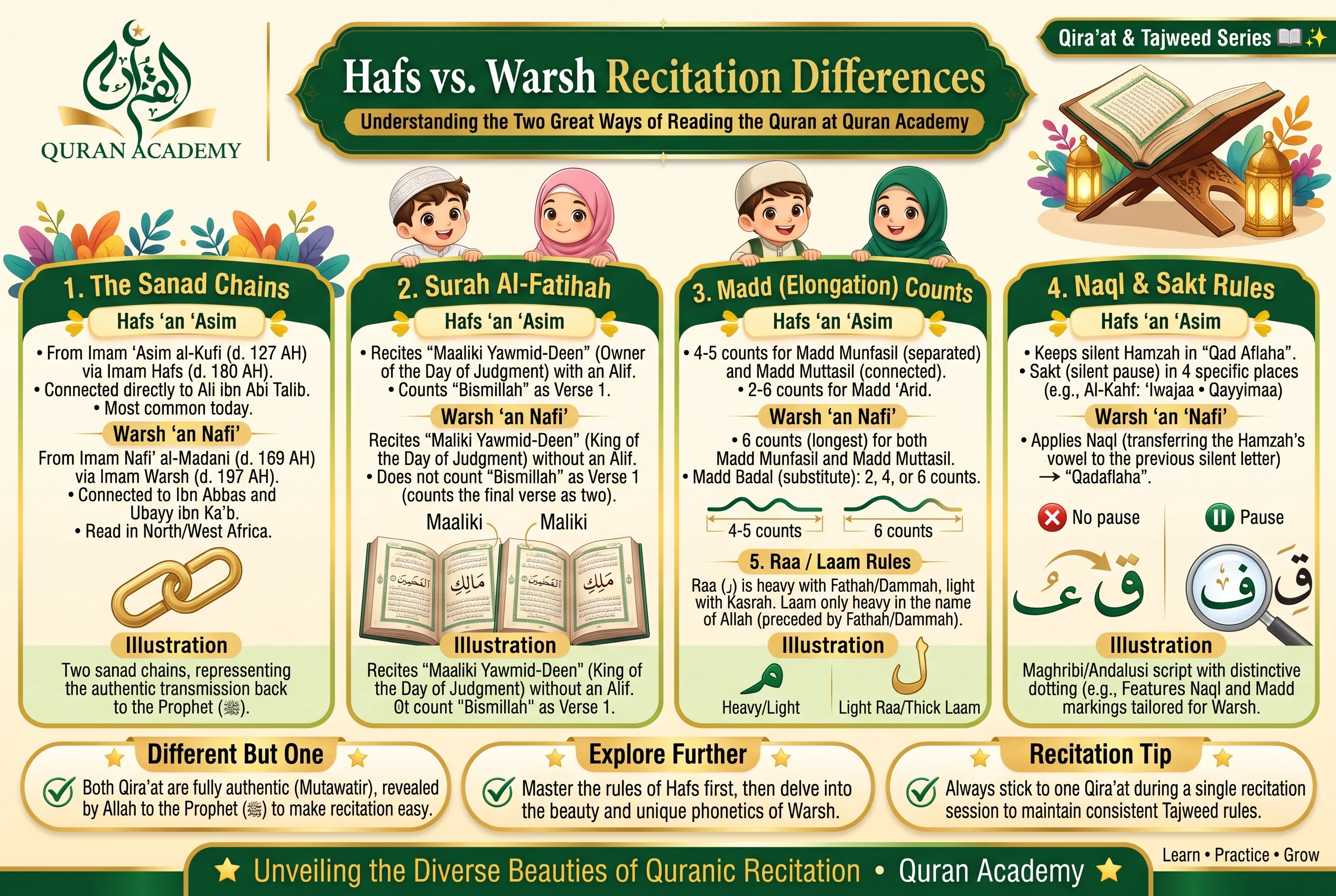
Understanding the Hafs vs Warsh recitation differences (الْفَرْقُ بَيْنَ رِوَايَةِ حَفْصٍ عَنْ عَاصِمٍ وَرِوَايَةِ وَرْشٍ عَنْ نَافِعٍ) opens a window into the miraculous beauty of the 10 Mutawatir Qira'at of the Holy Quran! Both Hafs 'an 'Asim (the Kufan transmission recited by ~95% of Muslims worldwide) and Warsh 'an Nafi' (the Madinan-Egyptian transmission recited across Morocco, Algeria, Mauritania, and West Africa) are 100% authentic, divinely revealed transmissions tracing back word for word to Prophet Muhammad (ﷺ). While the consonantal Uthmani text of the Quran is one, Warsh (via the primary path of Al-Azraq) features 10 distinct phonetic and orthographic principles (Al-Usul)—including reading مَلِكِ يَوْمِ ٱلدِّينِ (Maliki without Alif) in Surah Al-Fatihah, 6-beat Madd Muttasil & Munfasil, 2/4/6-beat Madd Al-Badal, An-Naql (transferring a Hamzah's vowel to a preceding Sukoon), and Taqleel (softening Alifs)! In our 1-on-1 Online Tajweed, Qira'at & Ijazah Program, students can study and earn a certified Sanad Ijazah in either Hafs, Warsh, or all 10 Qira'at!
- Who Was Imam Warsh (110–197 AH)? Born in Upper Egypt as 'Uthman ibn Sa'id Al-Qutbi Al-Misri; his teacher in Madinah, Imam Nafi' Al-Madani, nicknamed him "Warsh" because of his bright, fair complexion and energetic devotion to the Quran!
- Why "Maaliki" (Hafs) + "Maliki" (Warsh) Enrich Tafseer: Together in Surah Al-Fatihah (1:4), they declare that Allah is both the Owner (مَالِك) and the King (مَلِك) of the Day of Judgment!
- Why Warsh Sounds So Smooth & Flowing: Because Warsh softens double Hamzahs, transfers vowels in Naql (reading ٱلْأَرْضِ as ٱلَرْضِ = Al-ardi), and makes Raa after Kasrah/Yaa light!
- Script Difference in Maghribi Mushafs: ڢ (Faa = 1 dot below) vs. ڧ (Qaaf = 1 dot above)!
Have you ever prayed behind a Moroccan, Algerian, Mauritanian, or Senegalese Imam—or listened to a famous North African reciter like Shaykh 'Umar Al-Qazabri or Shaykh Al-Husary's Warsh recording—and noticed that in Surah Al-Fatihah he recited مَلِكِ يَوْمِ ٱلدِّينِ (Maliki Yawmid-Deen) without stretching the Meem, and in Surah Al-A'la / Ad-Duha he recited verse endings with a gentle, melodic tilt between an "A" and an "E" sound (Taqleel), and read مَنْ آمَنَ as مَنَ امَنَ (Ma-naamana)?
For a Muslim who has only ever heard the narration of Hafs 'an 'Asim (حَفْصٌ عَنْ عَاصِمٍ), hearing Warsh 'an Nafi' (وَرْشٌ عَنْ نَافِعٍ) for the first time can spark curiosity: "Where did these two recitations come from? Why are both 100% authentic? What are the exact 10 rules that differ between Hafs and Warsh? And if I visit a mosque in Morocco or West Africa and pick up a Warsh Mushaf, how do I read its unique dot symbols?" Building upon our guides to The 10 Qira'at of the Quran, Matn Tuhfat Al-Atfal, and Matn Al-Muqaddimah Al-Jazariyyah, this complete guide compares the Sanad Chains of Hafs & Warsh, breaks down the 10 Key Differences in a Master Chart, compares Surah Al-Fatihah & Ayatul Kursi in Both Readings, and explains the Maghribi Mushaf Script Symbols.
- 1. Who Were Imam Hafs (Kufah) & Imam Warsh (Madinah/Egypt)? Their Unbroken Chains to the Prophet (ﷺ)
- 2. Master Comparison Chart: The 10 Key Tajweed & Phonetic Differences Between Hafs & Warsh
- 3. Deep Dive Into Warsh's 4 Signature Rules: An-Naql, Madd Al-Badal, Taqleel & Taghleedh Al-Laam
- 4. Side-by-Side Comparison: How Surah Al-Fatihah & Ayatul Kursi Sound in Hafs vs. Warsh
- 5. How to Read a Warsh Mushaf: Faa vs. Qaaf Dots, Naql Dots & Waqf Signs
- 6. Frequently Asked Questions (FAQs)
1. Who Were Imam Hafs & Imam Warsh? Their Unbroken Chains to the Prophet (ﷺ)
In Sahih al-Bukhari (4992)—verifiable in our Online Hadith Explorer—Prophet Muhammad (ﷺ) explained that the Quran was revealed upon Seven Ahruf (modes of recitation) to make recitation easy for the diverse tribes of the Ummah, and during the standardization of the Uthmani Mushafs under Caliph 'Uthman ibn 'Affan (RA — #3 in our 10 Promised Paradise Guide), the Companions sent official Mushafs along with master reciters to the major Islamic capitals. Look at the two golden chains of Hafs and Warsh:
• His Teacher: Imam 'Asim ibn Abi An-Najud Al-Kufi (d. 127 AH).
• Chain to the Prophet (ﷺ): 'Asim learned from Abu 'Abdir-Rahman As-Sulami, who learned directly from 'Ali ibn Abi Talib, 'Uthman ibn 'Affan, Ubayy ibn Ka'b, and Zayd ibn Thabit (RA) from the Prophet (ﷺ)!
• His Teacher: Imam Nafi' ibn 'Abdir-Rahman Al-Madani (70–169 AH), who led recitation in the Prophet's Mosque in Madinah for 70 years!
• Chain to the Prophet (ﷺ): Nafi' learned from 70 Tabi'in scholars of Madinah (including Abu Ja'far, Al-A'raj, and Shaybah), who learned from Ubayy ibn Ka'b, Ibn 'Abbas, and Abu Hurayrah (RA) from the Prophet (ﷺ)!
2. Master Comparison Chart: The 10 Key Differences Between Hafs & Warsh
In the science of Qira'at, differences are divided into Al-Usul (الأصول — General Phonetic Rules that apply across the whole Quran) and Al-Farsh (الفرش — Specific Word Variations in individual verses). Compare the 10 signature differences between Hafs (via Ash-Shatibiyyah) and Warsh (via Al-Azraq):
| # & Tajweed / Qira'at Rule | Riwayat Hafs 'an 'Asim | Riwayat Warsh 'an Nafi' (Tariq Al-Azraq) |
|---|---|---|
| 1. Connecting Two Surahs (البسملة بين السورتين) |
Always reads the Basmalah between any two Surahs (except before Surah At-Tawbah 9). | Allows 3 ways between two Surahs: (a) Reading the Basmalah, (b) Sakt (2-count silent pause without Basmalah), or (c) Wasl (connecting directly without Basmalah)! |
| 2. Madd Muttasil & Madd Munfasil (المد المتصل والمنفصل) ⭐ |
4 or 5 counts (Tawassut) via Ash-Shatibiyyah (e.g., Jaaaa'a, Bimaaa unzila). | 6 full counts (Ishba' / Tul) on BOTH Madd Wajib Muttasil and Madd Ja'iz Munfasil! |
| 3. Madd Al-Badal (Hamzah + Madd) (مد البدل: آمَنُوا، إِيمَانًا، أُوتُوا) ⭐ |
Always 2 counts (Qasr) only (just like a Natural Madd). | Allows 2 counts (Qasr), 4 counts (Tawassut), or 6 counts (Tul) on every Madd Badal across the Quran! |
| 4. Plural Meem Before Hamzah (صلة ميم الجمع: عَلَيْكُمْ أَنفُسَكُمْ) |
Pronounces a crisp silent Meem (Izhar Shafawi: 'Alaykumْ anfusakum). | Silat Meem Al-Jam' (6 Beats!): Gives the plural Meem a Damma and stretches a Waw for 6 counts before any Hamzatul Qat' (عَلَيْكُمُوٓ أَنفُسَكُمْ)! |
| 5. An-Naql (Vowel Transfer to Sukoon) 🏆 (النقل: مَنْ آمَنَ، ٱلْأَرْضِ، قَدْ أَفْلَحَ) |
Pronounces the silent letter clearly followed by the Hamzah (Manْ aamana, Al-ardi, Qadْ aflaha). | Transfers the Hamzah's vowel onto the silent letter before it and drops the Hamzah: مَنَ امَنَ (Ma-naamana), ٱلَرْضِ (Al-ardi), قَدَ افْلَحَ (Qa-daflaha)! |
| 6. Softening Single Silent Hamzah (إبدال الهمز المفرد: مُؤْمِنُونَ، يَأْكُلُونَ) |
Pronounces the glottal stop Hamzah clearly (Mu'minoon, Ya'kuloon, Bi'r). | Replaces a silent Faa'-position Hamzah with a pure Madd letter matching the vowel before it: مُومِنُونَ (Moominoon), يَاكُلُونَ (Yaakuloon), بِير (Beer)! |
| 7. Taqleel / Minor Imalah on Alifs (التقليل في ذوات الياء: هُدَى، ضُحَاهَا) ⭐ |
Reads all Alifs upright (Fath), with Major Imalah in ONLY 1 word in the Quran: مَجْر۪يهَا (Hud 11:41)! | Applies Taqleel (Minor Imalah — a 45° soft tilt between Alif and Yaa) on Alifs originating from Yaa (like Hudaa, Moosaa, 'Eesaa) and before Raa' (like Al-Absaar, An-Naar)! |
| 8. Lightness of Raa (ترقيق الراء) (خَبِيرًا، بَصِيرًا، ذِكْرًا، سِحْرٌ) |
Reads voweled Raa with Fatha or Damma as Heavy (Tafkhim) even after a Kasrah or Yaa (Khabeeraa, Dhikraa). | Makes a Fatha/Damma Raa Light (Tarqeeq) whenever preceded in the same word by a Kasrah, a silent Yaa, or a single non-elevated silent letter after Kasrah (Khabeeraa, Baseeraa, Dhikraa)! |
| 9. Making Laam Heavy (تغليظ اللام) (ٱلصَّلَاةَ، ظَلَمُواْ، طَلَاقٌ) |
Every Laam in the Quran is Light (Tarqeeq) except the Name of Allah (ٱللَّه) after a Fatha or Damma! | Makes a Fatha-voweled Laam (لَ / لَا) Heavy (Taghleedh) whenever it comes immediately after ص، ط، or ظ (with Fatha or Sukoon)—as in ٱلصَّلَاةَ، ظَلَمُواْ، مَطْلَعِ! |
| 10. Madd Al-Leen Before Hamzah 🏆 (مد اللين المهموز: شَيْءٍ، سَوْءٍ) |
In continuation, reads شَيْءٍ (Shay'in) with zero elongation (and 2, 4, or 6 only when stopping). | Stretches the Yaa or Waw of Leen before a Hamzah in the same word (like شَيْءٍ، سَوْءٍ) for 4 or 6 counts in BOTH continuation and stopping! |
3. Deep Dive Into Warsh's 4 Signature Rules: Naql, Badal, Taqleel & Taghleedh
Why do listeners across the world fall in love with the gentle, flowing sound of a Warsh recitation? Because of four phonetic rules that remove vocal friction:
- 1. An-Naql (النَّقْلُ — Transferring the Hamzah's Vowel): In Arabic phonetics, the glottal stop Hamzah (ء) is the furthest letter deep in the throat (Aqsal-Halq in our Makharij Guide). Whenever a silent consonant at the end of a word (or the silent Laam of ٱلْـ) is followed by a Hamzah, Warsh transfers the vowel of the Hamzah onto the silent letter before it and drops the Hamzah! Look at how قَدْ أَفْلَحَ ٱلْمُؤْمِنُونَ (23:1) sounds in Hafs vs. Warsh:
• In Hafs: Qadْ aflahal-mu'minoon (with a Qalqalah bounce on the Dal + two glottal Hamzahs).
• In Warsh: Qa-daflahal-moominoon (the Fatha of Aflaha moves onto the Dal of Qad, and the silent Hamzah of Mu'minoon turns into a smooth Waw Madd!). - 2. At-Taqleel (التَّقْلِيلُ / الإِمَالَةُ الصُّغْرَىٰ): In Surahs whose verses end with an Alif Maqsurah (ـىٰ)—such as Surah Ad-Duha (93), Surah Al-A'la (87), Surah Ash-Shams (91), and Surah An-Nazi'at (79)—Warsh tilts the Alif halfway toward a Yaa sound (like the vowel in the English word "care" or "air"), creating a deeply moving cadence!
- 3. Taghleedh Al-Laam (تَغْلِيظُ اللَّامِ): While Hafs only makes the Laam of ٱللَّه heavy, Warsh also makes any Fatha-voweled Laam heavy when it follows one of the three elevated tongue-front letters ص، ط، ظ (when they have a Fatha or Sukoon)—which is why in Warsh, وَأَقِيمُواْ ٱلصَّلَاةَ and حَتَّىٰ مَطْلَعِ ٱلْفَجْرِ (97:5) have a rich, full-mouth Laam!
- 4. Why You Must Never Mix Rules Inside a Single Breath (Talfeeq): As we explained in our 10 Qira'at Guide, while a Muslim can pray one Rak'ah in Hafs and another in Warsh, when reciting a verse in a chosen Riwayah you keep its rules consistent from start to finish!
4. Side-by-Side Comparison: Surah Al-Fatihah & Ayatul Kursi in Hafs vs. Warsh
Open our Online Uthmani Quran Explorer and compare how the two greatest passages in the Quran—Surah Al-Fatihah and Ayatul Kursi (2:255)—are recited in Hafs versus Warsh:
Struggling to Perfect Your Recitation?
Join 1,250+ students mastering the Quran 1-on-1 with our Verified Al-Azhar Graduates. Flexible US, UK, Canadian & Australian schedules starting at $8/hr.
Book a Free Evaluation Class →- 1. In Surah Al-Fatihah (1:1–7):
• Verse Counting (7 Verses in Both!): In Hafs (following the Kufan verse count), بِسْمِ ٱللَّهِ ٱلرَّحْمَٰنِ ٱلرَّحِيمِ is counted as Verse 1, while Verse 7 is from Siraatal-ladheena... to the end. In Warsh (following the Madinan verse count), the Basmalah is an unnumbered opening banner, Al-hamdu lillaahi... is Verse 1, and the final verse is split into two at صِرَاطَ ٱلَّذِينَ أَنْعَمْتَ عَلَيْهِمْ ﴿٦﴾ غَيْرِ ٱلْمَغْضُوبِ عَلَيْهِمْ وَلَا ٱلضَّالِّينَ ﴿٧﴾—so both readings total exact 7 verses (As-Sab' Al-Mathani)!
• مَالِكِ (Hafs = Maaliki with 2-count Alif) vs. مَلِكِ (Warsh = Maliki without Alif): Master/Owner of the Day of Judgment + King of the Day of Judgment! - 2. In Ayatul Kursi (Surah Al-Baqarah 2:255):
• لَا إِلَٰهَ إِلَّا هُوَ: Stretched for 4–5 beats in Hafs vs. 6 full beats in Warsh!
• فِي ٱلسَّمَاوَاتِ وَمَا فِي ٱلْأَرْضِ: In Warsh, Al-Ardi is read with Naql as فِي ٱلَرْضِ (Fil-ardi)!
• يَعْلَمُ مَا بَيْنَ أَيْدِيهِمْ وَمَا خَلْفَهُمْ: When connecting to وَلَا يُحِيطُونَ بِشَيْءٍ, Warsh stretches the Leen of بِشَيْءٍ for 4 or 6 counts even in continuation!
5. How to Read a Warsh Mushaf: Faa vs. Qaaf Dots, Naql & Taqleel Symbols
If you pick up a Warsh Mushaf (whether the Madinah Warsh print or a traditional Moroccan/Algerian print), here are the 4 visual script symbols to know so you never misread a letter:
- 1. In Traditional Maghribi Prints — Faa (ڢ = 1 Dot Below) vs. Qaaf (ڧ = 1 Dot Above):
While the Madinah King Fahd Complex prints modern Warsh Mushafs using both Eastern dots (ف / ق) and Maghribi editions, traditional North African Mushafs follow the ancient Andalusian/Maghribi dot convention: Faa (ڢ) has 1 single dot UNDERNEATH its loop, while Qaaf (ڧ) has 1 single dot ABOVE its loop! - 2. A Large Solid Black Dot (•) Under a Letter = Taqleel / Imalah Sughra!
Whenever you see a round solid black dot placed underneath the letter before an Alif (such as under the Dal of هُدَىٰ or the Haa' of ضُحَاهَا), it tells the Warsh reciter to tilt that Alif with Taqleel! (Whereas a hollow diamond/circle below a letter in Hafs marks the single Major Imalah in Majreehaa 11:41!). - 3. A Large Solid Black Dot (•) in the Middle of a Softened Hamzah = Tashil!
Marks a softened second Hamzah (like ءَأَنذَرْتَهُمْ, which even Hafs softens in ءَأَعْجَمِيٌّ in Surah Fussilat 41:44!). - 4. How Naql Is Marked Visually in a Warsh Mushaf:
In a Warsh Mushaf, the Hamzah of ٱلْأَرْضِ is omitted visually from the Alif, and its Fatha is placed directly on top of the Laam (ٱلَارْضِ) so your eye reads Al-ardi automatically!
What stays 100% Identical in Both Hafs & Warsh? The 5 Qalqalah Letters (ق ط ب ج د)!
Here is a wonderful rule to remember: except when a silent Qalqalah letter takes a transferred vowel in Warsh's Naql (like Qa-daflaha in continuation), every single silent ق، ط، ب، ج، and د across the Quran—such as stopping on أَحَدْ، ٱلصَّمَدْ، لَمْ يَلِدْ وَلَمْ يُولَدْ in Surah Al-Ikhlas—bounces with the exact same Qalqalah (Echoing) rule in both Hafs and Warsh! Watch Senior Instructor Ustadhah Yasmeen Gamal demonstrate Qalqalah on our Quran Academy YouTube Channel:
- Learn Hafs, Warsh, Qaloon, or All 10 Qira'at: Study 1-on-1 with certified Al-Azhar Qira'at scholars!
- Official Sanad Ijazah Certificates: Connect your chain to the Prophet (ﷺ)!
Explore the rest of our advanced Tajweed, Qira'at, and Quranic Arabic guides: Makharij al-Huruf, Sifaat al-Huruf, Heavy & Light Letters, Rules of Madd, Noon Sakinah Rules, Meem Sakinah Rules, Rules of Waqf, Ahkam Al-Raa, Laam Shamsiyyah & Qamariyyah, Hamzatul Wasl vs. Qat', 7 Alifs in the Quran, Idgham Mutamathilayn, Mutajanisayn & Mutaqaribayn, Lahn Jali vs. Lahn Khafi, An-Nabr (Vocal Stress), 15 Sajdah Tilawah Verses, Iltiqa' As-Sakinayn in Tajweed, and 12 Duas for Seeking Knowledge & Memory in our Online Hifz Program (using our Smart Hifz Planner)! Meet our Al-Azhar Certified Tutors, test your knowledge on our Free 3-Minute Tajweed Quiz, enroll your child in our 1-on-1 Kids Quran Classes with our Printable Kids Star Chart, and read how families across the US, UK, Canada, and Australia rate our teachers on our Verified Student & Parent Reviews Page.
6. Frequently Asked Questions (FAQs) About Hafs vs. Warsh Recitation
1. Are both Hafs 'an 'Asim and Warsh 'an Nafi' 100% authentic revelations from Prophet Muhammad (ﷺ)?
Yes, by absolute scholarly consensus! Both Riwayat Hafs 'an 'Asim (the Kufan chain through 'Ali ibn Abi Talib and 'Abdullah ibn Mas'ud RA) and Riwayat Warsh 'an Nafi' (the Madinan chain through Ubayy ibn Ka'b, Zayd ibn Thabit, and Abu Hurayrah RA) are Mutawatir (mass-transmitted) recitations revealed by Allah via Angel Jibreel (AS) to Prophet Muhammad (ﷺ) as part of the Seven Ahruf (Sahih al-Bukhari 4992).
2. Where in the Muslim world are Hafs and Warsh recited today?
Riwayat Hafs 'an 'Asim is recited by roughly 90% to 95% of Muslims worldwide (across the Middle East, Egypt, Turkey, South & Southeast Asia, Europe, and North America). Riwayat Warsh 'an Nafi' is the primary historic recitation of North and West Africa—including Morocco, Algeria, Mauritania, Western Libya, Senegal, Nigeria, Niger, and Mali!
3. Why does Surah Al-Fatihah (1:4) read "Maaliki Yawmid-Deen" in Hafs and "Maliki Yawmid-Deen" in Warsh?
In the Uthmani Mushaf without dots or dagger Alifs, the word مـلـك (M-L-K) accommodates both Mutawatir readings: Hafs (and Al-Kisa'i) recites it with a 2-count dagger Alif as "Maaliki Yawmid-Deen" (Master/Owner of the Day of Judgment), while Warsh (and Nafi', Ibn Kathir, Abu 'Amr, Ibn 'Amir, and Hamzah) recites it without an Alif as "Maliki Yawmid-Deen" (Sovereign King of the Day of Judgment)—combining Absolute Ownership and Supreme Kingship across the two readings!
4. What is "An-Naql" (النقل — Vowel Transfer) in Warsh recitation?
An-Naql (النقل) is one of the signature rules of Warsh (via Al-Azraq): whenever a word ends in a healthy silent consonant (including Tanween) and the next word begins with a Hamzatul Qat', Warsh transfers the vowel of the Hamzah onto the preceding silent consonant and drops the Hamzah completely—so "Man Aamana" is recited smoothly as "Ma-naamana", and "Al-Ardi" is recited as "A-lardi"!
5. How do the dots of Faa (ف) and Qaaf (ق) differ in a traditional Maghribi Warsh Mushaf?
In the Eastern (Mashriqi) script used in standard Hafs Mushafs, Faa (ف) has 1 dot on top and Qaaf (ق) has 2 dots on top. In a traditional North African (Maghribi) Warsh Mushaf, Faa (ڢ) is written with 1 dot UNDERNEATH the loop, and Qaaf (ڧ) is written with 1 single dot ABOVE the loop (and both dots are omitted when Faa or Qaaf appears at the very end of a word)!
Master Hafs, Warsh, or All 10 Qira'at With an Al-Azhar Scholar!
Whether you want to perfect your daily recitation in Hafs 'an 'Asim, learn Riwayat Warsh 'an Nafi', or earn an official Sanad Ijazah with our certified male and female Al-Azhar scholars, book your free trial session today!
Book Your Free 1-on-1 Trial Class →