
✦ Quick Answer & Key Takeaways: Surah An-Naba' Tafseer & Benefits
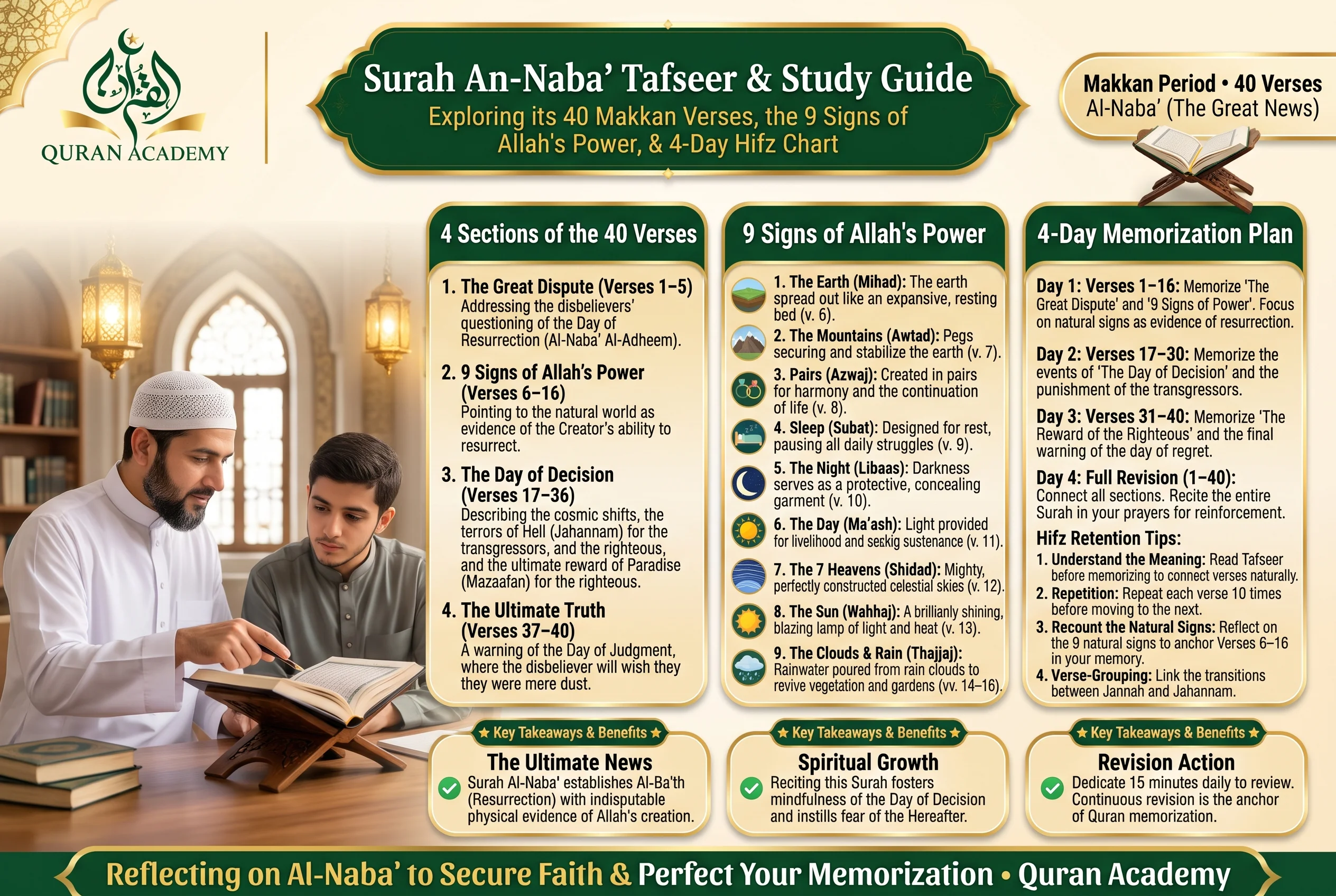
Exploring Surah An Naba Tafseer and benefits (تَفْسِيرُ وَفَضَائِلُ سُورَةِ النَّبَإِ — Chapter 78 of the Holy Quran, the crowning opening Surah of Juz 'Amma [Juz 30] on Pages 582–583 of the Madinah Mushaf) unlocks the grand spiritual theme of the entire final Juz of the Quran: certainty in the Day of Resurrection (Al-Ba'th)! Revealed in Makkah across 40 short, rhythmic verses, Surah An-Naba' opens with the famous rhetorical question that gave Juz 30 its name—عَمَّ يَتَسَاءَلُونَ ﴿١﴾ عَنِ ٱلنَّبَإِ ٱلْعَظِيمِ ﴿٢﴾—and then proves the certainty of the Hereafter through 9 breathtaking cosmic signs (the earth as a cradle, mountains as pegs, human pairs, restorative sleep, night and day, 7 strong heavens, the blazing sun, and life-giving rain) before contrasting the Accountability of Yawm Al-Fasl (The Day of Sorting) with the eternal triumph of the righteous (إِنَّ لِلْمُتَّقِينَ مَفَازًا — 78:31). In our 1-on-1 Online Quran Memorization (Hifz) & Tafseer Program, students memorize all 40 verses of Surah An-Naba' in just 4 days!
- Why Is Juz 30 Called "Juz 'Amma"? Because Surah An-Naba' is the 1st Surah of Juz 30 and opens with the word عَمَّ ('Amma = عَنْ + مَا — "About what?")!
- How Allah Proves Resurrection in Verses 6–16: The One Who created 7 heavens, pinned the earth with mountains, and revives dead soil with rain can resurrect human bodies effortlessly!
- Why Verse 38 Calls Judgment Day "The Day the Spirit (Jibreel AS) Stands": Shows the supreme awe of Allah's Majesty when even the greatest angel and all creation stand in humble silence!
- #1 Surah for Practicing "Madd Al-'Iwad": All 35 verses from Verse 6 to Verse 40 end with a 2-count open Alif on stop!
Whether you started memorizing Juz Amma from the bottom up (beginning with Surah An-Nas [114] and working your way up to 78) or from the top down, reaching Surah An-Naba' (سُورَةُ النَّبَإِ — also known as Surah 'Amma or Surah Al-Mu'sirat) is one of the most exciting milestones in any adult's or child's Hifz journey! It is the longest Surah in Juz Amma by verse flow (40 verses across 1.5 pages) and serves as the grand banner introducing all 37 Surahs of the 30th Juz.
Yet many students memorize its rhythmic -aa verse endings without pausing to marvel at its linguistic and scientific precision: Why did Arabic grammar drop the Alif at the end of عَمَّ in Verse 1? How do the 9 cosmic signs in Verses 6 to 16 prove both Allah's Oneness (Tawheed) and the physical resurrection of our bodies? Why is Accountability in Verse 26 called جَزَاءً وِفَاقًا (An Exact Proportional Recompense) while the reward of Paradise in Verse 36 is called عَطَاءً حِسَابًا (A Boundless Gift Beyond Measure)? Building upon our guides to Surah Al-Mulk and 25 Common Tajweed Mistakes in Salah, this complete guide breaks down the 4 Thematic Sections of Surah An-Naba', the Master Chart of the 9 Cosmic Signs, the 4-Day Hifz Schedule, and 5 Essential Tajweed Rules.
- 1. Overview of Surah An-Naba' & The Quranic Arabic Secret Behind the Word "'Amma" (عَمَّ)!
- 2. Section 1 (Verses 1 to 16): The Great News & Master Chart of the 9 Cosmic Signs of Allah's Power
- 3. Sections 2, 3 & 4 (Verses 17 to 40): Yawm Al-Fasl, "Jaza'an Wifaqa" vs. "'Ata'an Hisaba" & The Final Warning
- 4. 4-Day Hifz Memorization Schedule for Surah An-Naba' (10 Verses/Day!)
- 5. Five Essential Tajweed Rules in Surah An-Naba' (Madd 'Iwad, Ghunnah on 'Amma & Qalqalah!)
- 6. Frequently Asked Questions (FAQs)
1. Overview of Surah An-Naba' & The Quranic Arabic Secret Behind "'Amma" (عَمَّ)!
When Prophet Muhammad (ﷺ) began calling the people of Makkah to Tawheed and warning them of the Day of Resurrection (as we traced in our Prophet Muhammad ﷺ Seerah Timeline), the leaders of Quraysh sat in their gatherings mocking and asking one another in disbelief: "Can decomposed bones really come back to life after we turn to dust?" Allah Almighty revealed Surah An-Naba' to silence their doubts.
Look at two brilliant linguistic gems in Verses 1–2 that connect directly to our Harf Al-Jarr (Arabic Prepositions) Guide:
- 1. Why Is "عَمَّ" Written Without an Alif at the End?
Originally, عَمَّ is two words: the preposition عَنْ ('An = about) + the question particle مَا (Maa = what). First, because Noon Sakinah meets Meem, they merge into a doubled Meem with a 2-beat Ghunnah ('Am-maa). Second, in Arabic grammar, whenever any preposition enters upon interrogative مَا (what?), its final Alif is dropped to distinguish a question from a statement—just like فِيمَ (Fee-ma = in what? — 79:43), بِمَ (Bi-ma = with what?), and لِمَ (Li-ma = for what / why?)! - 2. What Is the Difference Between "Khabar" (خَبَر) and "Naba'" (نَبَأ)?
In classical Arabic, any everyday piece of news (even a small mundane detail) is called a Khabar. A Naba' (نَبَأٌ), however, is ONLY used in the Quran for a momentous, earth-shaking announcement of supreme truth and consequence—and here Allah adds the adjective ٱلْعَظِيمِ (The Tremendous/Great News)!
2. Section 1 (Verses 1 to 16): Master Chart of the 9 Cosmic Signs of Allah's Power
Instead of arguing abstractly with those who denied the Resurrection, Allah Almighty points their eyes to 9 awe-inspiring creations they experience every single day and night (Verses 6–16). Studying these 9 signs in order is the secret to memorizing Verses 6 to 16 in 10 minutes:
| Sign # & Verse | Quranic Phrase & Root Word | Tafseer & Scientific/Spiritual Reflection |
|---|---|---|
| 1. The Earth as a Cradle (Verse 6) |
﴿ أَلَمْ نَجْعَلِ ٱلْأَرْضَ مِهَادًا ﴾ (Al-Arda Mihaadaa) |
From Mahd (a baby's smooth, comfortable cradle)—settled, breathable, and perfectly calibrated for human life! |
| 2. Mountains as Pegs (Verse 7) ⭐ |
﴿ وَٱلْجِبَالَ أَوْتَادًا ﴾ (Wal-Jibaala Awtaadaa) |
Just like tent pegs (Awtad) have deep roots underground to anchor a tent against wind, mountains have deep crustal roots stabilizing the earth's surface! |
| 3. Created in Pairs (Verse 8) |
﴿ وَخَلَقْنَاكُمْ أَزْوَاجًا ﴾ (Wa Khalaqnaakum Azwaajaa) |
Male and female pairs bringing tranquility, family, and continuity of generations (Marriage & Offspring Duas). |
| 4. Sleep as Rest & Renewal (Verse 9) ⭐ |
﴿ وَجَعَلْنَا نَوْمَكُمْ سُبَاتًا ﴾ (Wa Ja'alnaa Nawmakum Subaataa) |
Subaat means cutting off toil and motion to rest the body and mind—and sleep + waking up every morning is a daily miniature rehearsal of death and Resurrection (Bedtime & Waking Duas)! |
| 5 & 6. Night as a Garment & Day for Livelihood (10–11) | ﴿ وَجَعَلْنَا ٱللَّيْلَ لِبَاسًا ﴿١٠﴾ وَجَعَلْنَا ٱلنَّهَارَ مَعَاشًا ﴾ | Night wraps the earth in calm darkness like a soothing garment (Libaasaa), while daytime is lit for seeking halal provision and worship (Ma'aashaa). |
| 7 & 8. Seven Strong Heavens & The Blazing Sun (12–13) | ﴿ وَبَنَيْنَا فَوْقَكُمْ سَبْعًا شِدَادًا ﴿١٢﴾ وَجَعَلْنَا سِرَاجًا وَهَّاجًا ﴾ | Seven vast, unshakeable cosmic layers above us without pillars, and the sun as a radiant lamp combining both intense light and heat (Wahhaajaa)! |
| 9. Rain-Clouds Reviving Dead Earth 🏆 (Verses 14–16) |
﴿ وَأَنزَلْنَا مِنَ ٱلْمُعْصِرَاتِ مَاءً ثَجَّاجًا ﴿١٤﴾ لِّنُخْرِجَ بِهِ حَبًّا وَنَبَاتًا ﴿١٥﴾ وَجَنَّاتٍ أَلْفَافًا ﴾ | Pouring rain from clouds heavy with water (Al-Mu'sirat) brings dead, barren soil to life with grain, plants, and intertwined gardens (Alfaafaa)—proving how easily Allah brings the dead back to life! |
3. Sections 2, 3 & 4 (Verses 17 to 40): Yawm Al-Fasl, "Jaza'an Wifaqa" vs. "'Ata'an Hisaba"
After proving His absolute power through the 9 cosmic signs, Allah Almighty unveils the scenes of the Hereafter across three powerful movements:
- Movement #1 (Verses 17–20 — The Opening of Yawm Al-Fasl):
Why is the Day of Judgment called يَوْمُ ٱلْفَصْلِ (The Day of Sorting / Decisive Judgment)? Because on that appointed day—when the Trumpet is blown and humanity comes forth in crowds (Afwaajaa), the sky opens like gates, and the mighty mountains are set in motion until they become like a mirage (Saraabaa)—Allah will decisively judge between truth and falsehood! - Movement #2 (Verses 21–30 — Justice for the Arrogant vs. Boundless Generosity for the Righteous in 31–36):
Look at one of the most moving Tafseer contrasts in the entire Quran between Verse 26 and Verse 36:
• When describing the punishment of those who denied the Reckoning and rejected Allah's signs (78:26), Allah calls it: ﴿ جَزَاءً وِفَاقًا ﴾ (Jazaa'an Wifaaqaa — "An exact, 1-to-1 proportional recompense!")—meaning Allah never wrongs anyone by even an atom's weight; a sin is only recompensed by its exact equal!
• Contrast that with Verse 36, when Allah describes the Gardens, vineyards, and overflowing cups prepared for the people of Taqwa (إِنَّ لِلْمُتَّقِينَ مَفَازًا — 78:31): He calls it ﴿ جَزَاءً مِّن رَّبِّكَ عَطَاءً حِسَابًا ﴾ (Jazaa'an min Rabbika 'Ataa'an Hisaabaa — "A reward from your Lord, a generous gift beyond abundant measure!")—multiplying every good deed by 10 to 700 times and more! - Movement #3 (Verses 37–40 — The Day of Truth & The Final Call):
On the day when Ar-Ruh (Angel Jibreel AS) and the angels stand in ranks (صَفًّا — 78:38), speaking only by permission of Ar-Rahman and speaking truth (Sawaabaa), Allah extends a warm, merciful invitation to every reader who is still alive today (78:39): ﴿ ذَٰلِكَ ٱلْيَوْمُ ٱلْحَقُّ ۖ فَمَن شَاءَ ٱتَّخَذَ إِلَىٰ رَبِّهِ مَآبًا ﴾—take your pathway of return to your Lord today through prayer, Quran, and repentance before that near Day arrives!
4. 4-Day Hifz Memorization Schedule for Surah An-Naba' (10 Verses/Day!)
Using our 3x3 Memorization Method and our Smart Hifz Planner, you or your child can memorize all 40 verses of Surah An-Naba' in 4 days (just 10 short verses per day, taking 15 minutes after Fajr or Maghrib!):
- 🌟 Day 1 (Verses 1–16 • Page 582): The Opening Question (1–5) + All 9 Cosmic Signs in Order (Earth → Mountains → Pairs → Sleep → Night → Day → 7 Heavens → Sun → Rain & Gardens!).
- 🌟 Day 2 (Verses 17–25 • Page 582): The Day of Sorting (Yawm Al-Fasl: Trumpet + Sky Gates + Moving Mountains) + The Ambush of Jahannam.
- 🌟 Day 3 (Verses 26–34 • Bottom of Page 582 to Top of 583): Jaza'an Wifaqa (26–30) → The Pivot to the Triumph of the Righteous (إِنَّ لِلْمُتَّقِينَ مَفَازًا ﴿٣١﴾ حَدَائِقَ وَأَعْنَابًا...).
- 🌟 Day 4 (Verses 35–40 + Full Surah Review • Page 583): Peace in Paradise (35–36) + The Majesty of Ar-Rahman & The Final Call (37–40), then recite all 40 verses from memory in your next 2 Rak'ahs of Sunnah Salah!
Mastering the Crisp Qalqalah in "Najْ'al", "Khalaqْnaakum", "Sabْ'an" & "Qareebْ"!
Open Surah An-Naba' (Verses 6 to 12) and listen to the rhythmic pulse of the 9 Cosmic Signs: أَلَمْ نَجْعَلِ (Najْ'ali — 78:6), وَخَلَقْنَاكُمْ (Wa Khalaqْnaakum — 78:8), and سَبْعًا شِدَادًا (Sabْ'an — 78:12)! Every single one contains a silent Jeem (جْ), Qaaf (قْ), or Baa (بْ) from the 5 Qalqalah (Echoing) letters (ق ط ب ج د)! Watch Senior Instructor Ustadhah Yasmeen Gamal demonstrate Qalqalah on our Quran Academy YouTube Channel:
Struggling to Perfect Your Recitation?
Join 1,250+ students mastering the Quran 1-on-1 with our Verified Al-Azhar Graduates. Flexible US, UK, Canadian & Australian schedules starting at $8/hr.
Book a Free Evaluation Class →- Heavy Qaaf Bounce Before Light Noon in "Khalaqْnaakum": Never let the Qaaf turn into a Kaaf!
- 1-on-1 Live Hifz Coaching: Memorize Juz Amma with our Al-Azhar scholars!
5. Five Essential Tajweed Rules in Surah An-Naba'
When reciting Surah An-Naba', apply these five Tajweed rules from our 1-on-1 Online Tajweed Course:
- 1. Two-Beat Ghunnah + Zero Alif on the Opening Word "'Amma" (عَمَّ يَتَسَاءَلُونَ — 78:1):
As we mastered in our Meem Sakinah & Mushaddadah Guide and Matn Tuhfat Al-Atfal (Verse 17), hold a full 2-beat nasal Ghunnah on the Meem Mushaddadah of عَمَّ, and then move immediately from the short Fatha of the Meem to the Yaa of يَتَسَاءَلُونَ ('Amm-ma yatasa'aloon)—never stretch 'Amma into an Alif ("'Am-maa" ❌)! - 2. Exact 2-Count "Madd Al-'Iwad" on All 35 Verse Endings (Verses 6 to 40):
Applying our Rules of Madd Guide and Rules of Waqf Guide, every single verse from Verse 6 (مِهَادًا) to Verse 40 (تُرَابًا) ends with a Fathatayn (ـًا). When stopping at the end of the verse, replace the "-an" Tanween sound with a smooth, 2-count Natural Alif Madd (Madd 'Iwad: Mihaadaa, Awtaadaa, Azwaajaa)—neither cutting it short to 1 beat nor over-stretching it to 4 beats! - 3. Four-to-Five Beat Madd Wajib Muttasil Before Stopping on "Maa'an", "Jazaa'an" & "'Ataa'an":
Look at مَاءً (78:14), جَزَاءً (78:26 & 36), and عَطَاءً (78:36): why is there no extra Alif written after the Hamzah in the Uthmani Mushaf? Because in Arabic orthography, a Hamzah preceded by an Alif never sits between two Alifs! When stopping on Jazaa'an or 'Ataa'an, stretch the first Alif for 4 to 5 counts (Madd Wajib Muttasil) and finish with a 2-count Madd 'Iwad after the Hamzah (Jazaaaa'aa / 'Ataaaa'aa)! - 4. Helper Kasrah in "'Anin-Naba'i" (78:2) for Iltiqa' As-Sakinayn:
Using our Iltiqa' As-Sakinayn in Tajweed Guide, notice that in Verse 2 (عَنِ ٱلنَّبَإِ ٱلْعَظِيمِ), the preposition عَنْ takes a helper Kasrah (عَنِ = 'Ani) so it can connect into the Sun Letter Noon of ٱلنَّبَإِ ('Anin-naba'il-'adheem)! - 5. Heavy Raa in "Mirsaadaa" (78:21)!
Following our Ahkam Al-Raa Guide and Matn Al-Jazariyyah, why is the silent Raa in إِنَّ جَهَنَّمَ كَانَتْ مِرْصَادًا (Mirْ-saadaa — 78:21) pronounced 100% Heavy (Tafkhim) even though it comes right after an original Kasrah on the Meem? Because it is one of the 5 famous Quranic words where a silent Raa is followed in the same word by an un-kasrated Isti'laa' letter (صَ in مِرْصَادًا!)! Also review our guides on Makharij al-Huruf, Sifaat al-Huruf, Heavy & Light Letters, Noon Sakinah Rules, Laam Shamsiyyah & Qamariyyah, Hamzatul Wasl vs. Qat', 4 Special Words of Hafs, 7 Alifs in the Quran, Idgham Pairs, 10 Qira'at, Hafs vs. Warsh, Lahn Jali vs. Lahn Khafi, An-Nabr (Vocal Stress), and 15 Sajdah Tilawah Verses, and test your skills on our Free 3-Minute Tajweed Quiz!
Continue your Juz Amma and Quranic journey across our interconnected library: Surah Al-Qadr, Surah Al-'Alaq, Surah Ad-Duha, Juz Tabarak 30-Day Plan, 12 Duas for Seeking Knowledge & Memory, 50 Most Common Arabic Roots, and Singular, Dual & Plural! Meet our Al-Azhar Certified Tutors, enroll your child in our 1-on-1 Kids Quran Classes with our Printable Kids Star Chart (and Online Hadith Explorer), and read how families across the US, UK, Canada, and Australia rate our teachers on our Verified Student & Parent Reviews Page.
6. Frequently Asked Questions (FAQs) About Surah An-Naba'
1. What does "An-Naba' Al-'Adheem" (النبأ العظيم) mean in Surah An-Naba' (78:2)?
According to classical Tafseer scholars (such as Qatadah, Mujahid, and Imam Ibn Kathir), "An-Naba' Al-'Adheem" (The Great News) refers primarily to the Day of Resurrection (Yawm Al-Qiyamah) and the Quran itself which announces it—about which the disbelievers of Quraysh were disputing and questioning one another in disbelief.
2. Why is the first word of Surah An-Naba' written as "عَمَّ" ('Amma) without an Alif?
In Quranic Arabic grammar, "عَمَّ" ('Amma — "About what?") is formed by combining the preposition "عَنْ" ('An = about) with the interrogative particle "مَا" (Maa = what). First, the Noon of 'An merges into the Meem of Maa with Idgham Bighunnah ('Am-maa), and second, Arabic grammar always drops the final Alif of interrogative "Maa" whenever a preposition enters upon it—giving us "عَمَّ" (and giving Juz 30 its famous name: Juz 'Amma)!
3. What are the 9 cosmic signs of Allah's power in Surah An-Naba' (Verses 6–16)?
To prove that the Creator of the universe can easily resurrect humanity, Allah presents 9 magnificent signs in Verses 6–16: (1) The Earth as a resting cradle (Mihaadaa), (2) The Mountains as stabilizing pegs (Awtaadaa), (3) Creating humanity in pairs (Azwaajaa), (4) Making sleep a means of rest and renewal (Subaataa), (5) Making the night a covering garment (Libaasaa), (6) Making the day for livelihood (Ma'aashaa), (7) Building 7 mighty heavens above us (Shidaadaa), (8) Placing the sun as a blazing, glowing lamp (Siraajan Wahhaajaa), and (9) Sending down abundant rain from rain-clouds to bring forth grain, plants, and lush gardens!
4. How can adults and children memorize all 40 verses of Surah An-Naba' in 4 days?
Because Surah An-Naba' consists of 40 short, rhythmic verses spanning just 1.5 pages of the Madinah Mushaf (Pages 582–583), it divides naturally into 4 thematic blocks of 10 verses per day: Day 1 (Verses 1–16: The Great News & 9 Cosmic Signs), Day 2 (Verses 17–25: The Opening of Yawm Al-Fasl), Day 3 (Verses 26–34: Warning & Beginning of Paradise), and Day 4 (Verses 35–40: The Triumph of the Muttaqeen & Final Day of Truth)!
5. What is the main verse-ending Tajweed rule across Surah An-Naba'?
Out of the 40 verses of Surah An-Naba', 35 verses (every single verse from Verse 6 to Verse 40!) end with a Fathatayn (ـًا) on an Alif—making Surah An-Naba' the ultimate Quranic practice ground for "Madd Al-'Iwad" (stopping on a Fathatayn by replacing the Tanween sound with a smooth, 2-count open Alif Madd, such as Mihaadaa, Awtaadaa, and Turaabaa)!
Memorize Surah An-Naba' & All of Juz Amma With an Al-Azhar Scholar!
Master every Surah of Juz Amma with deep Tafseer understanding, rock-solid Hifz retention, and authentic Tajweed in personalized 1-on-1 classes for adults and kids. Book your free diagnostic trial session today!
Book Your Free 1-on-1 Trial Class →