
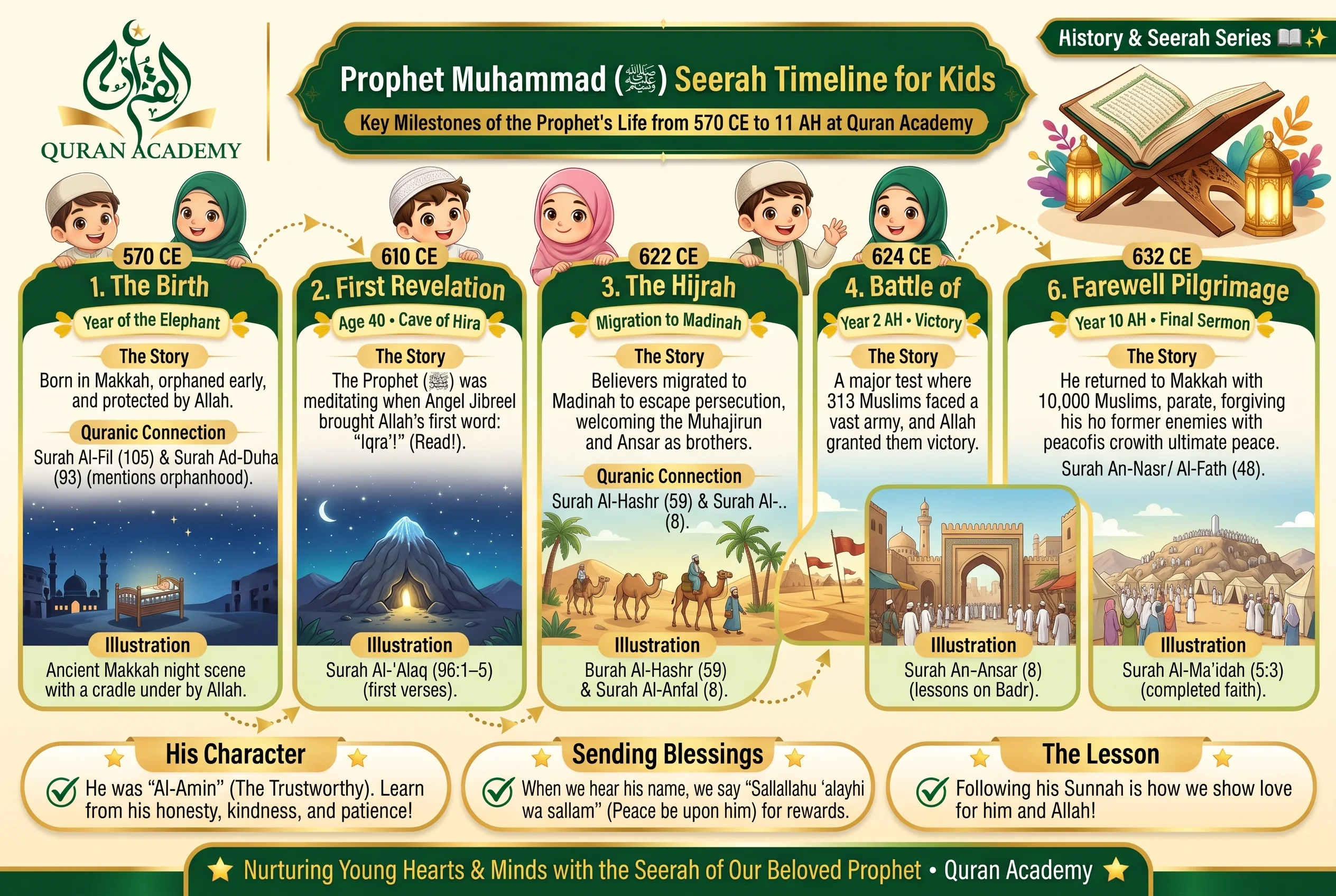
✦ Quick Answer & Key Takeaways: Prophet Muhammad Seerah Timeline for Kids
Teaching the Prophet Muhammad Seerah timeline for kids (السِّيرَةُ النَّبَوِيَّةُ لِلْأَطْفَالِ: مِنْ مَكَّةَ إِلَى الْمَدِينَةِ) plants deep, unshakeable love for the Messenger of Allah (ﷺ) in your child's heart while making the Surahs of the Noble Quran come alive in their daily prayers! Using the golden "40 – 13 – 10 Rule" recorded in Sahih al-Bukhari (3851) and Sahih Muslim (2351), children can easily memorize all 63 lunar years of his blessed life across three crystal-clear chapters: (1) 40 Years Before Revelation in Makkah (570–610 CE)—from his miraculous birth in the Year of the Elephant (Surah Al-Fil 105) and his childhood in the desert of Banu Sa'd to becoming universally revered as As-Sadiq Al-Amin (The Truthful, The Trustworthy); (2) 13 Years of Prophethood in Makkah (610–622 CE)—from the first revelation of Surah Al-'Alaq in Cave Hira, the patience of the early believers, and the Night Journey (Al-Isra' wal-Mi'raj) to the Hijrah via Cave Thawr; and (3) 10 Years in Madinah (1–11 AH / 622–632 CE)—building Al-Masjid An-Nabawi, establishing brotherhood, defending faith, opening Makkah with unmatched forgiveness, and delivering the Farewell Sermon! In our 1-on-1 Online Kids Islamic Studies, Seerah & Quran Program and our specialized Online Seerah Course, certified Al-Azhar scholars connect every Seerah milestone directly to the Quran!
- Why Did the Salaf Say "We Taught Our Kids the Seerah Like a Surah of the Quran"? Because a Muslim child growing up in the West who knows how the Prophet (ﷺ) lived, smiled, helped his family, stood up for truth, forgave enemies, and worshipped Allah has a real-life hero to imitate every single day (Surah Al-Ahzab 33:21)!
- The "40 + 13 + 10 = 63 Years" Memory Formula: 40 years before Prophethood in Makkah + 13 years of Prophethood in Makkah + 10 years in Madinah = 63 blessed lunar years!
- The 7 Children of the Prophet (ﷺ): 3 sons (Al-Qasim, 'Abdullah [At-Tayyib/At-Tahir], and Ibrahim) and 4 noble daughters (Zaynab, Ruqayyah, Umm Kulthum, and Fatimah Az-Zahra' RA).
- Age-by-Age Western Parenting Roadmap: Includes tailored storytelling methods for toddlers & preschoolers (ages 4–6), elementary schoolers (ages 7–10), and middle/high school teens (ages 11–16).
- Every Event Matches a Juz Amma or Famous Surah: Pair each historical milestone below with the exact Surahs your child is already memorizing and reciting in Salah!
In Surah Al-Ahzab (33:21), Allah Almighty gave every Muslim parent, teenager, and young child the ultimate role model for all times and places: لَّقَدْ كَانَ لَكُمْ فِي رَسُولِ ٱللَّهِ أُسْوَةٌ حَسَنَةٌ لِّمَن كَانَ يَرْجُواْ ٱللَّهَ وَٱلْيَوْمَ ٱلْآخِرَ وَذَكَرَ ٱللَّهَ كَثِيرًا ("There has certainly been for you in the Messenger of Allah an excellent pattern of conduct for anyone whose hope is in Allah and the Last Day and who remembers Allah often!"). And the noble Successor 'Ali ibn Al-Husayn (Zayn Al-'Abidin, may Allah be pleased with him) described how the Companions raised their children: « كُنَّا نُعَلَّمُ مَغَازِيَ النَّبِيِّ ﷺ وَسَرَايَاهُ كَمَا نُعَلَّمُ السُّورَةَ مِنَ الْقُرْآنِ » ("We used to be taught the Seerah and expeditions of the Prophet ﷺ just as we were taught a Surah from the Quran!"). Likewise, Sa'd ibn Abi Waqqas (RA), one of the ten promised Paradise, used to gather his children and say: "O my children, memorize the Seerah of your Prophet (ﷺ) and do not ever forget it, for it is the honor of your forefathers and your greatest legacy!"
Yet many Muslim parents living in the United States, the United Kingdom, Canada, and Australia ask us a deeply practical question: "In a world filled with fictional superheroes, cartoons, and social media influencers, how do I teach the biography of Prophet Muhammad (ﷺ) to my children in an exciting, chronological timeline so they genuinely love him, remember the order of events, and never confuse Cave Hira with Cave Thawr, or the Makkan Surahs with the Madinan Surahs?"
Building upon our foundational guides to The 25 Prophets in the Quran, The 4 Stories of Surah Al-Kahf for Kids, and The Story of Musa & Al-Khidr, this comprehensive Pillar Guide breaks the Prophet's (ﷺ) blessed life into 3 Visual Timeline Tables (The 40 – 13 – 10 Rule), narrates the heart-touching details behind every turning point, maps out his noble family tree and daily character (Shama'il), connects every event to its matching Quranic Surah, and highlights 4 Essential Tajweed Rules in the Quranic verses about the Prophet (ﷺ).
🎯 Age-by-Age Guide: How to Teach This Seerah Timeline at Home
- Toddlers & Young Kids (Ages 4–6): Focus on sensory bedtime stories—the elephants stopping before the Ka'bah (Surah Al-Fil), baby Muhammad (ﷺ) bringing barakah to Halimah's sheep in the desert, his gentle love for cats, birds, and children, and repeating "Sallallahu 'alayhi wa sallam" whenever his blessed name is mentioned (see our Bedtime Quran Stories & Short Surahs Course for Ages 4–6).
- Elementary Kids (Ages 7–10): Introduce the "40 – 13 – 10 Timeline Formula", the difference between Cave Hira and Cave Thawr, how he earned the title As-Sadiq Al-Amin before Prophethood, and how each Surah in Juz Amma connects to a real event in Makkah or Madinah (paired with our Tafseer for Kids & Teens Course).
- Pre-Teens & High Schoolers (Ages 11–16): Explore how the Prophet (ﷺ) handled peer pressure, bullying in Makkah, emotional grief during the Year of Sorrow, strategic peacemaking at Hudaybiyyah, and mercy during the Conquest of Makkah—empowering Western Muslim youth with unshakeable confidence (explore our Weekend Quran & Islamic Identity Classes for Busy Teens).
- 1. Part 1 (Ages 0 to 40 • 570–610 CE): From the Year of the Elephant to "As-Sadiq Al-Amin"
- 2. Part 2 (Ages 40 to 53 • 610–622 CE): The 13 Makkan Years (Cave Hira, Isra' & Mi'raj, and Cave Thawr!)
- 3. Part 3 (Ages 53 to 63 • 1–11 AH): The 10 Madinan Years (From Masjid Nabawi to the Farewell Pilgrimage)
- 4. Quick Kids Quiz Card: Cave Hira vs. Cave Thawr, The Prophet's (ﷺ) Family Tree & Daily Sunnahs
- 5. Four Essential Tajweed Rules in the Famous Seerah Verses of the Quran
- 6. Frequently Asked Questions (FAQs) About Teaching the Seerah to Kids
1. Part 1 (Ages 0 to 40 • 570–610 CE): From the Year of the Elephant to "As-Sadiq Al-Amin"
Before Angel Jibreel (AS) brought down the very first word of the Quran, Allah Almighty prepared His beloved Messenger (ﷺ) across 40 pure, sinless years in Makkah. Why did Allah wait until he was 40 years old to send revelation? So that every single man, woman, merchant, and tribal elder in Quraysh would personally witness four decades of his spotless honesty, modesty, courage, and wisdom—leaving them with zero excuse to ever accuse him of lying when he called them to worship Allah alone! Trace these 10 foundational milestones of the first 40 years with your child:
| Age & Year | Seerah Milestone for Kids | Matching Quran Surah & Character Lesson |
|---|---|---|
| 1. Birth (Age 0) Rabi' Al-Awwal, 570 CE |
Born in Makkah on Monday in the Year of the Elephant (عَامُ الْفِيلِ)! Just 50 days after Allah protected the Ka'bah from Abraha's army of elephants, he was born in Makkah. His father 'Abdullah ibn 'Abdil-Muttalib had passed away in Madinah before his birth, and his overjoyed grandfather 'Abdul-Muttalib carried him into the Ka'bah, thanked Allah, and named him Muhammad (مُحَمَّدٌ — The Praised One), while his mother Aminah bint Wahb named him Ahmad (أَحْمَدُ)! |
Surah Al-Fil (105:1–5), Surah As-Saff (61:6) & Surah Ad-Duha (93:6: "Did He not find you an orphan and give you shelter?")! |
| 2. Ages 0 – 2 (570–572 CE) |
Desert Barakah With Halimah As-Sa'diyyah in Banu Sa'd: Following Arab custom, he was entrusted to foster-mother Halimah As-Sa'diyyah in the pure desert of Banu Sa'd so he would grow up strong and master the most eloquent classical Arabic. The moment Halimah took him, her slow donkey outran the caravan, and her dry flock gave abundant milk! |
Gratitude to Allah and respect for caregivers & teachers. |
| 3. Age 4 (574 CE) |
The Miraculous Opening of the Chest (شَقُّ الصَّدْرِ): While playing with his foster-brother behind the tents of Banu Sa'd, Angel Jibreel (AS) came down, opened his chest without pain, washed his blessed heart with Zamzam water in a golden basin of wisdom and faith, and removed the tiny clot that Satan whispers to—protecting him forever (Sahih Muslim 162). |
Surah Ash-Sharh (94:1): أَلَمْ نَشْرَحْ لَكَ صَدْرَكَ ("Did We not expand for you your breast?"). |
| 4. Ages 6 & 8 (576 & 578 CE) |
Passing of His Mother Aminah (Age 6 at Al-Abwa') & Grandfather 'Abdul-Muttalib (Age 8): Returning from visiting family in Madinah with his faithful nursemaid Umm Ayman (Barakah RA), his mother Aminah passed away at age 6; two years later his grandfather passed away, and his loving uncle Abu Talib raised him ahead of his own children. |
Teaches children deep empathy and mercy toward orphans (Sahih al-Bukhari 5304)! |
| 5. Ages 10 – 15 (580–585 CE) |
Shepherding Sheep in the Valleys of Makkah: To help his uncle Abu Talib financially, young Muhammad (ﷺ) worked as a shepherd tending sheep on the hillsides of Makkah. He later told his Companions: "Allah never sent any Prophet except that he shepherded sheep... I used to shepherd them for the people of Makkah for a few Qirats (coins)" (Sahih al-Bukhari 2262). |
Patience, humility, gentle leadership, and never looking down on honest work. |
| 6. Age 20 (590 CE) |
The Alliance of the Virtuous (حِلْفُ الْفُضُولِ — Hilf Al-Fudul): After a visiting Yemeni merchant was cheated out of his goods in Makkah, the noblest leaders gathered at the house of 'Abdullah ibn Jud'an and swore a solemn pact to defend any oppressed person in Makkah until their right was restored. Even in Madinah years later, the Prophet (ﷺ) praised this pledge of justice! |
Standing up against bullying and injustice at school and in the community (Surah An-Nisa 4:135). |
| 7. Ages 20 – 25 (590–595 CE) |
Earning the Title "As-Sadiq Al-Amin" & Trading Journey With Maysarah: Never once bowing to an idol, drinking wine, or speaking a lie, everyone in Makkah called him As-Sadiq (The Truthful) and Al-Amin (The Trustworthy). When he led Khadijah's (RA) trade caravan to Syria with her servant Maysarah, his honesty doubled the profits! |
Why telling the truth and keeping promises is the #1 mark of a believer. |
| 8. Age 25 (595 CE) |
Blessed Marriage to Mother of the Believers Khadijah bint Khuwaylid (RA): Impressed by his noble character, pure speech, and trustworthiness, the respected noblewoman Khadijah (RA) married him. For 25 years she was his sole wife, his closest confidante, his greatest supporter, and the mother of 6 of his 7 children! |
Surah Ad-Duha (93:8) & Surah Al-Qalam (68:4: "And indeed, you are of a great moral character")! |
| 9. Age 35 🏆 (605 CE) |
Rebuilding the Ka'bah & The Black Stone (الْحَجَرُ الْأَسْوَدُ) Peacemaking Miracle: When floodwaters weakened the walls of the Ka'bah, the tribes of Quraysh rebuilt it together—until they nearly drew swords over which tribe would have the honor of placing the Black Stone! They agreed that the next man to enter the Haram gate would judge; when Muhammad (ﷺ) walked in, they shouted: "This is Al-Amin! We accept his judgment!" He spread his cloak (Rida'), placed the Black Stone in the center, had a chief from every tribe lift a corner together, and placed it into the corner of the Ka'bah with his own blessed hands! |
Brilliant problem-solving, teamwork, and uniting hearts without conflict! |
| 10. Ages 37 – 40 (607–610 CE) |
True Dreams (الرُّؤْيَا الصَّالِحَةُ) & Spiritual Retreats in Cave Hira: For 6 months prior to revelation, every dream he saw came true like the bright break of dawn (Bukhari 3). Rejecting the idols of Makkah, he climbed Jabal An-Noor during Ramadan to reflect upon the Creator of the heavens and earth in Cave Hira and feed the poor who visited him. |
Taking quiet time away from screens to reflect on Allah's creation (Tafakkur). |
💡 Parent-Child Dinner Table Discussion for Part 1: Ask your child: "Why did the chiefs of Quraysh immediately put away their swords and smile when they saw Prophet Muhammad (ﷺ) walk through the gate at age 35?" Because for 35 straight years, he had never cheated, lied, or broken a promise! When your classmates and teachers at school know that you always speak the truth because you follow Prophet Muhammad (ﷺ), you carry the legacy of As-Sadiq Al-Amin wherever you go.
2. Part 2 (Ages 40 to 53 • 610–622 CE): The 13 Makkan Years (From Cave Hira to Cave Thawr!)
When Prophet Muhammad (ﷺ) reached the age of 40, on a blessed Monday night during Laylatul-Qadr in the month of Ramadan (August 610 CE), heavenly light illuminated Cave Hira (غَارُ حِرَاءٍ) high atop Jabal An-Noor as Angel Jibreel (AS) descended with the very first five verses of the Quran! Why did the Makkan period last 13 full years before the Muslims migrated to Madinah? To build rock-solid Tawheed (belief in the Oneness of Allah), patience under hardship, and moral character! Trace the 8 major milestones of the 13 Makkan years below:
| Makkan Year & Age | Key Seerah Event in Makkah | Matching Quran Surah & Kids Lesson |
|---|---|---|
| 1. Year 1 (Age 40) Ramadan 610 CE |
First Revelation in Cave Hira & The First 4 Believers in Islam: Angel Jibreel (AS) embraced him three times and revealed: ٱقْرَأْ بِٱسْمِ رَبِّكَ ٱلَّذِي خَلَقَ! When he returned home trembling, saying "Zammilooni, Zammilooni (Cover me, cover me)!", Khadijah (RA) comforted him with her immortal words: "Never! By Allah, Allah will never disgrace you; for you keep ties of kinship, speak the truth, carry the burdens of the weak, honor the guest, and help those in distress!" (Bukhari 3). The first 4 believers were: Khadijah (RA), Abu Bakr As-Siddiq (RA), 10-year-old 'Ali ibn Abi Talib (RA), and Zayd ibn Harithah (RA)! |
Surah Al-'Alaq (96:1–5), Surah Al-Muzzammil (73) & Surah Al-Muddaththir (74:1–7)! |
| 2. Years 1 – 3 (Ages 40–43) |
3 Years of Private Call & The School of Dar Al-Arqam (دَارُ الْأَرْقَمِ): For the first 3 years, the Prophet (ﷺ) invited trustworthy individuals privately and gathered the early Companions—including young youths like Al-Arqam ibn Abi Al-Arqam (16 years old), Sa'd ibn Abi Waqqas (17), Mus'ab ibn 'Umayr, and Bilal ibn Rabah (RA)—at Dar Al-Arqam near Mount Safa to learn the Quran and pray together. |
Choosing righteous friends and building a strong foundation of knowledge. |
| 3. Year 4 (Age 43 • 613 CE) |
Public Call on Mount Safa & Patience Under Persecution: When Allah revealed فَٱصْدَعْ بِمَا تُؤْمَرُ ("Then declare publicly what you are commanded" — 15:94), the Prophet (ﷺ) stood on Mount Safa and asked Quraysh: "If I told you there was an army behind this mountain, would you believe me?" They answered: "Yes, we have never experienced anything from you except truth!" Despite fierce persecution against Bilal, 'Ammar, Yasir, and Sumayyah (RA), the believers stood firm: "Ahadun Ahad (One, One)!" |
Surah Al-Hijr (15:94), Surah Al-Masad (111) & Surah Al-Kafirun (109). |
| 4. Years 5 & 6 (Ages 45–46) |
Migration to Abyssinia (Najashi) & Islam of Hamzah & 'Umar (RA): To protect persecuted believers, the Prophet (ﷺ) sent them to Abyssinia (Ethiopia), where Ja'far ibn Abi Talib (RA) recited Surah Maryam before the just Christian King Ashamah An-Najashi until the king and his bishops wept and granted them safety! In Year 6, the Prophet's dua was answered when both Hamzah ibn 'Abdil-Muttalib (RA) and 'Umar ibn Al-Khattab (RA — after reading the opening verses of Surah Ta-Ha!) embraced Islam! |
Surah Maryam (19:1–36) & Surah Ta-Ha (20:1–14)! |
| 5. Years 7 – 10 (Ages 47–50) |
The 3-Year Boycott in Shi'b Abi Talib & The Year of Sorrow (عَامُ الْحُزْنِ): Quraysh boycotted Banu Hashim in a mountain valley for 3 years until Allah sent termites to eat the unjust parchment except His Name! Soon after, in Year 10, both beloved Khadijah (RA) and uncle Abu Talib passed away within weeks of each other, and Allah comforted His Messenger's heart by revealing the stories of the Prophets in Surah Yusuf and Surah Hud. |
Surah Yusuf (12) — how Quranic stories heal grief and sadness. |
| 6. Year 10 (Age 50 • 619 CE) |
The Journey to Ta'if, Unmatched Mercy & The Believing Jinn: Walking 60 miles uphill to Ta'if with Zayd ibn Harithah (RA), he was pelted with stones until his blessed sandals filled with blood. When the Angel of the Mountains offered to fold the two mountains over the city, the Mercy to the Worlds (ﷺ) forgave them and said: "No! Rather, I hope that Allah will bring forth from their descendants people who worship Allah alone without associating anything with Him!" (Bukhari 3231). On his return, both the Christian youth 'Addas (from Nineveh, the city of Prophet Yunus AS!) and a group of Jinn at Nakhlah embraced Islam! |
Surah Al-Anbiya (21:107), Surah Al-Ahqaf (46:29–32) & Surah Al-Jinn (72)! |
| 7. Years 10 – 12 (Ages 50–52) |
Al-Isra' wal-Mi'raj (The Night Journey) & The Two Pledges of 'Aqabah: After the heartbreak of Ta'if, Allah honored His Messenger (ﷺ) with the miraculous Night Journey on Al-Buraq from Al-Masjid Al-Haram in Makkah to Al-Masjid Al-Aqsa in Jerusalem—where he led all the Prophets in prayer—followed by the Ascension (Al-Mi'raj) through the seven heavens, gifting the Ummah the 5 Daily Prayers (equal in reward to 50!) and the Last 2 Verses of Surah Al-Baqarah! Meanwhile, pilgrims from Yathrib (Madinah) pledged allegiance at 'Aqabah, and the Prophet (ﷺ) sent young ambassador Mus'ab ibn 'Umayr (RA), whose gentle Quran recitation brought Islam into every home in Madinah! |
Surah Al-Isra (17:1), Surah An-Najm (53:1–18) & Al-Baqarah (2:285–286)! |
| 8. Year 13 (Age 53) 🏆 622 CE (1 AH) |
The Hijrah (Migration) to Madinah & The Miracle of Cave Thawr (غَارُ ثَوْرٍ): Even when Quraysh plotted to harm him, he left brave young 'Ali ibn Abi Talib (RA) in his bed to return every single valuable deposit and trust to its owner in Makkah! Then the Prophet (ﷺ) and Abu Bakr As-Siddiq (RA) walked south to Cave Thawr for 3 nights (helped by young 'Abdullah and Asma' bint Abi Bakr RA — Dhat An-Nitaqayn!). When trackers stood right at the mouth of the cave, the Prophet (ﷺ) whispered to Abu Bakr: « مَا ظَنُّكَ يا أَبَا بَكْرٍ بِاثْنَيْنِ اللَّهُ ثَالِثُهُمَا؟ لَا تَحْزَنْ إِنَّ ٱللَّهَ مَعَنَا » ("What do you think, O Abu Bakr, of two when Allah is their third? Do not grieve; indeed Allah is with us!" — 9:40)! |
Surah At-Tawbah (9:40), Surah Al-Anfal (8:30) & Surah Ya-Sin (36:9)! |
💡 Parent-Child Reflection for Part 2: Point out to your child how youths and children were heroes of the Hijrah: 'Ali ibn Abi Talib (RA) bravely slept in the Prophet's bed to return people's trusts; Asma' bint Abi Bakr (RA) tore her waistband in two (earning the title Dhat An-Nitaqayn) to carry food secretly to Cave Thawr; her brother 'Abdullah ibn Abi Bakr (RA) brought news by night; and 'Amir ibn Fuhayrah (RA) guided his flock of sheep over their footprints! Every Muslim child and teen has an essential role in serving Islam.
3. Part 3 (Ages 53 to 63 • 1–11 AH): The 10 Madinan Years (Building the Ummah!)
When the Prophet's (ﷺ) noble she-camel Al-Qaswa' entered Yathrib—forever after known as Al-Madinah Al-Munawwarah (The Radiant City)—the young girls and children of Banu An-Najjar sang with joy, and the families of the Ansar competed for the honor of hosting him until his camel knelt at the blessed site belonging to two orphan boys, Sahl and Suhayl, which he purchased to build his Mosque! Over the next 10 transformative years in Madinah (1–11 AH / 622–632 CE), Allah revealed the Madinan Surahs teaching community laws, family harmony, worship, and peace. Trace the 8 milestones of the 10 Madinan years with your child:
| Hijri Year (AH) | Key Seerah Event in Madinah | Matching Quran Surah & Kids Lesson |
|---|---|---|
| 1. Year 1 AH (622 CE) Age 53 |
Masjid Quba, Masjid Nabawi, Brotherhood (الْمُؤَاخَاةُ), The Adhan & Covenant of Madinah: Built the very first mosque in Islam founded on piety (Masjid Quba), built Al-Masjid An-Nabawi carrying mud bricks with his own blessed hands alongside the Companions, paired every Muhajir from Makkah with an Ansari brother in Madinah (such as 'Abdur-Rahman ibn 'Awf and Sa'd ibn Ar-Rabi' RA) in unmatched generosity, instituted the Adhan called by Bilal ibn Rabah (RA), and drafted the Charter of Madinah guaranteeing justice and religious freedom! |
Surah At-Tawbah (9:108) & Surah Al-Hashr (59:9: preferring their brothers over themselves even when in need!). |
| 2. Year 2 AH (624 CE) Ages 54 – 55 |
Change of Qiblah to the Ka'bah, Fasting Ramadan, Zakat & The Day of Badr: After 16 months of praying toward Masjid Al-Aqsa in Jerusalem, Allah answered the Prophet's prayer by turning the Qiblah toward the Ka'bah in Makkah! In the same year, Allah legislated Ramadan fasting, Zakat al-Fitr, and Salat Al-Eid, and granted miraculous victory to 313 believers on the 17th of Ramadan at Badr—where the Prophet (ﷺ) freed literate captives as soon as each taught 10 Muslim children in Madinah how to read and write! |
Surah Al-Baqarah (2:144 & 183–185) & Surah Al-Anfal (8:9–19) — Islam's love for literacy and education! |
| 3. Year 3 AH (625 CE) Age 56 |
The Lesson of Mount Uhud & Following the Prophet's (ﷺ) Instructions: At Mount Uhud north of Madinah, the Muslims initially prevailed until the archers on Jabal Ar-Rumah left their posts early thinking the battle was over. Though the Prophet (ﷺ) was injured and beloved uncle Hamzah (RA) was martyred, Allah comforted the believers, forgave them, and taught every generation that true success lies in obeying Allah and His Messenger in every command! |
Surah Al 'Imran (3:121–180) — resilience after mistakes and consulting others gently (3:159). |
| 4. Year 5 AH (627 CE) Age 58 |
The Trench (غَزْوَةُ الْخَنْدَقِ / الْأَحْزَابِ) & Salman Al-Farisi's (RA) Brilliant Idea: When 10,000 confederates marched on Madinah, the Prophet (ﷺ) welcomed the creative suggestion of Persian Companion Salman Al-Farisi (RA) to dig a wide defensive trench north of Madinah. Tying a stone to his stomach from hunger in the freezing cold, the Prophet (ﷺ) dug alongside his Companions, struck sparks from a giant boulder promising the opening of Persia and Rome, and Allah sent a fierce wind and angels that sent the armies home without a battle! |
Surah Al-Ahzab (33:9–27) — valuing creative teamwork and trusting Allah's promise! |
| 5. Year 6 AH (628 CE) Age 59 |
Pledge of Ridwan Under the Tree & The Peace Treaty of Hudaybiyyah: Marching peacefully in Ihram with 1,400 Companions to perform 'Umrah, the Prophet (ﷺ) took the Pledge of Ridwan (بَيْعَةُ الرِّضْوَانِ) under the acacia tree and signed the 10-year Peace Treaty of Hudaybiyyah. Though its terms looked difficult at first, Allah named it a "Clear Victory" (فَتْحًا مُّبِينًا)—because in just two years of peace, more people entered Islam than in all the previous 19 years combined! |
Surah Al-Fath (48:1–29) — why peace, patience, and long-term wisdom triumph over anger. |
| 6. Year 7 AH (629 CE) Age 60 |
Letters to World Kings & Leaders, Khaybar & The Fulfilled 'Umrah: During the peace of Hudaybiyyah, the Prophet (ﷺ) sent polite diplomatic letters stamped with his silver ring (مُحَمَّدٌ رَسُولُ اللَّهِ) to Emperor Heraclius of Rome, Khosrow of Persia, Al-Muqawqis of Egypt, and King Najashi of Abyssinia, inviting the world to Islam, and peacefully performed the make-up 'Umrah ('Umrat Al-Qada') in Makkah! |
Surah Al 'Imran (3:64) — polite dialogue and global outreach. |
| 7. Year 8 AH (630 CE) Age 61 |
The Peaceful Opening of Makkah (فَتْحُ مَكَّةَ) & Supreme Forgiveness: After Quraysh broke the treaty of Hudaybiyyah, the Prophet (ﷺ) entered Makkah peacefully with 10,000 Companions, bowing his head so low in gratitude and humility to Allah that his blessed beard nearly touched his camel's saddle while reciting Surah Al-Fath! After cleansing the Ka'bah of 360 idols, he asked Quraysh what they expected him to do, and forgave them all using Prophet Yusuf's (AS) words: « لَا تَثْرِيبَ عَلَيْكُمُ الْيَوْمَ ۖ اذْهَبُوا فَأَنْتُمُ الطُّلَقَاءُ » ("No blame upon you today; go, for you are all free!")! |
Surah An-Nasr (110:1–3) & Surah Al-Isra (17:81)! |
| 8. Years 9–11 AH 🏆 (630–632 CE • Age 63) |
Year of Delegations (9 AH), The Farewell Pilgrimage (حَجَّةُ الْوَدَاعِ — 10 AH) & Completion of the Message (11 AH): Tribes from across Arabia flocked to Madinah in Year 9 AH to embrace Islam. In Dhul-Hijjah 10 AH, the Prophet (ﷺ) delivered his historic Farewell Sermon at Mount 'Arafah before 100,000+ Companions—declaring that no Arab is superior to a non-Arab and no white person to a Black person except by piety (Taqwa)! In Ramadan 10 AH, he reviewed the entire Quran twice with Angel Jibreel (AS), and on Monday 12 Rabi' Al-Awwal 11 AH (June 632 CE) at age 63, he returned to the Highest Companion (Ar-Rafeeq Al-A'laa), leaving us upon the clear path of the Quran and Sunnah! |
Surah Al-Ma'idah (5:3: "Today I have perfected your religion for you!") & Surah Al-Hujurat (49:13). |
4. Quick Kids Quiz Card: Cave Hira vs. Cave Thawr, The Prophet's (ﷺ) Noble Family & Daily Character
In our 1-on-1 Kids Islamic Studies Classes and Online Weekend Islamic School, one of our favorite interactive games is helping children distinguish the two famous caves in Makkah, memorize the Prophet's (ﷺ) blessed children, and practice his gentle manners with kids:
- ⛰️ 1. Cave Hira (غَارُ حِرَاءٍ — on Jabal An-Noor, North-East of Makkah): Where the Makkan period BEGAN at Age 40 in Ramadan when Angel Jibreel (AS) revealed the first 5 verses of "Iqra'" (Surah Al-'Alaq 96:1–5) while the Prophet (ﷺ) was alone reflecting on Allah's creation!
- ⛰️ 2. Cave Thawr (غَارُ ثَوْرٍ — on Jabal Thawr, South of Makkah): Where the Makkan period ENDED at Age 53 during the Hijrah with his closest Companion Abu Bakr As-Siddiq (RA), when Allah revealed: إِذْ هُمَا فِي ٱلْغَارِ إِذْ يَقُولُ لِصَاحِبِهِۦ لَا تَحْزَنْ إِنَّ ٱللَّهَ مَعَنَا (Surah At-Tawbah 9:40)!
- 👨👩👧👦 3. The 7 Blessed Children of Prophet Muhammad (ﷺ): Tell your child that six of his children were born to Mother of the Believers Khadijah bint Khuwaylid (RA), and his youngest son was born in Madinah to Mariyah Al-Qibtiyyah (RA):
• His 3 Sons (who all passed away in early childhood): 1. Al-Qasim (from whom he took his Kunyah Abu Al-Qasim), 2. 'Abdullah (also titled At-Tayyib and At-Tahir because he was born after Prophethood—and when he passed away and an enemy mocked the Prophet ﷺ, Allah revealed Surah Al-Kawthar 108:1–3!), and 3. Ibrahim (born in Madinah in 8 AH).
• His 4 Noble Daughters (who all embraced Islam and migrated to Madinah): 1. Zaynab (RA), 2. Ruqayyah (RA), 3. Umm Kulthum (RA), and his youngest beloved daughter 4. Fatimah Az-Zahra' (RA)—mother of Al-Hasan and Al-Husayn (RA), the leaders of the youth of Paradise!
| Prophetic Habit With Kids (Shama'il) | Authentic Hadith Story for Children | How Your Child Can Practice This Sunnah Today |
|---|---|---|
| 1. Saying Salam First to Children | Whenever Prophet Muhammad (ﷺ) walked past children playing in the streets of Madinah, he would smile warmly and greet them first with "Assalamu Alaikum!" (Sahih al-Bukhari 6247 & Sahih Muslim 2168). | Be the first to smile and say Assalamu Alaikum to parents, siblings, and younger kids! |
| 2. Never Scolding a Child Helper | Young Anas ibn Malik (RA) served the Prophet (ﷺ) from age 10 to age 20 and testified: "I served the Prophet ﷺ for ten years, and he never once said 'Uff!' to me, nor asked 'Why did you do this?' or 'Why didn't you do that?'" (Bukhari 6038). | Speak gently to younger brothers and sisters and forgive honest mistakes at home. |
| 3. Comforting a Child's Sadness | When Anas's little brother Abu 'Umayr (RA) was heartbroken because his pet sparrow (Nughayr) died, the Prophet (ﷺ) visited him to cheer him up and gently joked: « يَا أَبَا عُمَيْرٍ، مَا فَعَلَ النُّغَيْرُ؟ » ("O Abu 'Umayr, what happened to the little sparrow?") (Bukhari 6129). | Care about your friend's or sibling's feelings and show kindness to all animals! |
| 4. Patience With Grandchildren in Salah | When little Al-Hasan or Al-Husayn (RA) climbed onto his back during prostration (Sujud), he prolonged his Sujud peacefully so he would not rush or drop the child, and he held baby Umamah bint Zaynab (RA) while praying (Sunan An-Nasa'i 1141 & Bukhari 516). | Love the mosque and make prayer time peaceful and welcoming for the whole family. |
Mastering the Very First Word Revealed in Cave Hira: The Qalqalah of "Iqْra'ْ" (96:1)!
Think about the very first word Angel Jibreel (AS) spoke to Prophet Muhammad (ﷺ) in Cave Hira: ٱقْرَأْ بِٱسْمِ رَبِّكَ ٱلَّذِي خَلَقَ (Iqْra' bismi Rabbikal-ladhee khalaqْ — 96:1)—and the Conquest of Makkah verse in Surah An-Nasr (110:3): فَسَبِّحْ بِحَمْدِ رَبِّكَ وَٱسْتَغْفِرْهُ ۚ إِنَّهُۥ كَانَ تَوَّابًا (Taw-waabaa)! In Iqْra', the silent Qaaf (قْ) is the strongest of the 5 Qalqalah (Echoing) letters (ق ط ب ج د)! Watch Senior Instructor Ustadhah Yasmeen Gamal demonstrate Qalqalah on our Quran Academy YouTube Channel:
Struggling to perfect your Recitation?
Join hundreds of students mastering the Quran with our Verified Al-Azhar Graduates. We offer flexible 1-on-1 sessions tailored to your schedule.
Book a Free Evaluation Class →- Sughra on "Iqْra'" + Kubra on "Khalaqْ": Teach your child how the first verse of revelation begins and ends with Qalqalah!
- 1-on-1 Live Kids Coaching: Learn Seerah, Quran & Tajweed with Al-Azhar scholars!
5. Four Essential Tajweed Rules in the Famous Seerah Verses of the Quran
Open our Online Uthmani Quran Explorer with your child and practice these four Tajweed rules from our 1-on-1 Online Tajweed Course across the 4 occurrences of the blessed name مُحَمَّدٌ (Muhammad ﷺ) in the Quran (3:144, 33:40, 47:2, and 48:29) and the Cave Thawr verse (9:40):
- 1. Holding the 2-Beat Nasal Ghunnah on the Meem Mushaddadah of "Muhammad" (مُّحَمَّدٌ):
As we mastered in our Meem Sakinah & Mushaddadah Guide, in all 4 verses where Allah mentions His Messenger by name—Surah Al 'Imran (3:144), Surah Al-Ahzab (33:40), Surah Muhammad (47:2), and مُّحَمَّدٌ رَّسُولُ ٱللَّهِ (Surah Al-Fath 48:29)—you must hold a full, loving 2-beat nasal Ghunnah on the doubled Meem (مَّ)! Then, in 48:29, merge the Dammatayn on the Dal into the Raa of Rasoolullaah with complete Idgham Bila Ghunnah (Muhammmadur-Rasoolullaah) while keeping the Raa heavy (Mufakhkhamah)! - 2. Why Do We Pause (or Not Pause) in the Cave Thawr Verse (Surah At-Tawbah 9:40)?
Applying our Rules of Waqf (Stopping) in the Quran Guide, in إِذْ يَقُولُ لِصَاحِبِهِۦ لَا تَحْزَنْ إِنَّ ٱللَّهَ مَعَنَا ۖ فَأَنزَلَ ٱللَّهُ سَكِينَتَهُۥ عَلَيْهِ, notice the Al-Waqf Al-Awlaa (صلى) stop sign after مَعَنَا: why do scholars of Waqf recommend pausing on Inna Allaaha ma'anaa before reading Fa-anzalallaahu sakeenatahu 'alayhi? So the listener clearly hears the completion of the Prophet's (ﷺ) comforting words to Abu Bakr (RA) inside the cave before the narrative shifts to Allah sending down His divine tranquility! - 3. Whispering the Khaa' & Taa and Testing All 3 Meem Sakinah Rules in Surah Al-Fil (105:1–5):
Using our Sifaat al-Huruf and Meem Sakinah guides, in Surah Al-Fil (which tells the story of the year the Prophet ﷺ was born!), notice how Verses 1, 2, 4, and 5 test all 3 Meem Sakinah rules in 15 seconds: أَلَمْ تَرَ / أَلَمْ يَجْعَلْ / كَيْدَهُمْ فِي (Izhar Shafawi — close the lips cleanly with zero extra hold!) vs. تَرْمِيهِم بِحِجَارَةٍ (Ikhfaa' Shafawi before Baa' with a 2-beat nasal Ghunnah!) vs. فَجَعَلَهُمْ كَعَصْفٍ مَّأْكُولٍ (Izhar Shafawi on -hum + Idgham Bighunnah on 'Asfim-Ma'kool!). - 4. Applying Nabr & Madd Rules in the Salawat Verse (Surah Al-Ahzab 33:56):
Following our Rules of Madd, Makharij al-Huruf, Heavy & Light Letters, Noon Sakinah Rules, Ahkam Al-Raa, Laam Shamsiyyah & Qamariyyah, Hamzatul Wasl vs. Qat', 4 Special Words of Hafs, 7 Alifs in the Quran, Idgham Mutamathilayn, Mutajanisayn & Mutaqaribayn, 10 Qira'at, Lahn Jali vs. Lahn Khafi, An-Nabr (Vocal Stress), and 15 Sajdah Tilawah Verses guides, in إِنَّ ٱللَّهَ وَمَلَائِكَتَهُۥ يُصَلُّونَ عَلَى ٱلنَّبِيِّ ۚ يَا أَيُّهَا ٱلَّذِينَ آمَنُواْ صَلُّواْ عَلَيْهِ وَسَلِّمُواْ تَسْلِيمًا (33:56), if you stop on ٱلنَّبِيِّ (An-Nabiyyّْ), apply Position #1 of An-Nabr on the doubled Yaa, and end the verse with a clean 2-count Madd 'Iwad on تَسْلِيمًا (Tasleemaa)! Test your family's Tajweed skills right now on our Free 3-Minute Tajweed Quiz!
Connect this Seerah timeline with our complete library of Quranic Arabic, Surah, and Fiqh guides: 50 Most Common Arabic Roots, Arabic Pronouns Chart (featuring Idh humaa fil-ghaar in 9:40!), Harf Al-Jarr Prepositions, Singular, Dual & Plural, Verbs in Quranic Arabic, How to Memorize Juz Tabarak, Surah Nuh, 99 Names of Allah, 30-Day Quran Khatmah Schedule, 15 Etiquettes of Reading the Quran, and Traveler's Prayer in our Online Hifz Program (using our Smart Hifz Planner and Online Hadith Explorer)! Meet our Al-Azhar Certified Tutors and read how parents across the US, UK, Canada, and Australia rate our teachers on our Verified Student & Parent Reviews Page.
6. Frequently Asked Questions (FAQs) About Prophet Muhammad's (ﷺ) Seerah Timeline for Kids
1. What is the "40 – 13 – 10 Rule" for memorizing Prophet Muhammad's (ﷺ) 63-year Seerah timeline?
Based on authentic narrations in Sahih al-Bukhari (3548 & 3851), the easiest way for children and adults to remember all 63 lunar years of Prophet Muhammad's (ﷺ) blessed life is the "40 – 13 – 10 Formula": (1) 40 Years Before Prophethood in Makkah (570–610 CE, growing up pure and earning the title As-Sadiq Al-Amin), (2) 13 Years of Prophethood in Makkah (610–622 CE, calling to Tawheed, enduring persecution with patience, and experiencing Al-Isra' wal-Mi'raj), and (3) 10 Years in Madinah after the Hijrah (1–11 AH / 622–632 CE, building the Islamic society, opening Makkah peacefully, and completing the religion).
2. What is the full lineage and family tree of Prophet Muhammad (ﷺ) that every Muslim child should know?
Every Muslim child should memorize his noble lineage up to 'Adnan: Muhammad ibn 'Abdillah ibn 'Abdil-Muttalib ibn Hashim ibn 'Abdi Manaf ibn Qusayy ibn Kilab (from the clan of Banu Hashim of the noble tribe of Quraysh, descending from Prophet Isma'il and Prophet Ibrahim, peace be upon them). His mother was Aminah bint Wahb, his loving foster-mother in the desert of Banu Sa'd was Halimah As-Sa'diyyah, his lifelong nursemaid was Umm Ayman (Barakah RA), and he was cared for by his grandfather 'Abdul-Muttalib and then his uncle Abu Talib.
3. Which Surahs of the Quran match the key events of the Seerah timeline for kids?
You can teach the entire Seerah through the Surahs your child already recites: (1) Surah Al-Fil (105) = His birth in the Year of the Elephant (570 CE), (2) Surah Ad-Duha (93) & Surah Ash-Sharh (94) = His orphanhood and the opening of his chest, (3) Surah Al-'Alaq (96:1–5) = First Revelation in Cave Hira at Age 40, (4) Surah Al-Muzzammil (73) & Al-Muddaththir (74) = Beginning of the Call, (5) Surah Al-Isra (17) & An-Najm (53) = The Night Journey & 5 Daily Prayers, (6) Surah At-Tawbah (9:40) = Cave Thawr & Hijrah, (7) Surah Al-Fath (48) = Treaty of Hudaybiyyah, and (8) Surah An-Nasr (110) = The Conquest of Makkah & Farewell!
4. Who were the first 4 people to embrace Islam at the beginning of the Makkan period?
The very first four believers in Islam—beautifully representing women, men, children, and freedmen—were: (1) Mother of the Believers Khadijah bint Khuwaylid (RA — the very first person on earth to believe and comfort the Prophet ﷺ), (2) Abu Bakr As-Siddiq (RA — the first free adult man to accept Islam without hesitation), (3) 'Ali ibn Abi Talib (RA — the first child, aged only 10 years old), and (4) Zayd ibn Harithah (RA — his freedman and beloved member of his household).
5. What were the first 3 actions Prophet Muhammad (ﷺ) took upon arriving in Madinah?
Upon arriving in Madinah in 1 AH (622 CE) after establishing Masjid Quba on the outskirts, Prophet Muhammad (ﷺ) built the foundations of the Muslim community through 3 immediate actions: (1) Building Al-Masjid An-Nabawi (The Prophet's Mosque) as a center of prayer, education, and fellowship, (2) Establishing Brotherhood (Al-Mu'akhah) pairing every Muhajir from Makkah with an Ansari brother in Madinah, and (3) Drafting the Covenant of Madinah (Sahifat Al-Madinah) for peaceful citizenship, mutual defense, and justice.
6. What is the difference between a Makkan Surah and a Madinan Surah for kids?
Scholars define Makkan Surahs (السُّوَرُ الْمَكِّيَّةُ — 86 Surahs) as every Surah revealed before the Hijrah to Madinah (during the 13 Makkan years), which usually have short, powerful verses focusing on Tawheed, the Day of Judgment, Jannah, and stories of earlier Prophets (like most of Juz Amma). Madinan Surahs (السُّوَرُ الْمَدَنِيَّةُ — 28 Surahs) are every Surah revealed after the Hijrah (during the 10 Madinan years), which feature longer verses teaching practical worship, fasting, charity, family life, and social justice (like Surah Al-Baqarah and Surah Al 'Imran).
7. How many times is Prophet Muhammad (ﷺ) mentioned by name in the Quran?
The blessed name Muhammad (مُحَمَّدٌ) is mentioned explicitly 4 times in the Noble Quran: in Surah Al 'Imran (3:144), Surah Al-Ahzab (33:40 — as Khatam An-Nabiyyin, the Seal of the Prophets), Surah Muhammad (47:2), and Surah Al-Fath (48:29); and he is mentioned once by his name Ahmad (أَحْمَدُ) in Surah As-Saff (61:6).
8. What is the best age to start teaching the Seerah of Prophet Muhammad (ﷺ) to children?
You can begin introducing the love of Prophet Muhammad (ﷺ) as early as ages 3 to 4 through 5-minute bedtime stories about the Year of the Elephant, his kindness to animals and children, and daily Sunnah Duas. Between ages 7 and 12, children are ready to learn the structured 40 – 13 – 10 chronological timeline alongside their Juz Amma memorization and Tafseer.
Raise Your Children on the Love of the Prophet (ﷺ) & the Quran!
Give your child a joyful, inspiring Islamic identity with live 1-on-1 Quran, Tajweed, Hifz, and Seerah classes taught by caring male and female Al-Azhar scholars. Book your free trial session today!
Book Your Child's Free 1-on-1 Trial Class →