
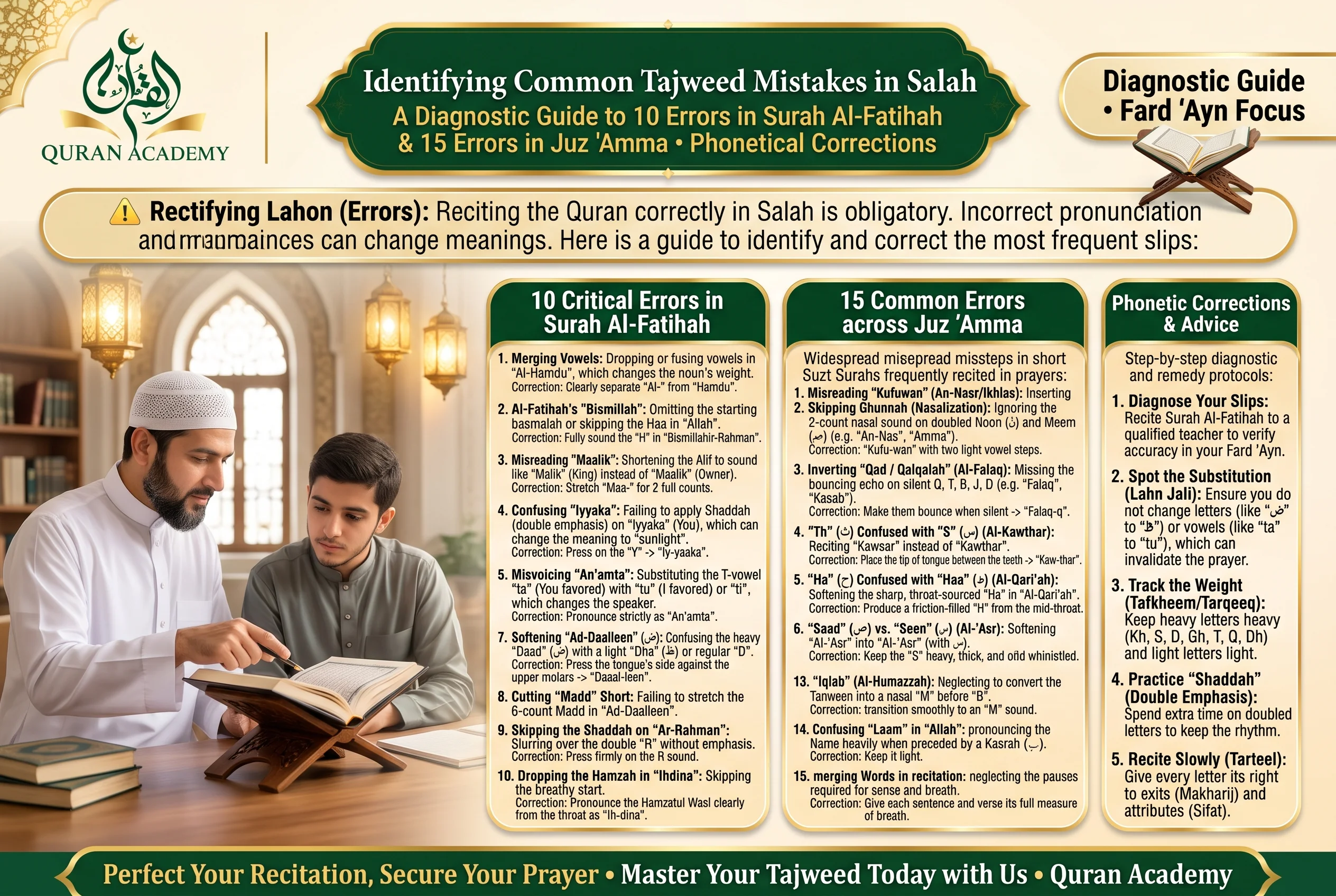
✦ Quick Answer & Key Takeaways: 25 Common Tajweed Mistakes in Salah
Identifying and fixing common Tajweed mistakes in Salah (الأَخْطَاءُ الشَّائِعَةُ فِي تِلَاوَةِ الفَاتِحَةِ وَقِصَارِ السُّوَرِ فِي الصَّلَاةِ) is one of the highest-reward steps any Muslim can take—because you recite Surah Al-Fatihah at least 17 times every single day in your obligatory prayers (and over 30 times with the 12 Sunnah Rawatib and Witr)! As we established in our Lahn Jali vs. Lahn Khafi Guide and Matn Al-Jazariyyah, errors in prayer fall into two categories: (1) Major Vowel, Shaddah & Letter Substitutions (Lahn Jali) that change the meaning of Allah's words (like misreading the vowel of An'amta or dropping the Shaddah of Iyyaaka), and (2) Subtle Phonetic Habits (Lahn Khafi) like bouncing non-Qalqalah silent letters, rushing 6-beat Madd Lazim, or mixing heavy and light letters in Al-Mustaqeem. In our 1-on-1 Online Tajweed Course, our Al-Azhar scholars conduct a live diagnostic check of your Salah Surahs in your very first free trial session!
- Part 1 (Mistakes #1 to #10): The 10 most frequent errors inside Surah Al-Fatihah—including the 3 Shaddahs that must never be dropped (Ar-Rahmaan, Iyyaaka, and Walaad-Daaalleen)!
- Part 2 (Mistakes #11 to #18): The 8 classic traps inside The 3 Quls (Al-Ikhlas, Al-Falaq, An-Nas) and Surah Al-Masad!
- Part 3 (Mistakes #19 to #25): The 7 hidden errors in Al-Kawthar, Al-Kafirun, An-Nasr, Al-'Asr, Al-Ma'un, and Quraysh!
- Instant Fix Method: Pair every mistake below with its exact tongue/lip drill from our 17 Makharij and Sifaat al-Huruf guides!
Most Muslims learned to recite Surah Al-Fatihah and the 10 Shortest Surahs of Juz Amma when they were five or six years old—long before they ever studied the articulation points of the throat and tongue or the rules of Matn Tuhfat Al-Atfal. Because those childhood muscle-memory habits are repeated thousands of times on autopilot during silent and loud prayers, even advanced students are often surprised during their first 1-on-1 evaluation with an Al-Azhar teacher when the teacher gently points out three or four subtle errors hiding inside their recitation of Al-Fatihah or Al-Ikhlas!
The good news? Once your ear and tongue become aware of a habit, fixing it takes less than five minutes of focused practice! Below, we organize all 25 Common Tajweed Mistakes in Salah into three diagnostic tables—covering Surah Al-Fatihah (#1–#10), The 3 Quls & Al-Masad (#11–#18), and The Short Surahs of Juz Amma (#19–#25)—showing you the exact mistake, why it happens, and the instant phonetic fix.
- 1. Part 1 (Mistakes #1 to #10): The 10 Most Common Tajweed Mistakes in Surah Al-Fatihah
- 2. Part 2 (Mistakes #11 to #18): Eight Common Mistakes in the 3 Quls (Al-Ikhlas, Al-Falaq, An-Nas) & Al-Masad
- 3. Part 3 (Mistakes #19 to #25): Seven Common Mistakes in Al-Kawthar, Al-Kafirun, An-Nasr, Al-'Asr & Quraysh
- 4. The 5-Minute Daily Salah Recitation Self-Audit (For Adults & Kids!)
- 5. Frequently Asked Questions (FAQs)
1. Part 1 (Mistakes #1 to #10): The 10 Most Common Tajweed Mistakes in Surah Al-Fatihah
Open Surah Al-Fatihah in our Online Uthmani Quran Explorer and audit your recitation from Verse 1 to Verse 7 against these 10 frequent mistakes:
| # & Word in Al-Fatihah | The Common Mistake ❌ (And Error Type) | The Instant Phonetic Fix ✅ |
|---|---|---|
| 1. بِسْمِ ٱللَّهِ (1:1) (Bismi-llaahi) |
Dropping the Kasrah of Baa (saying "Bas-millaah") or turning the whispered Seen (سْ) into a buzzing Zay ("Biz-millaah") ❌. | Lower your jaw for a crisp Kasrah on بِـ (Bi-), and keep your vocal cords un-vibrated with pure breath (Hams) on سْ (Bismi)! |
| 2. ٱلْحَمْدُ لِلَّهِ (1:2) (Al-Hamdu lillaahi) |
Pronouncing a chesty هـ (Al-Hamdu with Haa') instead of middle-throat ح, or bouncing the silent Laam and Meem ("Al-a-ham-a-du") ❌. | Articulate حَ cleanly from the middle throat (Wasatul-Halq), and hold لْ and مْ smoothly with Tawassut! |
| 3. رَبِّ ٱلْعَالَمِينَ (1:2) (Rabbil-'Aalameen) |
Replacing the deep middle-throat ع ('Ayn) with a Hamzah ("Al-Aalameen") or rushing the Shaddah on the Baa of رَبِّ ❌ (Lahn Jali). | Press the epiglottis back gently for a resonant عَا ('Aa-), and hold the doubled Baa of رَبِّ (Rab-bi) firmly! |
| 4. ٱلرَّحْمَٰنِ ٱلرَّحِيمِ (1:3) (Ar-Rahmaanir-Raheem) |
Making the heavy Raa (رَّ) sound like an English "R" or trilling it multiple times (Takreer) ❌. | Touch the tip of your tongue to the alveolar ridge ONCE while elevating the back of the tongue for a rich, single-tap heavy رَّ! |
| 5. إِيَّاكَ نَعْبُدُ (1:5) 🏆 (Iyyaaka Na'budu) |
Softening the Shaddah on the Yaa (reading "Iyaaka", which changes the meaning!) or stretching the Damma of Na'budu into a Waw ("Na'budoo wa...") ❌ (Major Lahn Jali!). | Apply firm Nabr (vocal stress) on the doubled Yaa (Iy-yaaka), and move immediately from the short Damma of دُ to the Waw of وَإِيَّاكَ! |
| 6. ٱهْدِنَا ٱلصِّرَاطَ (1:6) (Ihdinas-Siraata) |
Bouncing the silent Haa' of ٱهْدِنَا ("Ih-i-dinaa") or reading ٱلصِّرَاطَ with a light Seen ("As-Siraata") instead of heavy Saad (صِّ) ❌. | Let breath flow softly through the silent هْـ (Rakhawah + Hams), and elevate your tongue for the heavy velarized صِّ! |
| 7. ٱلْمُسْتَقِيمَ (1:6) (Al-Mustaqeem) |
Turning the light تَ (Ta) into a heavy طَ (Taa') because of the heavy Qaaf after it ("Al-Mustaqeem" with ط ❌), or turning the قِ into a light كِ! | Smile on the light سْـتَ (Mus-ta-), and only elevate the back of the tongue when you reach قِ (-qeem) (Heavy & Light Letters Rule)! |
| 8. أَنْعَمْتَ عَلَيْهِمْ (1:7) 🏆 (An'amta 'Alayhim) |
(a) Changing the Fatha of تَ (-ta = You) to -tu (I) or -ti (Invalidates Salah if deliberate!), or (b) Bouncing the silent Noon and Meem ("An-a-'am-a-ta") ❌. | Hold crisp Izhar Halqi on نْ and Izhar Shafawi on مْ without bouncing, and open your jaw clearly for the Fatha on تَ (Anْ'amْ-TA)! |
| 9. ٱلْمَغْضُوبِ (1:7) (Al-Maghdoobi) |
Bouncing the silent Ghayn ("Al-Magh-a-doobi"), turning Ghayn into Qaaf, or pronouncing ضُ as a Dal or Dhaa' ❌. | Let the silent upper-throat غْ flow smoothly (Rakhawah) directly into the molar ضُ (Al-Maghْ-doobi)! |
| 10. وَلَا ٱلضَّالِّينَ (1:7) ⭐ (Walad-Daaalleen) |
Stretching the Alif for only 2 or 3 counts instead of 6 obligatory counts (Madd Lazim), or dropping the Shaddah on the Laam (لِّ) ❌. | Articulate the molar ضَّ, stretch the Alif for a full 6 counts, and press with Nabr into the doubled Laam (لِّ)! |
2. Part 2 (Mistakes #11 to #18): Eight Common Mistakes in the 3 Quls & Surah Al-Masad
Next to Surah Al-Fatihah, the Three Quls (Surahs Al-Ikhlas, Al-Falaq, and An-Nas) are the most frequently recited Surahs in daily Salah, Witr, and Morning/Evening Adhkar. Check these 8 classic mistakes:
| # & Verse in Juz Amma | The Common Mistake ❌ | The Instant Phonetic Fix ✅ |
|---|---|---|
| 11. قُلْ هُوَ ٱللَّهُ أَحَدٌ (112:1) (Surah Al-Ikhlas) |
Swallowing the silent Laam of قُلْ before Huwa, or stopping on أَحَدْ / ٱلصَّمَدْ without a Qalqalah bounce ❌. | Touch your tongue tip firmly to the gums for the Laam of قُلْ هُوَ (Qulْ huwa), and bounce the final Dal with Qalqalah Kubra! |
| 12. لَمْ يَلِدْ وَلَمْ يُولَدْ (112:3) (Surah Al-Ikhlas) |
Stretching the Fatha of Yalid into an Alif ("Yaa-lid") or failing to bounce the mid-line Dal of يَلِدْ ❌. | Keep يَ (Ya-) to 1 short count in Yalidْ, vs. 2 full counts on the Waw of يُولَدْ (Yoo-ladْ)! |
| 13. كُفُوًا أَحَدٌ (112:4) 🏆 (Kufuwan Ahad) |
Silencing the Faa with a Sukoon (reading "Kufْ-wan" ❌ instead of كُفُوًا) or hiding the Tanween before Ahad! | Round your lips for a clear Damma on BOTH the Kaaf and the Faa (Ku-fu-wanْ Ahadْ), with crisp Izhar Halqi before the Hamzah! |
| 14. وَمِن شَرِّ غَاسِقٍ إِذَا وَقَبَ (113:3) (Surah Al-Falaq) |
Doing Ikhfaa' on غَاسِقٍ إِذَا instead of Izhar, or stopping on وَقَبْ / حَسَدْ / عُقَدْ with a weak whisper instead of Qalqalah ❌. | Because إِذَا starts with a throat Hamzah, pronounce غَاسِقٍ إِذَا (Ghaasiqinْ idhaa) with clear Izhar Halqi, and bounce every verse-ending! |
| 15. وَمِن شَرِّ ٱلنَّفَّاثَاتِ (113:4) (An-Naffaathaati) |
Rushing the 2-beat Ghunnah on ٱلنَّـ, or pronouncing the two interdental ث (Thaa) letters as "S" ("An-Naffaasaati") ❌ (Lahn Jali). | Hold 2 beats of Ghunnah on ٱلنَّـ, and place your tongue tip gently between your front teeth for both ثَا and ثِ! |
| 16. مِن شَرِّ ٱلْوَسْوَاسِ ٱلْخَنَّاسِ (114:4) (Surah An-Nas) |
Turning the whispered Seen of ٱلْوَسْوَاسِ into a heavy Saad, or skipping the 2-beat Ghunnah on ٱلْخَنَّاسِ / ٱلْجِنَّةِ / ٱلنَّاسِ ❌. | Surah An-Nas is the #1 Noon Mushaddadah (نّ) workout in the Quran—hold every single نّ for 2 full beats of nasal Ghunnah! |
| 17. يُوَسْوِسُ فِي صُدُورِ ٱلنَّاسِ (114:5) (Yuwaswisu Fee Sudoorin-Naas) |
Turning the light Dal of صُدُورِ into a heavy Daad ("Sudoor" with ض ❌) because it sits right after a heavy Saad! | Elevate your tongue on صُ (Su-), then immediately drop your tongue for a 100% Light Dal: دُو (-dohee-ri)! |
| 18. تَبَّتْ يَدَا أَبِي لَهَبٍ وَتَبَّ (111:1) (Surah Al-Masad) |
Stopping on وَتَبّْ / كَسَبْ / حَطَبْ with a weak single Baa instead of pressing with Nabr & Qalqalah Akbar on وَتَبّْ ❌. | On وَتَبَّ (Wa Tabbّْ), the final Baa has a Shaddah—hold the lip closure briefly with Nabr, then release a powerful Qalqalah Akbar bounce! |
3. Part 3 (Mistakes #19 to #25): Seven Common Mistakes in Al-Kawthar, Al-Kafirun, An-Nasr, Al-'Asr & Quraysh
Complete your Salah recitation audit by checking these 7 common mistakes across the remaining short Surahs of Juz Amma:
| # & Verse in Juz Amma | The Common Mistake ❌ | The Instant Phonetic Fix ✅ |
|---|---|---|
| 19. إِنَّا أَعْطَيْنَاكَ ٱلْكَوْثَرَ (108:1) (Surah Al-Kawthar) |
Turning the deep عْ ('Ayn) of A'taynaaka into a Hamzah, or making the Raa of ٱلْكَوْثَرْ / وَٱنْحَرْ / ٱلْأَبْتَرْ light ❌. | Articulate عْ from the middle throat, and pronounce all 3 verse-ending Raas in Surah Al-Kawthar 100% Heavy (Tafkhim)! |
| 20. فَصَلِّ لِرَبِّكَ وَٱنْحَرْ (108:2) 🏆 (Fa-salli li-Rabbika wanhar) |
Stretching the short Kasrah of the command verb فَصَلِّ into a 2-count Yaa (reading "Fa-sallee" ❌, which is feminine!) or hiding the Noon of وَٱنْحَرْ! | Keep فَصَلِّ (Fa-salli) to 1 crisp count on the Kasrah: Fa-salli-li-Rabbika, and read وَٱنْحَرْ (Wanْ-harْ) with clear Izhar Halqi before ح! |
| 21. وَلَا أَنَا۠ عَابِدٌ مَّا عَبَدتُّمْ (109:4) (Surah Al-Kafirun) |
(a) Stretching the oval-zero Alif of أَنَا۠ in continuation ("Wa laa anaa 'aabidun" ❌), or (b) Bouncing the Dal in عَبَدتُّمْ! | Drop the Oval-Zero Alif of Ana when continuing (Wa laaa ana 'aabidum-maa...), and merge the Dal of عَبَدتُّمْ ('Abat-tum) 100% into the Taa! |
| 22. لَكُمْ دِينُكُمْ وَلِيَ دِينِ (109:6) (Wa liya Deen) |
Silencing the Yaa of وَلِيَ (reading "Wa lee deen" ❌) instead of pronouncing the Fatha on the Yaa! | Pronounce a clear Fatha on the Yaa: Wa li-YA deenْ! |
| 23. فَسَبِّحْ بِحَمْدِ رَبِّكَ وَٱسْتَغْفِرْهُ (110:3) (Surah An-Nasr) |
Making the silent Raa of وَٱسْتَغْفِرْهُ heavy, or failing to press with Nabr on the Waw of تَوَّابًا ❌. | Because the Raa in وَٱسْتَغْفِرْهُ (Wastaghfirْ-hu) is preceded by an original Kasrah on the Faa, pronounce it 100% Light (Tarqeeq)! |
| 24. وَٱلْعَصْرِ ﴿١﴾ إِنَّ ٱلْإِنسَانَ لَفِي خُسْرٍ (103:1–2) (Surah Al-'Asr) |
Dropping the whispered whistle (Safeer & Rakhawah) of صْ and سْ when stopping on وَٱلْعَصْرْ and خُسْرْ ❌. | Let the air flow through the silent صْ and سْ first, then elevate the tip of your tongue for the heavy final رْ! |
| 25. لِإِيلَافِ قُرَيْشٍ ﴿١﴾ إِيلَافِهِمْ (106:1–2) (Surah Quraysh) |
Skipping the 2-count Yaa Madd at the start of Verse 2 (reading "Ilafihim" instead of إِيلَافِهِمْ = Ee-laafihim) ❌. | Look at the tiny miniature Yaa (إِىلَٰفِهِمْ) after the Hamzah in Verse 2—stretch it for a full 2 counts (Madd Badal: Ee-laafihim)! |
4. The 5-Minute Daily Salah Recitation Self-Audit (For Adults & Kids!)
Want to permanently upgrade your daily prayers this week? Follow this simple 3-step Al-Azhar diagnostic routine:
- Step 1 (Record Yourself Reciting Surah Al-Fatihah & Al-Ikhlas on Your Phone): Recite at your normal prayer speed, then listen back while checking Mistakes #1 to #13 in the tables above!
- Step 2 (Pause at Every Verse-Ending — Sunan Abu Dawud 4001): As Mother of the Believers Umm Salamah (RA) taught, pausing calmly at the end of every single verse in Surah Al-Fatihah immediately eliminates 80% of rushed vowel mistakes!
- Step 3 (Recite Live to a Certified Teacher — Talaqqi): Because our own ears get used to our own voice, reciting Surah Al-Fatihah and Juz Amma live to one of our Al-Azhar Certified Tutors catches subtle tongue placements in minutes!
Rule #1 for Bouncing in Salah: Bounce ONLY "Qutb Jadd" (ق ط ب ج د) & Never Bounce Noon, Laam, or Meem!
Notice how 6 of the 25 mistakes in the tables above come down to one golden rule: beginners accidentally bounce silent non-Qalqalah letters (like نْ، مْ، لْ، غْ، هـْ in An'amta and Al-Maghdoobi) while forgetting to bounce the true 5 Qalqalah letters (ق ط ب ج د) in Al-Ikhlas and Al-Falaq! Watch Senior Instructor Ustadhah Yasmeen Gamal demonstrate true Qalqalah on our Quran Academy YouTube Channel:
Struggling to Perfect Your Recitation?
Join 1,250+ students mastering the Quran 1-on-1 with our Verified Al-Azhar Graduates. Flexible US, UK, Canadian & Australian schedules starting at $8/hr.
Book a Free Evaluation Class →- Crisp Qalqalah on ق ط ب ج د Only: Keep all other 24 letters free of accidental bounces!
- 1-on-1 Live Salah Audit: Perfect your Al-Fatihah & Juz Amma with Al-Azhar scholars!
With this guide, we have completed all 5 Advanced & Applied Tajweed Guides of Day 1 of Matrix 5 (Articles 126 to 130)—connecting Iltiqa' As-Sakinayn, Matn Tuhfat Al-Atfal, Matn Al-Jazariyyah, and Hafs vs. Warsh Differences with our complete library: Rules of Madd, Noon Sakinah Rules, Meem Sakinah Rules, Rules of Waqf, Ahkam Al-Raa, Laam Shamsiyyah & Qamariyyah, Hamzatul Wasl vs. Qat', 4 Special Words of Hafs, Idgham Mutamathilayn, Mutajanisayn & Mutaqaribayn, 10 Qira'at, 15 Sajdah Tilawah Verses, 12 Duas for Seeking Knowledge & Memory, and 15 Duas for Parents, Marriage & Offspring in our Online Hifz Program (using our Smart Hifz Planner, Interactive Tajweed Encyclopedia, and Online Hadith Explorer)! Enroll your child in our 1-on-1 Kids Quran Classes with our Printable Kids Star Chart, and read how families across the US, UK, Canada, and Australia rate our teachers on our Verified Student & Parent Reviews Page.
5. Frequently Asked Questions (FAQs) About Common Tajweed Mistakes in Salah
1. Which Tajweed mistakes in Surah Al-Fatihah are serious enough to affect the validity of Salah?
Jurists across the 4 Sunni Madhhabs explain that Lahn Jali (Clear Errors) in Surah Al-Fatihah that alter the meaning or drop a mandatory letter/Shaddah affect prayer validity if done deliberately or without effort to learn: such as changing the Fatha of "An'am-ta" ("You bestowed favor") to a Damma ("An'am-tu" = "I bestowed favor") or Kasrah ("An'am-ti"), dropping the Shaddah on the Yaa of "Iyyaaka" (which changes "You alone" to "sunlight"), or replacing Haa' in "Al-Hamdu" with Ha'.
2. Why do beginners accidentally bounce the Noon in "An'amta" and the Ghayn in "Al-Maghdoobi"?
When a consonant carries a Sukoon (like the Noon Sakinah in "Anْ-'amta", the Laam in "Al-Hamdu", or the Ghayn in "Al-Maghْdoobi"), releasing the tongue or throat too abruptly creates an accidental vowel bounce resembling Qalqalah. The fix is holding Tawassut (moderate sound flow) on Noon and Laam, and Rakhawah (smooth friction flow) on Ghayn before moving to the next letter!
3. How do you prevent "Mustaqeem" in Surah Al-Fatihah from sounding like "Mustateem" or "Mustakeem"?
The word "Al-Mustaqeem" (المستقيم) places three contrasting tongue positions right next to each other: light Seen (سْ), light Taa (تَ), and heavy elevated Qaaf (قِ). Keep the Seen and Taa smiling and light with the front of the tongue, and then elevate the very back of the tongue against the soft palate for the Qaaf so it neither turns the Taa into a heavy Taa' (ط) nor weakens the Qaaf into a light Kaaf (ك)!
4. What is the most common vowel mistake in Surah Al-Ikhlas (112:3–4)?
The two most frequent mistakes in Surah Al-Ikhlas are: (1) Failing to bounce the silent Dal (دْ) with crisp Qalqalah on "Lam yalidْ", "Wa lam yooladْ", and "Ahadْ", and (2) Pronouncing "Kufuwan" (كُفُوًا) with a Sukoon on the Faa ("Kufْ-wan") instead of pronouncing the clear Damma on both the Kaaf and the Faa ("Ku-fu-wan")!
5. How can a non-native speaker fix their Tajweed mistakes in Salah quickly?
The fastest way to eliminate ingrained recitation habits is a live 1-on-1 diagnostic session (Talaqqi and Mushafahah) where a certified Al-Azhar teacher listens to your recitation of Surah Al-Fatihah and the last 10 Surahs of Juz Amma, pinpoints your exact tongue and lip positions, and drills the corrections in 15 minutes!
Get Your Surah Al-Fatihah & Juz Amma Checked by an Al-Azhar Scholar!
Recite Surah Al-Fatihah and your favorite short Surahs live in a friendly, 1-on-1 diagnostic session with our certified male and female Al-Azhar scholars and perfect your daily prayers. Book your free trial class today!
Book Your Free 1-on-1 Trial Class →