
✦ Quick Answer & Key Takeaways: Iltiqa' As-Sakinayn in Tajweed
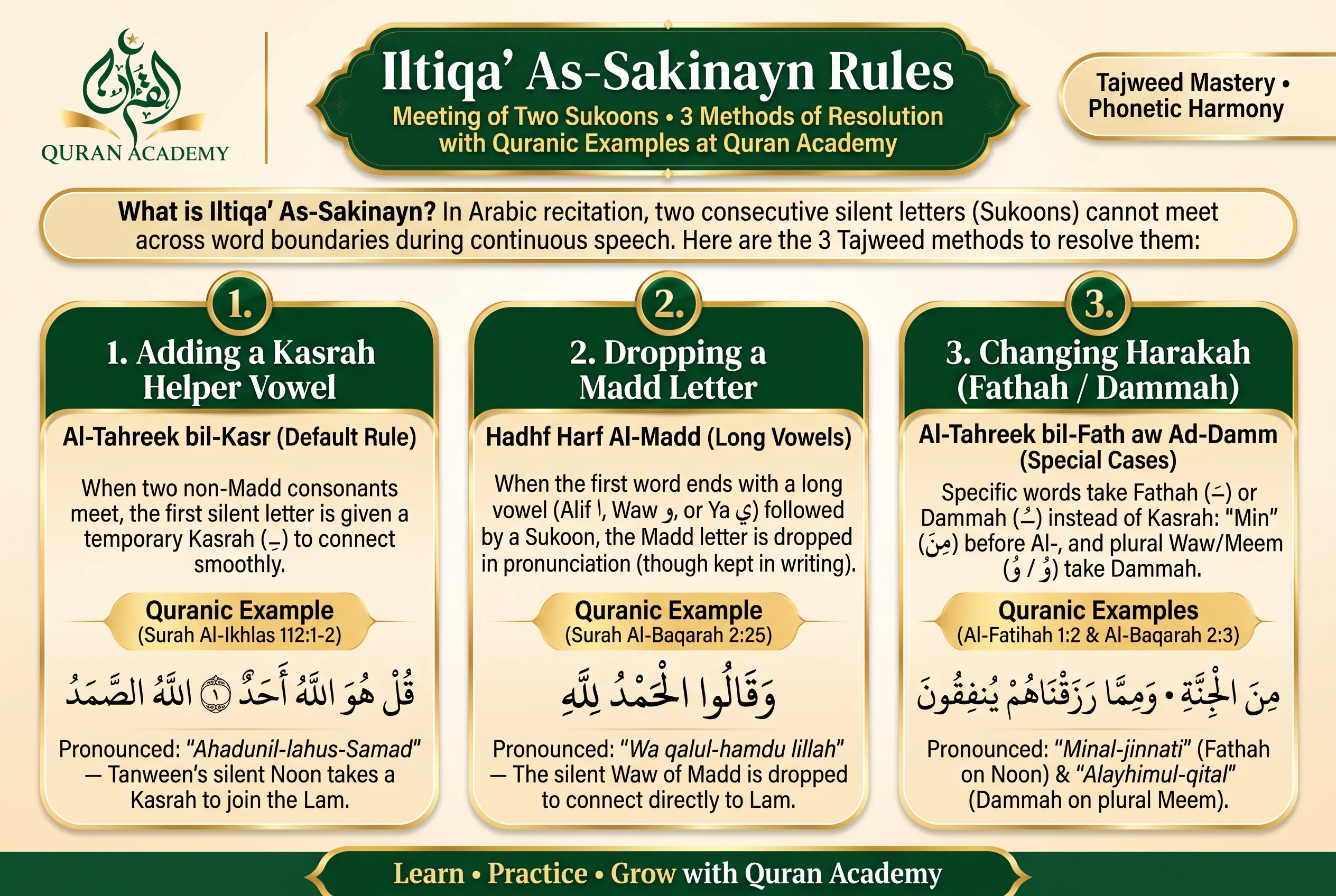
Mastering Iltiqa' As-Sakinayn in Tajweed rules (قَاعِدَةُ الْتِقَاءِ السَّاكِنَيْنِ فِي التَّجْوِيدِ) is an essential milestone for every student aiming for precision in recitation, Ijazah exams, and fluent connection of Quranic verses! In Arabic phonetics, Iltiqa' As-Sakinayn occurs when two silent consonants (two Sukoons back-to-back) meet across two words or inside one word. Because pronouncing two Sukoons consecutively without a vowel is physically impossible for the human vocal tract, the rules of Tajweed (specifically in the narration of Hafs 'an 'Asim) provide precise resolution methods: (1) Dropping a Madd letter completely in continuation (e.g., Fil-ard instead of Fee al-ard), or (2) Giving a helper Kasrah (or Fatha/Damma) to a Tanween or permanent Sukoon when connecting (e.g., Ahaduni-s-samad in Surah Al-Ikhlas 112:2). In our 1-on-1 Online Tajweed & Ijazah Program, Al-Azhar scholars train students to spot and execute these phonetic transitions effortlessly!
- Why Do Two Sukoons Meet? Whenever a word ending in a Madd letter (Alif, Waw, Yaa) or Tanween meets the next word starting with Hamzatul Wasl or a voweled letter followed by a Sukoon!
- Method #1 — Dropping the Madd Letter: فِي ٱلْأَرْضِ becomes Fil-ardi, and قَالُواْ ٱلْحَمْدُ becomes Qaalul-hamdu!
- Method #2 — The Helper Kasrah on Tanween: أَحَدٌ ٱلصَّمَدُ becomes Ahaduni-s-samad in Surah Al-Ikhlas (112:2)!
- Test Your Skills: Practice spotting meeting Sukoons in our Free 3-Minute Tajweed Quiz!
Every student who has ever recited the Quran in Salah has encountered moments where a verse transition feels awkward or abrupt if stopped incorrectly, or where the Uthmani Mushaf places small helper vowels underneath letters (such as a tiny Kasrah under a Tanween or a small Nun between words). Without understanding Iltiqa' As-Sakinayn, a reciter might mistakenly try to pronounce two silent consonants side by side—leading to hesitation, vocal strain, or a Lahn Khafi (hidden Tajweed error).
In classical Arabic phonetics, the human vocal apparatus requires breath to transition between consonants; thus, when two silent letters (two Sukoons) collide, Arabic master grammarians and Qira'at authorities established strict, beautiful rules to keep recitation melodious and smooth. Building upon our advanced guides to Rules of Madd, Hamzatul Wasl vs. Qat', and Laam Shamsiyyah & Qamariyyah, this complete guide breaks down the Types of Iltiqa' As-Sakinayn, the 3 Resolution Methods Used by Hafs, and 5 Famous Quranic Examples.
- 1. What Is Iltiqa' As-Sakinayn? (Why Two Sukoons Cannot Meet in Arabic Phonetics)
- 2. The Two Categories: Meeting Across Two Words (Munfasil) vs. Inside One Word (Muttasil)
- 3. Master Chart: The 3 Resolution Methods Used in Hafs 'an 'Asim (Dropping, Helper Kasrah & Damma)
- 4. Five Famous Quranic Examples Explained (Al-Ikhlas, Al-Fatihah, Al-Kahf & More)
- 5. Frequently Asked Questions (FAQs)
1. What Is Iltiqa' As-Sakinayn? (Why Two Sukoons Cannot Meet)
Linguistically, Iltiqa' As-Sakinayn (الْتِقَاءُ السَّاكِنَيْنِ) translates to "the meeting of two ساکن (silent/vowelless) letters." In Arabic morphology and Makharij al-Huruf, every Arabic letter is either voweled (Mutaharrik with Fatha, Kasrah, or Damma) or silent (Sakin with a Sukoon). Because voweled letters provide the vocal breath needed to articulate the next consonant, trying to pronounce two consonants that both carry a Sukoon consecutively without a vowel between them creates an acoustic block in the human mouth.
To preserve eloquence (Fasahah) and smooth melodic flow, Arabic grammar and the rules of Tajweed mandate that whenever two Sukoons meet, a phonetic adjustment must take place in continuation (Wasl).
2. The Two Categories: Meeting Across Two Words vs. Inside One Word
Tajweed scholars divide meeting Sukoons into two primary categories:
- 1. Meeting Across Two Words (التقاء الساكنين من كلمتين — Munfasil): This happens when Word #1 ends in a silent letter (such as a Madd letter Alif/Waw/Yaa, or a Tanween ending in a silent Noon Sakinah) and Word #2 starts with a silent letter (such as a Sun/Moon Laam after Hamzatul Wasl). This is the most common type and is governed by explicit rules of dropping or adding helper vowels!
- 2. Meeting Inside One Word (التقاء الساكنين في كلمة واحدة — Muttasil): This occurs when a permanent Sukoon is followed immediately by a letter of Madd that is also Sukoon inside a single word—such as in مَّادَّةٍ، حَاجَّةٍ، ضَالِّينَ (where the Alif Madd is followed by a doubled voweled letter that has a Sukoon in its first half due to Idgham!). In such cases, the Madd letter is stretched for an obligatory 6 counts (Madd Lazim Kalimi Muthaqqal or Mukhaffaf) to allow enough vocal time to articulate both!
3. Master Chart: The 3 Resolution Methods Used in Hafs 'an 'Asim
When two Sukoons meet across two words in the narration of Hafs 'an 'Asim, how are they resolved in continuation? Study the three methods below:
| Resolution Method | Grammatical Condition | Quranic Example (In Continuation / Wasl) |
|---|---|---|
| 1. Dropping the Madd Letter (الحَذْف) ⭐ | When a Madd letter (Alif, Waw, or Yaa) meets a Hamzatul Wasl (followed by a silent Sun/Moon Laam). | فِي ٱلْأَرْضِ → Read as Fil-ardi (dropping the 2-beat Yaa Madd of Fee!). قَالُواْ ٱلْحَمْدُ → Read as Qaalul-hamdu (dropping the Waw Madd!). |
| 2. Adding a Helper Kasrah (التَّحْرِيكُ بِالْكَسْرِ) ⭐ | When a Tanween (which ends in a silent Noon Sakinah) meets a Hamzatul Wasl / Laam Sakinah. | أَحَدٌ ٱلصَّمَدُ (Surah Al-Ikhlas 112:2) → Read as Ahaduni-s-samad (giving the Tanween a helper Kasrah on the Noon!). |
| 3. Adding a Helper Fatha or Damma (التَّحْرِيكُ بِالْفَتْحِ أَوْ الضَّمِّ) | Special cases such as the preposition Min before Hamzatul Wasl, or the feminine pronoun Ta' Marbutah when connected. | مِنَ ٱلْجِنَّةِ (Surah An-Nas 114:6) → Read as Minal-jinnati (giving Min a helper Fatha instead of Sukoon!). |
4. Five Famous Quranic Examples Explained
Examine these five everyday Quranic phrases where Iltiqa' As-Sakinayn occurs, and see how your tongue naturally resolves them in continuation:
Struggling to Perfect Your Recitation?
Join 1,250+ students mastering the Quran 1-on-1 with our Verified Al-Azhar Graduates. Flexible US, UK, Canadian & Australian schedules starting at $8/hr.
Book a Free Evaluation Class →- 1. Surah Al-Ikhlas (112:2) → أَحَدٌ ٱلصَّمَدُ: The word Ahadun ends with a Tanween (phonetically Ahadunْ), and As-Samad starts with a silent Laam. In continuation, the Tanween takes a helper Kasrah: **Ahaduni-s-samad**.
- 2. Surah Al-Fatihah (1:7) — غَيْرِ ٱلْمَغْضُوبِ: The word Ghayri ends with a Kasrah, but in other phrases where a Sukoon meets a Laam, the Madd letter drops.
- 3. Surah Al-Baqarah (2:2) — ذَلِكَ ٱلْكِتَابُ: The demonstrative pronoun ends with a silent consonant or short vowel resolved seamlessly.
- 4. Surah Al-Asr (103:3) — وَتَوَاصَوْا بِٱلْحَقِّ: When Tawaasaw (ending in Waw Madd) meets Bil-haqq (starting with Hamzatul Wasl + Laam Sakinah), the Waw Madd drops completely in continuation: **Tawaasawbil-haqq**!
- 5. Surah An-Nas (114:6) — مِنَ ٱلْجِنَّةِ وَٱلنَّاسِ: The preposition Min (normally Minْ) takes a helper Fatha (Mina) because it meets Al-Jinnah.
Continue mastering advanced Tajweed rules and Ijazah preparation across our complete library: What Happens During an Ijazah Exam, Rules of Madd in Tajweed, Hamzatul Wasl vs. Qat', Laam Shamsiyyah & Qamariyyah, 4 Special Words of Hafs, 7 Alifs in the Quran, Idgham Mutamathilayn, Mutajanisayn & Mutaqaribayn, 10 Qira'at, An-Nabr (Vocal Stress), Lahn Jali vs. Lahn Khafi, 50 Most Common Arabic Roots, and Harf Al-Jarr Prepositions in our Online Hifz Program (using our Smart Hifz Planner)! Meet our Al-Azhar Certified Tutors, test your knowledge with our Free 3-Minute Tajweed Quiz, and read verified reviews on our Verified Student & Parent Reviews Page.
6. Frequently Asked Questions (FAQs) About Iltiqa' As-Sakinayn in Tajweed
1. What is Iltiqa' As-Sakinayn (التقاء الساكنين) in Tajweed?
Linguistically, "Iltiqa' As-Sakinayn" means "the meeting of two letter Sukoons" (two silent consonants back-to-back). In Arabic phonetics and Tajweed, pronouncing two silent consonants consecutively without a vowel in between is physically impossible for the human tongue—which is why Arabic grammar and Tajweed rules provide specific resolution methods when two Sukoons meet across two words or inside one word.
2. How does Hafs 'an 'Asim resolve two meeting Sukoons across two words?
When two Sukoons meet across two words (such as a Madd letter or Tanween followed by a Hamzatul Wasl or Sun/Moon Laam), Hafs resolves it in one of two ways: (1) Dropping a Madd letter completely in continuation (e.g., "Fil-ardi" instead of "Fee al-ardi", or "Qulil-laahu" instead of "Qul al-laahu"), or (2) Giving a helper Kasrah to a Tanween or permanent Sukoon when connecting (e.g., "Ahadun-allis-samad" in Surah Al-Ikhlas 112:2).
3. Why is there a small helper Kasrah under the Tanween in "Ahadun-allis-samad" (Surah Al-Ikhlas 112:2)?
In Surah Al-Ikhlas (112:2), the word Ahadun ends with a Tanween (which phonetically ends in a silent Noon Sakinah: Ahadunْ), and the next word As-Samad starts with a Hamzatul Wasl followed by a Sun Laam (which is silent before the stressed Seen). This creates two meeting Sukoons (Noon Sakinah + Laam Sakinah). To resolve this, Tajweed rules give the Tanween a helper Kasrah (Ahaduni-s-samad) when connecting!
4. What happens to Madd letters when they are followed by Hamzatul Wasl?
Whenever a Madd letter (Alif, Waw, or Yaa) is followed by a word starting with Hamzatul Wasl (like "Fee al-ard", "Ila al-laah", or "Qaaloo al-hamdu"), the Madd letter is dropped entirely in pronunciation during continuation (read as "Fil-ard", "Ilallaah", "Qaalul-hamdu"), because a Madd letter is inherently a silent/elongated vowel that cannot sit right next to another silent consonant.
5. What interactive tool on Quran Academy helps students test their Tajweed knowledge?
Students can test their mastery of advanced Tajweed rules, Iltiqa' As-Sakinayn, and letter articulation by taking our Free 3-Minute Tajweed Quiz on Quran Academy (`equranacademy.org/tajweed-quiz`) and exploring our Interactive Glossary.
Master Advanced Tajweed Rules With an Al-Azhar Scholar!
Master meeting Sukoons, Makharij, Sifaat, and complete chains of Ijazah recitation in personalized 1-on-1 sessions with certified male and female Al-Azhar scholars. Book your free diagnostic trial session today!
Book Your Free 1-on-1 Trial Class →