
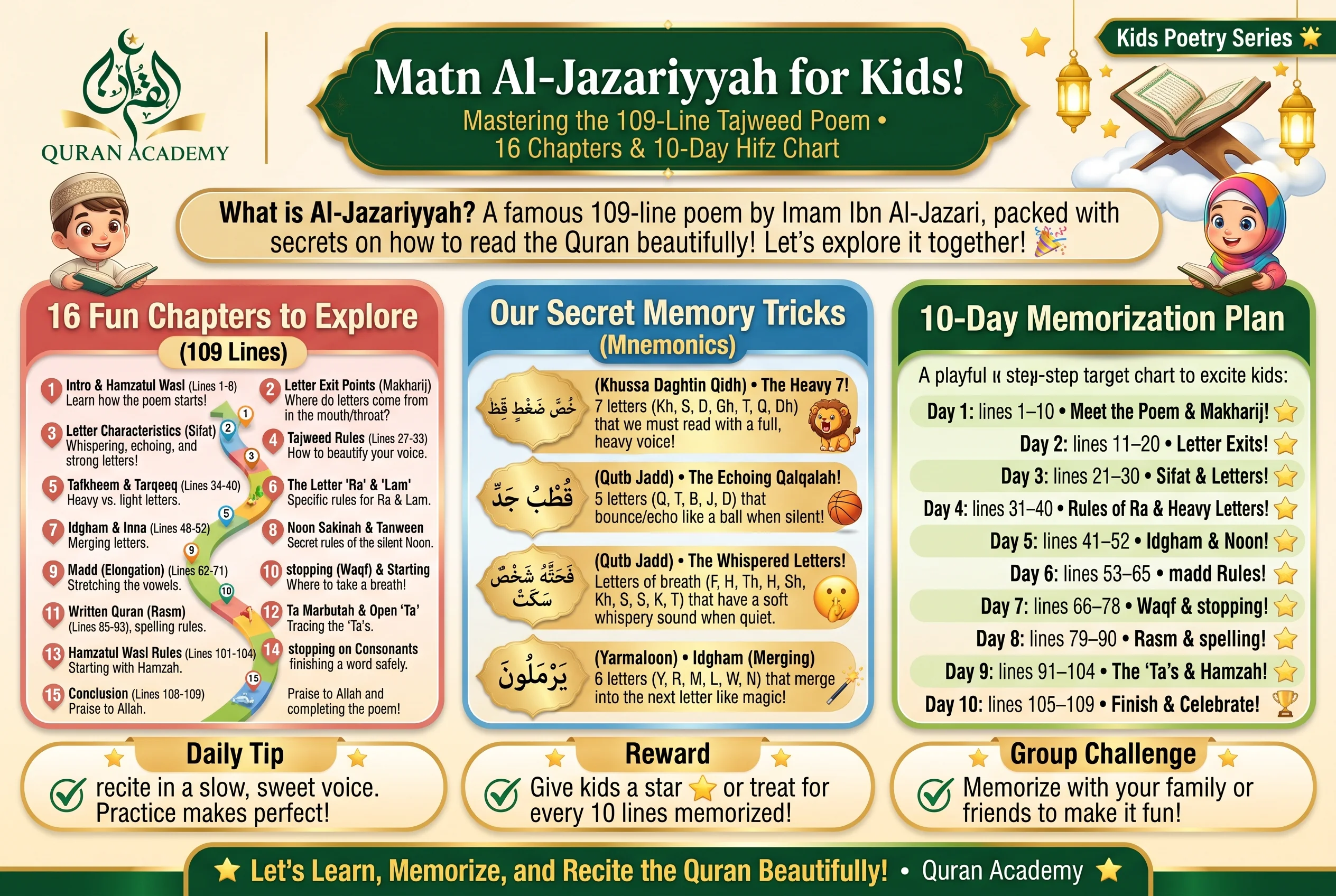
✦ Quick Answer & Key Takeaways: Matn Al-Jazariyyah Tajweed Guide
Studying our Matn Al Jazariyyah Tajweed guide (شَرْحُ مَتْنِ الْمُقَدِّمَةِ الْجَزَرِيَّةِ فِي التَّجْوِيدِ) takes you from foundational Tajweed—which we covered in the 61 verses of Matn Tuhfat Al-Atfal—to the highest level of classical Quranic phonetic mastery required for an Online Quran Ijazah! Composed by the undisputed Imam of the 10 Qira'at, Imam Muhammad ibn Muhammad ibn Al-Jazari Ash-Shafi'i (751–833 AH / 1350–1429 CE), this 109-verse poem is organized into 16 comprehensive chapters that define the 17 Makharij al-Huruf, the 17 Sifaat al-Huruf, Tafkhim & Tarqeeq, Ahkam Al-Raa, distinguishing ض from ظ, Waqf & Ibtida', and the Uthmani script secrets of Al-Maqtu' wal-Mawsool, Ha'at At-Ta'neeth, and Hamzatul Wasl! In our 1-on-1 Online Tajweed & Ijazah Course, students master and earn a certified Sanad Ijazah in Al-Muqaddimah Al-Jazariyyah directly from Al-Azhar scholars!
- Who Was Imam Ibn Al-Jazari (751–833 AH)? The supreme preserver of all 10 Mutawatir Qira'at (author of An-Nashr fil-Qira'at Al-'Ashr and Tayyibat An-Nashr)—every living Quran Sanad on earth today passes through him!
- Why 107 vs. 109 Verses? The original poem is 107 verses ending with Hamzatul Wasl, plus 2 universally recited closing verses of praise and Salawat (= 109 lines total).
- The 4 Pillars of Tajweed (Verses 31–33): Knowing Makharij + Sifaat + Rules of Combination + Constant Vocal Exercise (Riyadatul-Lisan)!
- 10-Day Hifz Plan: Memorize just 11 rhyming lines per day!
If you look at any authentic Quran Ijazah certificate anywhere in the Muslim world today—whether in Cairo, Madinah, Damascus, Istanbul, or Kuala Lumpur—and trace its chain of narrators (Sanad) upward from teacher to teacher toward the Companions and Prophet Muhammad (ﷺ), you will notice a breathtaking historical fact: every single chain of the 10 Qira'at converges at one towering scholar of the 8th/9th century Hijri: Imam Muhammad ibn Al-Jazari (رحمه الله)!
Born in Damascus in Ramadan 751 AH after his father drank Zamzam water at the Ka'bah praying for a scholar son, Ibn Al-Jazari memorized the entire Quran by age 13 and mastered all ten readings. To give every Quran student on earth a single, compact manual containing everything a reciter MUST know—from how letters are born in the throat and tongue to how words are spelled and stopped on in the Uthmani Mushaf—he composed الْمُقَدِّمَةُ فِيمَا يَجِبُ عَلَى قَارِئِ الْقُرْآنِ أَنْ يَعْلَمَهُ (Al-Muqaddimah Al-Jazariyyah). Building directly upon our guides to Matn Tuhfat Al-Atfal and Iltiqa' As-Sakinayn in Tajweed, this complete guide maps out all 16 Chapters & 109 Verses of Al-Jazariyyah, explains its famous anchor verses, and breaks down the advanced chapters of Daad vs. Dhaa', Al-Maqtu' wal-Mawsool, and Ha'at At-Ta'neeth (Open vs. Tied Taa).
- 1. Master Map: All 16 Chapters & 109 Verses of Matn Al-Muqaddimah Al-Jazariyyah
- 2. Part 1 (Verses 1 to 33): Makharij (17 Points), Sifaat & The True Definition of Tajweed
- 3. Part 2 (Verses 34 to 78): Tarqeeq Warnings, Raa, Laam, Idgham & The Famous Daad vs. Dhaa' Chapter!
- 4. Part 3 (Verses 79 to 109): Waqf & Ibtida', Al-Maqtu' wal-Mawsool, Open Taa'at & Hamzatul Wasl
- 5. 10-Day Memorization Schedule for Matn Al-Jazariyyah (11 Lines/Day!)
- 6. Frequently Asked Questions (FAQs)
1. Master Map: All 16 Chapters & 109 Verses of Matn Al-Muqaddimah Al-Jazariyyah
Look at how Imam Ibn Al-Jazari (رحمه الله) structured his 109-verse encyclopedia across 16 chapters—and notice how every single chapter connects directly to our deep-dive Tajweed articles:
| Chapter # & Title | Verses | Core Rules & Famous Mnemonics Inside the Chapter |
|---|---|---|
| 1. Introduction (الْمُقَدِّمَةُ) | 1 – 8 | Opening by Muhammad ibn Al-Jazari Ash-Shafi'i and listing the 4 pillars a reciter must know before reciting: Makharij, Sifaat, Waqf, and Rasm Al-Mushaf (Maqtu'/Mawsool & Taa'at)! |
| 2. Makharij al-Huruf (بَابُ مَخَارِجِ الْحُرُوفِ) ⭐ |
9 – 19 | Establishes the 17 Articulation Points across the 5 vocal areas (Al-Jawf, Al-Halq, Al-Lisan, Ash-Shafataan, and Al-Khayshoom) → Full 17 Makharij Guide. |
| 3. Sifaat al-Huruf (بَابُ صِفَاتِ الْحُرُوفِ) ⭐ |
20 – 26 | Opposite pairs (Hams = فَحَثَّهُ شَخْصٌ سَكَتْ, Shiddah = أَجِدْ قَطٍ بَكَتْ, Tawassut = لِنْ عُمَرْ, Isti'laa' = خُصَّ ضَغْطٍ قِظْ) + 7 non-opposite Sifaat including قَلْقَلَةٌ قُطْبُ جَدٍّ → Full Sifaat Guide. |
| 4. Defining Tajweed (بَابُ التَّجْوِيدِ) | 27 – 33 | Obligation of avoiding Lahn Jali, giving every letter its right (Haqq) and due (Mustahaqq), and practicing without artificial strain (Bila Ta'assufi)! |
| 5. Tarqeeq & Vocal Warnings | 34 – 40 | Keeping light letters light next to heavy letters (like ٱلْحَمْدُ، بَاطِلْ، وَعَلَى ٱللَّهِ، مَخْمَصَةٍ) → Full Heavy & Light Letters Guide. |
| 6 & 7. Raa, Laam & Isti'laa' Ranks | 41 – 51 | When Raa is light, the Khulf in فِرْقٍ (26:63), hiding Takreer on رّ, making the Laam of Allah heavy after Fatha/Damma, and the 4 Itbaq letters → Full Ahkam Al-Raa Guide. |
| 8. Idgham & Letter Pairs | 52 – 56 | Mithlayn, Mutajanisayn (like بَسَطتَ، أَحَطتُ، نَخْلُقكُّمْ، ٱرْكَب مَّعَنَا، يَلْهَث ذَّٰلِكَ) → Full Idgham Pairs Guide. |
| 9. Daad (ض) vs. Dhaa' (ظ) 🏆 | 57 – 64 | Distinguishing the molar Istitalah of ض from the interdental tongue-tip ظ, and listing all 32 root words of ظ in the Quran! |
| 10, 11 & 12. Noon, Meem & Madd | 65 – 78 | Concise 14-line summary of Ghunnah, Meem Sakinah, Noon Sakinah, and Madd Lazim/Wajib/Ja'iz → Full Rules of Madd Guide. |
| 13. Waqf & Ibtida' (الْوَقْفُ وَالِابْتِدَاءُ) ⭐ | 79 – 85 | The 3 Permissible Stops (Taamm, Kaafi, Hasan), Forbidden Stop (Qabeeh), and rules of stopping with Sukoon, Rawm, and Ishmam → Full Rules of Waqf Guide. |
| 14 & 15. Maqtu'/Mawsool & Taa'at | 86 – 106 | Disjoined vs. Joined Uthmani compounds (like أَن لَّا vs. أَلَّا) and Feminine Nouns written with an open ت (like رَحْمَتْ، نِعْمَتْ، سُنَّتْ)! |
| 16. Hamzatul Wasl & Conclusion | 107 – 109 | The 3rd-letter rule for starting Verbs with Damma vs. Kasrah, the 7 Nouns starting with Kasrah, and final praise → Full Hamzatul Wasl Guide. |
2. Part 1 (Verses 1 to 33): Makharij, Sifaat & The True Definition of Tajweed
Examine the most famous lines of Part 1 of Al-Muqaddimah Al-Jazariyyah—the exact verses quoted in every Tajweed classroom and Ijazah exam on earth:
- The 17 Makharij & 17 Sifaat (Verses 9 & 20–24):
٩- مَخَارِجُ الْحُرُوفِ سَبْعَةَ عَشَرْ ... عَلَى الَّذِي يَخْتَارُهُ مَنِ اخْتَبَرْ
٢٠- صِفَاتُهَا جَهْرٌ وَرِخْوٌ مُسْتَفِلْ ... مُنْفَتِحٌ مُصْمَتَةٌ وَالضِّدَّ قُلْ
٢١- مَهْمُوسُهَا (فَحَثَّهُ شَخْصٌ سَكَتْ) ... شَدِيدُهَا لَفْظُ (أَجِدْ قَطٍ بَكَتْ)
٢٢- وَبَيْنَ رِخْوٍ وَالشَّدِيدِ (لِنْ عُمَرْ) ... وَسَبْعُ عُلْوٍ (خُصَّ ضَغْطٍ قِظْ) حَصَرْ
٢٤- صَفِيرُهَا صَادٌ وَزَايٌ سِينُ ... قَلْقَلَةٌ (قُطْبُ جَدٍّ) وَاللِّينُ... Commentary: In just 18 lines, Imam Ibn Al-Jazari gives you the exact birthplace (Makhraj) and acoustic personality (Sifah) of all 29 Arabic letters! - The Famous Verse 27 on the Obligation of Tajweed & Verses 29–33 on Natural Beauty:
٢٧- وَالْأَخْذُ بِالتَّجْوِيدِ حَتْمٌ لَازِمُ ... مَنْ لَمْ يُجَوِّدِ الْقُرْآنَ آثِمُ
٢٨- لِأَنَّهُ بِهِ الْإِلَهُ أَنْزَلَا ... وَهَكَذَا مِنْهُ إِلَيْنَا وَصَلَا
٢٩- وَهْوَ أَيْضًا حِلْيَةُ التِّلَاوَةِ ... وَزِينَةُ الْأَدَاءِ وَالْقِرَاءَةِ
٣٠- وَهْوَ إِعْطَاءُ الْحُرُوفِ حَقَّهَا ... مِنْ صِفَةٍ لَهَا وَمُسْتَحَقَّهَا
٣٢- مُكَمَّلًا مِنْ غَيْرِ مَا تَكَلُّفِ ... بِاللُّطْفِ فِي النُّطْقِ بِلَا تَعَسُّفِ
٣٣- وَلَيْسَ بَيْنَهُ وَبَيْنَ تَرْكِهِ ... إِلَّا رِيَاضَةُ امْرِئٍ بِفَكِّهِ Commentary: Look at the balance in Lines 27 to 33: (1) Avoiding Lahn Jali (clear errors that change letters or vowels) is an individual obligation (Hatmun Lazimu) because Allah revealed the Quran with Tajweed; (2) True Tajweed must be recited with gentle grace and zero artificial exaggeration (بِاللُّطْفِ فِي النُّطْقِ بِلَا تَعَسُّفِ); and (3) The only secret separating a beginner from a master reciter is daily jaw and tongue practice with a qualified teacher (رِيَاضَةُ امْرِئٍ بِفَكِّهِ)!
3. Part 2 (Verses 34 to 78): Tarqeeq Warnings, Raa, Laam & The Famous Daad vs. Dhaa' Chapter!
Why did Imam Ibn Al-Jazari dedicate 8 full verses (Lines 57 to 64) exclusively to the difference between ض (Daad) and ظ (Dhaa')? Because in Arabic, swapping ض and ظ changes the meaning of Allah's words! Look at three examples you can check in our Online Uthmani Quran Explorer:
- ⚠️ ظَلَّتْ (Dhallat with ظ) = "It remained/continued" (20:97) vs. ضَلَّتْ (Dallat with ض) = "It went astray!"
- ⚠️ مَحْظُورًا (Mahdhooraa with ظ — 17:20) = "Restricted/withheld" vs. مَحْضُورًا (Mahdooraa with ض) = "Brought present!"
- ⚠️ بِظَنِينٍ (with ظ) = "Accused/untrustworthy" vs. بِضَنِينٍ (Bi-daneenin with ض — Surah At-Takwir 81:24) = "Withholding/stingy [with the revelation]!"
- How Do You Articulate Them Distinctly (Verses 52–53)?
• Daad (ض): Keep the tip of your tongue INSIDE your teeth while pressing the left or right side of your tongue against your upper molars with Istitalah (وَالضَّادَ بِاسْتِطَالَةٍ وَمَخْرَجِ ... مَيِّزْ مِنَ الظَّاءِ)!
• Dhaa' (ظ): Place the tip of your tongue gently against the edges of your upper front teeth (interdental)!
4. Part 3 (Verses 79 to 109): Waqf, Al-Maqtu' wal-Mawsool, Open Taa'at & Hamzatul Wasl
In the final third of the poem (Verses 79–109), Imam Ibn Al-Jazari teaches the three advanced sciences that every candidate for an Online Ijazah Exam is tested on:
- 1. Waqf & Ibtida' (Verses 79–85 — Stopping & Starting Rules):
Divides stopping into Taamm (Complete), Kaafi (Sufficient), and Hasan (Good — where you may stop, but if it is not a verse-ending you must go back a word or two to connect the grammar when restarting!) versus Qabeeh (Ugly/Forbidden Stop that distorts meaning, like stopping on "Indeed Allah does not guide..." without completing "...the wrongdoing people"!). And in Verse 83, he establishes the golden rule: وَحَاذِرِ الْوَقْفَ بِكُلِّ الْحَرَكَهْ ... إِلَّا إِذَا رُمْتَ فَبَعْضُ حَرَكَهْ (never stop on a full vowel in Arabic—always stop with Sukoon, or 1/3 vowel in Rawm, or lip-rounding in Ishmam!). - 2. Al-Maqtu' wal-Mawsool (Verses 86–99 — Disjoined vs. Joined Uthmani Compound Words):
In the Uthmani Mushaf, certain two-part compound phrases are written separated as two words (مَقْطُوعٌ) in some verses and joined together as one word (مَوْصُولٌ) in others! For example:
• أَن لَّا (Disjoined in 10 places, like 9:118 & 36:60): In an emergency breath test, you may stop on the first word أَنْ (Anْ)!
• أَلَّا (Joined as one word, like 27:31): You may ONLY stop on the whole word أَلَّا (Allaa)! - 3. Ha'at At-Ta'neeth Written With Open Taa (بَابُ التَّاءَاتِ — Verses 100–106):
Normally, a feminine noun ending in a tied Taa Marbutah (ـة / ة, like رَحْمَةٌ، نِعْمَةٌ، سُنَّةٌ، شَجَرَةٌ، جَنَّةٌ) turns into a soft Haa' Sakinah (ـهْ = Rahmahْ, Ni'mahْ) when you stop on it. However, in specific verses listed by Ibn Al-Jazari in Lines 100–106, the Uthmani Mushaf writes those words with an Open Taa Mabsutah (ت — such as رَحْمَتُ ٱللَّهِ in 2:218, 7:56, 11:73, 19:2, 30:50, and 43:32 [2x])!
• How Hafs Stops on Open Taa Words: Whenever one of these words is written with an open ت, Imam Hafs stops on it with a whispered Taa Sakinah (ـتْ = Rahmatْ, Ni'matْ, Sunnatْ, Shajaratْ, Jannatْ [in 56:89: وَجَنَّتُ نَعِيمٍ])!
5. 10-Day Memorization Schedule for Matn Al-Jazariyyah (11 Lines/Day!)
Once you finish memorizing the 61 verses of Tuhfat Al-Atfal, use our Smart Hifz Planner to memorize all 109 verses of Al-Muqaddimah Al-Jazariyyah in 10 days:
Struggling to Perfect Your Recitation?
Join 1,250+ students mastering the Quran 1-on-1 with our Verified Al-Azhar Graduates. Flexible US, UK, Canadian & Australian schedules starting at $8/hr.
Book a Free Evaluation Class →- 🌟 Days 1 & 2 (Verses 1–19): Introduction (1–8) + All 17 Makharij al-Huruf (9–19).
- 🌟 Days 3 & 4 (Verses 20–40): Sifaat al-Huruf (20–26) + Defining Tajweed (27–33) + Tarqeeq Warnings (34–40).
- 🌟 Days 5 & 6 (Verses 41–64): Raa, Laam & Isti'laa' (41–51) + Idgham Pairs (52–56) + Daad vs. Dhaa' (57–64).
- 🌟 Days 7 & 8 (Verses 65–85): Noon, Meem & Madd (65–78) + Waqf & Ibtida' (79–85).
- 🌟 Days 9 & 10 (Verses 86–109): Al-Maqtu' wal-Mawsool (86–99) + Open Taa'at (100–106) + Hamzatul Wasl & Conclusion (107–109)!
Mastering Verses 24 & 36–37 of Al-Jazariyyah: "Qalqalah Qutb Jadd" & "Wa Bayyinan Muqalqalaa"!
In Matn Al-Jazariyyah, Imam Ibn Al-Jazari not only named the 5 Qalqalah (Echoing) letters in Line 24 (قَلْقَلَةٌ قُطْبُ جَدٍّ), he also explained their exact levels in Lines 36–37: وَبَيِّنَنْ مُقَلْقَلًا إِنْ سَكَنَا ... وَإِنْ يَكُنْ فِي الْوَقْفِ كَانَ أَبْيَنَا ("And make every Qalqalah letter clear when it is silent [Sughra]—and if it occurs when stopping at the end of a word, make it even clearer [Kubra]!")! Watch Senior Instructor Ustadhah Yasmeen Gamal demonstrate Qalqalah on our Quran Academy YouTube Channel:
- Sughra vs. Kubra From Al-Jazariyyah: Hear Lines 36–37 applied live!
- 1-on-1 Live Ijazah Coaching: Earn your Sanad in Al-Jazariyyah with Al-Azhar scholars!
Explore the rest of our interconnected Tajweed, Quranic Arabic, and Surah encyclopedia: Noon Sakinah Rules, Meem Sakinah Rules, Laam Shamsiyyah & Qamariyyah, 4 Special Words of Hafs, 7 Alifs in the Quran, An-Nabr (Vocal Stress), 15 Sajdah Tilawah Verses, 12 Authentic Duas for Seeking Knowledge & Memory, 15 Duas for Parents, Marriage & Offspring, Voluntary Fasting in Islam, How to Pray Salat Al-Kusoof, Newborn Baby Sunnahs, 50 Most Common Arabic Roots, and Verbs in Quranic Arabic in our Online Hifz Program (using our Online Hadith Explorer)! Meet our Al-Azhar Certified Tutors, test your knowledge on our Free 3-Minute Tajweed Quiz, enroll your child in our 1-on-1 Kids Quran Classes with our Printable Kids Star Chart, and read how students across the US, UK, Canada, and Australia rate our teachers on our Verified Student & Parent Reviews Page.
6. Frequently Asked Questions (FAQs) About Matn Al-Muqaddimah Al-Jazariyyah
1. What is "Matn Al-Muqaddimah Al-Jazariyyah" and who was Imam Ibn Al-Jazari?
Matn Al-Muqaddimah فيما يجب على قارئ القرآن أن يعلمه (commonly known as Al-Muqaddimah Al-Jazariyyah) is the supreme classical didactic poem on the science of Tajweed. It was composed around 799 AH by the chief authority of the 10 Qira'at in Islamic history, Imam Shams Ad-Din Muhammad ibn Muhammad ibn Al-Jazari Ad-Dimashqi Ash-Shafi'i (751–833 AH / 1350–1429 CE), and consists of 107 original verses (plus 2 closing verses = 109 verses in Bahr Ar-Rajaz).
2. What are the 16 chapters covered in Matn Al-Jazariyyah?
The 109 verses of Matn Al-Jazariyyah are organized into 16 comprehensive chapters: (1) Introduction (1–8), (2) Makharij al-Huruf — 17 Articulation Points (9–19), (3) Sifaat al-Huruf — Letter Characteristics (20–26), (4) Defining Tajweed & Lahn (27–33), (5) Tarqeeq & Warnings Against Errors (34–40), (6) Ahkam Al-Raa (41–43), (7) Laam of Allah & Isti'laa' Letters (44–51), (8) Idgham & Letter Relationships (52–56), (9) Distinguishing Daad from Dhaa' (57–64), (10) Noon & Meem Mushaddadatayn and Meem Sakinah (65–68), (11) Noon Sakinah & Tanween (69–72), (12) Madd & Qasr (73–78), (13) Waqf & Ibtida' — Stopping & Starting (79–85), (14) Maqtu' & Mawsool — Disjoined & Joined Uthmani Words (86–99), (15) Feminine Taa'at Written with Open Taa (100–106), and (16) Hamzatul Wasl & Conclusion (107–109).
3. How did scholars explain Imam Ibn Al-Jazari's famous line "Wal-Akhdhu bit-Tajweedi Hatmun Lazimu" (Verse 27)?
In Verse 27, Imam Ibn Al-Jazari wrote: "And applying Tajweed is an absolute obligation; whoever does not recite the Quran with Tajweed is sinful!" Commentators (such as Mulla 'Ali Al-Qari and Shaykh Zakariyya Al-Ansari) explain that "absolute obligation" (Fard 'Ayn) whose abandonment is sinful refers to avoiding Lahn Jali (Clear Errors that change a letter, a grammatical vowel, or the meaning of Allah's words), whereas mastering the subtle artistic refinements and theoretical terms is Fard Kifayah and obligatory during formal Ijazah transmission!
4. Why did Imam Ibn Al-Jazari dedicate 8 full verses (57–64) solely to the difference between Daad (ض) and Dhaa' (ظ)?
Because both Daad (ض) and Dhaa' (ظ) are heavy, elevated, velarized letters (Isti'laa' + Itbaq + Jahr), and in many spoken dialects their sounds merge—which can drastically alter the meaning of Quranic verses (such as "Zallat" vs. "Dallat", or "Mahdhooraa" vs. "Mahdooraa"). Therefore, Imam Ibn Al-Jazari listed all the words in the Quran spelled with the interdental Dhaa' (ظ) so a reciter never confuses them with the molar Daad (ض)!
5. What are the "Maqtu' wal-Mawsool" and "Taa'at" chapters at the end of Al-Jazariyyah (Verses 86–106)?
They are the two chapters of Uthmani Orthography (Rasm Al-Mushaf) required for every Ijazah exam: (1) Al-Maqtu' wal-Mawsool (86–99) teaches which compound words are written disconnected (like "An Laa") versus connected ("Allaa") so you know how to stop in an emergency test, and (2) باب التاءات (100–106) lists the feminine nouns written with an open Taa Mabsutah (ت — like "Rahmat" in 7 places) where Hafs stops with a "T" sound instead of an "H" sound!
Join the Unbroken Chain of Imam Ibn Al-Jazari Today!
Master all 109 verses of Al-Muqaddimah Al-Jazariyyah and earn your certified Sanad Ijazah in Tajweed and Quranic recitation with our male and female Al-Azhar scholars. Book your free diagnostic trial session today!
Book Your Free 1-on-1 Trial Class →