
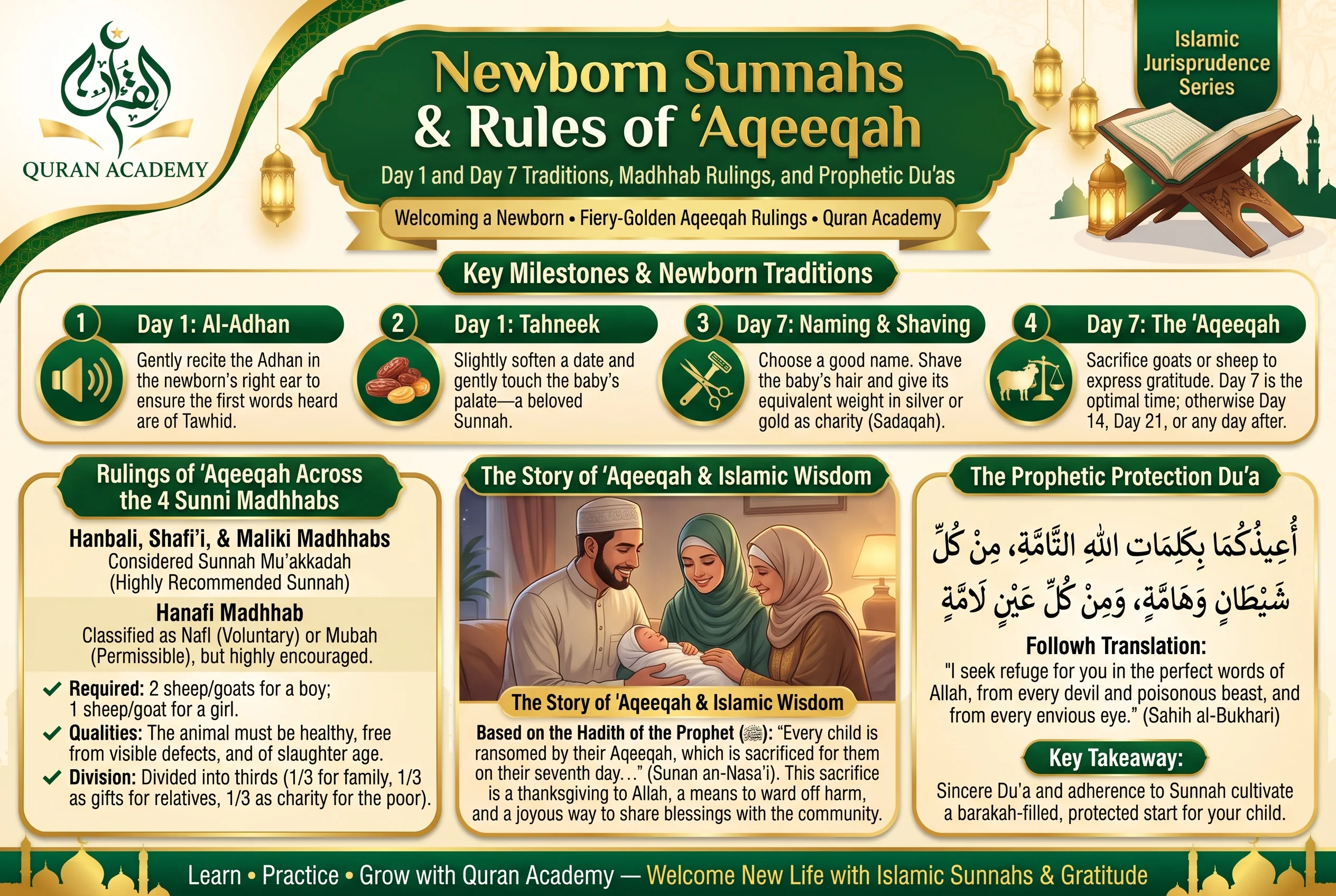
✦ Quick Answer & Key Takeaways: Newborn Baby Sunnahs & 'Aqeeqah Rules
Mastering newborn baby Sunnahs and Aqeeqah rules (سُنَنُ الْمَوْلُودِ وَأَحْكَامُ الْعَقِيقَةِ فِي الْإِسْلَامِ) empowers expectant Muslim parents to welcome their child into the world wrapped in the remembrance of Allah, gratitude, and Prophetic barakah from their very first breath! Summarized in the authentic Hadith of Samurah ibn Jundub (RA) in Sunan Abu Dawud (2838): « كُلُّ غُلَامٍ رَهِينَةٌ بِعَقِيقَتِهِ، تُذْبَحُ عَنْهُ يَوْمَ سَابِعِهِ، وَيُحْلَقُ، وَيُسَمَّى » ("Every child is pledged to his 'Aqeeqah, which is sacrificed on his behalf on his seventh day, his head is shaved, and he is given a name!"), the Sunnah checklist spans 7 blessed practices from Day 1 to Day 7: (1) Joyful glad tidings (Bisharah) for both boys and girls equally, (2) Soft Adhan in the right ear, (3) Tahneek with a softened date and Dua, (4) Choosing a noble Islamic name, (5) The 7th-day 'Aqeeqah sacrifice (2 sheep for a boy, 1 for a girl), (6) Shaving the baby's hair and donating its weight in silver, and (7) Khitan. In our 1-on-1 Online Islamic Studies, Fiqh & Family Program, Al-Azhar scholars guide parents through every step of raising righteous, Quran-loving children!
- How to Calculate "Day 7" for 'Aqeeqah: Count the day of birth as Day 1 (if born before Maghrib)—so a baby born on Friday has their 7th day on Thursday of the next week!
- How Much Silver Charity Is a Newborn's Hair? A newborn's shaved hair typically weighs 1.5 to 3 grams—so giving the value of 3 to 5 grams of silver (or more!) to the poor fulfills the Sunnah!
- The Best Names (Sahih Muslim 2132): 'Abdullah, 'Abdur-Rahman, names of the 25 Prophets, 10 Promised Paradise, and Mothers of the Believers!
- The Prophetic Shield Against the Evil Eye (Bukhari 3371): U'eedhuka bi-kalimaatillaahit-taammati min kulli shaytaanin wa haammah, wa min kulli 'aynin laammah!
Few moments in life are as emotional and awe-inspiring as holding your newborn son or daughter in your arms for the very first time. In Surah Ash-Shura (42:49–50), Allah Almighty reminds us that every single child—putting daughters first to honor them!—is a direct gift (Hibah) from the Creator of the heavens and the earth: يَهَبُ لِمَن يَشَاءُ إِنَاثًا وَيَهَبُ لِمَن يَشَاءُ ٱلذُّكُورَ ("He grants to whom He wills females, and He grants to whom He wills males!").
Yet in the excitement and busyness of hospital bags, birth certificates, and family visits, new parents in the West often ask five practical Fiqh questions: "What are the exact Sunnahs we should do on Day 1 in the hospital room versus Day 7 at home? How do we perform Tahneek safely? What is the scholarly ruling on whispering the Adhan in the baby's ear? How many sheep are required for 'Aqeeqah, how is the meat distributed, and what if we couldn't do it on Day 7? And which Duas did Prophet Muhammad (ﷺ) recite to protect his grandsons Al-Hasan and Al-Husayn (RA)?" Building upon our guides to Surah Maryam (the birth of Yahya and 'Isa AS), Surah Luqman's 10 Parenting Lessons, and Authentic Ruqyah Shariah, this complete guide walks you through the 7 Newborn Sunnahs From Day 1 to Day 7, the 4 Madhhab 'Aqeeqah Chart, Islamic Baby Naming Rules, and the Authentic Duas for Newborns.
- 1. Part 1 (Day 1 Sunnahs): Glad Tidings, Soft Adhan, Tahneek With a Date & Blessing Dua
- 2. Part 2 (Day 7 Sunnahs): Master Chart of 'Aqeeqah, Shaving the Hair & Silver Charity Across 4 Madhhabs
- 3. Islamic Baby Naming Rules: The 4 Tiers of Beloved Names vs. Forbidden Names
- 4. Authentic Duas for Congratulating Parents & Protecting Your Newborn From the Evil Eye
- 5. Four Essential Tajweed Rules When Reciting the Newborn & Righteous Offspring Duas
- 6. Frequently Asked Questions (FAQs)
1. Part 1 (Day 1 Sunnahs): Glad Tidings, Soft Adhan, Tahneek & Blessing Dua
As soon as your baby is born and safely checked by the medical team, Islam surrounds the newborn with three gentle Day 1 traditions:
- 1. Rejoicing & Giving Glad Tidings (Al-Bisharah) for Both Sons & Daughters Equally:
In the Quran, Allah Almighty modeled giving joyful news of a birth (فَبَشَّرْنَاهَا بِإِسْحَاقَ — 11:71 and يَا زَكَرِيَّا إِنَّا نُبَشِّرُكَ بِغُلَامٍ — 19:7) and praised the immense reward of welcoming and raising daughters with love and honor (Sahih al-Bukhari 5995 & Muslim 2629: "Whoever is blessed with daughters and treats them kindly, they will be a shield for him from the Fire!"). - 2. Whispering the Soft Adhan in the Baby's Right Ear:
Based on the narration of Abu Rafi' (RA) in Sunan Abu Dawud (5105) and Sunan at-Tirmidhi (1514) that the Prophet (ﷺ) called the prayer Adhan gently in the ear of Al-Hasan ibn 'Ali (RA) when Fatimah (RA) gave birth to him, the four Sunni schools recommend (Mustahabb) whispering the words of the Adhan softly near the baby's right ear (never loudly!) so that the very first sound to enter the child's hearing on earth is the proclamation of Allah's greatness and Laa ilaaha illallaah! *(Note: While scholars point out that the chain of the Adhan Hadith has weakness—and the second narration about calling the Iqamah in the left ear is very weak—practicing the soft Adhan is widely endorsed by jurists across the 4 Madhhabs as a beautiful Dhikr).* - 3. Performing "At-Tahneek" (التَّحْنِيكُ) With a Softened Date & Supplicating for Barakah (Sahih al-Bukhari 5467 & Muslim 2145):
In Sahih al-Bukhari (5467) and Sahih Muslim (2145), Abu Musa Al-Ash'ari, Anas ibn Malik, and Asma' bint Abi Bakr (may Allah be pleased with them) narrated that whenever a newborn baby was brought to the Prophet (ﷺ), he would take a date (Tamrah), soften it thoroughly, rub a tiny trace of its sweet moisture onto the baby's upper palate (Hanak), and pray for barakah upon the child!
• How Parents Do Tahneek Safely Today: Wash your hands thoroughly, mash the center of a clean, soft Medjool/Ajwa date with a drop of Zamzam water until it is a smooth paste (with zero solid pieces!), touch a tiny smear onto the tip of your clean index finger, gently rub the roof of the baby's mouth, and make Dua: « ٱللَّهُمَّ بَارِكْ فِيهِ، وَأَنْبِتْهُ نَبَاتًا حَسَنًا »!
2. Part 2 (Day 7 Sunnahs): Master Chart of 'Aqeeqah, Shaving the Hair & Silver Charity
When the 7th day of your baby's life arrives, three confirmed Prophetic traditions come together: (1) Sacrificing the 'Aqeeqah (الْعَقِيقَةُ / النَّسِيكَةُ), (2) Shaving the baby's birth hair and giving its weight in silver to the poor, and (3) Finalizing/announcing the baby's Name (alongside Khitan / Circumcision for boys whenever medically optimal in the first days). Here is how the four Sunni schools explain every detail:
| Day 7 Sunnah Question | Prophetic Sunnah & Majority (Shafi'i, Hanbali & Maliki) | Additional Madhhab Notes (Hanafi & Maliki) |
|---|---|---|
| 1. Ruling & Number of Sheep for 'Aqeeqah | Confirmed Sunnah (Sunnah Mu'akkadah) for parents who can afford it: 2 sheep/goats for a baby boy, and 1 sheep/goat for a baby girl (Sunan at-Tirmidhi 1516 & Abu Dawud 2834 — Sahih). *(Note: Sacrificing **1 sheep for a boy** is also 100% valid and fulfills the base Sunnah, as the Prophet ﷺ sacrificed 1 ram each for Al-Hasan and Al-Husayn in Abu Dawud 2841!).* |
• Maliki School: Recommends 1 sheep for a boy and 1 sheep for a girl. • Hanafi School: Classifies 'Aqeeqah as voluntary/recommended (Mubah / Tatawwu'). |
| 2. Best Day for 'Aqeeqah (How to Count Day 7!) | The 7th Day (Counting the day of birth as Day 1 if born before sunset!): • Born Saturday → Day 7 is Friday • Born Sunday → Day 7 is Saturday • Born Monday → Day 7 is Sunday! |
What If You Missed Day 7? Perform it on Day 14, or Day 21, or on any day thereafter whenever Allah grants you financial ease (an adult may even perform 'Aqeeqah for themselves if their parents did not!). |
| 3. How to Distribute the 'Aqeeqah Meat | Just like Udhiyah: eat 1/3 with your family, gift 1/3 to relatives/neighbors, and give 1/3 in charity to the poor—and unlike Udhiyah, scholars mention it is even better to cook the 'Aqeeqah meat and invite family/friends to a meal (or distribute cooked meals) to save the poor the trouble of cooking! | The 'Aqeeqah animal must meet the exact same age and health conditions as Udhiyah (at least 6 months for a sheep/Jadha'ah, or 1 full year for a goat/Thaniyyah). |
| 4. Shaving the Hair & Giving Its Weight in Silver 🏆 | In Sunan at-Tirmidhi (1519 — Hasan), when Al-Hasan (RA) was born, the Prophet (ﷺ) told his daughter Fatimah (RA): « احْلِقِي رَأْسَهُ، وَتَصَدَّقِي بِزِنَةِ شَعْرِهِ فِضَّةً » ("Shave his head, and give the weight of his hair in silver as charity!")—and when they weighed it, it equaled about a dirham (~3 grams of silver). Gently shaving the birth hair on Day 7 invigorates the scalp and opens the pores (and note the Prophetic prohibition of Al-Qaza'—shaving parts of the head while leaving other parts, Bukhari 5920!). | |
3. Islamic Baby Naming Rules: The 4 Tiers of Beloved Names vs. Forbidden Names
One of the first lifelong gifts you give your child is a noble, dignified name by which they will be called in this world and on the Day of Resurrection! When may you name your baby? The Sunnah accommodates both: you may name the baby on Day 1 at birth (as the Prophet ﷺ named his son Ibrahim on the night he was born, Sahih Muslim 2315) OR on Day 7 alongside the 'Aqeeqah (Sunan Abu Dawud 2838). Classical scholars organize Islamic baby names into four beloved tiers:
- Tier 1 (Servitude to Allah): In Sahih Muslim (2132), the Prophet (ﷺ) declared: « إِنَّ أَحَبَّ أَسْمَائِكُمْ إِلَى اللَّهِ عَبْدُ اللَّهِ وَعَبْدُ الرَّحْمَنِ » ("Indeed, the most beloved of your names to Allah are 'Abdullah and 'Abdur-Rahman!"), followed by any name combining 'Abd- with one of the 99 Names of Allah (like 'Abdul-'Azeez, 'Abdul-Malik, 'Abdul-Kareem)!
- Tier 2 (Names of the Prophets & Messengers): Naming after Prophet Muhammad / Ahmad (ﷺ) and any of the 25 Prophets in the Quran (such as Ibrahim, Musa, 'Isa, Yusuf, Yahya, Zakariyya, Nuh, Dawud, Sulayman, Adam, and Ayyub)!
- Tier 3 (Names of the Sahabah, Maryam & Mothers of the Believers): Naming sons after the 10 Promised Paradise (Abu Bakr, 'Umar, 'Uthman, 'Ali, Talhah, Zubayr, Sa'd, Zayd, Hasan, Husayn, Hamza, Bilal) and naming daughters after Maryam, Asiyah, Fatimah Az-Zahra', and the 11 Mothers of the Believers (Khadijah, 'Aishah, Hafsah, Zaynab, Ruqayyah, Umm Kulthum, Safiyyah, Juwayriyah, Maymunah, Asma', Sumayyah, Sara, Hajar)!
- Tier 4 (Any Name With a Pure, Noble Meaning): Such as Noor, Layla, Yasmeen, Salma, Tariq, Rayyan, Kareem, Ameen!
- ⚠️ Names Forbidden or Disliked in Islam: (a) Any name attributing servitude ('Abd-) to other than Allah, (b) Any name exclusive to Allah alone (like Al-Khaliq, Ar-Rahman [without 'Abd], or Malikul-Amlak), and (c) Names with sad, pessimistic, or self-praising meanings (for the Prophet ﷺ used to change sad names like Huzn [grief] to Sahl [ease], and changed Barrah to Zaynab in Sahih Muslim 2141!).
4. Authentic Duas for Congratulating Parents & Protecting Your Newborn
Memorize and share these two essential supplications—(1) the classical congratulation taught by Imam Al-Hasan Al-Basri and recorded by Imam An-Nawawi in Al-Adhkar, and (2) the authentic Prophetic protection Dua from Sahih al-Bukhari (3371):
« بَارَكَ ٱللَّهُ لَكَ فِي ٱلْمَوْهُوبِ لَكَ، وَشَكَرْتَ ٱلْوَاهِبَ، وَبَلَغَ أَشُدَّهُۥ، وَرُزِقْتَ بِرَّهُۥ »
Transliteration: Baarakallaahu laka fil-mawhoobi laka, wa shakarta Al-Waahiba, wa balagha ashuddahu, wa ruziqta birrahu.
Meaning: "May Allah bless you in the child gifted to you, may you give thanks to the Giver [Al-Wahhab], may the child reach full maturity, and may you be blessed with their righteousness and dutifulness!"
• How the Parents Reply: « بَارَكَ ٱللَّهُ لَكَ وَبَارَكَ عَلَيْكَ، وَجَزَاكَ ٱللَّهُ خَيْرًا، وَرَزَقَكَ ٱللَّهُ مِثْلَهُۥ، وَأَجْزَلَ ثَوَابَكَ ».
« أُعِيذُكَ (أُعِيذُكِ / أُعِيذُكُمَا) بِكَلِمَاتِ ٱللَّهِ ٱلتَّامَّةِ، مِنْ كُلِّ شَيْطَانٍ وَهَامَّةٍ، وَمِنْ كُلِّ عَيْنٍ لَامَّةٍ »
Struggling to perfect your Recitation?
Join hundreds of students mastering the Quran with our Verified Al-Azhar Graduates. We offer flexible 1-on-1 sessions tailored to your schedule.
Book a Free Evaluation Class →Transliteration: U'eedhuka (for a girl: U'eedhuki / for two: U'eedhukumaa) bi-kalimaatillaahit-taammati, min kulli shaytaanin wa haammah, wa min kulli 'aynin laammah.
Meaning: "I seek refuge for you in the Perfect Words of Allah from every devil and poisonous creature, and from every envious evil eye!" (The Prophet ﷺ said: "Indeed your forefather Ibrahim used to seek refuge with these words for Isma'il and Ishaq!").
Mastering the Crisp Qalqalah in "Ruziqْta", "Al-Wahhaabْ" & "Habْ Lanaa"!
When you congratulate new parents with وَرُزِقْتَ بِرَّهُ (Wa Ruziqْta), or stop on Allah's Name ٱلْوَاهِبْ / ٱلْوَهَّابْ (Al-Waahibْ / Al-Wahhaabْ), or recite the Quranic prayer for righteous children in Surah Al-Furqan (25:74): رَبَّنَا هَبْ لَنَا مِنْ أَزْوَاجِنَا وَذُرِّيَّاتِنَا قُرَّةَ أَعْيُنٍ (Habْ lanaa), notice how the silent Qaaf (قْ) and Baa (بْ) belong to the 5 Qalqalah (Echoing) letters (ق ط ب ج د)! Watch Senior Instructor Ustadhah Yasmeen Gamal demonstrate Qalqalah on our Quran Academy YouTube Channel:
- Heavy Qaaf Bounce Before Light Taa in "Ruziqْta": Bounce the قْ cleanly before saying -ta!
- 1-on-1 Live Coaching: Start your child's Quran journey with Al-Azhar scholars!
5. Four Essential Tajweed Rules When Reciting the Newborn & Offspring Duas
When reciting the Prophetic protection Dua over your newborn or the Quranic Duas for righteous offspring (such as Maryam's mother's Dua in Surah Al 'Imran 3:36: وَإِنِّي أُعِيذُهَا بِكَ وَذُرِّيَّتَهَا مِنَ ٱلشَّيْطَانِ ٱلرَّجِيمِ), apply these four Tajweed rules from our 1-on-1 Online Tajweed Course:
- 1. Six-Beat Madd Lazim + 2-Beat Ghunnah in "At-Taammati", "Wa Haammatin" & "Laammatin":
As we mastered in our Rules of Madd Guide and Meem Sakinah & Mushaddadah Guide, look at the three rhyming words in the Prophetic protection Dua: ٱلتَّامَّةِ (At-Taaaaamm-mati), وَهَامَّةٍ (Wa Haaaaamm-mah), and لَامَّةٍ (Laaaaamm-mah)! In all three words, an Alif Madd is followed immediately by a doubled Meem with a Shaddah (مَّ)—requiring 6 full beats of Madd Lazim Kalimi Muthaqqal, followed by Position #3 of An-Nabr and a 2-beat nasal Ghunnah on the Meem Mushaddadah! - 2. Matching the Attached Pronoun to Your Baby (ـكَ vs. ـكِ vs. ـكُمَا):
Applying our Arabic Pronouns in the Quran Chart:
• For a baby boy: say أُعِيذُكَ (U'eedhu-KA — with a Fatha).
• For a baby girl: say أُعِيذُكِ (U'eedhu-KI — with a Kasrah).
• For two children: say أُعِيذُكُمَا (U'eedhu-KUMAA), and for three or more children: say أُعِيذُكُمْ (U'eedhu-KUM)! - 3. Idgham Bila Ghunnah in "'Aynin Laammah" (عَيْنٍ لَّامَّةٍ):
Using our Noon Sakinah & Tanween Guide, merge the Kasratayn of عَيْنٍ completely into the Laam of لَّامَّةٍ with zero nasal Ghunnah ('Aynil-laaaaamm-mah)! - 4. Heavy vs. Light Raa in "Birrahu" & "Dhurriyyatahaa" (Ahkam Al-Raa):
Following our Ahkam Al-Raa, Makharij al-Huruf, Sifaat al-Huruf, Heavy & Light Letters, Rules of Waqf, Laam Shamsiyyah & Qamariyyah, Hamzatul Wasl vs. Qat', 4 Special Words of Hafs, 7 Alifs in the Quran, Idgham Mutamathilayn, Mutajanisayn & Mutaqaribayn, 10 Qira'at, Lahn Jali vs. Lahn Khafi, and 15 Sajdah Tilawah Verses guides, in بِرَّهُ (Bir-rahu — in continuation with Fatha on the Raa) the Raa is Heavy (and if stopped on after the Kasrah of Baa: Birrْ, it becomes Light!), whereas in وَذُرِّيَّتَهَا (Wa Dhur-riy-yatahaa — 3:36), the Raa is voweled with a Kasrah—making it 100% Light (Tarqeeq)! Test your Tajweed accuracy right now on our Free 3-Minute Tajweed Quiz!
Pair this newborn Sunnah guide with our complete library of parenting, Seerah, and Quranic guides: 40 Rabbana Duas From the Quran, Story of Musa & Al-Khidr ("Wa kaana aboohumaa saalihaa!"), 4 Stories of Surah Al-Kahf for Kids, 50 Most Common Arabic Roots, Harf Al-Jarr Prepositions, Singular, Dual & Plural, Verbs in Quranic Arabic, How to Memorize Juz Tabarak, Surah Nuh (Istighfar for wealth & children!), Surah Al-Qadr, 30-Day Quran Khatmah Schedule, and 15 Etiquettes of Reading the Quran in our Online Hifz Program (using our Smart Hifz Planner and Online Quran Explorer)! Meet our Al-Azhar Certified Tutors, enroll your older children in our 1-on-1 Kids Quran Classes with our Printable Kids Star Chart, and read how parents across the US, UK, Canada, and Australia rate our teachers on our Verified Student & Parent Reviews Page.
6. Frequently Asked Questions (FAQs) About Newborn Sunnahs & 'Aqeeqah
1. What are the main Sunnahs of welcoming a newborn baby in Islam from Day 1 to Day 7?
The Prophetic traditions for welcoming a newborn baby in Islam divide into Day 1 and Day 7 practices: (1) Giving glad tidings (Bisharah) and congratulating the parents, (2) Calling the soft Adhan in the baby's right ear so the first words heard are Tawheed, (3) Performing Tahneek (rubbing a tiny piece of softened date on the baby's upper palate) and making Dua for barakah, (4) Choosing a beautiful Islamic name (on Day 1 or Day 7), (5) Performing the 'Aqeeqah sacrifice on the 7th day (2 sheep for a boy, 1 sheep for a girl), (6) Shaving the baby's head on the 7th day and giving the weight of the hair in silver (approx. 2 to 3 grams) as charity, and (7) Circumcision (Khitan) for boys.
2. What are the rules of 'Aqeeqah for a boy and a girl across the 4 Sunni Madhhabs?
Based on the authentic Hadith of Samurah ibn Jundub (RA) in Sunan Abu Dawud (2838): "Every child is pledged to his 'Aqeeqah, which is sacrificed on his behalf on the seventh day, his head is shaved, and he is given a name," the majority of scholars (Maliki, Shafi'i, and Hanbali schools) rule that 'Aqeeqah is an emphasized confirmed Sunnah (Sunnah Mu'akkadah), while the Hanafi school considers it permissible/voluntary (Mubah/Mustahabb). From the Sunnah of Umm Kurz (RA — Sunan at-Tirmidhi 1516, Sahih), 2 sheep are sacrificed for a baby boy (though 1 sheep also fulfills the basic Sunnah if a family cannot afford 2!) and 1 sheep for a baby girl.
3. How do you calculate the "7th Day" for 'Aqeeqah if a baby is born on a Friday?
Jurists explain that the day of birth is counted as Day 1 (provided the baby was born before Maghrib/sunset): therefore, as a general rule, the 7th day is the day BEFORE the day of birth in the following week! For example, if a baby is born on Friday during the day, Friday is Day 1, and Thursday of the next week is Day 7 (whereas if born after Maghrib on Friday night, Saturday is Day 1 and Friday is Day 7). If Day 7 is missed, scholars recommend Day 14, Day 21, or any day thereafter!
4. What is the authentic Dua for congratulating new parents and protecting a newborn baby?
To congratulate new parents, the famous formula from Al-Hasan Al-Basri is: "Baarakallaahu laka fil-mawhoobi laka, wa shakarta Al-Waahiba, wa balagha ashuddahu, wa ruziqta birrahu" (May Allah bless you in what has been gifted to you, may you thank the Giver, may the child reach full maturity, and may you be blessed with their righteousness!). And to protect the newborn from the evil eye, recite the Prophetic refuge of Ibrahim (AS) in Sahih al-Bukhari (3371): "U'eedhuka bi-kalimaatillaahit-taammati min kulli shaytaanin wa haammah, wa min kulli 'aynin laammah!"
5. Which baby names are most beloved to Allah, and which names are forbidden in Islam?
In Sahih Muslim (2132), Prophet Muhammad (ﷺ) stated: "Indeed, the most beloved of your names to Allah are 'Abdullah and 'Abdur-Rahman!" Followed by names of servitude to any of the 99 Names of Allah (like 'Abdul-'Azeez or 'Abdul-Malik), the names of the 25 Prophets, and the names of the righteous Companions and Mothers of the Believers. Forbidden names include any name attributing servitude to other than Allah, names exclusive to Allah alone (like Al-Khaliq or Malikul-Amlak), or names with ugly, pessimistic, or arrogant meanings.
Raise a Righteous Generation Connected to the Book of Allah!
From reciting the Quran during pregnancy to enrolling your children at age 4+ in our joyful 1-on-1 Noorani Qaida and Hifz classes, our certified male and female Al-Azhar scholars are with your family every step of the way. Book your free trial session today!
Book Your Free 1-on-1 Trial Class →