
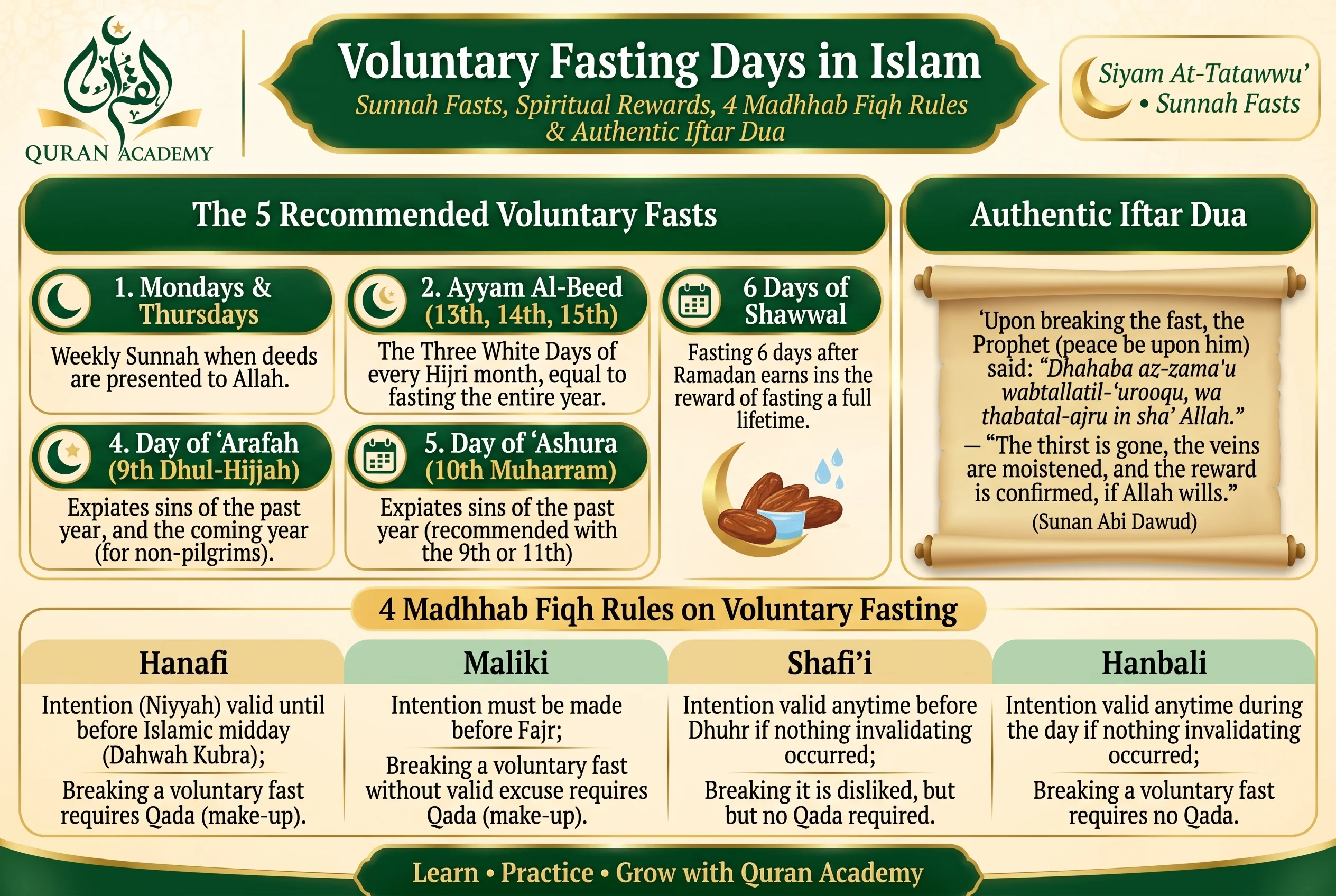
✦ Quick Answer & Key Takeaways: Voluntary Fasting Days in Islam
Mastering the voluntary fasting days in Islam (صِيَامُ التَّطَوُّعِ وَالسُّنَنِ الرَّوَاتِبِ فِي الصِّيَامِ) keeps your soul connected to the spirituality of Ramadan all year round while earning the special Paradise gate of Ar-Rayyan (الرَّيَّانُ — Sahih al-Bukhari 1896)! Prophet Muhammad (ﷺ) promised in Sahih al-Bukhari (2840) and Sahih Muslim (1153): « مَنْ صَامَ يَوْمًا فِي سَبِيلِ اللَّهِ بَعَّدَ اللَّهُ وَجْهَهُ عَنِ النَّارِ سَبْعِينَ خَرِيفًا » ("Whoever fasts a single day for the sake of Allah, Allah will distance his face from the Fire by seventy years!"). Across the Hijri calendar, Sunnah fasting is organized into Weekly Fasts (Mondays & Thursdays), Monthly Fasts (3 days every month, especially the White Days / Ayyam Al-Beed: 13th, 14th & 15th), and Annual Seasonal Fasts (6 Days of Shawwal, First 9 Days of Dhul-Hijjah crowned by the Day of 'Arafah, 'Ashura on the 9th & 10th of Muharram, and Sha'ban). In our 1-on-1 Online Islamic Studies, Fiqh & Quran Program, families learn how to pair Sunnah fasting with daily Quran recitation!
- Why Do 3 Days a Month Equal Fasting the Whole Year? (Muslim 1159): Because every good deed is multiplied by 10 (Surah Al-An'am 6:160):
3 days × 10 = 30 days (the entire month!), and Ramadan (30 × 10 = 300) + 6 Days of Shawwal (6 × 10 = 60) = 360 days (the entire year!). - 'Arafah (2 Years) vs. 'Ashura (1 Year) Expiation (Muslim 1162): Fasting the 9th of Dhul-Hijjah expiates 2 years of minor sins; fasting the 10th of Muharram expiates 1 year!
- Morning Intention Concession (Muslim 1154): You may form the intention for a general voluntary fast in the morning after Fajr if you haven't eaten or drunk!
- The 5 Forbidden Days to Fast: The 2 Eid days + the 3 Days of Tashreeq (11th, 12th & 13th of Dhul-Hijjah).
Just as Allah Almighty surrounded the 5 daily obligatory prayers with the 12 Sunnah Rawatib Prayers and Salat Ad-Duha to mend any deficiency in our obligatory Salah on the Day of Judgment, He surrounded the obligatory month of Ramadan (the 4th pillar in our 5 Pillars of Islam Guide!) with a treasury of voluntary Sunnah fasts (صِيَامُ التَّطَوُّعِ) throughout the year!
In the famous Hadith Qudsi in Sahih al-Bukhari (1894 & 6502), Allah Almighty declared: « كُلُّ عَمَلِ ابْنِ آدَمَ لَهُ إِلَّا الصِّيَامَ، فَإِنَّهُ لِي وَأَنَا أَجْزِي بِهِ » ("Every deed of the son of Adam is for him except fasting—for indeed it is for Me, and I Myself shall reward it!"). Yet Muslims often ask five practical Fiqh questions about voluntary fasting: "What if I cannot fast the exact 13th, 14th, and 15th of the Hijri month because of work—can I fast any 3 days of the month? Can a sister fast the 6 Days of Shawwal or the Day of 'Arafah before finishing her missed Ramadan Qada days? Can I wake up at 9:00 AM, realize I haven't eaten since Fajr, and decide to fast today? What if my host offers me food while I am fasting a voluntary fast? And what is the most authentic Dua to say at Iftar?" Below, we answer all five with our Master Annual & Monthly Sunnah Fasting Chart, the 4 Madhhab Fiqh Comparison, and the Authentic Iftar Duas With Tajweed.
- 1. Master Calendar Chart: All 7 Categories of Voluntary Fasting in Islam & Their Hadith Rewards
- 2. Deep Dive #1: Weekly (Mondays & Thursdays) & Monthly Fasts (Ayyam Al-Beed: 13th, 14th & 15th)
- 3. Deep Dive #2: Annual Fasts — 6 Days of Shawwal, Day of 'Arafah, 'Ashura & Sha'ban
- 4. Master Fiqh Chart Across 4 Madhhabs: Morning Intention, Qada Before Shawwal & Breaking a Voluntary Fast
- 5. The Authentic Prophetic Iftar Duas & 4 Essential Tajweed Rules
- 6. Frequently Asked Questions (FAQs)
1. Master Calendar Chart: All 7 Categories of Voluntary Fasting in Islam
You can verify every Hadith reference below in our Online Hadith Explorer. Here is your complete year-round Sunnah fasting roadmap:
| # & Voluntary Fast | When It Occurs | Prophetic Reward & Authentic Hadith Proof |
|---|---|---|
| 1. Mondays & Thursdays (صِيَامُ الِاثْنَيْنِ وَالْخَمِيسِ) ⭐ |
Every Week | "Deeds are presented on Monday and Thursday, so I love that my deeds be presented while I am fasting!" (Sunan at-Tirmidhi 747 — Sahih). And Monday is the day the Prophet (ﷺ) was born and received revelation (Sahih Muslim 1162)! |
| 2. The 3 White Days (أَيَّامُ الْبِيضِ) ⭐ |
13th, 14th & 15th of Every Hijri Month | Equals Fasting the Entire Year (صِيَامُ الدَّهْرِ)! Because each day is multiplied by 10 (= 30 days every month!), as advised to Abu Hurayrah and Abu Dharr RA (Sahih al-Bukhari 1978 & An-Nasa'i 2424). |
| 3. Six Days of Shawwal (سِتٌّ مِنْ شَوَّالٍ) |
Any 6 Days in Shawwal (From 2nd of Shawwal) | « مَنْ صَامَ رَمَضَانَ ثُمَّ أَتْبَعَهُ سِتًّا مِنْ شَوَّالٍ كَانَ كَصِيَامِ الدَّهْرِ » "Whoever fasts Ramadan and follows it with six days of Shawwal, it is as if he fasted for a lifetime/the entire year!" (Sahih Muslim 1164). |
| 4. Day of 'Arafah (& First 9 of Dhul-Hijjah) 🏆 | 1st – 9th of Dhul-Hijjah (For Non-Pilgrims!) | Expiates 2 Full Years of Minor Sins (The Previous Year & The Coming Year)! (Sahih Muslim 1162)—and righteous deeds in the first 10 days of Dhul-Hijjah are more beloved to Allah than in any other days (Bukhari 969)! |
| 5. Day of 'Ashura (& Month of Muharram) ⭐ | 9th + 10th (or 10th + 11th) of Muharram | Expiates 1 Full Year of Previous Minor Sins (Sahih Muslim 1162)! Commemorates the day Allah saved Prophet Musa (AS) and drowned Pharaoh; the best fast after Ramadan is in Allah's month of Muharram (Muslim 1163)! |
| 6. Fasting in Sha'ban (صِيَامُ شَعْبَانَ) |
Majority of the Month Before Ramadan | 'Aishah (RA) said the Prophet (ﷺ) never fasted in any month outside Ramadan more than in Sha'ban (Bukhari 1969)—the month in which annual deeds are raised to the Lord of the Worlds (An-Nasa'i 2357)! |
| 7. Fast of Prophet Dawud (AS) (صِيَامُ دَاوُودَ عَلَيْهِ السَّلَامُ) |
Fasting 1 Day & Breaking 1 Day | The Most Beloved Voluntary Fast to Allah (Sahih al-Bukhari 1979): Fasting every other day (half the year)—and the Prophet (ﷺ) forbade going beyond this ceiling! |
2. Deep Dive #1: Weekly (Mondays & Thursdays) & Monthly Fasts (Ayyam Al-Beed)
Why are Mondays & Thursdays and the 3 White Days (أَيَّامُ الْبِيضِ) the easiest habits for busy parents, students, and professionals to maintain all year round?
- 1. Why Are the 13th, 14th, and 15th Called "Ayyam Al-Beed" (Days of the White Nights)?
In Arabic grammar (applying our Singular, Dual & Plural Guide!), the phrase أَيَّامُ الْبِيضِ (Ayyaamul-Beed) literally means "The Days of the White [Nights]"—because on the 13th, 14th, and 15th of every lunar Hijri month, the moon is a full, glowing circle that illuminates the sky in white from sunset until dawn!
• Flexible Bonus Rule (Sahih Muslim 1160): What if you are traveling, working, or a sister is on her monthly cycle during the 13th, 14th, and 15th? Mother of the Believers 'Aishah (RA) narrated in Sahih Muslim (1160) that the Prophet (ﷺ) used to fast 3 days of every month without restricting them to specific dates—so fasting ANY 3 days of the Hijri month (whether at the beginning, middle, or end, or combining them with two Mondays and a Thursday!) still earns you the full 30-day reward! *(Note: In the month of Dhul-Hijjah, because the 13th of Dhul-Hijjah is the final Day of Tashreeq when fasting is forbidden, scholars recommend fasting the 14th, 15th, and 16th instead!).* - 2. Combining Intentions (Tashreek An-Niyyah) When White Days Fall on Monday/Thursday:
What if the 13th of the Hijri month happens to be a Monday or Thursday? Scholars like Imam An-Nawawi and Shaykh Ibn 'Uthaymeen explain that because both are voluntary Sunnah fasts intended to keep that day occupied with fasting, you can intend BOTH the Monday/Thursday fast AND the White Day fast together and earn both rewards by Allah's grace!
3. Deep Dive #2: Annual Fasts — 6 Days of Shawwal, Day of 'Arafah & 'Ashura
Here are the essential rules for the three crown-jewel seasonal fasts of the Islamic year:
- The 6 Days of Shawwal (Must They Be Consecutive?):
According to the majority of jurists (Hanafi, Shafi'i, and Hanbali), the 6 Days of Shawwal do NOT have to be fasted consecutively right after Eid—you may fast them together OR spread them out comfortably (e.g., every Monday and Thursday across Shawwal) anytime between the 2nd of Shawwal and the 29th/30th of Shawwal! - The Day of 'Arafah (9th of Dhul-Hijjah — Why Non-Pilgrims Fast While Pilgrims Don't!):
While Fasting the Day of 'Arafah is the single greatest single-day expiation of the year (wiping away 2 full years of minor sins, Sahih Muslim 1162), Prophet Muhammad (ﷺ) did NOT fast on the Day of 'Arafah while standing at 'Arafah during Hajj (Sahih al-Bukhari 1988) so that pilgrims have full physical strength for Dua and remembrance during the afternoon of 'Arafah! - The 3 Ranks of Fasting 'Ashura (9th, 10th & 11th of Muharram):
When the Prophet (ﷺ) arrived in Madinah (1 AH in our Seerah Timeline) and saw the people of the Book fasting the 10th of Muharram in gratitude for Allah saving Prophet Musa (AS), he said: « فَأَنَا أَحَقُّ بِمُوسَى مِنْكُمْ » ("I have more right to Musa than you!") (Bukhari 2004), and at the end of his life resolved: « لَئِنْ بَقِيتُ إِلَى قَابِلٍ لَأَصُومَنَّ التَّاسِعَ » ("If I live until next year, I will surely fast the 9th [Tasu'a] as well!") (Muslim 1134). Thus Imam Ibn al-Qayyim summarized the 3 valid ways to fast 'Ashura: (a) 9th + 10th + 11th, (b) 9th + 10th (Primary Sunnah!), or (c) 10th + 11th (and fasting the 10th alone is also valid and earns the 1-year expiation if someone missed the 9th!).
4. Master Fiqh Chart Across 4 Madhhabs: Morning Intention, Qada Before Shawwal & Breaking a Voluntary Fast
Compare the four Sunni schools on the three most practical Fiqh questions about voluntary fasting:
| Fiqh Question | Majority Ruling & Hadith Proof | Madhhab Nuances |
|---|---|---|
| 1. Can You Make the Intention After Fajr in the Morning? | YES in the Hanafi, Shafi'i, and Hanbali schools! Proof: In Sahih Muslim (1154), the Prophet (ﷺ) entered upon 'Aishah (RA) one morning and asked: "Do you have any food?" When she said "No," he said: « فَإِنِّي إِذَنْ صَائِمٌ » ("Then indeed, I am fasting!")—provided you haven't eaten or drunk since Fajr and intend before Zawal (midday)! |
• Maliki School: Requires intention before Fajr for both obligatory and voluntary fasts. • Tip for Specific Day Fasts ('Arafah / 'Ashura / 6 of Shawwal): Intend the night before so you capture 100% of the full-day reward! |
| 2. Fasting 6 Days of Shawwal (Or 'Arafah) Before Finishing Missed Ramadan Qada? | Valid & Permissible in the Hanafi, Maliki, and Shafi'i schools (and a narration in Hanbali, because 'Aishah RA used to make up her missed Ramadan days in Sha'ban, Sahih al-Bukhari 1950!), though completing your obligatory Ramadan Qada first and then fasting the 6 Days of Shawwal is universally agreed to be best so you literally fulfill "Whoever fasts Ramadan and THEN follows it with six..."! | • Standard Hanbali View: To earn the specific 1-year Hadith reward of the 6 of Shawwal, complete your Ramadan Qada days first (whereas fasting 'Arafah or 'Ashura before finishing Qada is valid by consensus!). |
| 3. Can You Break a Voluntary Fast If Invited as a Guest (And Must You Make It Up)? 🏆 | Permissible & ZERO Make-Up (Qada) Required in the Shafi'i and Hanbali schools! Proof: In Sahih al-Bukhari (5199) & Tirmidhi (732): « الصَّائِمُ الْمُتَطَوِّعُ أَمِيرُ نَفْسِهِ، إِنْ شَاءَ صَامَ وَإِنْ شَاءَ أَفْطَرَ » ("The voluntary faster is the ruler of himself: if he wishes, he continues fasting, and if he wishes, he breaks his fast!"). |
• Hanafi & Maliki Schools: Once you start a voluntary fast, completing it becomes obligatory, and if broken without an excuse, that 1 day is made up later (though completing any worship you start is always best across all 4 schools!). |
5. The Authentic Prophetic Iftar Duas & 4 Essential Tajweed Rules
In Sahih al-Bukhari (1904), the Prophet (ﷺ) said: « لِلصَّائِمِ فَرْحَتَانِ يَفْرَحُهُمَا: إِذَا أَفْطَرَ فَرِحَ، وَإِذَا لَقِيَ رَبَّهُ فَرِحَ بِصَوْمِهِ » ("The fasting person has two moments of joy: when he breaks his fast he rejoices, and when he meets his Lord he rejoices over his fast!"). When Maghrib enters, break your fast with fresh dates (Rutab), or dry dates (Tamr), or sips of water saying "Bismillaah", and then recite the most authentic Prophetic Iftar Dua (recorded in Sunan Abu Dawud 2357 — graded Hasan/Sahih from 'Abdullah ibn 'Umar RA):
« ذَهَبَ ٱلظَّمَأُ، وَٱبْتَلَّتِ ٱلْعُرُوقُ، وَثَبَتَ ٱلْأَجْرُ إِنْ شَاءَ ٱللَّهُ »
Transliteration: Dhahabadh-dhama'u, wabtallatil-'urooqu, wa thabatal-ajru in shaa' Allaah.
Struggling to Perfect Your Recitation?
Join 1,250+ students mastering the Quran 1-on-1 with our Verified Al-Azhar Graduates. Flexible US, UK, Canadian & Australian schedules starting at $8/hr.
Book a Free Evaluation Class →Meaning: "The thirst has gone, the veins are moistened, and the reward is established, if Allah wills!" *(And you may also add the famous classical supplication: **ٱللَّهُمَّ لَكَ صُمْتُ، وَعَلَىٰ رِزْقِكَ أَفْطَرْتُ** — Abu Dawud 2358).*
• And What to Say When Breaking Fast as a Guest at Someone's Home (Abu Dawud 3854 — Sahih):
« أَفْطَرَ عِنْدَكُمُ ٱلصَّائِمُونَ، وَأَكَلَ طَعَامَكُمُ ٱلْأَبْرَارُ، وَصَلَّتْ عَلَيْكُمُ ٱلْمَلَائِكَةُ »
(Aftara 'indakumus-saa'imoon, wa akala ta'aamakumul-abraar, wa sallat 'alaykumul-malaa'ikah — "May the fasting break their fast with you, may the righteous eat your food, and may the angels pray for blessings upon you!").
Mastering the 3 Qalqalah Bounces in the Iftar Dua: "Wabْtallati", "Al-'Urooqْ" & "Al-Ajْru"!
Look closely at the authentic Prophetic Iftar Dua above: وَٱبْتَلَّتِ ٱلْعُرُوقُ (Wabْtallatil-'Urooqْ), وَثَبَتَ ٱلْأَجْرُ (Al-Ajْru), and ٱلْأَبْرَارُ (Al-Abْraar)! In just six words, you articulate three of the 5 Qalqalah (Echoing) letters (بْ، قْ، جْ)! Watch Senior Instructor Ustadhah Yasmeen Gamal demonstrate Qalqalah on our Quran Academy YouTube Channel:
- Sughra on "Wabْtallati" & "Al-Ajْru": Bounce the silent Baa and Jeem cleanly in the middle of the word!
- 1-on-1 Live Coaching: Combine your Sunnah fasts with live Quran & Tajweed sessions!
Before reciting the Iftar Dua or the Quranic fasting verses (Surah Al-Baqarah 2:183–185, openable in our Online Uthmani Quran Explorer), check these four Tajweed rules from our 1-on-1 Online Tajweed Course:
- 1. Three Interdental Letters in One Line ("Dhahabadh-Dhama'u ... Wa Thabatal-Ajru"):
Applying our Makharij al-Huruf Guide and Laam Shamsiyyah Guide, notice that the Iftar Dua tests all 3 interdental tongue-tip letters (ذ، ظ، ث) in a single breath: (a) Light ذَ (Dha-haba), (b) Heavy merged Sun Letter ٱلظَّمَأُ (-dh-Dha-ma'u), and (c) Light whispered وَثَبَتَ (Wa Tha-bata)! - 2. Light Ikhfaa' + Madd Wajib Muttasil in "In Shaa' Allaah" (إِنْ شَاءَ ٱللَّهُ):
Using our Noon Sakinah Guide and Rules of Madd Guide, conceal the Noon Sakinah before Sheen for 2 beats (In-shaaaa'a) and stretch the Alif before the Hamzah for 4 to 5 beats! - 3. Whispering "Hams" on the Kaaaf Sakinah of "Kutiba 'Alaykumus-Siyaam" (2:183):
According to our Sifaat al-Huruf and Heavy & Light Letters guides, in لَعَلَّكُمْ تَتَّقُونَ (2:183), keep the Meem Sakinah crisp with Izhar Shafawi before the light Taa, and elevate the heavy Qaaf of Tatta-qoon! - 4. Heavy Raa across "Shahru Ramadaan", "Al-'Urooq", "Al-Ajr" & "Al-Abraar":
Following our Ahkam Al-Raa, Meem Sakinah Rules, Rules of Waqf, Hamzatul Wasl vs. Qat', 4 Special Words of Hafs, 7 Alifs in the Quran, Idgham Mutamathilayn, Mutajanisayn & Mutaqaribayn, 10 Qira'at, Lahn Jali vs. Lahn Khafi, An-Nabr (Vocal Stress), and 15 Sajdah Tilawah Verses guides, pronounce the Raa in شَهْرُ رَمَضَانَ (2:185), ٱلْعُرُوقُ, ٱلْأَجْرُ, and ٱلْأَبْرَارْ 100% Heavy (Tafkhim)! Test your Tajweed accuracy right now on our Free 3-Minute Tajweed Quiz!
Pair your voluntary fasting days with our complete library of Fiqh, Seerah, and Quranic guides: How to Pray Salat Al-Kusoof, Newborn Baby Sunnahs & 'Aqeeqah Rules, Mothers of the Believers, The 10 Promised Paradise, 4 Stories of Surah Al-Kahf for Kids, 50 Most Common Arabic Roots, Arabic Pronouns Chart, Harf Al-Jarr Prepositions, Verbs in Quranic Arabic, How to Memorize Juz Tabarak, Surah Al-Qalam, Surah Nuh, Surah Al-Muzzammil, and 30-Day Quran Khatmah Schedule in our Online Hifz Program (using our Smart Hifz Planner)! Meet our Al-Azhar Certified Tutors, enroll your child in our 1-on-1 Kids Quran Classes with our Printable Kids Star Chart, and read how families across the US, UK, Canada, and Australia rate our teachers on our Verified Student & Parent Reviews Page.
6. Frequently Asked Questions (FAQs) About Voluntary Fasting in Islam
1. What are the main voluntary fasting days in Islam throughout the year?
The 7 primary categories of voluntary Sunnah fasting (Siyam At-Tatawwu') in Islam are: (1) Weekly fasting on Mondays and Thursdays (when deeds are presented to Allah), (2) Monthly fasting of the 3 White Days (Ayyam Al-Beed: the 13th, 14th, and 15th of every Hijri month), (3) Fasting 6 Days of Shawwal after Ramadan, (4) Fasting the Day of 'Arafah (9th of Dhul-Hijjah, for non-pilgrims) and the first 9 days of Dhul-Hijjah, (5) Fasting 'Ashura (10th of Muharram, paired with the 9th or 11th) and much of Muharram, (6) Fasting much of the month of Sha'ban, and (7) The Fast of Prophet Dawud (AS — fasting every other day).
2. What is the difference in reward between fasting the Day of 'Arafah and the Day of 'Ashura?
Recorded in Sahih Muslim (1162) from Abu Qatadah (RA), Prophet Muhammad (ﷺ) stated: "Fasting the Day of 'Arafah (9th of Dhul-Hijjah), I hope from Allah, expiates the minor sins of the year before it AND the year after it (two full years!); and fasting the Day of 'Ashura (10th of Muharram), I hope from Allah, expiates the minor sins of the year before it (one full year)!"
3. Can you make the intention (Niyyah) for a voluntary fast in the morning after Fajr?
In the Hanafi, Shafi'i, and Hanbali schools (based on the Hadith of 'Aishah RA in Sahih Muslim 1154), unlike obligatory Ramadan or Qada fasts—which require an intention before Fajr—it is completely valid to form the intention for a general voluntary fast after Fajr in the morning (before midday/Zawal), provided you have not eaten, drunk, or done anything that breaks the fast since Fajr! In the Maliki school, the intention must be made before Fajr.
4. What happens if someone who is voluntarily fasting eats or drinks out of forgetfulness?
According to the Hadith of Abu Hurayrah (RA) in Sahih al-Bukhari (1933) and Sahih Muslim (1155): "Whoever forgets while he is fasting and eats or drinks, let him complete his fast—for it is only Allah Who has fed him and given him drink!" Whether you are fasting an obligatory Ramadan fast or a voluntary Sunnah fast, eating or drinking by mistake out of genuine forgetfulness does NOT break your fast!
5. Which days of the year is it strictly forbidden (Haram) to fast in Islam?
It is strictly forbidden (Haram) to fast on 5 days of the year: (1) The Day of Eid Al-Fitr (1st of Shawwal), (2) The Day of Eid Al-Adha (10th of Dhul-Hijjah), and (3, 4, & 5) The 3 Days of Tashreeq (11th, 12th, and 13th of Dhul-Hijjah, except for a Hajj pilgrim who cannot afford the Hady sacrifice in the Maliki/Shafi'i/Hanbali view). Additionally, singling out Friday or Saturday alone without a day before or after it (unless it coincides with a regular habit or 'Arafah/'Ashura) is disliked.
Let Fasting & the Quran Intercede for You on the Day of Judgment!
In Musnad Ahmad (6626), the Prophet (ﷺ) promised that Fasting and the Quran will both intercede for the servant on the Day of Resurrection! Build your daily Quran, Tajweed, and Hifz habit with certified male and female Al-Azhar scholars today.
Book Your Free 1-on-1 Trial Class →