
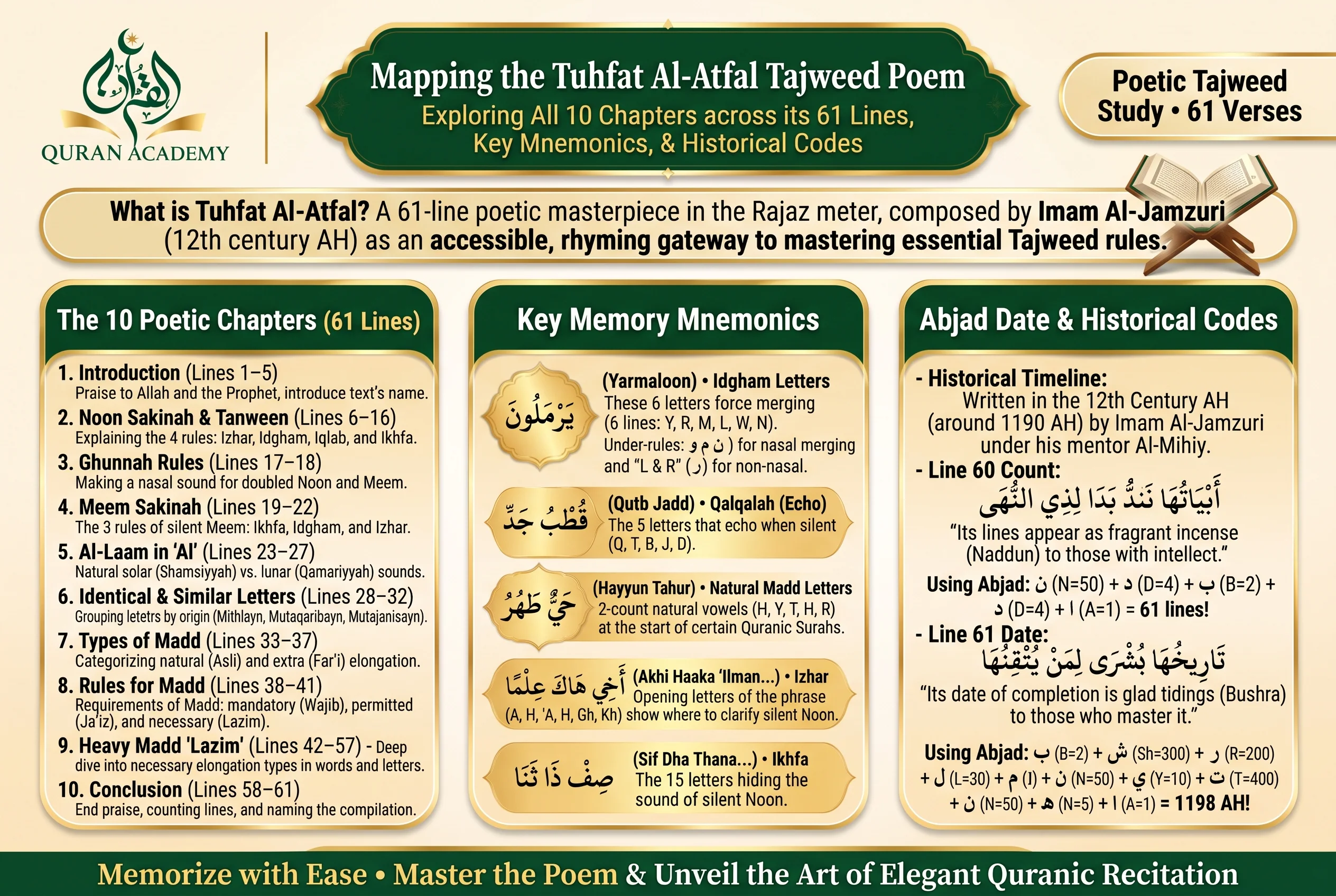
✦ Quick Answer & Key Takeaways: The Tuhfat Al-Atfal Tajweed Poem
Mastering the Tuhfat Al Atfal Tajweed poem (مَتْنُ تُحْفَةِ الْأَطْفَالِ وَالْغِلْمَانِ فِي تَجْوِيدِ الْقُرْآنِ) is the universal first gateway to earning an authentic, unbroken Sanad & Ijazah in Tajweed! Composed in 1198 AH (1784 CE) by the renowned Egyptian Al-Azhar scholar Imam Sulayman ibn Husayn Al-Jamzuri (رحمه الله), this 61-verse rhyming poem distills 80% of daily practical Tajweed into 10 melodic chapters: (1) Introduction, (2) Noon Sakinah & Tanween, (3) Noon & Meem Mushaddadatayn, (4) Meem Sakinah, (5) Laam of "Al-" & Verb Laam, (6) Mutamathilayn, Mutaqaribayn & Mutajanisayn, and (7–9) the complete architecture of Madd (Elongation) & Disjointed Letters! In our 1-on-1 Online Tajweed & Ijazah Program, kids and adults memorize and receive a certified Ijazah in Tuhfat Al-Atfal in just 6 days!
- Why Every Student Memorizes Tuhfat Al-Atfal First: Because every famous Tajweed mnemonic you use today—like يَرْمَلُون (Yarmaloon), إِبْغِ حَجَّكَ وَخَفْ عَقِيمَهُ, طِبْ ثُمَّ صِلْ رُحْمًا..., and حَيٌّ طَهُرْ—comes directly from the verses of this poem!
- The Hidden Abjad Code in Verse 59: نَدٌّ بَدَا (Naddun Badaa) =
50 + 4 + 2 + 4 + 1 = 61 Verses, and بُشْرَىٰ لِمَن يُتْقِنُهَا =Year 1198 AH! - Level 1 (Al-Jamzuri) → Level 2 (Ibn Al-Jazari): Pair Tuhfat Al-Atfal (61 lines on Noon, Meem, Laam & Madd) with Matn Al-Jazariyyah (109 lines on Makharij, Sifaat & Waqf)!
- 6-Day Memorization Plan: Memorize just 10 rhyming lines per day!
Have you ever wondered why, when your Tajweed teacher explains the 14 Moon Letters of Laam Qamariyyah, they immediately quote the phrase « إِبْغِ حَجَّكَ وَخَفْ عَقِيمَهُ »? Or why, when teaching the 15 letters of Ikhfaa' Haqiqi, every Tajweed book on earth quotes the exact same 15-word poem starting with « صِفْ ذَا ثَنَا كَمْ جَادَ شَخْصٌ قَدْ سَمَا... »? Where did all those brilliant memory formulas come from?
Every single one of them comes from a 61-verse masterpiece written over 240 years ago in Tanta, Egypt by the great Shafi'i and Al-Azhar Qira'at scholar Imam Sulayman ibn Husayn ibn Muhammad Al-Jamzuri (born ~1160s AH, composed the poem in 1198 AH), who summarized the teachings of his beloved Shaykh, Nur Ad-Din 'Ali ibn 'Umar Al-Mihi (رحمهما الله)! Instead of forcing beginners and children to memorize dry pages of prose rules that are easily forgotten, Imam Al-Jamzuri wove every rule of Noon Sakinah, Meem Sakinah, Laam Sakinah, Idgham, and Madd into a joyful, rhythmic poem called تُحْفَةُ الْأَطْفَالِ وَالْغِلْمَانِ فِي تَجْوِيدِ الْقُرْآنِ (Tuhfat Al-Atfal wal-Ghilman fi Tajweed Al-Quran). Building upon our guides to Iltiqa' As-Sakinayn in Tajweed and How to Get an Online Quran Ijazah, this complete guide breaks down the 10 Chapters of Tuhfat Al-Atfal, the 8 Golden Mnemonic Codes Inside the Poem, the Key Verses of Every Chapter With Commentary, and a 6-Day Memorization Plan.
- 1. Master Blueprint: All 10 Chapters & 61 Verses of Matn Tuhfat Al-Atfal Mapped Out
- 2. The 8 Golden Mnemonic Codes Inside Tuhfat Al-Atfal (Unlocking 80% of Tajweed Letters!)
- 3. Part 1 (Verses 1 to 34): Introduction, Noon Sakinah, Meem Sakinah, Laam & Idgham Chapters
- 4. Part 2 (Verses 35 to 61): The 3 Madd Chapters, Disjointed Letters & The Verse 59 Abjad Secret!
- 5. How to Memorize Tuhfat Al-Atfal in 6 Days & Earn Your Sanad Ijazah Online
- 6. Frequently Asked Questions (FAQs)
1. Master Blueprint: All 10 Chapters & 61 Verses of Matn Tuhfat Al-Atfal
Before diving into the verses, look at how logically Imam Al-Jamzuri (رحمه الله) architected all 61 lines into two halves: Lines 1–34 cover the rules of Consonants (Noon, Meem, Laam, and Letter Relationships), while Lines 35–61 cover the complete science of Vowels & Elongation (Al-Mudood):
| Chapter # & Title | Verse Numbers | Core Tajweed Rules Covered & Matching Deep-Dive Guide |
|---|---|---|
| 1. Introduction (الْمُقَدِّمَةُ) | Verses 1 – 5 (5 lines) |
Praise to Allah, Salawat upon Prophet Muhammad (ﷺ), naming author Sulayman Al-Jamzuri and his teacher Al-Mihi, and praying for acceptance! |
| 2. Noon Sakinah & Tanween (أَحْكَامُ النُّونِ السَّاكِنَةِ وَالتَّنْوِينِ) ⭐ |
Verses 6 – 16 (11 lines) |
The 4 Rulings: (1) Izhar Halqi (6 throat letters), (2) Idgham in Yarmaloon (with & without Ghunnah, + the 4 Izhar Mutlaq exceptions!), (3) Iqlab before Baa, and (4) Ikhfaa' in 15 letters → Full Noon Sakinah Guide. |
| 3. Meem & Noon Mushaddadatayn | Verse 17 (1 line) |
Obligatory 2-beat nasal Ghunnah on every مّ and نّ with a Shaddah! |
| 4. Meem Sakinah (أَحْكَامُ الْمِيمِ السَّاكِنَةِ) ⭐ |
Verses 18 – 23 (6 lines) |
The 3 Lip Rules: (1) Ikhfaa' Shafawi before Baa, (2) Idgham Mithlayn Sagheer before Meem, and (3) Izhar Shafawi before the remaining 26 letters (with special warning on و and ف!) → Full Meem Sakinah Guide. |
| 5. Laam of "Al-" & Verb Laam (حُكْمُ لَامِ آلْ وَلَامِ الْفِعْلِ) |
Verses 24 – 29 (6 lines) |
The 14 Moon Letters (Izhar Qamari), the 14 Sun Letters (Idgham Shamsi), and pronouncing Verb Laam clearly except before ل and ر → Full Sun & Moon Letters Guide. |
| 6. Mithlayn, Mutaqaribayn & Mutajanisayn | Verses 30 – 34 (5 lines) |
Defines Identical, Close, and Homogeneous letter pairs and distinguishes Sagheer (1st silent, 2nd voweled) from Kabeer (both voweled) → Full Idgham Relationships Guide. |
| 7. Divisions of Madd (أَقْسَامُ الْمَدِّ) | Verses 35 – 41 (7 lines) |
Natural Madd (Asli / Tabee'i = 2 beats in نُوحِيهَا) vs. Secondary Madd (Far'i caused by Hamzah or Sukoon), plus Madd Leen! |
| 8. Rulings of Madd (أَحْكَامُ الْمَدِّ) ⭐ | Verses 42 – 47 (6 lines) |
The 3 Rulings of Madd Far'i: (1) Al-Wujub (Madd Wajib Muttasil), (2) Al-Jawaz (Munfasil, 'Aarid lis-Sukoon, & Badal), and (3) Al-Luzum (Madd Lazim) → Full Rules of Madd Guide. |
| 9. Subtypes of Madd Lazim 🏆 (أَقْسَامُ الْمَدِّ اللَّازِمِ) |
Verses 48 – 57 (10 lines) |
The 4 Subtypes of 6-Beat Madd Lazim (Kalimi Muthaqqal, Kalimi Mukhaffaf, Harfi Muthaqqal, & Harfi Mukhaffaf) and the 14 Disjointed Letters (Huroof Muqatta'at)! |
| 10. Conclusion (الْخَاتِمَةُ) | Verses 58 – 61 (4 lines) |
Praise to Allah upon completion, the Verse 59 Abjad riddle (61 lines in 1198 AH), and final Salawat upon the Prophet (ﷺ)! |
2. The 8 Golden Mnemonic Codes Inside Tuhfat Al-Atfal
Before memorizing the full poem, memorize these 8 famous mnemonic phrases coined or immortalized by Imam Al-Jamzuri (and searchable in our Interactive Tajweed Encyclopedia):
6 letters of Idgham = يَرْمَلُون: 4 with Ghunnah (يَنْمُو) + 2 without Ghunnah (ل، ر)!
The 1st letter of each of the 15 words in Verse 16 gives you all 15 Ikhfaa' letters: ص ذ ث ك ج ش ق س د ط ز ف ت ض ظ!
14 Moon Letters in one phrase + 14 Sun Letters at the start of the 14 words of Verse 27!
نُوحِيهَا = 3 Madd letters; كَمْ عَسَلْ نَقَصْ = 8 letters of 6-beat Madd Lazim Harfi; حَيٌّ طَهُرْ = 5 letters of 2-beat Madd Tabee'i Harfi!
3. Part 1 (Verses 1 to 34): Key Anchor Verses & Commentary on Consonant Rules
Here are the signature anchor verses of Chapters 1 to 6 of Matn Tuhfat Al-Atfal, with full Tashkeel and concise scholarly commentary:
- Chapter 1 — Opening Lines (Verses 1–5):
١- يَقُولُ رَاجِي رَحْمَةِ الْغَفُورِ ... دَوْمًا سُلَيْمَانُ هُوَ الْجَمْزُورِي
٤- سَمَّيْتُهُ بِتُحْفَةِ الْأَطْفَالِ ... عَنْ شَيْخِنَا الْمِيهِيِّ ذِي الْكَمَالِ Commentary: Notice how Imam Sulayman Al-Jamzuri opens by calling himself "the one constantly hoping for the Mercy of the All-Forgiving (Al-Ghafoor)" and credits his teacher Shaykh Al-Mihi right in Line 4—teaching every student the etiquette of honoring one's teachers in the chain of transmission! - Chapter 2 — Noon Sakinah & Tanween (Verses 6–16):
٦- لِلنُّونِ إِنْ تَسْكُنْ وَلِلتَّنْوِينِ ... أَرْبَعُ أَحْكَامٍ فَخُذْ تَبْيِينِي
٨- هَمْزٌ فَهَاءٌ ثُمَّ عَيْنٌ حَاءُ ... مُهْمَلَتَانِ ثُمَّ غَيْنٌ خَاءُ
١١- إِلَّا إِذَا كَانَا بِكَلْمَةٍ فَلَا ... تُدْغِمْ كَدُنْيَا ثُمَّ صِنْوَانٍ تَلَا
١٦- صِفْ ذَا ثَنَا كَمْ جَادَ شَخْصٌ قَدْ سَمَا ... دُمْ طَيِّبًا زِدْ فِي تُقًى ضَعْ ظَالِمَا Commentary: Look at the genius of Line 8 (where Muhmalataan means ع and ح have no dots, while غ and خ have dots!) and Line 11 (warning that if Noon Sakinah meets Waw or Yaa inside ONE word—like دُنْيَا، صِنْوَانٌ، قِنْوَانٌ، بُنْيَانٌ—you must NOT merge them, pronouncing Izhar Mutlaq!). - Chapters 3 & 4 — Ghunnah & Meem Sakinah (Verses 17–23):
١٧- وَغُنَّ مِيمًا ثُمَّ نُونًا شُدِّدَا ... وَسَمِّ كُلًّا حَرْفَ غُنَّةٍ بَدَا
٢٣- وَاحْذَرْ لَدَى وَاوٍ وَفَا أَنْ تَخْتَفِي ... لِقُرْبِهَا وَالِاتِّحَادِ فَاعْرِفِ Commentary: Line 23 contains the golden rule of Izhar Shafawi: beware of hiding a silent Meem (مْ) when it meets و (Waw) or ف (Faa), because Meem shares the exact same lip articulation point (Ittihad) with Waw and is very close (Qurb) to Faa! - Chapters 5 & 6 — Laam Rules & Letter Relationships (Verses 24–34):
٢٥- أُولَاهُمَا إِظْهَارُهَا فَلْتَعْرِفِ ... قَبْلَ أَرْبَعٍ مَعْ عَشْرَةٍ خُذْ عِلْمَهُ مِنْ (إِبْغِ حَجَّكَ وَخَفْ عَقِيمَهُ)
٢٩- وَأَظْهِرَنَّ لَامَ فِعْلٍ مُطْلَقَا ... فِي نَحْوِ قُلْ نَعَمْ وَقُلْنَا وَالْتَقَى Commentary: Line 29 highlights the 3 classic exam words where beginners accidentally swallow a silent Verb Laam: قُلْ نَعَمْ (37:18), وَقُلْنَا, and وَٱلْتَقَى ٱلْمَاءُ (54:12)!
4. Part 2 (Verses 35 to 61): The 3 Madd Chapters & The Verse 59 Abjad Secret!
In the second half of the poem (Verses 35–61), Imam Al-Jamzuri gives the clearest summary of The Rules of Madd in Tajweed ever written in Arabic poetry, culminating in the famous Abjad numerical code of Verse 59:
Struggling to Perfect Your Recitation?
Join 1,250+ students mastering the Quran 1-on-1 with our Verified Al-Azhar Graduates. Flexible US, UK, Canadian & Australian schedules starting at $8/hr.
Book a Free Evaluation Class →٣٩-حُرُوفُهُ ثَلَاثَةٌ فَعِيهَا ... مِنْ لَفْظِ (وَايٍ) وَهْيَ فِي (نُوحِيهَا)
٤٢- لِلْمَدِّ أَحْكَامٌ ثَلَاثَةٌ تَدُومْ ... وَهْيَ الْوُجُوبُ وَالْجَوَازُ وَاللُّزُومْ
٤٨- أَقْسَامُ لَازِمٍ لَدَيْهِمْ أَرْبَعَةْ ... وَتِلْكَ كِلْمِيٌّ وَحَرْفِيٌّ مَعَهْ
٥٥- وَذَاكَ أَيْضًا فِي فَوَاتِحِ السُّوَرْ ... فِي لَفْظِ (حَيٌّ طَهُرْ) قَدِ انْحَصَرْ
٥٦- وَيَجْمَعُ الْفَوَاتِحَ الْأَرْبَعْ عَشَرْ ... (صِلْهُ سُحَيْرًا مَنْ قَطَعْكَ) ذَا اشْتَهَرْ
٥٩- أَبْيَاتُهَا (نَدٌّ بَدَا) لِذِي النُّهَى ... تَارِيخُهَا (بُشْرَى لِمَنْ يُتْقِنُهَا)
How the Secret Mathematical Code in Verse 59 Works (Hisab Al-Jummal / Abjad Numerals):
In classical Islamic scholarship, authors prevented anyone from adding or deleting lines from their poems by encoding the exact verse count and completion year inside the final lines using the Abjad numerical value of each Arabic letter (Abjad Hawwaz Huttiy Kalamun Sa'fas Qarashat Thakhadh Dhadhagh):
• 1. Verse Count = نَدٌّ بَدَا (Naddun Badaa — "fragrant incense that appeared"):ن (50) + د (4) + ب (2) + د (4) + ا (1) = 61 Verses!
• 2. Year of Composition = بُشْرَى لِمَنْ يُتْقِنُهَا (Bushraa liman yutqinuha — "Glad tidings to the one who masters it!"):ب (2) + ش (300) + ر (200) + ى (10) + ل (30) + م (40) + ن (50) + ي (10) + ت (400) + ق (100) + ن (50) + هـ (5) + ا (1) = Year 1198 AH (1784 CE)!
5. How to Memorize Tuhfat Al-Atfal in 6 Days & Earn Your Sanad Ijazah Online
Using our 3x3 Memorization Method and our Smart Hifz Planner, you or your child can memorize all 61 verses of Matn Tuhfat Al-Atfal in 6 days (10 lines per day) and recite it from memory in a single sitting to receive an official **Ijazah in Matn Tuhfat Al-Atfal** with a connected chain (*Sanad*) back to Imam Sulayman Al-Jamzuri:
• Day 1 (Verses 1–11): Introduction + Izhar Halqi & Idgham (Yarmaloon).
• Day 2 (Verses 12–23): Iqlab, Ikhfaa' Haqiqi, Ghunnah, and all 3 Meem Sakinah rules.
• Day 3 (Verses 24–34): Laam Qamariyyah, Laam Shamsiyyah, Verb Laam, and Idgham Mithlayn/Mutaqaribayn/Mutajanisayn.
• Day 4 (Verses 35–47): Divisions of Madd (Asli vs. Far'i) and Rulings of Madd (Wajib, Ja'iz, Lazim).
• Day 5 (Verses 48–57): The 4 Subtypes of Madd Lazim and the 14 Disjointed Letters (Huroof Muqatta'at).
• Day 6 (Verses 58–61 + Full 61-Line Review): Conclusion + reciting all 61 verses in 6 minutes to your Al-Azhar teacher!
Why Didn't Tuhfat Al-Atfal Include Qalqalah? Because It's in Matn Al-Jazariyyah ("Qutb Jadd")!
Here is a great question our Ijazah students ask: "Why doesn't Tuhfat Al-Atfal have a chapter on Qalqalah (ق ط ب ج د), Makharij, or Sifaat?" Because Imam Al-Jamzuri designed Tuhfat Al-Atfal as the companion prelude to Matn Al-Jazariyyah (where Imam Ibn Al-Jazari wrote in Line 24: قَلْقَلَةٌ قُطْبُ جَدٍّ)! Watch Senior Instructor Ustadhah Yasmeen Gamal demonstrate the 5 letters of Qutb Jadd on our Quran Academy YouTube Channel:
- Complete Both Poems With Ijazah: Start with Tuhfat Al-Atfal and advance to Al-Jazariyyah!
- 1-on-1 Live Coaching: Study directly with our Al-Azhar Ijazah holders!
Explore the rest of our Tajweed, Quranic Arabic, and Surah encyclopedia—each of which expands on the chapters of Tuhfat Al-Atfal: Heavy & Light Letters, Ahkam Al-Raa, Rules of Waqf, Hamzatul Wasl vs. Qat', 4 Special Words of Hafs, 7 Alifs in the Quran, 10 Qira'at of the Quran, Lahn Jali vs. Lahn Khafi, An-Nabr (Vocal Stress), 15 Sajdah Tilawah Verses, 12 Authentic Duas for Seeking Knowledge & Memory, 15 Duas for Parents, Marriage & Offspring, Voluntary Fasting in Islam, How to Pray Salat Al-Kusoof, and 50 Most Common Arabic Roots in our Online Hifz Program (using our Online Quran Explorer and Online Hadith Explorer)! Meet our Al-Azhar Certified Tutors, enroll your child in our 1-on-1 Kids Quran Classes with our Printable Kids Star Chart, and read how families across the US, UK, Canada, and Australia rate our teachers on our Verified Student & Parent Reviews Page.
6. Frequently Asked Questions (FAQs) About the Tuhfat Al-Atfal Tajweed Poem
1. What is "Matn Tuhfat Al-Atfal" and who wrote it?
Matn Tuhfat Al-Atfal wal-Ghilman fi Tajweed Al-Quran ("The Gift for Children and Youth on the Tajweed of the Quran") is the world's most famous beginner-to-intermediate classical didactic poem (Mandhumah) on Tajweed rules. Composed in 1198 AH (1784 CE) in Egypt by the Al-Azhar scholar Imam Sulayman ibn Husayn ibn Muhammad Al-Jamzuri Ash-Shafi'i (learning directly from his teacher Shaykh Nur Ad-Din 'Ali Al-Mihi), it summarizes the core rules of Noon Sakinah, Meem Sakinah, Laam Sakinah, Idgham, and Madd in just 61 rhyming verses (Abyat)!
2. Why did Imam Al-Jamzuri name the poem "Tuhfat Al-Atfal" (Gift for Children) if adults also study it?
Scholars of Tajweed explain that "Al-Atfal wal-Ghilman" refers both literally to young students memorizing the Quran AND metaphorically to beginners of any age taking their first structured steps in the science of theoretical Tajweed—because its meter (Bahr Ar-Rajaz) and rhymes are so melodic and concise that both a 9-year-old child and an adult student can memorize all 61 lines in a single week!
3. What are the 10 chapters covered in the 61 verses of Tuhfat Al-Atfal?
The 61 verses of Tuhfat Al-Atfal are organized into 10 crisp sections: (1) Introduction (Verses 1–5), (2) Rules of Noon Sakinah & Tanween (Verses 6–16), (3) Rules of Meem & Noon Mushaddadatayn (Verse 17), (4) Rules of Meem Sakinah (Verses 18–23), (5) Rules of Laam of "Al-" and Verb Laam (Verses 24–29), (6) Mutamathilayn, Mutaqaribayn & Mutajanisayn (Verses 30–34), (7) Divisions of Madd (Verses 35–41), (8) Rulings of Madd — Wajib, Ja'iz & Lazim (Verses 42–47), (9) The 4 Subtypes of Madd Lazim & Disjointed Letters (Verses 48–57), and (10) Conclusion & Abjad Date Code (Verses 58–61).
4. What does the riddle "Abyatuha Naddun Badaa li-Dhin-Nuha, Tareekhuha Bushraa liman Yutqinuha" in Verse 59 mean?
In Verse 59, Imam Al-Jamzuri encoded the exact number of verses and the year he finished writing the poem using the classical Arabic Abjad numeral system (Hisab Al-Jummal): (1) "Naddun Badaa" (نَدٌّ بَدَا) = ن (50) + د (4) + ب (2) + د (4) + ا (1) = 61 verses! And (2) "Bushraa liman yutqinuha" (بُشْرَىٰ لِمَن يُتْقِنُهَا) sums in Abjad numerals to the year 1198 AH (1784 CE)!
5. What is the difference between Tuhfat Al-Atfal and Matn Al-Jazariyyah?
Tuhfat Al-Atfal (61 verses by Imam Al-Jamzuri) is the Level 1 foundation poem covering Noon Sakinah, Meem Sakinah, Laam Rules, Idgham relationships, and Madd. Matn Al-Muqaddimah Al-Jazariyyah (109 verses by Imam Ibn Al-Jazari) is the Level 2 advanced poem covering Makharij al-Huruf (Articulation Points), Sifaat al-Huruf (Characteristics), Tafkhim and Tarqeeq, Raa and Laam rules, Waqf and Ibtida', and the Maqtu' and Mawsool words of the Uthmani Mushaf!
Earn Your Certified Sanad Ijazah in Tuhfat Al-Atfal Online!
Memorize and master all 61 verses of Tuhfat Al-Atfal with live explanation, practical application, and an authentic chain of transmission (Sanad) to Imam Al-Jamzuri with our certified Al-Azhar scholars. Book your free trial session today!
Book Your Free 1-on-1 Trial Class →