
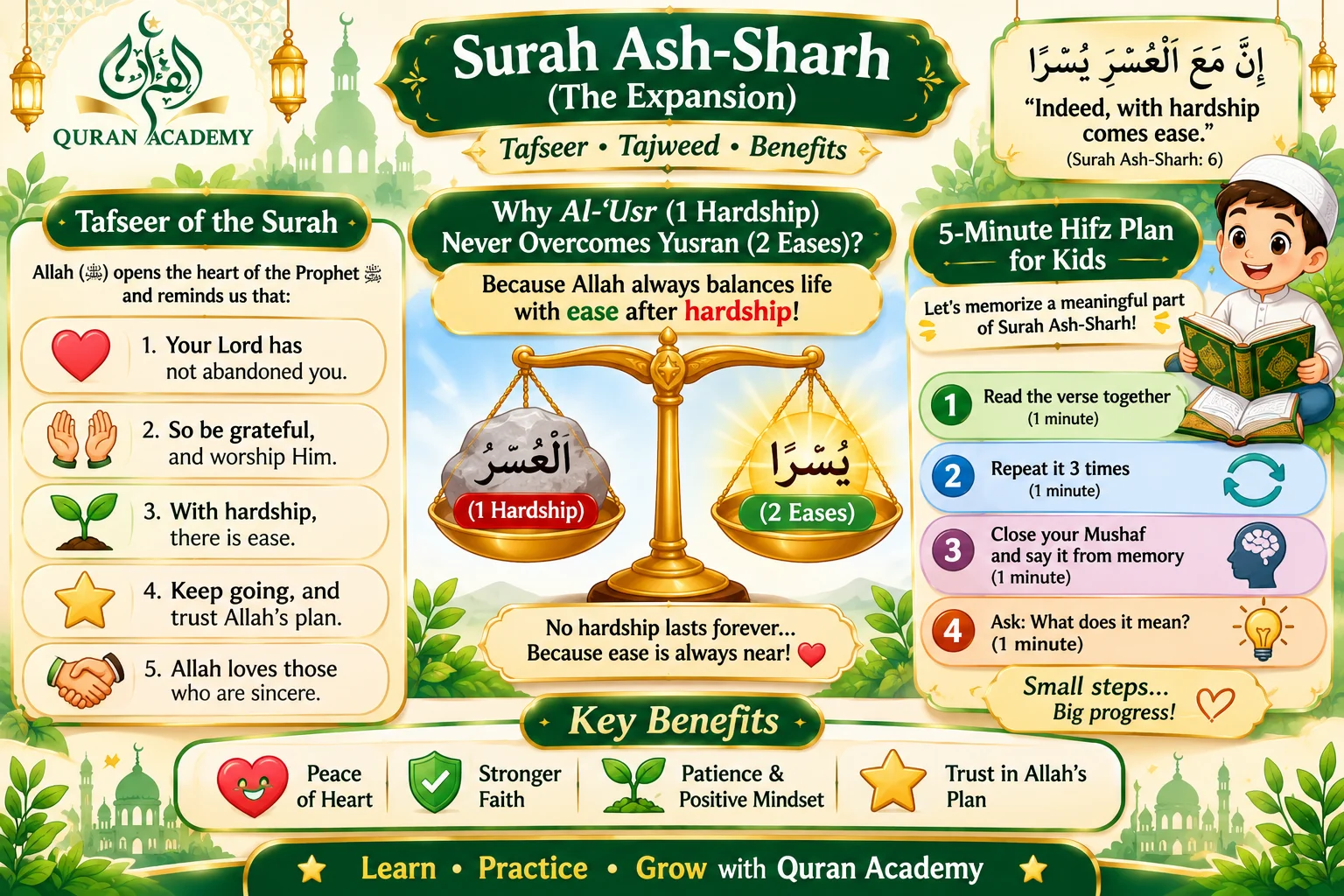
✦ Quick Answer & Key Takeaways: Surah Ash-Sharh Tafseer & Benefits
Studying Surah Ash Sharh Tafseer and benefits (تَفْسِيرُ وَفَضَائِلُ سُورَةِ الشَّرْحِ / الِانْشِرَاحِ — Chapter 94 of the Holy Quran, the spiritual twin of Surah Ad-Duha [Chapter 93] on Page 596 of the Madinah Mushaf) delivers the single most comforting promise in human language for anyone facing stress, grief, or hardship! Across 8 short Makkan verses (27 words total), Allah Almighty reminds His beloved Messenger (ﷺ)—and every believer walking in his footsteps—of three immense spiritual gifts (expanding his chest with light, lifting his heavy burden, and elevating his mention across the worlds), reveals the double guarantee فَإِنَّ مَعَ ٱلْعُسْرِ يُسْرًا ﴿٥﴾ إِنَّ مَعَ ٱلْعُسْرِ يُسْرًا ﴿٦﴾ (where one definite hardship is surrounded by two indefinite eases!), and concludes with the golden rule of Islamic productivity and devotion: فَإِذَا فَرَغْتَ فَٱنصَبْ ﴿٧﴾ وَإِلَىٰ رَبِّكَ فَٱرْغَب ﴿٨﴾. In our 1-on-1 Online Quran Memorization (Hifz), Tafseer & Tajweed Program, adults and children master Surah Ash-Sharh in just 5 minutes!
- Why "One Hardship Will Never Overcome Two Eases": Because ٱلْعُسْرِ (Al-'Usr) is definite (1 single hardship), while يُسْرًا (Yusran) is indefinite with Tanween (2 separate eases)!
- Why Allah Used "Ma'a" (مَعَ = WITH) Instead of "Ba'da" (After): Relief is not distant—Allah sends inner tranquility and relief simultaneously alongside the very moment of trial!
- How Allah Elevated the Prophet's Mention (94:4): Every second on earth, a Mu'adhin somewhere is calling Ashhadu anna Muhammadar-Rasoolullaah alongside Allah's Name!
- 4 Verse-Ending Qalqalahs in a Row: Verses 1, 2, 3, 4, 7, and 8 end with crisp Qalqalah or Hams stops!
When you open Page 596 of the Madinah Mushaf, you notice immediately that Surah Ad-Duha (Chapter 93) and Surah Ash-Sharh (سُورَةُ الشَّرْحِ / الِانْشِرَاحِ — Chapter 94) sit side by side like two halves of a single comforting letter from Allah Almighty to a weary heart. In Surah Ad-Duha (93:6–8), Allah reminded His Messenger (ﷺ) of three outer, visible blessings: sheltering him when he was an orphan, guiding him, and enriching his heart. Then, right beneath it in Surah Ash-Sharh (94:1–4), Allah reminds him of three inner, spiritual blessings that carried him through the hardest days of Makkah!
Even more remarkably, right in the center of this 8-verse Surah (Verses 5 and 6), Allah reveals a grammatical miracle that made 'Umar ibn Al-Khattab and 'Abdullah ibn 'Abbas (RA) smile with joy whenever hardship struck the Muslims: « لَنْ يَغْلِبَ عُسْرٌ يُسْرَيْنِ » ("One hardship will NEVER overcome two eases!"). Pairing with our guides to Surah An-Naba', Surah Al-A'la, and Prophetic Duas for Anxiety & Distress, this complete guide breaks down the 3 Spiritual Blessings of Verses 1–4, the Linguistic Miracle of Verses 5–6, the Productivity Rule of Verses 7–8, and 4 Essential Tajweed Rules.
- 1. Section 1 (Verses 1 to 4): The 3 Inner Blessings — Expanding the Chest, Lifting the Burden & Raising His Mention
- 2. Section 2 (Verses 5 & 6): The Arabic Grammar Miracle — Why 1 Hardship Brings 2 Eases!
- 3. Section 3 (Verses 7 & 8): "Fa-idha Faraghta Fansab" — The Quranic Formula for Time Management & Sincerity
- 4. 5-Minute Memorization Plan & 4 Essential Tajweed Rules in Surah Ash-Sharh
- 5. Frequently Asked Questions (FAQs)
1. Section 1 (Verses 1 to 4): The 3 Inner Blessings Granted to the Prophet (ﷺ)
Open our Online Uthmani Quran Explorer to Surah Ash-Sharh (94:1–4) and reflect on the three gifts Allah Almighty bestowed upon His Messenger (ﷺ)—and how every believer receives a share of these three gifts in proportion to how closely they follow his Sunnah:
| Blessing & Verse | Voweled Arabic Text & Transliteration | Tafseer & How It Applies to the Believer Today |
|---|---|---|
| 1. Expansion of the Chest (Verse 1) ⭐ |
﴿ أَلَمْ نَشْرَحْ لَكَ صَدْرَكَ ﴿١﴾ ﴾ Alam nashrah laka sadrak. |
Both physical (when the angels washed his heart with Zamzam water in childhood and before Al-Isra' wal-Mi'raj, Sahih Muslim 162) and spiritual: filling his chest with the light of the Quran, spacious forbearance, and serenity! (Contrast with Prophet Musa's prayer in 20:25: Rabbish-rah lee sadree—Allah granted it to Muhammad ﷺ before he even asked!). |
| 2. Lifting the Heavy Burden (Verses 2–3) |
﴿ وَوَضَعْنَا عَنكَ وِزْرَكَ ﴿٢﴾ ٱلَّذِي أَنقَضَ ظَهْرَكَ ﴿٣﴾ ﴾ Wa wada'naa 'anka wizrak (2) Alladheee anqada dhahrak (3). |
Anqada in Arabic refers to the creaking sound a camel's saddle makes under a crushing load! Allah forgave His Messenger (Surah Al-Fath 48:2) and relieved the heavy weight of grief he carried for the guidance of his people. |
| 3. Elevating His Mention 🏆 (Verse 4) |
﴿ وَرَفَعْنَا لَكَ ذِكْرَكَ ﴿٤﴾ ﴾ Wa rafa'naa laka dhikrak. |
As Angel Jibreel (AS) informed the Prophet (ﷺ), Allah declared: "Whenever I am mentioned, you are mentioned with Me!"—in the Shahadah, in the Adhan and Iqamah 5 times a day across every time zone, in the Tashahhud of every prayer, and in Salawat! And every believer who serves the Quran and Sunnah is blessed with honorable remembrance according to their following of him! |
2. Section 2 (Verses 5 & 6): The Arabic Grammar Miracle — Why 1 Hardship Brings 2 Eases!
Now look closely at Verses 5 and 6—two verses that look identical in English translation, yet in Quranic Arabic rhetoric (Balaghah) contain three life-changing secrets of hope:
﴿ فَإِنَّ مَعَ ٱلْعُسْرِ يُسْرًا ﴿٥﴾ إِنَّ مَعَ ٱلْعُسْرِ يُسْرًا ﴿٦﴾ ﴾
- Secret #1 — Definite "Al-'Usr" (1 Hardship) vs. Indefinite "Yusran" (2 Eases!):
In classical Arabic grammar, there is a golden rule of repetition: "When a definite noun (with ٱلْـ) is repeated, the second one is the EXACT SAME entity as the first; when an indefinite noun (with Tanween) is repeated, the second one is a NEW, DIFFERENT entity!"
• Look at ٱلْعُسْرِ (Al-'Usr — The Hardship): it has the definite article ٱلْـ in both Verse 5 and Verse 6—so there is ONLY ONE single hardship!
• Now look at يُسْرًا (Yusran — An Ease): it is indefinite with Tanween in Verse 5 (Ease #1) and indefinite again in Verse 6 (Ease #2)—so there are TWO distinct eases surrounding that single hardship! That is why the Prophet (ﷺ) and 'Umar ibn Al-Khattab (RA, verifiable in Muwatta' Malik and our Online Hadith Explorer) proclaimed: « لَنْ يَغْلِبَ عُسْرٌ يُسْرَيْنِ » ("One hardship will never defeat two eases!")! - Secret #2 — Why "Ma'a" (مَعَ = WITH) Instead of "Ba'da" (After)?
Notice that Allah did not merely say ease comes *after* hardship (as in 65:7); here He said مَعَ ٱلْعُسْرِ يُسْرًا ("WITH the hardship is ease!")—teaching us that at the exact moment a trial descends, Allah sends down accompanying ease, patience, spiritual sweetness, and hidden relief right alongside it! - Secret #3 — Indefinite "Yusran" Means Unlimited Magnification (At-Ta'dheem):
While Al-'Usr is bounded and limited to a specific worldly test, Yusran is left open and indefinite—encompassing both the ease of this world and the eternal ease of Paradise!
3. Section 3 (Verses 7 & 8): "Fa-idha Faraghta Fansab" — The Quranic Formula for Time Management
How should a believer respond when Allah expands their chest, lifts their burdens, and surrounds every difficulty with two eases? Look at the two closing commands in Verses 7 and 8:
- 1. ﴿ فَإِذَا فَرَغْتَ فَٱنصَبْ ﴿٧﴾ ﴾ (Fa-idha faraghta fansab):
Literally: "So when you have finished [one task], then stand up and exert yourself [in the next]!" Classical Tafseer scholars mention three complementary meanings:
• Ibn 'Abbas & Qatadah (RA): "When you finish your obligatory prayer, strive earnestly in Dua and supplication!"
• Ibn Mas'ud (RA): "When you finish your obligatory prayers, stand up for Qiyam Al-Layl / Tahajjud!"
• Mujahid & General Rule: "When you finish your worldly work and responsibilities, immediately turn your free time to worshipping Allah, reciting the Quran, and seeking beneficial knowledge!" (As 'Umar ibn Al-Khattab RA said: "Indeed I dislike to see a person idle—neither working for the benefit of this world nor working for the Hereafter!"). - 2. ﴿ وَإِلَىٰ رَبِّكَ فَٱرْغَب ﴿٨﴾ ﴾ (Wa ilaa Rabbika farghab):
Notice the prepositional phrase إِلَىٰ رَبِّكَ ("To your Lord") is placed *before* the command verb فَٱرْغَب ("direct your longing/hope")! In Arabic rhetoric, fronting the preposition creates exclusivity (Al-Hasr): place 100% of your hope, longing, and attachment in Allah alone, never in creation!
4. 5-Minute Memorization Plan & 4 Essential Tajweed Rules in Surah Ash-Sharh
Using our 3x3 Memorization Method and our Smart Hifz Planner, you or your child can memorize all 8 verses (just 27 words!) in 5 minutes by grouping the rhyme endings:
• Verses 1–4 (All 4 end with "-rak" → stopped on as "-rakْ"): Sadrakْ (1) → Wizrakْ (2) → Dhahrakْ (3) → Dhikrakْ (4)!
• Verses 5–6 (All 2 end with "Yusraa"): Fa-inna ma'al-'usri yusraa (5) Inna ma'al-'usri yusraa (6)!
• Verses 7–8 (All 2 end with silent Baa "-bْ"): Fa-idhaa faraghta fansabْ (7) Wa ilaa Rabbika farghabْ (8)!
Mastering the Crisp Qalqalah on "Sadْrak", "Fansabْ" & "Farghabْ" vs. Whispered Hams on "-rakْ"!
Look at the contrast inside Surah Ash-Sharh: in Verse 1 (صَدْرَكَ = Sadْrakْ), the mid-word Dal (دْ) is one of the 5 Qalqalah (Echoing) letters (ق ط ب ج د), while the final Kaaf (ـكْ) at the end of Verses 1–4 is a whispered Hams letter (NEVER bounce the Kaaf!), and then Verses 7 and 8 end on a silent Baa (فَٱنصَبْ / فَٱرْغَبْ = Fansabْ / Farghabْ) with crisp Qalqalah Kubra! Watch Senior Instructor Ustadhah Yasmeen Gamal demonstrate Qalqalah on our Quran Academy YouTube Channel:
Struggling to Perfect Your Recitation?
Join 1,250+ students mastering the Quran 1-on-1 with our Verified Al-Azhar Graduates. Flexible US, UK, Canadian & Australian schedules starting at $8/hr.
Book a Free Evaluation Class →- Hams on Verses 1–4 vs. Qalqalah on Verses 7–8: Hear the exact difference!
- 1-on-1 Live Coaching: Perfect your Juz Amma recitation with Al-Azhar scholars!
When reciting Surah Ash-Sharh, check these four Tajweed rules from our 1-on-1 Online Tajweed Course:
- 1. Whispered Breath (Hams) on stopping on "Sadrakْ", "Wizrakْ", "Dhahrakْ" & "Dhikrakْ" (Verses 1–4):
Applying our Sifaat al-Huruf Guide and Matn Al-Jazariyyah, when stopping on the final Kaaf (ـكْ) of Verses 1 to 4, first touch the back of the tongue to the palate (Shiddah) and then release a gentle whisper of air (Hams)—never add a vocalized vowel bounce! Also keep the mid-word Dal of صَدْرَكَ (Sadْ-raka) 100% Light right after the heavy Saad! - 2. Three Types of Ikhfaa' Haqiqi (Light vs. Heavy Ghunnah) in Verses 2, 3 & 7:
Using our Noon Sakinah & Tanween Guide and Matn Tuhfat Al-Atfal, notice how Surah Ash-Sharh contrasts Light and Heavy Ikhfaa':
• Verse 2 (عَنكَ = 'An-ka): Noon Sakinah before light Kaaf → 2-beat Light Ikhfaa' Ghunnah!
• Verse 3 (أَنقَضَ = An-qada): Noon Sakinah before heavy Qaaf → 2-beat Heavy Ikhfaa' Ghunnah!
• Verse 7 (فَٱنصَبْ = Fan-sabْ): Noon Sakinah before heavy Saad → 2-beat Heavy Ikhfaa' Ghunnah! - 3. Keeping "An-qa-da" Balanced (Light Hamzah → Heavy Qaaf & Daad):
According to our Heavy & Light Letters Guide, in أَنقَضَ ظَهْرَكَ (94:3), start with a smiling, light Hamzah (أَ = A-, never "Aww-nqada" ❌), then elevate your tongue for قَ, ضَ, and the interdental ظَ! - 4. Heavy vs. Light Raa Across All 8 Verses of Surah Ash-Sharh:
Following our Ahkam Al-Raa, Makharij al-Huruf, Rules of Madd, Meem Sakinah Rules, Rules of Waqf, Laam Shamsiyyah & Qamariyyah, Hamzatul Wasl vs. Qat', 4 Special Words of Hafs, 7 Alifs in the Quran, Idgham Pairs, 10 Qira'at, Hafs vs. Warsh, Iltiqa' As-Sakinayn, 25 Common Tajweed Mistakes in Salah, An-Nabr (Vocal Stress), and 15 Sajdah Tilawah Verses guides, notice that every single Raa in Surah Ash-Sharh is Heavy (Tafkhim) EXCEPT ٱلْعُسْرِ (Al-'us-ri — in continuation, because it carries a Kasrah!)! Test your Tajweed accuracy right now on our Free 3-Minute Tajweed Quiz!
Explore more Juz Amma, Quranic Arabic, and Fiqh guides across our library: Surah Al-Qadr, Surah Al-'Alaq, 12 Duas for Seeking Knowledge & Memory, 15 Duas for Parents, Marriage & Offspring, Voluntary Fasting in Islam, How to Pray Salat Al-Kusoof, and 50 Most Common Arabic Roots (using our Interactive Tajweed Encyclopedia)! Meet our Al-Azhar Certified Tutors, enroll your child in our 1-on-1 Kids Quran Classes with our Printable Kids Star Chart, and read how families across the US, UK, Canada, and Australia rate our teachers on our Verified Student & Parent Reviews Page.
5. Frequently Asked Questions (FAQs) About Surah Ash-Sharh (Al-Inshirah)
1. Why is Chapter 94 of the Quran called both "Surah Ash-Sharh" and "Surah Al-Inshirah"?
Both names come from the root ش-ر-ح (Sh-R-H, meaning to expand, open, and illuminate) in Verse 1: "Alam nashrah laka sadrak" (Did We not expand for you your breast/heart?). In the standard Madinah Mushaf, it is titled "Surah Ash-Sharh" (The Expansion), while classical scholars also call it "Surah Al-Inshirah" (The Opening of the Heart) or "Surah Alam Nashrah".
2. What is the Arabic grammar secret behind "Fa-inna ma'al-'usri yusraa (5) Inna ma'al-'usri yusraa (6)"?
As explained by Prophet Muhammad (ﷺ) and Companions like 'Umar ibn Al-Khattab and Ibn 'Abbas (RA): "One hardship will never overcome two eases (Lan yaghliba 'usrun yusrayn)!" In Arabic grammar, "Al-'Usr" (العسر — the hardship) is repeated with the definite article "Al-" in both Verses 5 and 6, meaning it is the EXACT SAME single hardship; whereas "Yusran" (يسرا — an ease) is indefinite with Tanween in both verses, meaning the second ease is a NEW, second ease! Moreover, Allah used "Ma'a" (مع = WITH hardship), not "Ba'da" (after)—meaning ease accompanies the trial at the exact same time!
3. What are the 3 great blessings Allah reminds Prophet Muhammad (ﷺ) of in Verses 1–4 of Surah Ash-Sharh?
Just as Surah Ad-Duha (93:6–8) mentioned three outer blessings, Surah Ash-Sharh (94:1–4) mentions three inner spiritual blessings: (1) Sharh As-Sadr (expanding and illuminating his chest with faith, wisdom, tranquility, and the Quran), (2) Wad' Al-Wizr (removing the heavy burden of grief and anxiety over his people's guidance that weighed down his back), and (3) Raf' Adh-Dhikr (elevating his honorable mention across the heavens and earth so that his name is proclaimed alongside Allah's Name in every Adhan, Iqamah, Tashahhud, and Khutbah!).
4. What does "Fa-idha faraghta fansab (7) Wa ilaa Rabbika farghab (8)" mean for a Muslim's daily life?
In Verses 7–8, Allah teaches the ultimate Islamic productivity and gratitude principle: "So when you have finished [one duty], then stand up and strive hard [in worship and the next noble duty], and to your Lord alone direct your longing and hope!" Whether you finish your worldly work to stand in Salah and Quran recitation, or finish your obligatory prayer to strive in Dua and Tahajjud, a believer never wastes free time in heedlessness!
5. How are Surah Ad-Duha (Chapter 93) and Surah Ash-Sharh (Chapter 94) connected?
Surah Ad-Duha (93) and Surah Ash-Sharh (94) are twin Surahs revealed in Makkah to comfort the heart of Prophet Muhammad (ﷺ): both open with "Did He/We not...?" detailing three blessings, both promise imminent relief and ease from Allah, and both conclude with practical commands of gratitude, worship, and service!
Fill Your Chest With the Light & Tranquility of the Quran!
Experience the serenity of "Alam Nashrah Laka Sadrak" through live 1-on-1 Quran recitation, Tafseer reflection, and Hifz classes with certified male and female Al-Azhar scholars. Book your free trial session today!
Book Your Free 1-on-1 Trial Class →