
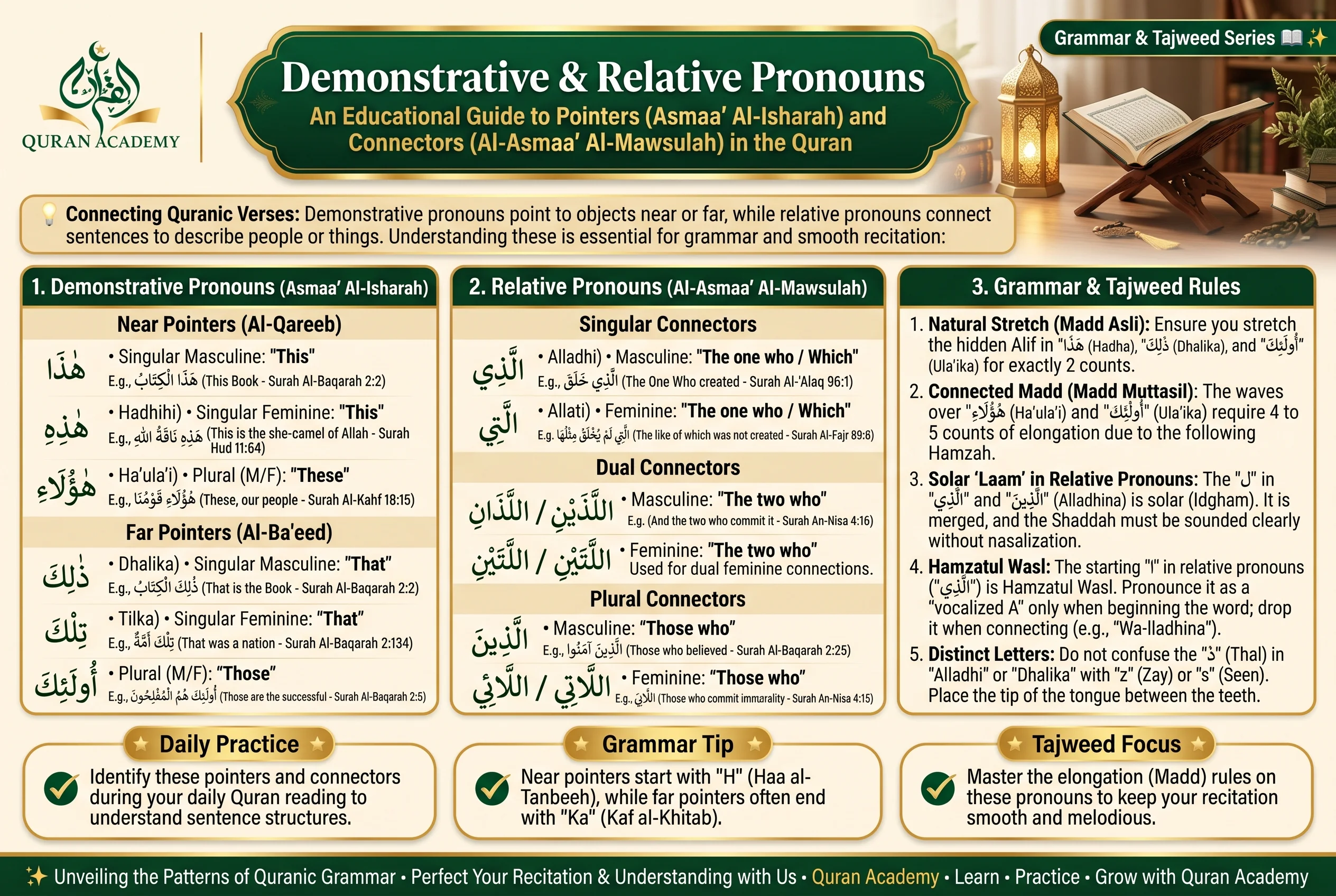
✦ Quick Answer & Key Takeaways: Demonstrative & Relative Pronouns in the Quran
Mastering demonstrative and relative pronouns in the Quran (أَسْمَاءُ الْإِشَارَةِ وَالْأَسْمَاءُ الْمَوْصُولَةُ فِي الْقُرْآنِ الْكَرِيمِ) instantly unlocks the meaning of over 2,200 high-frequency words across every single page of the Mushaf! Building directly upon our Arabic Personal Pronouns (Ad-Dama'ir) Chart and Singular, Dual & Plural Guide, Quranic Arabic uses two essential pointer-and-connector families: (1) Asma' Al-Isharah (Demonstrative Pronouns — "This, That, These, Those"), divided into Near Pointers (هَٰذَا، هَٰذِهِ، هَٰؤُلَاءِ) and Far/Lofty Pointers (ذَٰلِكَ، تِلْكَ، أُوْلَٰئِكَ); and (2) Al-Asma' Al-Mawsoolah (Relative Pronouns — "The one who, Those who, What"), led by ٱلَّذِي (300+ times), ٱلَّتِي, and ٱلَّذِينَ (1,080+ times!) alongside universal مَنْ (whoever) and مَا (whatever). In our 1-on-1 Online Quranic Arabic & Tajweed Program, students master both families in a single interactive lesson!
- Why Surah Al-Baqarah (2:2) Uses "Dhalikal-Kitab" (That Book) & Verse 5 Uses "Ula'ika" (Those): In Quranic Balaghah (rhetoric), pointing with a "far" demonstrative expresses Supreme Loftiness and Exalted Rank ('Uluww Al-Manzilah)!
- The 1-Laam vs. 2-Laam Uthmani Script Secret: ٱلَّذِي، ٱلَّتِي، ٱلَّذِينَ are written with 1 Laam, whereas Dual ٱللَّذَانِ، ٱللَّتَيْنِ and Feminine Plural ٱللَّاتِي / ٱللَّائِي are written with 2 Laams!
- What Comes After "Alladhi / Alladhina"? A connecting clause called Silatul-Mawsool (صِلَةُ الْمَوْصُولِ) that defines their character!
- The #1 Tajweed Mistake in "Ula'ika" (أُوْلَٰئِكَ): The Waw has a zero circle (وْ)—never stretch "Oo-laa'ika"; say U-laaaa'ika!
Open the very first page of Surah Al-Baqarah (2:1–5) after Surah Al-Fatihah and look at the words that hold the entire passage together: ﴿ ذَٰلِكَ ٱلْكِتَابُ لَا رَيْبَ ۛ فِيهِ ۛ هُدًى لِّلْمُتَّقِينَ ﴿٢﴾ ٱلَّذِينَ يُؤْمِنُونَ بِٱلْغَيْبِ... وَٱلَّذِينَ يُؤْمِنُونَ بِمَا أُنزِلَ إِلَيْكَ... أُوْلَٰئِكَ عَلَىٰ هُدًى مِّن رَّبِّهِمْ ۖ وَأُوْلَٰئِكَ هُمُ ٱلْمُفْلِحُونَ ﴿٥﴾ ﴾. In just four verses, you encounter ذَٰلِكَ (That), ٱلَّذِينَ (Those who — 2x), مَا (What — 2x), and أُوْلَٰئِكَ (Those — 2x)!
Why does the Holy Quran use these pointer and connector words over 2,200 times? Because instead of merely naming people by tribe or label, the Quran describes believers and disbelievers by their living actions and qualities using Al-Asma' Al-Mawsoolah (ٱلَّذِينَ آمَنُواْ وَعَمِلُواْ ٱلصَّالِحَاتِ — "Those who believe and do righteous deeds") and then crowns them with the lofty pointer of honor (أُوْلَٰئِكَ — "Those exalted ones!"). Launching Day 4 of Matrix 5—and building upon our 50 Most Common Arabic Roots, Harf Al-Jarr Prepositions, and Verbs in Quranic Arabic guides—this complete guide gives you the Master Chart of Demonstrative Pronouns, the Master Chart of Relative Pronouns, the Balaghah Secrets of Near vs. Far Pointers, and 5 Essential Tajweed & Uthmani Script Rules.
- 1. Part 1 (Asma' Al-Isharah): Master Chart of All Demonstrative Pronouns in the Quran (Near vs. Far)
- 2. Part 2 (Balaghah Secrets): Why the Quran Uses "Dhalika" for Loftiness & How "-ka / -kum" Changes!
- 3. Part 3 (Al-Asma' Al-Mawsoolah): Master Chart of All Relative Pronouns in the Quran (Alladhi to Man & Ma)
- 4. Part 4: Bonus Chart of Place Pointers (Huna, Hunaka, Hunalika & Thamma!)
- 5. Five Essential Uthmani Script & Tajweed Rules (Ula'ika, Ha'ula'i & Dropping Madd in Wasl!)
- 6. Frequently Asked Questions (FAQs)
1. Part 1 (Asma' Al-Isharah): Master Chart of Demonstrative Pronouns in the Quran
In Quranic Arabic, a Demonstrative Pronoun (ٱسْمُ الْإِشَارَةِ) points to a specific person, object, or truth, and adjusts according to three simple questions: (a) Is it Masculine or Feminine? (b) Is it Singular, Dual, or Plural? And (c) Is it Near (لِلْقَرِيبِ — starting with a "Haa' of Alert" هَـ) or Far/Lofty (لِلْبَعِيدِ — ending with "-ka" or "-lika")?
| Number & Gender | Near Pointer (لِلْقَرِيبِ = This / These) | Far / Lofty Pointer (لِلْبَعِيدِ = That / Those) | Famous Quranic Examples |
|---|---|---|---|
| 1. Singular Masculine ⭐ (مُفْرَدٌ مُذَكَّرٌ) |
هَٰذَا (Haadhaa — This) (220+ times in the Quran) |
ذَٰلِكَ / ذَٰلِكُمَا / ذَٰلِكُمْ (Dhaalika / Dhaalikum — That) (470+ times in the Quran!) |
• Near: هَٰذَا ٱلْبَلَدِ ٱلْأَمِينِ (At-Tin 95:3). • Far/Lofty: ذَٰلِكَ ٱلْكِتَابُ (2:2) & ذَٰلِكَ ٱلْيَوْمُ ٱلْحَقُّ (An-Naba' 78:39). |
| 2. Singular Feminine ⭐ (مُفْرَدَةٌ مُؤَنَّثَةٌ — & Non-Human Plural!) |
هَٰذِهِۦ (Haadhihee — This) (47 times in the Quran) |
تِلْكَ / تِلْكُمَا / تِلْكُمْ (Tilka / Tilkum — That) (43 times in the Quran) |
• Near: هَٰذِهِۦ جَهَنَّمُ (Yaseen 36:63). • Far (Non-Human Plural!): تِلْكَ آيَاتُ ٱلْكِتَابِ ٱلْحَكِيمِ (Luqman 31:2). |
| 3. Dual Masculine (مُثَنًّى مُذَكَّرٌ) |
هَٰذَانِ / هَٰذَيْنِ (Haadhaani / Haadhayni — These two) |
ذَانِكَ (Dhaanika — Those two) |
• Near: هَٰذَانِ خَصْمَانِ (Al-Hajj 22:19). • Far: فَذَانِكَ بُرْهَانَانِ مِن رَّبِّكَ (Al-Qasas 28:32 — Musa's 2 miracles!). |
| 4. Dual Feminine (مُثَنًّى مُؤَنَّثٌ) |
هَاتَانِ / هَاتَيْنِ (Haataani / Haatayni — These two) |
(Rare: Taanika) | • Near: إِحْدَى ٱبْنَتَيَّ هَاتَيْنِ (Al-Qasas 28:27 — "One of these two daughters of mine!"). |
| 5. Plural (M & F) 🏆 (جَمْعٌ لِلْمُذَكَّرِ وَالْمُؤَنَّثِ) |
هَٰؤُلَاءِ (Haaa'ulaaa'i — These) (46 times in the Quran) |
أُوْلَٰئِكَ / أُوْلَٰئِكُمْ (Ulaaaa'ika — Those) (204 times in the Quran!) |
• Near: إِنَّ هَٰؤُلَاءِ يُحِبُّونَ ٱلْعَاجِلَةَ (76:27). • Far/Lofty: أُوْلَٰئِكَ هُمُ ٱلْمُفْلِحُونَ (2:5 & Al-Hashr 59:9)! |
2. Part 2 (Balaghah Secrets): Why the Quran Uses "Dhalika" for Loftiness & How "-ka / -kum" Changes!
When studying Tafseer, three grammatical secrets about Asma' Al-Isharah will transform how you understand the verses you recite:
- 1. Why Does Allah Say "Dhalikal-Kitab" (2:2 — That Book) & "Tilka Aayatul-Kitab" (31:2 — Those Verses)?
Even though the Quran is right in front of your eyes and in your heart, Allah points to it with the far demonstrative ذَٰلِكَ (That) and تِلْكَ (Those) to express عُلُوُّ الْمَنْزِلَةِ وَبُعْدُ الْمَرْتَبَةِ (Supreme Loftiness and Exalted Rank)! Conversely, when speaking of this fleeting worldly life, the Quran often uses the near pointer هَٰذِهِ ٱلْحَيَوٰةُ ٱلدُّنْيَا ("THIS low, immediate life")! - 2. Why Are Non-Human Plurals Pointed to With Singular Feminine "Hadhihi" & "Tilka"?
Remember the golden rule we learned in our Singular, Dual & Plural Guide: in Arabic grammar, any Non-Human Plural (جَمْعُ غَيْرِ الْعَاقِلِ — like آيَاتٌ [Verses], أَمْثَالٌ [Parables], حُدُودٌ [Limits], or أَنْهَارٌ [Rivers]) is treated grammatically as Singular Feminine! That is why in Surah Al-Hashr (59:21) Allah says وَتِلْكَ ٱلْأَمْثَالُ نَضْرِبُهَا لِلنَّاسِ ("And THOSE parables We strike for mankind") using Tilka! - 3. Why Does "Dhalika / Tilka / Ula'ika" Sometimes Change to "Dhalikum / Tilkum / Ula'ikum"?
Look inside the word ذَٰلِكَ: the first part (ذَا) means "That thing", while the final letter (ـكَ / ـكُمَا / ـكُمْ) is the Kaaf of Address (كَافُ الْخِطَابِ — addressing the listener!):
• When Allah addresses one listener (like the Prophet ﷺ or the individual reader) pointing to one thing: ذَٰلِكَ (Dhaalika).
• When Prophet Yusuf (AS) addressed his two prison companions in Surah Yusuf (12:37): ذَٰلِكُمَا مِمَّا عَلَّمَنِي رَبِّي (Dhaalikumaa — "That [knowledge], O you two...")!
• When Allah addresses a plural group of listeners pointing to one Lord or one command: ذَٰلِكُمُ ٱللَّهُ رَبُّكُمْ (Dhaalikumullaahu Rabbukum — "That [for all of you] is Allah, your Lord!"), and in Paradise: تِلْكُمُ ٱلْجَنَّةُ أُورِثْتُمُوهَا (7:43 — "That [for all of you] is Paradise!")!
3. Part 3 (Al-Asma' Al-Mawsoolah): Master Chart of Relative Pronouns in the Quran
While a Demonstrative Pronoun points to a noun, a Relative Pronoun (ٱلِاسْمُ الْمَوْصُولُ — literally "The Connected Noun") connects a noun to a descriptive sentence immediately after it called صِلَةُ الْمَوْصُولِ (Silatul-Mawsool)! Study all 8 Relative Pronouns in the Quran below—and pay special attention to the 1-Laam vs. 2-Laam Uthmani spelling rule:
| Relative Pronoun & Gender/Number | Uthmani Script Spelling Rule | Meaning & Famous Quranic Example |
|---|---|---|
| 1. ٱلَّذِي (Alladhee) ⭐ Singular Masculine (300+ times) |
Written with 1 Single Laam with Shaddah (لّ). | "The one who / He who / Which" → تَبَارَكَ ٱلَّذِي بِيَدِهِ ٱلْمُلْكُ (Al-Mulk 67:1) & ٱلَّذِي خَلَقَ فَسَوَّىٰ (Al-A'la 87:2). |
| 2. ٱلَّتِي (Allatee) ⭐ Singular Feminine (& Non-Human Plural!) |
Written with 1 Single Laam with Shaddah (لّ). | "She who / That which" → وَٱلَّتِي أَحْصَنَتْ فَرْجَهَا (21:91 — Maryam AS) & ٱلَّتِي تَطَّلِعُ عَلَى ٱلْأَفْئِدَةِ (Al-Humazah 104:7). |
| 3. ٱلَّذِينَ (Alladheena) 🏆 Plural Masculine (1,080+ times!) |
Written with 1 Single Laam with Shaddah (لّ). | "Those who" → صِرَاطَ ٱلَّذِينَ أَنْعَمْتَ عَلَيْهِمْ (Al-Fatihah 1:7) & إِلَّا ٱلَّذِينَ آمَنُواْ وَعَمِلُواْ ٱلصَّالِحَاتِ (103:3). |
| 4 & 5. ٱللَّذَانِ / ٱللَّذَيْنِ & ٱللَّتَانِ / ٱللَّتَيْنِ Dual Masculine & Dual Feminine |
Written with 2 Double Laams (ٱللَّـ) so Dual is never confused with Plural! | "The two who" → وَٱللَّذَانِ يَأْتِيَانِهَا مِنكُمْ (An-Nisa 4:16) & رَبَّنَا أَرِنَا ٱللَّذَيْنِ أَضَلَّانَا (Fussilat 41:29). |
| 6. ٱللَّاتِي / ٱللَّائِي (Allaatii / Allaaa'ee) Plural Feminine (Believing Women) |
Written with 2 Double Laams (ٱللَّـ). | "The women who" → وَأُمَّهَاتُكُمُ ٱللَّاتِي أَرْضَعْنَكُمْ (4:23) & إِنْ أُمَّهَاتُهُمْ إِلَّا ٱللَّائِي وَلَدْنَهُمْ (Al-Mujadilah 58:2). |
| 7 & 8. مَنْ (Man) & مَا (Maa) ⭐ Universal Relative Pronouns |
مَنْ = Rational Beings (Who/Whoever). مَا = Non-Rational / General (What/Whatever). |
• مَنْ: قَدْ أَفْلَحَ مَن تَزَكَّىٰ (87:14 — "He who purifies himself"). • مَا: لَا أَعْبُدُ مَا تَعْبُدُونَ (109:2 — "What you worship"). |
4. Part 4: Bonus Chart of Place Pointers (Huna, Hunalika & Thamma!)
In addition to pointing to people and things, the Quran uses four famous Place Demonstratives (أَسْمَاءُ الْإِشَارَةِ لِلْمَكَانِ — "Here" and "There")—including a classic vowel trap between ثَمَّ (Thamma with Fatha) and ثُمَّ (Thumma with Damma):
- 📍 1. هُنَا / هَاهُنَا (Hunaa / Haa-hunaa = "Right Here" — Near Place): As in إِنَّا هَاهُنَا قَاعِدُونَ (Al-Ma'idah 5:24).
- 📍 2. هُنَالِكَ (Hunaalika = "There / At That Moment & Place" — Far/Lofty Place): As in Surah Al 'Imran (3:38): هُنَالِكَ دَعَا زَكَرِيَّا رَبَّهُۥ ("Right there [in the sanctuary], Zakariyya called upon his Lord!").
- ⚠️ 3. ثَمَّ (Thamma with FATHA = "Over There!") vs. ثُمَّ (Thumma with DAMMA = "Then / Afterwards!"):
Never confuse the two in recitation! With a Damma (ثُمَّ), it is a conjunction meaning "then." With a Fatha on the Thaa (ثَمَّ), it is a Place Demonstrative meaning "There / Over there!"—as in Surah Al-Baqarah (2:115): فَأَيْنَمَا تُوَلُّواْ فَثَمَّ وَجْهُ ٱللَّهِ ("So wherever you turn, THERE is the Face of Allah!") and Surah Al-Insan (76:20): وَإِذَا رَأَيْتَ ثَمَّ رَأَيْتَ نَعِيمًا وَمُلْكًا كَبِيرًا ("And when you look THERE [in Paradise], you will see bliss and a vast kingdom!")!
How Relative Pronouns ("Man" & "Ma") Trigger Crisp Qalqalah in Conditional & Descriptive Verses!
Notice how often the relative pronouns مَن (He who), مَا (What), and ٱلَّذِي (The One Who) pair immediately with a Qalqalah (Echoing) verb (ق ط ب ج د): قَدْ أَفْلَحَ مَن تَزَكَّىٰ (Qadْ aflaha man tazakkaa — 87:14), ٱقْرَأْ بِٱسْمِ رَبِّكَ ٱلَّذِي خَلَقْ (Iqْra' bismi Rabbikal-ladhee khalaqْ — 96:1), and لَا أَعْبُدُ مَا تَعْبُدُونَ (109:2)! Watch Senior Instructor Ustadhah Yasmeen Gamal demonstrate Qalqalah on our Quran Academy YouTube Channel:
Struggling to Perfect Your Recitation?
Join 1,250+ students mastering the Quran 1-on-1 with our Verified Al-Azhar Graduates. Flexible US, UK, Canadian & Australian schedules starting at $8/hr.
Book a Free Evaluation Class →- Combine Quranic Grammar + Flawless Tajweed: Understand every word as you recite!
- 1-on-1 Live Coaching: Study Quranic Arabic & Tajweed with Al-Azhar scholars!
5. Five Essential Uthmani Script & Tajweed Rules in Demonstratives & Relatives
When reciting Demonstrative and Relative Pronouns across the Mushaf, apply these five Tajweed rules from our 1-on-1 Online Tajweed Course:
- 1. Never Pronounce the Zero-Circle Waw in "Ula'ika" (أُوْلَٰئِكَ) or "Uloo" (أُوْلُواْ):
As we mastered in our 7 Alifs & Uthmani Zero Symbols Guide and 25 Common Tajweed Mistakes in Salah, look at the round zero circle (Sifr Mustadeer ـْ) on top of the Waw in أُوْلَٰئِكَ (Ulaaaa'ika) and أُوْلِي ٱلْأَبْصَارِ (Al-Hashr 59:2): that Waw is 100% silent! Give the opening Hamzah a single 1-count Damma (أُ = U-), then stretch the Dagger Alif after the Laam for 4 to 5 counts (Madd Wajib Muttasil: U-laaaa'ika)! - 2. Two Elongations in One Word in "Haa'ulaa'i" (هَٰؤُلَاءِ):
Applying our Rules of Madd Guide and Matn Tuhfat Al-Atfal, notice that هَٰؤُلَاءِ contains TWO 4-to-5 beat elongations back-to-back:
• The first Dagger Alif on هَٰـ is really the separate alerting particle Haa before Ulaa'i → 4 to 5 counts (Madd Ja'iz Munfasil)!
• The second Alif in ـلَاءِ meets a Hamzah inside the same word → 4 to 5 counts (Madd Wajib Muttasil: Haaaa-'u-laaaa'i)! - 3. Dropping the Final Madd of "Hadha, Alladhi, Allati & Ma" Before Hamzatul Wasl!
Using our Iltiqa' As-Sakinayn in Tajweed Guide, whenever a word ending in an Alif or Yaa Madd—such as هَٰذَا، ٱلَّذِي، ٱلَّتِي، or مَا—is followed immediately by a word starting with Hamzatul Wasl (ٱلْـ), the Madd letter drops completely in continuation:
• هَٰذَا ٱلْقُرْآنَ (59:21) → Read as Haadhal-Qur'aana (dropping the final Alif of Haadhaa!).
• ٱلَّذِي ٱسْتَوْقَدَ نَارًا (2:17) → Read as Alladhis-tawqada (dropping the Yaa of Alladhee!).
• فِي ٱلسَّمَاوَاتِ وَمَا فِي ٱلْأَرْضِ → Keep the 2-count Alif of مَا before Fee, but in مَا ٱلْقَارِعَةُ (101:2) drop the Alif of Maa in continuation: Mal-Qaari'ah! - 4. Starting Directly on "Alladhi / Allati / Alladhina" With a Fatha on Hamzatul Wasl:
According to our Hamzatul Wasl & Hamzatul Qat' Guide and Matn Al-Jazariyyah, because all relative pronouns starting with ٱلَّـ begin with the definite article Al-, whenever you start a verse with ٱلَّذِينَ آمَنُواْ, pronounce the initial Hamzatul Wasl with a clear Fatha (A-lladheena) and hold the Shaddah on the Laam! - 5. Madd Silah Sughra (2 Beats) vs. Kubra (4–5 Beats) on "Hadhihi" (هَٰذِهِۦ):
Following our Makharij al-Huruf, Sifaat al-Huruf, Heavy & Light Letters, Noon Sakinah Rules, Meem Sakinah Rules, Rules of Waqf, Ahkam Al-Raa, Laam Shamsiyyah & Qamariyyah, 4 Special Words of Hafs, Idgham Pairs, 10 Qira'at, Hafs vs. Warsh, An-Nabr (Vocal Stress), and 15 Sajdah Tilawah Verses guides, notice the miniature Yaa (ۦ) after هَٰذِهِۦ: it follows the exact same rule as the pronoun -hi—stretched 2 beats before any non-Hamzah voweled letter (e.g., هَٰذِهِۦ جَهَنَّمُ = Haadhihee Jahannamu), 4–5 beats before a Hamzatul Qat' (e.g., هَٰذِهِۦٓ أُمَّتُكُمْ = Haadhiheee ummatukum), and dropped before Hamzatul Wasl (e.g., هَٰذِهِ ٱلشَّجَرَةَ = Haadhihish-shajarata)! Test your Tajweed & Quranic Arabic skills right now on our Free 3-Minute Tajweed Quiz!
Explore more Surah Tafseer and Quranic Arabic guides across our library: Surah Al-Hujurat, Surah Ad-Dukhan, Surah Al-Hadid, Surah Ash-Sharh, Surah Az-Zalzalah & Al-'Adiyat, and 12 Duas for Seeking Knowledge & Memory in our Online Hifz Program (using our Smart Hifz Planner, Interactive Tajweed Encyclopedia, and Online Hadith Explorer)! Meet our Al-Azhar Certified Tutors, enroll your child in our 1-on-1 Kids Quran Classes with our Printable Kids Star Chart, and read how families across the US, UK, Canada, and Australia rate our teachers on our Verified Student & Parent Reviews Page.
6. Frequently Asked Questions (FAQs) About Demonstrative & Relative Pronouns in the Quran
1. How many times do Demonstrative and Relative Pronouns appear in the Holy Quran?
Together, Demonstrative Pronouns (Asma' Al-Isharah — like Hadha, Dhalika, Tilka, Ha'ula'i, and Ula'ika) and Relative Pronouns (Al-Asma' Al-Mawsoolah — like Alladhi, Allati, Alladhina, Man, and Ma) appear over 2,200 times across the Holy Quran! Specifically, "Alladhina" (الذين) alone appears over 1,080 times, "Dhalika" (ذلك) over 470 times, "Alladhi" (الذي) over 300 times, "Hadha" (هذا) over 220 times, and "Ula'ika" (أولئك) over 200 times!
2. Why does Surah Al-Baqarah (2:2) say "Dhalikal-Kitabu" (That Book) instead of "Hadhal-Kitabu" (This Book)?
In Quranic Arabic rhetoric (Balaghah), the far demonstrative pronoun "Dhalika" (ذلك — That) is used instead of the near "Hadha" (هذا — This) to express 'Uluww Al-Manzilah wa Bu'd Al-Martabah (Supreme Loftiness, Honor, and Exalted Rank)! Just as we look up at a star high in the sky, "Dhalikal-Kitab" signifies that the Holy Quran is so lofty in perfection, wisdom, and divine origin that it stands exalted above all human speech!
3. What are the 3 letter components inside the word "Dhalika" (ذَٰلِكَ)?
In classical Arabic grammar, "Dhalika" (ذَٰلِكَ) is composed of 3 meaningful elements: (1) "Dhaa" (ذَا) — the actual pointer word ("this/that"), (2) "Al-Laam" (لِ) — the Laam of Distance and Exaltation (Laam Al-Bu'd), and (3) "Al-Kaaf" (كَ) — the Particle of Direct Address (Kaaf Al-Khitab, meaning "Look, O listener!"), which can change to plural "Dhalikum" (ذَٰلِكُمْ) when addressing a group!
4. Why is the Waw in "Ula'ika" (أُوْلَٰئِكَ) never pronounced in Tajweed?
In the Uthmani Mushaf, the Waw in "Ula'ika" (أُوْلَٰئِكَ) carries a round zero circle (Sifr Mustadeer) on top of it—indicating that the Waw is a purely orthographic Uthmani script letter that is NEVER pronounced in either continuation or stopping! You jump straight from the short 1-count Damma on the Hamzah (أُ = U-) to the 4–5 count Madd Wajib Muttasil on the Laam ("U-laaaa'ika", NEVER "Oo-laa'ika")!
5. Why are "Hadha, Dhalika, Alladhi, and Alladhina" written differently in the Uthmani Mushaf than in modern Arabic?
In Uthmani script (Rasm Al-Mushaf), high-frequency demonstrative words like هَٰذَا، هَٰذِهِ، ذَٰلِكَ، هَٰؤُلَاءِ، أُوْلَٰئِكَ are written with a miniature Dagger Alif (Alif Khanjariyyah) instead of a full standing Alif, and Singular/Masculine Plural relative pronouns (ٱلَّذِي، ٱلَّتِي، ٱلَّذِينَ) are written with ONE single Laam with a Shaddah, whereas Dual relative pronouns (ٱللَّذَانِ، ٱللَّتَيْنِ) and Feminine Plural (ٱللَّاتِي / ٱللَّائِي) are written with TWO Laams so they are never confused without dots!
Understand the Arabic of the Quran Direct From the Mushaf!
Master 80% of Quranic vocabulary and grammar—without dry memorization—in live, interactive 1-on-1 classes with certified male and female Al-Azhar scholars. Book your free diagnostic trial session today!
Book Your Free 1-on-1 Trial Class →