
✦ Quick Answer & Key Takeaways: Surah Az-Zalzalah & Surah Al-'Adiyat
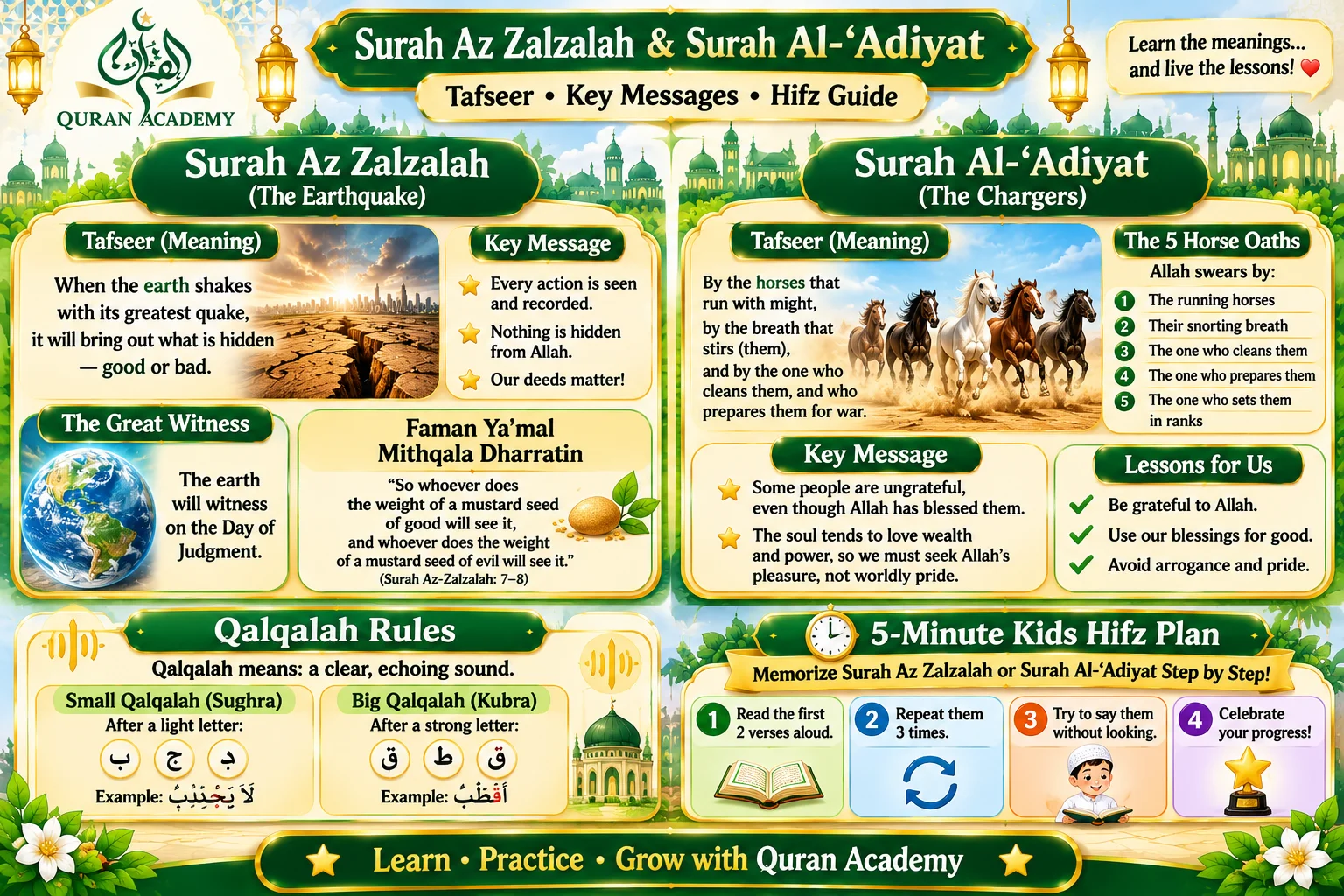
Mastering Surah Az Zalzalah Tafseer and benefits (تَفْسِيرُ وَفَضَائِلُ سُورَتَيِ الزَّلْزَلَةِ وَالْعَادِيَاتِ — Chapters 99 and 100 of the Holy Quran, sitting side by side on Pages 599–600 of the Madinah Mushaf in Juz Amma) awakens deep mindfulness of Allah in both adults and children! Together totaling just 19 short verses (8 verses in Az-Zalzalah + 11 verses in Al-'Adiyat), these two neighboring Surahs form a powerful spiritual pair: Surah Az-Zalzalah (The Earthquake) reveals how the very ground beneath our feet will speak on the Day of Judgment to testify to every prayer and deed we performed upon it, culminating in what Prophet Muhammad (ﷺ) called "The Uniquely Comprehensive Verse" (فَمَن يَعْمَلْ مِثْقَالَ ذَرَّةٍ خَيْرًا يَرَهُۥ — 99:7–8); while Surah Al-'Adiyat (The Charging Steeds) swears by 5 vivid scenes of loyal horses galloping through sparks at dawn to expose human ingratitude (Al-Kanood) and remind us of the Day when what is hidden in the chests is brought to light (100:9–11)! In our 1-on-1 Online Quran Memorization (Hifz), Tafseer & Kids Program, students master both Surahs in 10 minutes!
- Why the Prophet (ﷺ) Recited Surah Az-Zalzalah in BOTH Rak'ahs of Fajr (Abu Dawud 816): A Companion thought the Prophet (ﷺ) forgot and repeated it in Rak'ah 2, showing its immense weight for contemplation!
- How the Earth Testifies for You (Tirmidhi 2429): Every spot where you pray Salah, recite Quran, or give charity will speak on Judgment Day as your witness!
- The Parable of the Loyal Horse in Al-'Adiyat (100:1–6): A horse risks its life for a master who feeds it grass—how then can a human be ungrateful to the Lord of the Worlds?!
- #1 Qalqalah Workout in Juz Amma: Verses 1–5 of Surah Al-'Adiyat contain 5 mid-word Qalqalah Sughra bounces in 5 consecutive lines!
Have you ever stopped yourself from giving a single dollar or a single date in charity because you thought, "This is too small to make a difference"? Or conversely, have you ever brushed off a small backbiting word or a fleeting glance thinking, "It's just a tiny thing that doesn't matter"? In Sahih al-Bukhari (4962) and Sahih Muslim (987), Prophet Muhammad (ﷺ) pointed to the final two verses of Surah Az-Zalzalah (99:7–8) and called them « الْآيَةُ الْجَامِعَةُ الْفَاذَّةُ » ("The Uniquely Comprehensive Verse!")—and Mother of the Believers 'Aishah (RA, see our Mothers of the Believers Guide) once gave a single grape in charity to a poor person and said: "How many atoms' weights (Mithqala Dharrah) do you see inside this one grape?!"
And right after Surah Az-Zalzalah (Chapter 99) comes Surah Al-'Adiyat (Chapter 100)—moving from the outer earthquake of the earth throwing out its treasures to the inner examination of the human heart's love for wealth and ingratitude! Completing Day 2 of Matrix 5 alongside Surah An-Naba', Surah Al-A'la, Surah Ash-Sharh, and Surah At-Tin, this complete guide breaks down Surah Az-Zalzalah (Verses 1–8), Surah Al-'Adiyat (Verses 1–11), a 10-Minute Hifz Schedule, and 5 Essential Tajweed Rules.
- 1. Part 1 (Surah Az-Zalzalah • Chapter 99): How the Earth Testifies & "Mithqala Dharrah"
- 2. Part 2 (Surah Al-'Adiyat • Chapter 100): Master Chart of the 5 Oaths of the Charging Steeds
- 3. Part 3 (Al-'Adiyat 100:6–11): Curing "Al-Kanood" (Ingratitude) & Preparing for the Reckoning
- 4. 10-Minute Memorization Plan for Both Surahs (5 Minutes Each!)
- 5. Five Essential Tajweed Rules in Az-Zalzalah & Al-'Adiyat (Yarahْ, Yawma'idhin & Qalqalah!)
- 6. Frequently Asked Questions (FAQs)
1. Part 1 (Surah Az-Zalzalah • Chapter 99): How the Earth Testifies & "Mithqala Dharrah"
Open our Online Uthmani Quran Explorer to Surah Az-Zalzalah (Chapter 99 • 8 Verses). Notice how the entire 8-verse Surah unfolds like a live courtroom scene on the Day of Resurrection across three stages:
| Verses in Az-Zalzalah | Voweled Arabic Text & Transliteration | Tafseer & Prophetic Hadith Explanation |
|---|---|---|
| Stage 1 (Verses 1–3) The Final Earthquake & Burdens |
﴿ إِذَا زُلْزِلَتِ ٱلْأَرْضُ زِلْزَالَهَا ﴿١﴾ وَأَخْرَجَتِ ٱلْأَرْضُ أَثْقَالَهَا ﴿٢﴾ وَقَالَ ٱلْإِنسَانُ مَا لَهَا ﴿٣﴾ ﴾ | Not a localized tremor, but "HER earthquake" (زِلْزَالَهَا) encompassing the entire globe! The earth casts out its Athqal (أَثْقَالَهَا): both the dead bodies buried inside it for Resurrection AND its buried treasures of gold and silver (Sahih Muslim 1013), while bewildered man cries: "What is wrong with it?!" |
| Stage 2 (Verses 4–6) The Earth Speaks as a Witness! ⭐ |
﴿ يَوْمَئِذٍ تُحَدِّثُ أَخْبَارَهَا ﴿٤﴾ بِأَنَّ رَبَّكَ أَوْحَىٰ لَهَا ﴿٥﴾ يَوْمَئِذٍ يَصْدُرُ ٱلنَّاسُ أَشْتَاتًا لِّيُرَوْاْ أَعْمَالَهُمْ ﴿٦﴾ ﴾ | By Allah's direct command (Aw-haa lahaa), the soil, floor, and rooms you walked and prayed upon will speak aloud as an eyewitness (Sunan at-Tirmidhi 2429 — Sahih, verifiable in our Online Hadith Explorer), as people depart the reckoning in distinct groups (Ashtaataa) to be shown their deeds! |
| Stage 3 (Verses 7–8) 🏆 The Atom's Weight of Justice! |
﴿ فَمَن يَعْمَلْ مِثْقَالَ ذَرَّةٍ خَيْرًا يَرَهُۥ ﴿٧﴾ وَمَن يَعْمَلْ مِثْقَالَ ذَرَّةٍ شَرًّا يَرَهُۥ ﴿٨﴾ ﴾ Faman ya'mal mithqala dharratin khayran yarah... |
Dharrah in classical Arabic is the tiniest red ant or a microscopic speck of dust floating in a sunbeam! Never belittle a smile, a single Tasbeeh, a sip of water given to a thirsty creature, or a single verse of the Quran—you will see it shining on your scale! |
2. Part 2 (Surah Al-'Adiyat • Chapter 100): Master Chart of the 5 Oaths of the Charging Steeds
Turning from Page 599 to Page 600 of the Mushaf, Surah Al-'Adiyat (سُورَةُ الْعَادِيَاتِ — Chapter 100 • 11 Verses) opens with five cinematic oaths in Verses 1 to 5 that paint the sound, sparks, timing, dust, and courage of charging steeds in the cause of Allah:
| Oath # & Verse | Voweled Arabic Text & Transliteration | Vocabulary & Vivid Imagery Explained for Kids & Adults |
|---|---|---|
| 1. Verse 1 ⭐ (The Sound of Breath) |
﴿ وَٱلْعَادِيَاتِ ضَبْحًا ﴿١﴾ ﴾ Wal-'Aadiyaati dabْhaa. |
Al-'Adiyat: Fast-galloping horses (from 'Adw = running swiftly). Dabh (ضَبْحًا): The rhythmic, panting sound of the horses' chests as they gallop at full speed! |
| 2. Verse 2 ⭐ (The Sparks of Fire) |
﴿ فَٱلْمُورِيَاتِ قَدْحًا ﴿٢﴾ ﴾ Fal-Mooriyaati qadْhaa. |
Al-Muriyat: Striking out sparks of fire (from Ee-raa') as their iron hooves strike hard rocks in the dark (Qadh = قَدْحًا)! |
| 3. Verse 3 (The Dawn Charge) |
﴿ فَٱلْمُغِيرَاتِ صُبْحًا ﴿٣﴾ ﴾ Fal-Mugheeraati subْhaa. |
Al-Mughirat Subha: Charging forward at early dawn (Subh)—following the Prophetic ethic of waiting until dawn to listen if the Adhan is called in a town before acting! |
| 4. Verse 4 (The Cloud of Dust) |
﴿ فَأَثَرْنَ بِهِۦ نَقْعًا ﴿٤﴾ ﴾ Fa-atharna bihi naqْ'aa. |
Naq' (نَقْعًا): Stirring up a thick cloud of desert dust in that valley with their galloping hooves! |
| 5. Verse 5 🏆 (Into the Center) |
﴿ فَوَسَطْنَ بِهِۦ جَمْعًا ﴿٥﴾ ﴾ Fa-wasatْna bihi jam'aa. |
Wasatna bihi Jam'a: Plunging fearlessly right into the middle of the opposing ranks out of total loyalty to their rider! |
3. Part 3 (Al-'Adiyat 100:6–11): Curing "Al-Kanood" (Ingratitude) & Preparing for the Reckoning
Now look at how Verses 6 to 11 of Surah Al-'Adiyat deliver the punchline (Jawab Al-Qasam) of those five horse oaths:
- 1. What Is "Al-Kanood" (إِنَّ ٱلْإِنسَانَ لِرَبِّهِۦ لَكَنُودٌ ﴿٦﴾)?
In classical Arabic, Ardun Kanood means barren soil that drinks rain yet refuses to grow any fruit! And as Al-Hasan Al-Basri (رحمه الله) defined it in a famous golden sentence: « الْكَنُودُ: هُوَ الَّذِي يَعُدُّ الْمَصَائِبَ، وَيَنْسَى نِعَمَ رَبِّهِ! » ("Al-Kanood is the one who keeps counting his hardships while forgetting the countless blessings of his Lord!"). While the noble horse in Verses 1–5 risks its life in gratitude for a master who merely gives it hay and water, ungrateful man forgets the Creator Who gave him life, sight, and breath! - 2. Intense Love of Wealth (وَإِنَّهُۥ عَلَىٰ ذَٰلِكَ لَشَهِيدٌ ﴿٧﴾ وَإِنَّهُۥ لِحُبِّ ٱلْخَيْرِ لَشَدِيدٌ ﴿٨﴾):
Here Allah calls wealth ٱلْخَيْرِ (Al-Khayr — "the good") because when wealth is earned halal and spent in Zakah and charity, it is a great good—yet when love of wealth becomes excessive and stingy (Shadeed), it blinds a person from gratitude and the Hereafter! - 3. The Two Wake-Up Questions (أَفَلَا يَعْلَمُ إِذَا بُعْثِرَ مَا فِي ٱلْقُبُورِ ﴿٩﴾ وَحُصِّلَ مَا فِي ٱلصُّدُورِ ﴿١٠﴾ إِنَّ رَبَّهُم بِهِمْ يَوْمَئِذٍ لَّخَبِيرٌ ﴿١١﴾):
Notice the rhyme and symmetry: on the Day of Resurrection, bodies will be overturned from the graves (ما في القبور) AND hidden intentions will be extracted and sorted from the chests (ما في الصدور)—so purify your heart's intention today before the All-Aware (Al-Khabeer)!
4. 10-Minute Memorization Plan for Both Surahs (5 Minutes Each!)
Using our 3x3 Memorization Method and our Smart Hifz Planner:
• Minutes 1–5 (Surah Az-Zalzalah • 8 Verses): Notice that Verses 1–5 all end with the feminine pronoun ـهَا (-haa = the Earth: Zilzaalahaa → Athqaalahaa → Maa lahaa → Akhbaarahaa → Aw-haa lahaa), Verse 6 ends with ـهُمْ (-hum = People: A'maalahum), and Verses 7–8 end with يَرَهْ (Yarahْ = The Individual)!
• Minutes 6–10 (Surah Al-'Adiyat • 11 Verses): Verses 1–5 end with 2-count Madd 'Iwad (Dabhaa → Qadhaa → Subhaa → Naq'aa → Jam'aa), Verses 6–8 end with Qalqalah Dal (Lakanoodْ → Lashaheedْ → Lashadeedْ), and Verses 9–11 end with Raa (Al-Quboorْ → As-Sudoorْ → Lakhabeerْ)!
The Ultimate 8-Bounce Qalqalah Workout in Surah Al-'Adiyat (Verses 1 to 8)!
Did you know that the first 8 verses of Surah Al-'Adiyat are the #1 Qalqalah (Echoing) drill in all of Juz Amma?! Every single verse from Verse 1 to Verse 5 has a mid-word Qalqalah Sughra that mimics the sound of galloping hooves—ضَبْحًا (Dabْhaa), قَدْحًا (Qadْhaa), صُبْحًا (Subْhaa), نَقْعًا (Naqْ'aa), and فَوَسَطْنَ (Fa-wasatْna)—and then Verses 6 to 8 end with 3 Qalqalah Kubra bounces on لَكَنُودْ، لَشَهِيدْ، لَشَدِيدْ! Watch Senior Instructor Ustadhah Yasmeen Gamal demonstrate Qalqalah on our Quran Academy YouTube Channel:
Struggling to Perfect Your Recitation?
Join 1,250+ students mastering the Quran 1-on-1 with our Verified Al-Azhar Graduates. Flexible US, UK, Canadian & Australian schedules starting at $8/hr.
Book a Free Evaluation Class →- 4 of the 5 Letters of "Qutb Jadd" in 5 Lines: Practice بْ، دْ، قْ، and طْ back-to-back!
- 1-on-1 Live Coaching: Perfect your Juz Amma Tajweed with Al-Azhar scholars!
5. Five Essential Tajweed Rules in Az-Zalzalah & Al-'Adiyat
When reciting Surah Az-Zalzalah and Surah Al-'Adiyat, apply these five Tajweed rules from our 1-on-1 Online Tajweed Course:
- 1. Pronouncing Both Silent Laams Clearly in "Zulْzilat" & "Zilْzaalahaa" (99:1):
As we mastered in our Laam Sakinah Guide and 25 Common Tajweed Mistakes in Salah, when a silent Laam (لْ) sits right before a buzzing Zay (ز) in زُلْزِلَتِ (Zulْ-zilati) and زِلْزَالَهَا (Zilْ-zaalahaa), never swallow the Laam into the Zay ("Zuzzilati" ❌)—touch the tip of your tongue firmly to the upper gums for each لْ! - 2. Whispering the Final Haa' Sakinah When Stopping on "Yarahْ" (يَرَهْ — 99:7–8):
Applying our Rules of Waqf Guide and Rules of Madd Guide, in خَيْرًا يَرَهُۥ (99:7) and شَرًّا يَرَهُۥ (99:8):
• First, merge the Fathatayn of Khayran and Sharran into the Yaa of Yarah with a 2-beat nasal Idgham Bighunnah (Khayray-yarahْ / Sharray-yarahْ)!
• Second, when stopping on يَرَهُۥ, drop the miniature Waw (Madd Silah Sughra only applies in continuation!) and release a clear, gentle breath from the deepest throat on the silent Haa' (Ya-rahْ)—so it never sounds like "Yara" without a Haa'! - 3. Three Different Noon/Tanween Rules on "Yawma'idhin" Across Both Surahs!
Using our Noon Sakinah & Tanween Guide and Matn Tuhfat Al-Atfal, look at what happens to the Kasratayn of يَوْمَئِذٍ (Yawma'idhin) in its 3 occurrences across Pages 599–600:
• In يَوْمَئِذٍ تُحَدِّثُ (99:4): followed by ت → 2-beat Light Ikhfaa' Haqiqi!
• In يَوْمَئِذٍ يَصْدُرُ (99:6): followed by ي → 2-beat Idgham Bighunnah (Yawma'idhiy-yasduru)!
• In يَوْمَئِذٍ لَّخَبِيرٌ (100:11): followed by ل → Idgham Bila Ghunnah (Yawma'idhil-lakhabeer)! - 4. Two Lip Rules Back-to-Back in "Inna Rabbahum Bihim" (100:11):
According to our Meem Sakinah Rules Guide, in the final verse of Surah Al-'Adiyat (إِنَّ رَبَّهُم بِهِمْ يَوْمَئِذٍ لَّخَبِيرٌ), the first Meem Sakinah in رَبَّهُم بِهِمْ is followed by a ب (Baa)—requiring a 2-beat Ikhfaa' Shafawi Ghunnah—while the second Meem Sakinah in بِهِمْ يَوْمَئِذٍ is followed by a ي (Yaa)—requiring crisp, instant Izhar Shafawi! - 5. Heavy Raa on "Al-Quboorْ" & "As-Sudoorْ" vs. Light Raa on "Lakhabeerْ" (100:9–11):
Following our Ahkam Al-Raa, Makharij al-Huruf, Sifaat al-Huruf, Heavy & Light Letters, Hamzatul Wasl vs. Qat', 4 Special Words of Hafs, 7 Alifs in the Quran, Idgham Pairs, 10 Qira'at, Hafs vs. Warsh, Iltiqa' As-Sakinayn, Matn Al-Jazariyyah, An-Nabr (Vocal Stress), and 15 Sajdah Tilawah Verses guides, when stopping at the end of Verses 9 and 10, the Raa in ٱلْقُبُورْ and ٱلصُّدُورْ is preceded by a Waw Madd (Damma) → 100% Heavy Raa (Tafkhim); whereas in Verse 11, the Raa in لَخَبِيرْ (Lakhabeerْ) is preceded by a Yaa Madd → 100% Light Raa (Tarqeeq)! Test your Tajweed accuracy right now on our Free 3-Minute Tajweed Quiz!
With this guide, we have completed all 5 High-Search Juz Amma Guides of Day 2 of Matrix 5 (Articles 131 to 135)—connecting Az-Zalzalah and Al-'Adiyat with Surah Al-Qadr, Surah Al-'Alaq, Surah Ad-Duha, 12 Duas for Seeking Knowledge & Memory, 15 Duas for Parents, Marriage & Offspring, Voluntary Fasting in Islam, How to Pray Salat Al-Kusoof, and 50 Most Common Arabic Roots (using our Interactive Tajweed Encyclopedia)! Meet our Al-Azhar Certified Tutors, enroll your child in our 1-on-1 Kids Quran Classes, and read how families across the US, UK, Canada, and Australia rate our teachers on our Verified Student & Parent Reviews Page.
6. Frequently Asked Questions (FAQs) About Surah Az-Zalzalah & Surah Al-'Adiyat
1. How did Prophet Muhammad (ﷺ) explain "Yawma'idhin Tuhaddithu Akhbaraha" (99:4 — That Day the Earth will report its news)?
Recorded in Sunan at-Tirmidhi (2429 — graded Hasan Sahih) from Abu Hurayrah (RA), Prophet Muhammad (ﷺ) recited Verse 4 of Surah Az-Zalzalah ("That Day it will report its news") and asked his Companions: "Do you know what its news is?" They said: "Allah and His Messenger know best." He said: "Indeed, its news is that it will testify against every male and female servant regarding what they did upon its back—saying: He or she did such-and-such on such-and-such day! That is its news!" That is why scholars recommend praying Sunnah prayers in different spots in the mosque and at home so more places on earth testify for you!
2. Why did Prophet Muhammad (ﷺ) call Verses 7–8 of Surah Az-Zalzalah "Al-Ayah Al-Jami'ah Al-Fadhdhah"?
In Sahih al-Bukhari (2371 & 4962) and Sahih Muslim (987), Prophet Muhammad (ﷺ) called Verses 7–8 ("Faman ya'mal mithqala dharratin khayran yarah, wa man ya'mal mithqala dharratin sharran yarah") "Al-Ayah Al-Jami'ah Al-Fadhdhah" (The Uniquely Comprehensive Verse), and 'Abdullah ibn Mas'ud (RA) called it "Ahkamu Ayatin fil-Quran" (the most decisive verse of justice in the Quran)—because it guarantees that not even a single speck or atom's weight of charity, Dhikr, or kindness is ever lost with Allah!
3. What do the 5 oaths at the beginning of Surah Al-'Adiyat (100:1–5) describe?
In Verses 1–5 of Surah Al-'Adiyat, Allah swears by 5 vivid descriptions of noble warhorses (or charging camels at Hajj, according to 'Ali RA) charging in Allah's cause: (1) Al-'Adiyati Dabha (galloping steeds panting with audible breath), (2) Fal-Muriyati Qadha (striking sparks of fire as their hooves hit rocks), (3) Fal-Mughirati Subha (launching a swift raid at dawn), (4) Fa-Atharna bihi Naq'a (raising clouds of dust), and (5) Fa-Wasatna bihi Jam'a (plunging right into the center of the gathering)!
4. How does the oath of the loyal horses in Surah Al-'Adiyat prove man's ingratitude ("Innal-Insana li-Rabbihi la-Kanood" — 100:6)?
As Imam Ibn al-Qayyim and Al-Qurtubi explain, look at the contrast: a horse is fed a handful of grass and water by its human master, and in return it loyally charges through sparks and dust at dawn risking its life for its owner! Yet the human being—whom Allah created in Ahsan Taqweem and showered with eyesight, heartbeat, family, and provision—is "Kanood" (ungrateful, counting only his trials while forgetting Allah's countless blessings)!
5. What is the special Tajweed rule when stopping on "Yarahْ" (يَرَهْ) in Verses 7–8 of Surah Az-Zalzalah?
In Verses 7–8 of Surah Az-Zalzalah ("Khayran yarahْ" and "Sharran yarahْ"), if you connect the verses in continuation, the miniature Waw after the Haa' (يَرَهُۥ) is stretched for 2 beats as Madd Silah Sughra ("Yarahoo wa man..."). However, when you STOP at the end of Verse 7 or Verse 8, Madd Silah drops completely and you stop on a crisp, whispered Haa' Sakinah ("Yarahْ")—making sure to release the breath of the Haa' so it does not disappear into "Yara"!
Make Every Room in Your Home Testify for Your Quran Recitation!
Fill your home with the recitation of the Book of Allah in live 1-on-1 Quran, Tajweed, Hifz, and Tafseer sessions for adults and kids with certified male and female Al-Azhar scholars. Book your free trial class today!
Book Your Free 1-on-1 Trial Class →