
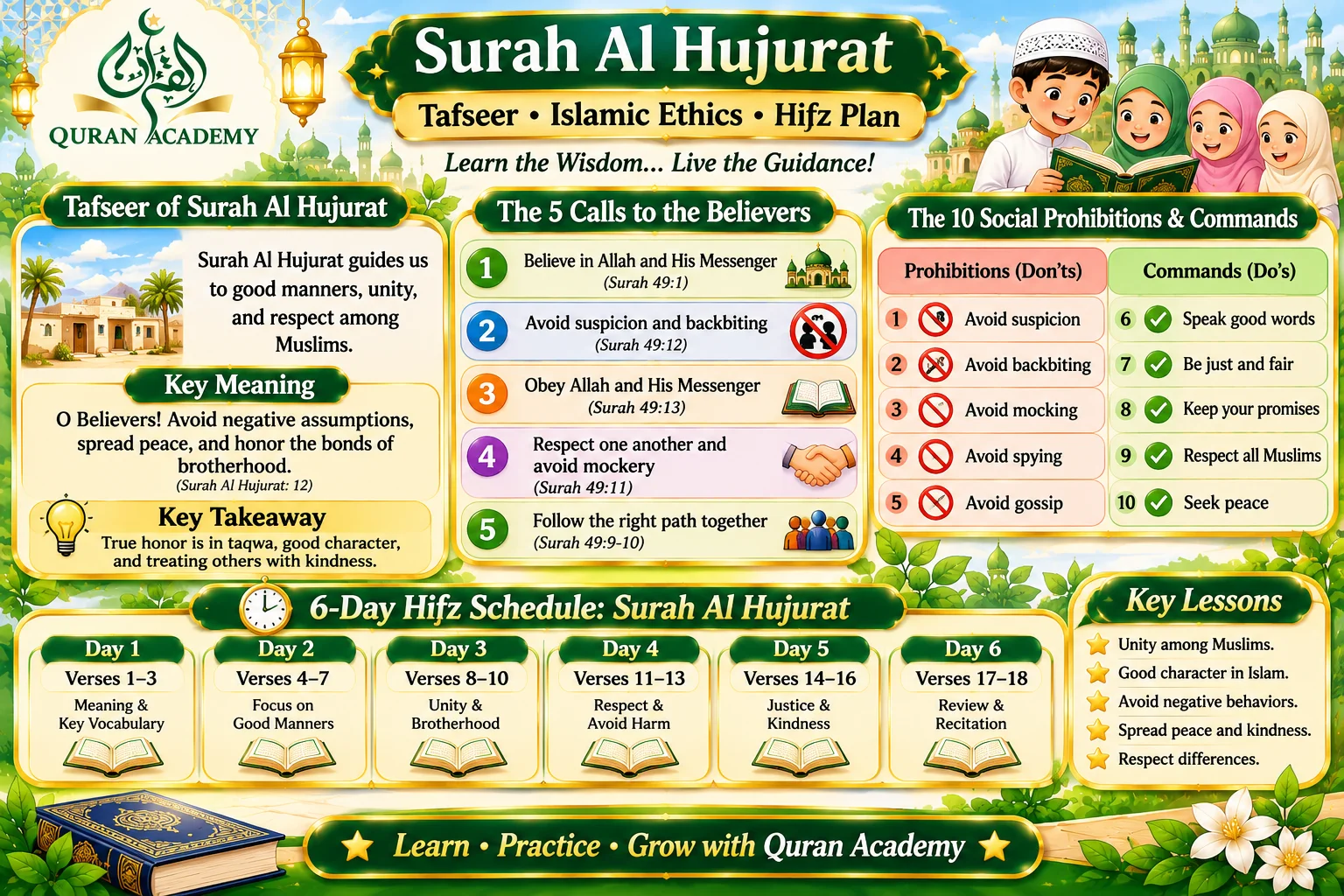
✦ Quick Answer & Key Takeaways: Surah Al-Hujurat Lessons & Tafseer
Studying Surah Al Hujurat lessons and Tafseer (تَفْسِيرُ وَآدَابُ سُورَةِ الْحُجُرَاتِ — Chapter 49 of the Holy Quran, spanning 2.5 pages on Pages 515–517 of the Madinah Mushaf in Juz 26) equips every Muslim family with the Quran's supreme manual of character, speech etiquette, and social harmony! Revealed in Madinah in 9 AH (The Year of Delegations) across 18 transformative verses, Surah Al-Hujurat is structured around 5 direct calls to the believers (يَا أَيُّهَا ٱلَّذِينَ آمَنُواْ) and 1 universal call to all humanity (يَا أَيُّهَا ٱلنَّاسُ). Together, they establish the 10 Golden Rules of Islamic Manners: putting Allah and His Messenger (ﷺ) first, lowering one's voice in reverence, verifying news before sharing (At-Tabayyun), reconciling between believers (Al-Islah), prohibiting mockery, defamation, offensive nicknames, negative suspicion, spying, and backbiting, and crowning human brotherhood with the truth that honor before Allah belongs solely to Taqwa (إِنَّ أَكْرَمَكُمْ عِندَ ٱللَّهِ أَتْقَاكُمْ — 49:13)! In our 1-on-1 Online Tafseer, Hifz & Islamic Studies Program, adults and youth study and memorize Surah Al-Hujurat in 6 days!
- Why Classical Scholars Call It "Surah Al-Adab": Because in just 18 verses, it organizes our etiquette with Allah, with the Prophet (ﷺ), with fellow believers, and with all humanity!
- The 6 Sins of the Tongue & Heart in Verses 11–12: Divided into 3 Public Sins (Mockery, Defamation, Bad Nicknames) and 3 Hidden/Private Sins (Suspicion, Spying, Backbiting)!
- Islam vs. Iman in Verse 14: Explains how outward submission (Islam) matures into deep heart conviction and striving (Iman)!
- #1 Ijazah Test Word in Verse 11: Learn how to pronounce and start on بِئْسَ ٱلِٱسْمُ ٱلْفُسُوقُ (Bi'sa-lismul-fusooq)!
Imagine how peaceful our homes, mosques, workplaces, and WhatsApp/social media groups would become overnight if every single message, conversation, and disagreement had to pass through the filter of Surah Al-Hujurat (سُورَةُ الْحُجُرَاتِ — Chapter 49)! No unverified rumor would ever be forwarded without checking its source (Verse 6). No brother or sister would ever be laughed at, labeled with a hurtful nickname, spied upon, or talked about behind their back (Verses 11–12). And no person would ever look down on another because of race, nationality, or tribe (Verse 13).
Revealed in the 9th year after the Hijrah (The Year of Delegations in our Seerah Timeline), when tribes from across the Arabian Peninsula were entering Islam in waves and coming to the humble rooms (Al-Hujurat) of the Mothers of the Believers to meet the Messenger of Allah (ﷺ), this Surah laid down the ethical constitution of a civilized Muslim society. Starting Day 3 of Matrix 5—and building upon our guides to 15 Etiquettes of Reading the Quran and Iltiqa' As-Sakinayn in Tajweed—this complete guide maps out the 5 Calls to the Believers, the Master Chart of the 10 Golden Rules of Manners, the Universal Charter of Equality in Verse 13, a 6-Day Hifz Schedule, and 5 Essential Tajweed Rules.
- 1. Architectural Blueprint: How Surah Al-Hujurat Is Built Around 5 Calls to the Believers
- 2. Master Chart: The 10 Golden Rules of Islamic Manners & Brotherhood (Verses 1 to 12)
- 3. Deep Dive: Information Verification (Tabayyun in 49:6) & The 6 Diseases of the Tongue & Heart (49:11–12)
- 4. Verses 13 to 18: Human Equality ("Li-Ta'arafoo") & The Difference Between Islam & Iman
- 5. 6-Day Hifz Schedule & 5 Essential Tajweed Rules (The Secret of "Bi'sa-lismu" in 49:11!)
- 6. Frequently Asked Questions (FAQs)
1. Architectural Blueprint: How Surah Al-Hujurat Is Built Around 5 Calls
As Abdullah ibn Mas'ud (RA) famously advised: "Whenever you hear Allah say يَا أَيُّهَا ٱلَّذِينَ آمَنُواْ (O you who believe!) in the Quran, lend it your full ear and heart—for it is either a noble command you are being called to fulfill, or an evil you are being protected from!"
In just 18 verses, Surah Al-Hujurat contains 5 consecutive calls of يَا أَيُّهَا ٱلَّذِينَ آمَنُواْ (in Verses 1, 2, 6, 11, and 12) followed by 1 universal call of يَا أَيُّهَا ٱلنَّاسُ (in Verse 13)! Notice the logical progression from the top down:
• Calls #1 & #2 (Verses 1–5): Our etiquette with Allah Almighty and His Messenger (ﷺ)—submitting to the Quran and Sunnah and honoring the Prophet's dignity.
• Call #3 (Verses 6–10): Protecting Public Community Peace—verifying news (Tabayyun) and reconciling disputes between believers (Islah).
• Calls #4 & #5 (Verses 11–12): Protecting Individual Honor & Private Dignity—banning mockery, insults, offensive nicknames, suspicion, spying, and backbiting.
• Universal Call #6 (Verses 13–18): Our relationship with All Humanity (Ta'aruf & Taqwa) and purifying the heart's Sincerity (Iman)!
2. Master Chart: The 10 Golden Rules of Islamic Manners & Brotherhood
Open our Online Uthmani Quran Explorer to Pages 515–517 and review all 10 Golden Rules of Surah Al-Hujurat in one structured chart:
| # & Golden Rule | Quranic Anchor Phrase & Verse | Practical Application in Family & Daily Life |
|---|---|---|
| 1. Putting Revelation First (عدم التقدم بين يدي الله ورسوله) |
﴿ لَا تُقَدِّمُواْ بَيْنَ يَدَيِ ٱللَّهِ وَرَسُولِهِۦ ﴾ (Verse 1) |
Never place personal opinions, cultural habits, or desires ahead of a clear ruling in the Quran and authentic Sunnah! |
| 2. Reverence for the Sunnah (غض الصوت عند سنة النبي ﷺ) ⭐ |
﴿ لَا تَرْفَعُواْ أَصْوَاتَكُمْ فَوْقَ صَوْتِ ٱلنَّبِيِّ ﴾ (Verses 2–5) |
During his life, Companions like Abu Bakr, 'Umar, and Thabit ibn Qays (RA, Sahih al-Bukhari 4845) lowered their voices in his presence; today, we lower our voices and humble our hearts whenever his Hadith is read! |
| 3. Verifying News (At-Tabayyun) 🏆 (التبين والتثبت من الأخبار) |
﴿ إِن جَاءَكُمْ فَاسِقٌ بِنَبَإٍ فَتَبَيَّنُواْ ﴾ (Verse 6) |
The Islamic media & communication rule: never act on or forward an unverified rumor, screenshot, or accusation without verifying the facts first! |
| 4. Peacemaking (Al-Islah) (الإصلاح بين المؤمنين بالعدل) ⭐ |
﴿ إِنَّمَا ٱلْمُؤْمِنُونَ إِخْوَةٌ فَأَصْلِحُواْ بَيْنَ أَخَوَيْكُمْ ﴾ (Verses 9–10) |
Believers are one single family of brothers and sisters—whenever a misunderstanding arises between spouses, relatives, or neighbors, step in with fair reconciliation! |
| 5. Zero Mockery or Ridicule (النهي عن السخرية والاستهزاء) |
﴿ لَا يَسْخَرْ قَوْمٌ مِّن قَوْمٍ ﴾ (Verse 11) |
Never laugh at or belittle any man or woman's appearance, accent, wealth, or status—for the person being mocked may be far more beloved to Allah than the one mocking! |
| 6. Zero Defamation (Al-Lamz) (النهي عن لمز الأنفس) |
﴿ وَلَا تَلْمِزُواْ أَنفُسَكُمْ ﴾ (Verse 11) |
Notice the miracle of the phrasing: Allah says "Do not insult YOUR OWN SELVES!"—because insulting a fellow believer is like wounding your own body! |
| 7. Zero Hurtful Nicknames (النهي عن التنابز بالألقاب) |
﴿ وَلَا تَنَابَزُواْ بِٱلْأَلْقَابِ ﴾ (Verse 11) |
Call people by the names and titles they love most (and never remind a repentant person of their past mistakes!). |
| 8. Avoiding Negative Suspicion (اجتناب كثير من الظن) ⭐ |
﴿ ٱجْتَنِبُواْ كَثِيرًا مِّنَ ٱلظَّنِّ ﴾ (Verse 12) |
Give your spouse, brother, and sister 70 good excuses (Husn Adh-Dhann), for Prophet Muhammad (ﷺ) warned that suspicion is the most untruthful of speech (Sahih al-Bukhari 6064)! |
| 9. Zero Spying (At-Tajassus) (النهي عن التجسس وتتبع العورات) |
﴿ وَلَا تَجَسَّسُواْ ﴾ (Verse 12) |
Respect people's privacy—never snoop into private phones, homes, or hidden faults that Allah has concealed! |
| 10. Zero Backbiting (Al-Gheebah) 🏆 (النهي عن الغيبة) |
﴿ وَلَا يَغْتَب بَّعْضُكُم بَعْضًا ﴾ (Verse 12) |
Defined by the Prophet (ﷺ) in Sahih Muslim (2589) as mentioning your brother in his absence in a way he would dislike—likened in Verse 12 to eating the flesh of one's own dead brother! |
3. Deep Dive: Information Verification (49:6) & The 3-Step Chain of Verse 12
Look closely at two of the most famous passages in Surah Al-Hujurat:
- 1. Two Mutawatir Qira'at in Verse 6 ("Fa-Tabayyanoo" vs. "Fa-Tathabbatoo"):
As we learned in our 10 Qira'at Guide, in Verse 6 (إِن جَاءَكُمْ فَاسِقٌ بِنَبَإٍ فَتَبَيَّنُواْ), the majority of the 10 Readers (including Hafs and Warsh) read فَتَبَيَّنُواْ (Fa-Tabayyanoo — "Investigate until the truth becomes clear!"), while Imams Hamzah, Al-Kisa'i, and Khalaf read فَتَثَبَّتُواْ (Fa-Tathabbatoo — "Pause slowly and verify firmly without rushing!"). Together, both Mutawatir readings give us the complete methodology of truth: (a) Slow down and don't react hastily (Tathabbut), and (b) Seek clear proof (Tabayyun)! - 2. Why Verse 12 Lists "Suspicion → Spying → Backbiting" in Exact Psychological Order:
Notice the diagnostic wisdom of Verse 12: how does the sin of backbiting (Gheebah) start? It starts inside the heart with a negative assumption (الظَّنّ — Step 1); then the person tries to confirm their suspicion by spying and snooping (التَّجَسُّس — Step 2); and once they find or imagine a fault, their tongue speaks about it to others in backbiting (الْغِيبَة — Step 3)! By cutting off Step 1 (negative suspicion) at the root, Islam protects both your heart and your tongue!
4. Verses 13 to 18: Human Equality ("Li-Ta'arafoo") & The Difference Between Islam & Iman
In Verse 13, the call widens from the believers to every human being on earth (يَا أَيُّهَا ٱلنَّاسُ): declaring that all human beings are biological brothers and sisters from one father (Adam AS) and one mother (Hawwa AS), and that our diverse languages, skin colors, and nations were designed for التَّعَارُف (mutual acquaintance, learning, and cooperation)—while the ONLY scale of nobility in the sight of Allah is Taqwa (as Prophet Muhammad ﷺ proclaimed in his Farewell Sermon and in Sahih Muslim 2564: "Indeed Allah does not look at your outward forms or your wealth, but He looks at your hearts and your deeds!", verifiable in our Online Hadith Explorer).
Then in Verses 14 to 18—connecting directly to our 5 Pillars of Islam & 6 Articles of Faith Guide—when certain new bedouins came to Madinah boasting as if they had done the Prophet (ﷺ) a personal favor by accepting Islam without fighting, Allah taught them two foundational truths:
• 1. Outward Islam vs. Deep Heart Iman (49:14–15): When "Islam" and "Iman" are mentioned together in the same passage, Islam refers to entering the fold of Islam with outward submission and actions, whereas complete Iman is when faith settles deeply in the heart without a trace of doubt (ثُمَّ لَمْ يَرْتَابُواْ) and proves itself through sacrifice!
• 2. Guiding You to Faith Is Allah's Greatest Favor Upon You (49:17): ﴿ بَلِ ٱللَّهُ يَمُنُّ عَلَيْكُمْ أَنْ هَدَاكُمْ لِلْإِيمَانِ إِن كُنتُمْ صَادِقِينَ ﴾—every prayer we pray and every verse of the Quran we memorize is a pure gift of grace from Allah upon us!
5. 6-Day Hifz Schedule & 5 Essential Tajweed Rules (The Secret of "Bi'sa-lismu"!)
Using our 3x3 Memorization Method and our Smart Hifz Planner, you can memorize all 18 verses of Surah Al-Hujurat in 6 days (just 3 verses / half a page per day!):
• Day 1 (Verses 1–3): Calls #1 & #2 — Etiquette with Allah & His Messenger (ﷺ).
• Day 2 (Verses 4–6): Patience outside Al-Hujurat + Call #3 (At-Tabayyun).
• Day 3 (Verses 7–9): Loving Faith in our hearts + Reconciling between two groups.
• Day 4 (Verses 10–11): Brotherhood + Call #4 (Banning Mockery, Defamation & Bad Nicknames).
• Day 5 (Verses 12–13): Call #5 (Banning Suspicion, Spying & Backbiting) + Universal Call #6 (Human Equality).
• Day 6 (Verses 14–18 + Full Review): Islam vs. Iman & Gratitude for Guidance!
Struggling to Perfect Your Recitation?
Join 1,250+ students mastering the Quran 1-on-1 with our Verified Al-Azhar Graduates. Flexible US, UK, Canadian & Australian schedules starting at $8/hr.
Book a Free Evaluation Class →Mastering the Crisp Qalqalah in "Tahْbata", "Al-Hujuraat", "Fa-Ajْma'oo" & "Ijْtaniboo"!
Listen to the key words across Surah Al-Hujurat: أَن تَحْبَطَ أَعْمَالُكُمْ (Tahْbata — 49:2), أُوْلَٰئِكَ ٱلَّذِينَ امْتَحَنَ ٱللَّهُ قُلُوبَهُمْ لِلتَّقْوَىٰ (Lit-Taqْwaa — 49:3), فَتُصْبِحُواْ (Fa-tusbْihoo — 49:6), and ٱجْتَنِبُواْ كَثِيرًا مِّنَ ٱلظَّنِّ (Ijْtaniboo — 49:12)! Every single one features a silent Baa (بْ), Qaaf (قْ), or Jeem (جْ) from the 5 Qalqalah (Echoing) letters (ق ط ب ج د)! Watch Senior Instructor Ustadhah Yasmeen Gamal demonstrate Qalqalah on our Quran Academy YouTube Channel:
- Crisp Jeem Bounce in "Ijْtaniboo": Never let the Jeem turn into a soft "zh" sound before Taa!
- 1-on-1 Live Coaching: Study Surah Al-Hujurat with our Al-Azhar scholars!
When reciting Surah Al-Hujurat, master these five famous Tajweed rules—especially Rule #1, which is asked in nearly every Online Ijazah Exam:
- 1. The Famous "Bi'sa-lismul-Fusooq" Rule in Verse 11 (بِئْسَ ٱلِٱسْمُ ٱلْفُسُوقُ بَعْدَ ٱلْإِيمَانِ):
As we explained in our Hamzatul Wasl Guide and Iltiqa' As-Sakinayn in Tajweed Guide, why is there a Kasrah under the Laam of ٱلِٱسْمُ in Verse 11?
• Originally, the word ٱسْمُ begins with a silent Seen (سْ) preceded by a Hamzatul Wasl. When the definite article ٱلْـ enters upon it, the silent Laam (لْ) of Al- meets the silent Seen (سْ) of Ismu (since the middle Hamzatul Wasl drops in connection!).
• To resolve those two meeting Sukoons (لْ + سْ), the Laam is given a helper Kasrah (لِـ)—so in continuation after Bi'sa, both Hamzatul Wasls drop and you read smoothly: بِئْسَ لِسْمُ ٱلْفُسُوقُ (Bi'sa-lismul-fusooqu)!
• And what if an Ijazah examiner asks you to start directly on the word ٱلِٱسْمُ? Both ways are 100% valid in Hafs: (a) Starting with the Fatha on the first Hamzatul Wasl: أَلِسْمُ (Al-ismu), OR (b) Dropping the first Hamzatul Wasl and starting directly on the Kasrated Laam: لِسْمُ (Lismu)! - 2. Complete Idgham Mutamathilayn in "Wa Laa Yaghtab-Ba'dukum Ba'daa" (49:12):
Applying our Idgham Mutamathilayn Guide and Meem Sakinah Guide, in وَلَا يَغْتَب بَّعْضُكُم بَعْضًا:
• First, the silent Baa of يَغْتَبْ meets the voweled Baa of بَّعْضُكُم—so merge the two identical Baas into a single stressed Baa with ZERO Qalqalah bounce (Wa laa yaghtab-ba'dukum...)!
• Second, the silent Meem of بَّعْضُكُم meets the Baa of بَعْضًا—triggering a 2-beat nasal Ikhfaa' Shafawi (...ba'dukum-ba'daa)! - 3. Two-Beat Iqlab in "Faasiqun Bi-Naba'in" (فَاسِقٌۢ بِنَبَإٍ — 49:6) & "Qawmun Min Qawm" (49:11):
Using our Noon Sakinah & Tanween Guide and Matn Tuhfat Al-Atfal, notice the small standing Meem (ۢ) over فَاسِقٌۢ بِنَبَإٍ in Verse 6—convert the Tanween into a hidden Meem before the Baa with 2 beats of Ghunnah! - 4. Dual Pronouns in Verses 9 & 10 ("Baynahumaa" & "Akhawaykum"):
Connecting to our Arabic Pronouns Chart and Singular, Dual & Plural Guide, stretch the 2-count Alif of فَأَصْلِحُواْ بَيْنَهُمَا (49:9 — between the two groups) and keep the soft Waw Leen in أَخَوَيْكُمْ (49:10 — your two brothers)! - 5. Heavy vs. Light Raa in "Laa Yas-kharْ Qawmun" (49:11) & "Al-Hujuraat":
Following our Ahkam Al-Raa, Makharij al-Huruf, Sifaat al-Huruf, Heavy & Light Letters, Rules of Madd, Rules of Waqf, Laam Shamsiyyah & Qamariyyah, 4 Special Words of Hafs, 7 Alifs in the Quran, Matn Al-Jazariyyah, 25 Common Tajweed Mistakes in Salah, An-Nabr (Vocal Stress), and 15 Sajdah Tilawah Verses guides, pronounce the silent Raa of لَا يَسْخَرْ (Laa yas-kharْ) 100% Heavy (Tafkhim) because it is preceded by a Fatha! Test your Tajweed skills right now on our Free 3-Minute Tajweed Quiz!
Explore more Surah Tafseer, Quranic Arabic, and Fiqh guides across our library: Surah An-Naba', Surah Al-A'la, Surah Ash-Sharh, Surah At-Tin, Surah Az-Zalzalah & Al-'Adiyat, 12 Duas for Seeking Knowledge & Memory, 15 Duas for Parents, Marriage & Offspring, and 50 Most Common Arabic Roots in our Online Hifz Program (using our Interactive Tajweed Encyclopedia)! Meet our Al-Azhar Certified Tutors, enroll your child in our 1-on-1 Kids Quran Classes with our Printable Kids Star Chart, and read how families across the US, UK, Canada, and Australia rate our teachers on our Verified Student & Parent Reviews Page.
6. Frequently Asked Questions (FAQs) About Surah Al-Hujurat
1. Why is Chapter 49 of the Quran named "Surah Al-Hujurat" (The Private Chambers)?
Surah Al-Hujurat (Chapter 49, revealed in Madinah in 9 AH — the Year of Delegations) takes its name from Verse 4, which mentions the private living chambers (Al-Hujurat) of Prophet Muhammad (ﷺ) and the Mothers of the Believers. When a delegation from Banu Tamim called out loudly to the Prophet (ﷺ) from behind his private rooms at midday, Allah revealed these verses to teach the Ummah the highest standards of reverence, patience, and social etiquette.
2. What are the 10 Golden Rules of Islamic manners taught in Surah Al-Hujurat?
Across its 18 Madinan verses, Surah Al-Hujurat establishes 10 foundational rules of manners (Adab): (1) Never put personal opinions ahead of Allah and His Messenger (49:1), (2) Lower your voice and show reverence for the Prophetic Sunnah (49:2–5), (3) Verify news and rumors before sharing (At-Tabayyun — 49:6), (4) Reconcile with justice between quarreling believers (Al-Islah — 49:9–10), (5) Never mock or ridicule anyone (As-Sukhriyah — 49:11), (6) Never defame or insult others (Al-Lamz — 49:11), (7) Never call people by offensive nicknames (At-Tanabuz bil-Alqab — 49:11), (8) Avoid negative suspicion (Su' Adh-Dhann — 49:12), (9) Never spy on others' private affairs (At-Tajassus — 49:12), and (10) Never backbite (Al-Gheebah — 49:12)!
3. How does Surah Al-Hujurat (49:6) protect families and communities in the age of social media?
Verse 6 of Surah Al-Hujurat establishes the timeless Islamic principle of information verification (At-Tabayyun / At-Tathabbut): whenever an unverified report or rumor reaches you, pause and investigate the truth before reacting or forwarding it—so that you do not harm innocent people out of ignorance and end up filled with regret!
4. Why is Verse 13 of Surah Al-Hujurat considered the universal charter of human equality?
Addressing all of humanity ("Yaa Ayyuhan-Naas"), Verse 13 declares that every human being originates from a single father and mother (Adam and Hawwa, peace be upon them), and that diverse nations, races, and tribes were created so people may get to know and cooperate with one another (Li-Ta'aarafoo)—never to boast! With Allah, the only true measure of nobility and honor is Taqwa (God-consciousness and righteous character).
5. What is the special Tajweed rule when starting to read the word "Al-Ismu" in "Bi'sal-Ismul-Fusooqu" (49:11)?
In Surah Al-Hujurat (49:11 — بِئْسَ ٱلِٱسْمُ ٱلْفُسُوقُ), the word ٱلِٱسْمُ starts with two Hamzatul Wasls surrounding a Laam that takes a helper Kasrah due to Iltiqa' As-Sakinayn. In continuation, it is read smoothly as "Bi'sa-lismul-fusooq". If tested in an Ijazah exam on how to start directly on ٱلِٱسْمُ, Hafs allows two valid ways: starting with the Fatha on the first Hamzatul Wasl ("Al-ismu") OR starting directly with the Kasrah on the Laam ("Lismu")!
Raise a Family Adorned With the Manners of the Quran!
Join our live 1-on-1 Quran, Tajweed, Tafseer, and Islamic Studies classes for adults and children with certified male and female Al-Azhar scholars. Book your free diagnostic trial session today!
Book Your Free 1-on-1 Trial Class →