
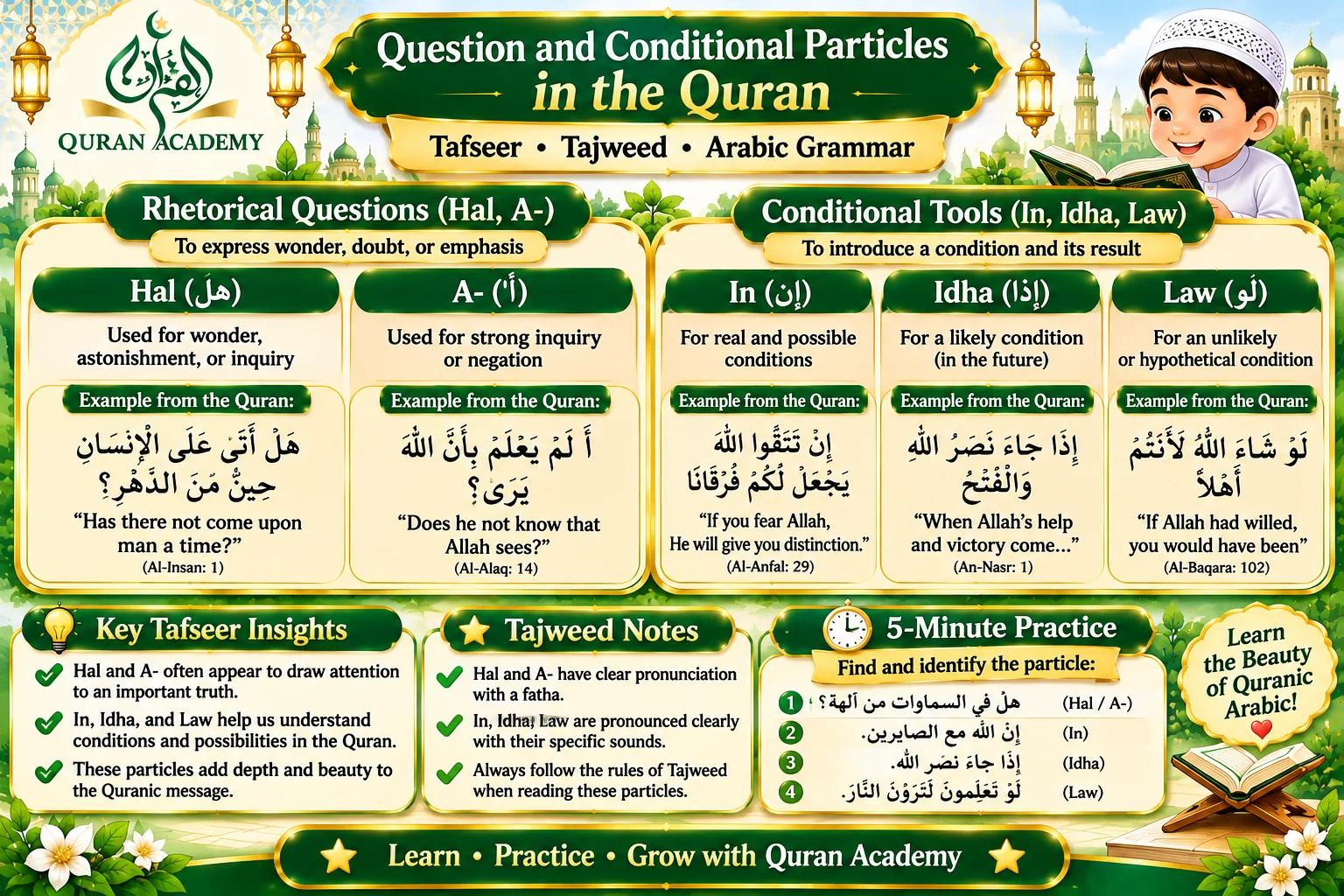
✦ Quick Answer & Key Takeaways: Question & Conditional Particles in the Quran
Mastering question and conditional particles in the Quran (أَدَوَاتُ الِاسْتِفْهَامِ وَأَدَوَاتُ الشَّرْطِ فِي الْقُرْآنِ الْكَرِيمِ) unlocks both the rhetorical tone (Balaghah) and the grammatical structure of thousands of Quranic verses! In Quranic Arabic, questions (Al-Istifham) use particles like هَلْ (Hal), the prefixed Hamzah أَ (A-), مَا (Maa), مَنْ (Man), مَتَىٰ (Mataa), أَيَّانَ (Ayyaana), and كَيْفَ (Kayfa)—often to stir awe, challenge denial, or affirm truth rather than merely ask for information—while conditional statements (Ash-Shart) link a condition to its result using إِنْ (In — uncertain/hypothetical "if"), إِذَا (Idhaa — certain/expected "when/whenever"), لَوْ (Law — contrafactual/hypothetical "if"), and conditional مَنْ / مَا / كُلَّمَا! Building upon our Demonstrative & Relative Pronouns Chart and Inna & Kana Sisters Chart, this guide gives you complete charts and 5 Tajweed rules. In our 1-on-1 Online Quranic Arabic & Tafseer Program, students master these tools while reading directly from the Mushaf!
- Idhaa vs. In vs. Law: إِذَا = when it's expected/certain; إِنْ = if it's uncertain/hypothetical; لَوْ = contrafactual/imagined scenario!
- Rhetorical Questions in the Quran: Many questions like هَلْ جَزَاءُ ٱلْإِحْسَانِ إِلَّا ٱلْإِحْسَانُ (55:60) affirm a truth with emotional power!
- How Jussive Conditionals Shape Verbs: Particles like مَنْ and إِنْ often put verbs into Jazm (e.g., فَمَن يَعْمَلْ مِثْقَالَ ذَرَّةٍ... — 99:7)!
- Tajweed Alert on "Hal" & "Man": Watch out for Noon Sakinah and Laam Sakinah rules right after question & conditional particles!
When you read the Quran, you don't just read declarative statements—you frequently hear direct questions and vivid "If / When" conditions spoken straight to your heart: ﴿ أَلَمْ نَشْرَحْ لَكَ صَدْرَكَ ﴿١﴾ ﴾ ("Did We not expand for you your breast?" — Ash-Sharh 94:1), ﴿ إِذَا زُلْزِلَتِ ٱلْأَرْضُ زِلْزَالَهَا ﴿١﴾ ﴾ ("When the earth is shaken with its earthquake..." — Az-Zalzalah 99:1), and ﴿ لَوْ أَنزَلْنَا هَٰذَا ٱلْقُرْآنَ عَلَىٰ جَبَلٍ... ﴿٢١﴾ ﴾ ("If We had sent down this Quran upon a mountain..." — Al-Hashr 59:21).
Recognizing how each particle works prevents two common reading mistakes: first, translating a rhetorical question literally as if Allah were asking for information rather than emphasizing a truth; and second, confusing إِذَا (When), إِنْ (If), and لَوْ (Had it been / If). Continuing Day 4 of Matrix 5 alongside our guides to Demonstrative & Relative Pronouns, Inna & Kana Sisters, and Harf Al-Jarr Prepositions, this complete guide maps out Question Particles, Conditional Particles, Rhetorical Meanings, and 5 Essential Tajweed Rules.
- 1. Part 1 (Adawat Al-Istifham): Master Chart of Question Particles in the Quran
- 2. Part 2 (Balaghah): Why the Quran Uses Questions for Awe, Affirmation & Denial
- 3. Part 3 (Adawat Ash-Shart): Master Chart of Conditional Particles (In, Idha, Law, Man, Ma & Kullama)
- 4. Part 4: Comparing "Idha" vs. "In" vs. "Law" in Quranic Tafseer
- 5. Five Essential Tajweed Rules in Question & Conditional Verses
- 6. Frequently Asked Questions (FAQs)
1. Part 1 (Adawat Al-Istifham): Master Chart of Question Particles in the Quran
In Arabic grammar, question tools (أَدَوَاتُ الِاسْتِفْهَامِ) divide into two particles (حُرُوف: Hal and the prefixed Hamzah A-) and interrogative nouns (أَسْمَاء: Maa, Man, Mataa, Ayyaana, Kayfa, Annaa, Ayna). Study the core chart below:
| Question Tool | Literal / Core Meaning | Famous Quranic Verse Example |
|---|---|---|
| 1. هَلْ (Hal) ⭐ | Standalone yes/no question word (often conveying awe, challenge, or affirmation). | ﴿ هَلْ أَتَاكَ حَدِيثُ ٱلْغَاشِيَةِ ﴿١﴾ ﴾ (Al-Ghashiyah 88:1) & ﴿ هَلْ جَزَاءُ ٱلْإِحْسَانِ إِلَّا ٱلْإِحْسَانُ ﴾ (Ar-Rahman 55:60). |
| 2. أَـ (A- — Hamzah) ⭐ | Prefixed question Hamzah attached directly to the start of a word (can enter on negation!). | ﴿ أَلَمْ نَشْرَحْ لَكَ صَدْرَكَ ﴾ (Ash-Sharh 94:1) & ﴿ أَلَيْسَ ٱللَّهُ بِأَحْكَمِ ٱلْحَاكِمِينَ ﴾ (At-Tin 95:8). |
| 3. مَا (Maa) & عَمَّ ('Amma) | What? (And عَمَّ = 'An + Maa = "About what?", as in Surah An-Naba' 78:1). | ﴿ مَا ٱلْقَارِعَةُ ﴿٢﴾ وَمَا أَدْرَاكَ مَا ٱلْقَارِعَةُ ﴿٣﴾ ﴾ (Al-Qari'ah 101:2–3). |
| 4. مَنْ (Man) | Who? (Asks about rational beings). | ﴿ مَن ذَا ٱلَّذِي يُقْرِضُ ٱللَّهَ قَرْضًا حَسَنًا ﴾ (Al-Hadid 57:11 — "Who is it that will lend Allah a goodly loan?"). |
| 5. مَتَىٰ & أَيَّانَ 🏆 | When? (Mataa = general when; Ayyaana = emphatic/awe-inspiring "When will that be?!"). | ﴿ مَتَىٰ نَصْرُ ٱللَّهِ ﴾ (Al-Baqarah 2:214) & ﴿ أَيَّانَ يَوْمُ ٱلدِّينِ ﴾ (Adh-Dhariyat 51:12). |
| 6. كَيْفَ & أَنَّىٰ & أَيْنَ | How? (Kayfa), How / From where? (Annaa), and Where? (Ayna). | ﴿ كَيْفَ تَكْفُرُونَ بِٱللَّهِ ﴾ (2:28) & ﴿ يَا مَرْيَمُ أَنَّىٰ لَكِ هَٰذَا ﴾ (Al 'Imran 3:37). |
2. Part 2 (Balaghah): Why the Quran Uses Questions for Awe, Affirmation & Denial
In Quranic rhetoric (Balaghah), a question often carries a deeper purpose than seeking a spoken answer:
• 1. Exalting & Magnifying Awe (At-Tafkhim wat-Ta'dheem): In ﴿ وَمَا أَدْرَاكَ مَا ٱلْقَارِعَةُ ﴾ or ﴿ وَمَا أَدْرَاكَ مَا لَيْلَةُ ٱلْقَدْرِ (97:2), the question "What can make you know what it is?" tells the listener that its greatness exceeds ordinary imagination!
• 2. Emphatic Affirmation (At-Taqreer): In ﴿ أَلَمْ نَشْرَحْ لَكَ صَدْرَكَ ﴾ ("Did We not expand for you your breast?"), the question with negation (A-lam) affirms a reality that everyone knows is true: "Yes indeed, We have expanded your breast!"
• 3. Emphatic Negation (An-Nafyu): In ﴿ هَلْ جَزَاءُ ٱلْإِحْسَانِ إِلَّا ٱلْإِحْسَانُ ﴾ (55:60), the question means: "There is NO reward for goodness except goodness!"
3. Part 3 (Adawat Ash-Shart): Master Chart of Conditional Particles in the Quran
A conditional sentence in Arabic connects two parts: فِعْلُ الشَّرْطِ (The Condition) and جَوَابُ الشَّرْطِ (The Result / Consequence). Look at the main conditional tools in the Quran:
| Conditional Tool | Conditional Nuance & Grammar | Famous Quranic Verse Example |
|---|---|---|
| 1. إِذَا (Idhaa) ⭐ | When / Whenever (Used for expected, certain, or recurring conditions). | ﴿ إِذَا زُلْزِلَتِ ٱلْأَرْضُ زِلْزَالَهَا ﴾ (99:1) & ﴿ إِذَا جَاءَ نَصْرُ ٱللَّهِ وَٱلْفَتْحُ ﴾ (110:1). |
| 2. إِنْ (In) ⭐ | If (Used for uncertain or hypothetical possibilities; puts verbs in Jazm). | ﴿ إِن تَنصُرُواْ ٱللَّهَ يَنصُرْكُمْ ﴾ (Muhammad 47:7 — "If you support Allah, He will support you!"). |
| 3. لَوْ (Law) 🏆 | If [contrary to fact / hypothetical] (Often highlights an imagined or unfulfilled condition). | ﴿ لَوْ أَنزَلْنَا هَٰذَا ٱلْقُرْآنَ عَلَىٰ جَبَلٍ لَّرَأَيْتَهُۥ خَاشِعًا... ﴾ (59:21). |
| 4. مَنْ (Man — Conditional) ⭐ | Whoever / He who (Jussive conditional noun putting condition & result verbs in Jazm). | ﴿ فَمَن يَعْمَلْ مِثْقَالَ ذَرَّةٍ خَيْرًا يَرَهُۥ ﴾ (99:7). |
| 5. مَا / مَهْمَا (Maa / Mahmaa) | Whatever / Whenever (Jussive conditional tools). | ﴿ وَمَا تَفْعَلُواْ مِنْ خَيْرٍ يَعْلَمْهُ ٱللَّهُ ﴾ (Al-Baqarah 2:197). |
| 6. كُلَّمَا (Kullamaa) | Whenever / Every single time that (Repeated occurrence). | ﴿ كُلَّمَا دَخَلَ عَلَيْهَا زَكَرِيَّا ٱلْمِحْرَابَ وَجَدَ عِندَهَا رِزْقًا ﴾ (3:37). |
4. Part 4: Comparing "Idha" vs. "In" vs. "Law" in Quranic Tafseer
Notice how carefully the Quran chooses between إِذَا, إِنْ, and لَوْ:
• When Allah speaks of the Day of Resurrection or the help of Allah coming at its appointed hour, He uses إِذَا (When)—because its occurrence is certain!
• When Allah speaks of human choices or possibilities—such as "If you are grateful, I will surely increase you" or "If you do good, you do good for yourselves"—إِنْ (If) highlights the choice and responsibility of the condition!
• When Allah sets up a striking hypothetical contrast—such as sending the Quran down upon a mountain (59:21)—لَوْ invites deep reflection on a vivid scenario!
Spotting Crisp Qalqalah After Conditional "Man" & Question "A-" in Quranic Recitation!
Listen to how conditional and question verses frequently feature a crisp Qalqalah (Echoing) bounce (ق ط ب ج د): فَمَن يَعْمَلْ مِثْقَالَ ذَرَّةٍ (Ya'ْmal — 99:7), إِن تَكُ مِثْقَالَ حَبَّةٍ (Takْ — 31:16), and أَلَمْ تَرَ كَيْفَ فَعَلَ رَبُّكَ (105:1)! Watch Senior Instructor Ustadhah Yasmeen Gamal demonstrate Qalqalah on our Quran Academy YouTube Channel:
Struggling to Perfect Your Recitation?
Join 1,250+ students mastering the Quran 1-on-1 with our Verified Al-Azhar Graduates. Flexible US, UK, Canadian & Australian schedules starting at $8/hr.
Book a Free Evaluation Class →- Grammar + Tajweed Together: Understand every verse you recite!
- 1-on-1 Live Coaching: Study Quranic Arabic & Tajweed with Al-Azhar scholars!
5. Five Essential Tajweed Rules in Question & Conditional Verses
When reciting verses with question and conditional particles, apply these five Tajweed rules from our 1-on-1 Online Tajweed Course:
- 1. Clear Izhar Halqi on Conditional "Man" Before Throat Letters ("Man Aamana" & "Man Yakhshaa"):
As we mastered in our Noon Sakinah & Tanween Guide and Matn Tuhfat Al-Atfal, whenever conditional مَنْ (Whoever) is followed by a throat letter like Hamzah (مَنْ آمَنَ) or Khaa' (مَن يَخْشَىٰ vs. Yaa which takes Idgham Bighunnah: مَن يَعْمَلْ), apply the exact Noon Sakinah rule! - 2. Clear Laam on "Hal" Before Most Letters & Smooth Connection in "Hal Ataa" (88:1):
Applying our Laam Sakinah Guide, pronounce the silent Laam of هَلْ (Halْ) clearly without bouncing it, and in هَلْ أَتَاكَ, remember that the first Alif of Ataa-ka is a Hamzatul Qat' with a Fatha! - 3. Two-Beat Ghunnah on "'Amma" (عَمَّ = 'An + Maa) Without Stretching a Final Alif:
Using our Meem Sakinah & Mushaddadah Guide, hold a 2-beat nasal Ghunnah on the Meem Mushaddadah of عَمَّ and move straight to the next word! - 4. Four-to-Five Beat Madd Wajib Muttasil on "Idhaa Jaaa'a" (إِذَا جَاءَ) & "Maa Aghnaa":
According to our Rules of Madd Guide, when a conditional or question particle is followed by a word beginning with a Hamzah after an Alif Madd, stretch smoothly for 4 to 5 counts! - 5. Heavy vs. Light Raa After Question & Conditional Tools ("Alam Tara", "Law Anzalnaa", "Man Yaghfiru"):
Following our Ahkam Al-Raa, Makharij al-Huruf, Sifaat al-Huruf, Heavy & Light Letters, Rules of Waqf, Hamzatul Wasl vs. Qat', 4 Special Words of Hafs, 7 Alifs in the Quran, Idgham Pairs, 10 Qira'at, Hafs vs. Warsh, Iltiqa' As-Sakinayn, Matn Al-Jazariyyah, 25 Common Tajweed Mistakes in Salah, An-Nabr (Vocal Stress), and 15 Sajdah Tilawah Verses guides, check the vowel of the Raa itself to decide between heavy (Fatha/Damma) and light (Kasrah)! Test your Tajweed accuracy right now on our Free 3-Minute Tajweed Quiz!
Explore more Quranic Arabic and Surah Tafseer guides across our library: Demonstrative & Relative Pronouns, Inna & Kana Sisters, Arabic Personal Pronouns Chart, Harf Al-Jarr Prepositions, Singular, Dual & Plural, Verbs in Quranic Arabic, 50 Most Common Arabic Roots, and Surah Al-Hashr (using our Interactive Tajweed Encyclopedia and Online Hadith Explorer)! Meet our Al-Azhar Certified Tutors, enroll your child in our 1-on-1 Kids Quran Classes with our Printable Kids Star Chart, and read how families across the US, UK, Canada, and Australia rate our teachers on our Verified Student & Parent Reviews Page.
6. Frequently Asked Questions (FAQs) About Question & Conditional Particles in the Quran
1. What is the difference between "Hal" (هَلْ) and the Question Hamzah "A-" (أَ) in the Quran?
Both "Hal" (هَلْ) and the prefixed Question Hamzah "A-" (أَ — Hamzatul-Istifham) are yes/no question particles, but they have distinct grammatical and rhetorical behaviors: (1) "Hal" is a standalone word that cannot enter upon a negated sentence or an "Inna" clause, and in Quranic rhetoric often conveys amazement, awe, or a challenge (such as "Hal ataaka hadeethul-ghaashiyah" in 88:1 or "Hal jazaa'ul-ihsaani illal-ihsaan" in 55:60); whereas (2) the prefixed Hamzah "A-" attaches directly to the first letter of a word, CAN enter upon a negated sentence ("Alam nashrah laka sadrak" in 94:1), and is used for affirmation, rebuke, or comparison!
2. What is the difference between "Idha" (إِذَا), "In" (إِنْ), and "Law" (لَوْ) as conditional particles in the Quran?
In Quranic grammar and Balaghah, conditional particles signal the likelihood or nature of the condition: (1) "Idha" (إِذَا — When/Whenever) is used for conditions that are expected, certain, or frequently occurring (such as "Idhaa zulzilatil-ardu" in 99:1 or "Idhaa jaaa'a nasrullaahi" in 110:1); (2) "In" (إِنْ — If) is used for uncertain, hypothetical, or rarer possibilities (and puts the conditional and response verbs into Jazm / Sukoon); and (3) "Law" (لَوْ — If) is a contrafactual/hypothetical conditional particle often expressing regret, wish, or impossibility ("Law anzalnaa haadhal-Qur'aana 'alaa jabalin..." in 59:21)!
3. Why do many question words in the Quran (like "Hal ataa..." or "Ma adraaka...") mean "No" or "You cannot grasp how great it is"?
In Quranic rhetoric (Balaghah), questions are frequently used not to ask for information, but for amazement, denial, or emphasis: for example, "Hal min khaaliqin ghayrullaah" (35:3 — "Is there any creator other than Allah?") is a rhetorical negation meaning "There is NO creator other than Allah!"; while "Wa maa adraaka mal-qaari'ah" (101:3 — "And what can make you know what Al-Qari'ah is?") magnifies the awe and grandeur of the Day of Judgment!
4. How do conditional particles like "In" (إِنْ) and "Man" (مَنْ) affect the vowels of verbs in the Quran?
When a Jussive Conditional Particle (Adat Shart Jazimah—such as "In" [إِنْ], "Man" [مَنْ], "Maa" [مَا], or "Mahmaa" [مَهْمَا]) governs two verbs (the condition verb [Fi'l Ash-Shart] and the result/response verb [Jawab Ash-Shart]), both verbs take Jazm—which typically appears as a Sukoon on a healthy final letter (e.g., "Wa man ya'mal mithqaala dharratin..." in 99:7–8) or dropping a final weak letter/Noon!
5. What is the #1 Tajweed rule when reciting "Hal" (هَلْ) before different letters in the Quran?
According to Tajweed rules (and Matn Tuhfat Al-Atfal / Al-Jazariyyah), the silent Laam of "Hal" (هَلْ) is pronounced clearly (Izhar) before almost all letters—and always verify the exact Uthmani marking in the Mushaf when reading conditional and question phrases!
Read the Quran With Direct Understanding & Tajweed Precision!
Master Quranic grammar, vocabulary, Tafseer, and Tajweed in personalized 1-on-1 online classes with certified male and female Al-Azhar scholars. Book your free diagnostic trial session today!
Book Your Free 1-on-1 Trial Class →