
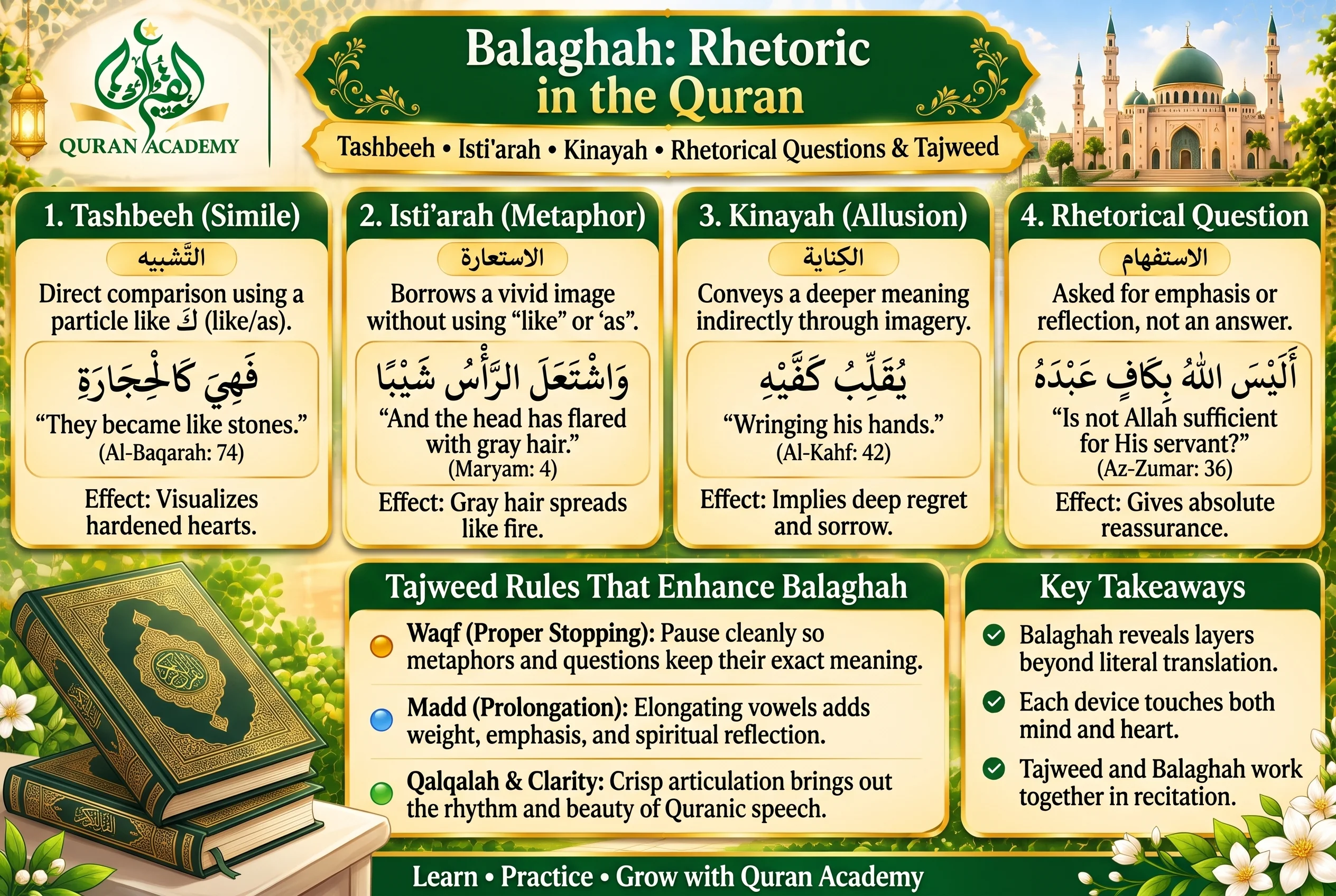
✦ Quick Answer & Key Takeaways: Balaghah Rhetoric in the Quran
Exploring Balaghah rhetoric in the Quran (عِلْمُ الْبَلَاغَةِ الْقُرْآنِيَّةِ: التَّشْبِيهُ وَالِاسْتِعَارَةُ وَالْكِنَايَةُ وَالِاسْتِفْهَامُ الْبَلَاغِيُّ) reveals why the style of the Holy Quran captivates minds across every era! Through figurative imagery—such as Simile (Tashbeeh), Metaphor (Isti'arah), and Metonymy (Kinayah)—alongside structural tools like Rhetorical Questions and Nominal vs. Verbal Sentences, the Quran turns abstract spiritual realities into vivid, unforgettable pictures! Building upon our guides to The 10 Verb Forms and Reading Arabic Without Tashkeel, this guide breaks down core rhetorical devices for Day 5 of Matrix 5. In our 1-on-1 Online Quranic Arabic & Tafseer Program, students connect rhetoric directly to Quran Tafseer!
- Tashbeeh (Simile): Compares two things to highlight shared traits (often using Ka- or Ka'anna).
- Isti'arah (Metaphor): Borrows imagery across domains—like "light" for guidance and "darknesses" for misguidance!
- Kinayah (Allusion / Metonymy): Points to a meaningful state through its natural outward sign.
- Tajweed Precision: Every rhetorical verse is recited with full Madd, Ghunnah, and Qalqalah rules!
When Surah Al-Hujurat (49:12) warns against backbiting (Gheebah), it does not merely say "Backbiting is a grave sin"—it asks whether any of you would like to eat the dead flesh of his brother, sparking an immediate visceral revulsion that stays in the memory forever! Similarly, in Surah Al-Hadid (57:20), worldly life is pictured as rain-fed vegetation that flourishes, turns yellow, and crumbles into dry fragments.
Understanding Balaghah rhetoric in the Quran helps students of Tafseer and Hifz see why a specific word or image was chosen in a given verse. Continuing Day 5 of Matrix 5 alongside our guides to Question & Conditional Particles, Nominal vs. Verbal Sentences, and The 10 Verb Forms, this guide gives you a Rhetorical Devices Comparison Chart, practical Tafseer takeaways, and 5 Essential Tajweed Rules.
1. Master Chart: Simile (Tashbeeh), Metaphor (Isti'arah), Kinayah & Questions
Compare the core rhetorical tools of Quranic Balaghah in the chart below:
| Rhetorical Device | How It Works | Quranic Context & Effect |
|---|---|---|
| 1. التشبيه (Tashbeeh — Simile) ⭐ | Likens one thing to another sharing a key quality (often with Ka- or Ka'anna). | Likens fleeting worldly growth to plants after rain (Al-Hadid 57:20) so the heart grasps transience immediately. |
| 2. الاستعارة (Isti'arah — Metaphor) 🏆 | Uses a word figuratively outside its literal domain based on a strong analogy. | Describes guidance as Light (Noor) and misguidance/doubt as Darknesses (Dhulumat) across the Quran. |
| 3. الكناية (Kinayah — Allusion) ⭐ | Expresses an intended meaning indirectly via a closely associated trait or outcome. | Alludes to a state or quality with refined dignity and depth rather than blunt phrasing. |
| 4. الاستفهام البلاغي (Rhetorical Question) | Asks a question to evoke awe, affirmation, rebuke, or denial rather than to gather news. | As in ﴿ أَلَيْسَ ٱللَّهُ بِأَحْكَمِ ٱلْحَاكِمِينَ ﴾ (At-Tin 95:8) & Question Particles Guide. |
2. Why Parables & Imagery Matter in Tafseer and Memorization
Human memory is naturally visual and relational. When a student memorizing Juz Amma or Surah Al-Hashr visualizes the mountain humbling itself before the Quran (59:21) or the earth reporting its news (99:4), the mental image anchors the exact sequence of verses without effort!
Eloquence + Accuracy: Crisp Qalqalah on "Qutb Jadd" (ق ط ب ج د)!
Appreciating the eloquence of a Quranic verse goes hand in hand with reciting every letter cleanly—including crisp Qalqalah (Echoing) bounces (ق ط ب ج د)! Watch Senior Instructor Ustadhah Yasmeen Gamal demonstrate Qalqalah on our Quran Academy YouTube Channel:
- Tafseer + Tajweed Together: Reflect deeply while reciting cleanly!
- 1-on-1 Live Coaching: Study with certified Al-Azhar scholars!
3. Five Essential Tajweed Rules in Rhetorical Quranic Verses
When reciting figurative and rhetorical verses in the Quran, apply these five Tajweed rules from our 1-on-1 Online Tajweed Course:
Struggling to Perfect Your Recitation?
Join 1,250+ students mastering the Quran 1-on-1 with our Verified Al-Azhar Graduates. Flexible US, UK, Canadian & Australian schedules starting at $8/hr.
Book a Free Evaluation Class →- 1. Two-Beat Ghunnah on "Ka'anna" (كَأَنَّ) & "Inna" (إِنَّ):
Applying our Noon Sakinah & Mushaddadah Guide and Matn Tuhfat Al-Atfal, always hold a 2-beat nasal Ghunnah on the doubled Noon of simile/emphasis particles! - 2. Clear Laam on "Hal" & "Bal" Before Following Letters:
Using our Laam Sakinah Guide, articulate the silent Laam cleanly without bouncing it! - 3. Clear Meem Sakinah Rules Across Clauses:
According to our Meem Sakinah Rules Guide, apply Ikhfaa' Shafawi before Baa, Idgham Mithlayn before Meem, and Izhar Shafawi before other letters! - 4. Consistent Madd Counts & Thoughtful Waqf:
Using our Rules of Madd and Rules of Waqf guides, honor Madd durations and pause at meaningful stopping points! - 5. Heavy vs. Light Raa Based on Vowels & Surrounding Letters:
Following our Ahkam Al-Raa, Makharij al-Huruf, Sifaat al-Huruf, Heavy & Light Letters, Hamzatul Wasl vs. Qat', 4 Special Words of Hafs, 7 Alifs in the Quran, Idgham Pairs, 10 Qira'at, Hafs vs. Warsh, Iltiqa' As-Sakinayn, Matn Al-Jazariyyah, 25 Common Tajweed Mistakes in Salah, An-Nabr (Vocal Stress), and 15 Sajdah Tilawah Verses guides, apply the exact vowel-based Raa rule! Test your Tajweed skills right now on our Free 3-Minute Tajweed Quiz!
Explore more Quranic Arabic, Balaghah, and Surah Tafseer guides across our library: Reading Arabic Without Tashkeel, Question & Conditional Particles, Nominal vs. Verbal Sentences, 10 Verb Forms, Inna & Kana Sisters, and Demonstrative & Relative Pronouns (using our Interactive Tajweed Encyclopedia and Online Hadith Explorer)! Meet our Al-Azhar Certified Tutors, enroll your child in our 1-on-1 Kids Quran Classes with our Printable Kids Star Chart, and read how families across the US, UK, Canada, and Australia rate our teachers on our Verified Student & Parent Reviews Page.
4. Frequently Asked Questions (FAQs) About Balaghah Rhetoric in the Quran
1. What is "Balaghah" in Quranic Arabic, and what are its 3 traditional branches?
In Arabic scholarship, "Balaghah" (البلاغة) means conveying eloquent, exact meaning suited to the context and audience with clarity and beauty. It traditionally comprises three branches: (1) 'Ilm Al-Bayan (Figurative Imagery—such as Simile [Tashbeeh], Metaphor [Isti'arah], and Metonymy [Kinayah]), (2) 'Ilm Al-Ma'ani (Sentence Structure & Context—such as nominal vs. verbal sentences, emphasis, and rhetorical questions), and (3) 'Ilm Al-Badi' (Rhetorical Embellishments—such as antithesis [Tibaq] and verbal symmetry).
2. What is the difference between a Simile (Tashbeeh) and a Metaphor (Isti'arah) in the Quran?
In a Simile (Tashbeeh), two things are explicitly linked by similarity using a tool or comparison (such as "Ka-" or "Ka'anna"—e.g., comparing worldly life to rain-fed plants in 57:20). In a Metaphor (Isti'arah), the comparison is compressed into an implied or direct figurative transfer—such as when the Quran speaks of "Kitabun anzalnaahu ilayka li-tukhrijan-naasa minadh-dhulumaati ilan-noor" (14:1 — bringing people out of "darknesses" into "light" as a metaphor for misguidance vs. guidance)!
3. What is a "Kinayah" (Metonymy / Allusion) in Quranic Balaghah?
A "Kinayah" (الكناية) expresses an idea indirectly by mentioning a well-known trait, action, or consequence that naturally accompanies it—allowing the literal meaning to remain valid while pointing to the intended deeper meaning!
4. Why are parables (Amthal) so frequent in the Quran?
As Allah states in verses like "Wa tilkal-amthaalu nadribuhaa lin-naasi la'allahum yatafakkaroon" (59:21), parables bridge abstract spiritual or unseen truths with tangible, everyday experiences so the mind can visualize and reflect on them immediately.
5. How does studying Quranic Balaghah enrich Hifz and Tafseer?
When you see the imagery, contrast, and logical flow connecting one verse to the next, verses stop feeling like isolated lines and become linked chapters of meaning—making both Tafseer reflection and long-term Hifz retention much stronger.
Discover the Eloquence of the Quran With an Al-Azhar Scholar!
Explore Quranic Arabic, Tafseer, Hifz, and Tajweed in personalized 1-on-1 online classes tailored to your goals. Book your free diagnostic trial session today!
Book Your Free 1-on-1 Trial Class →