
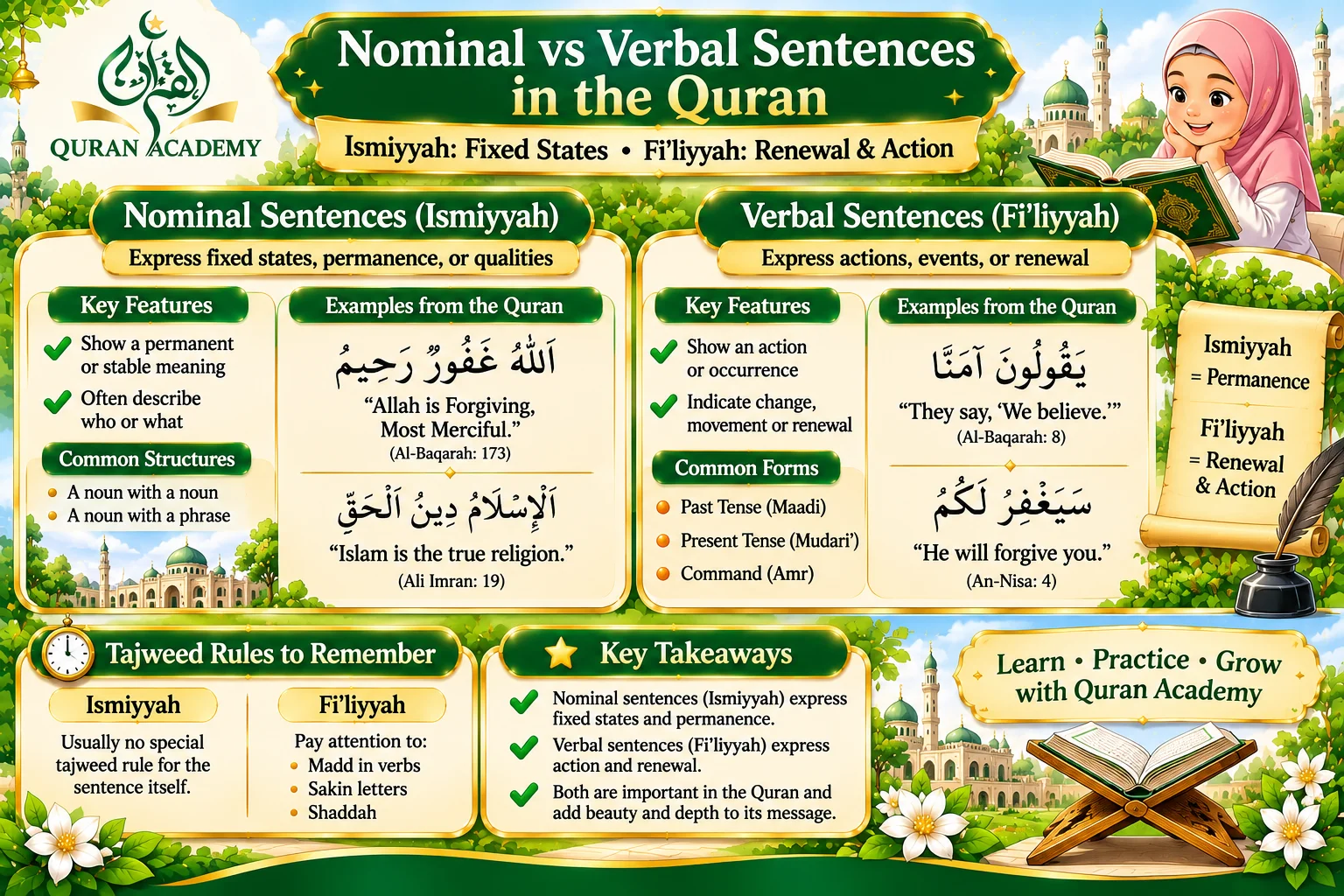
✦ Quick Answer & Key Takeaways: Nominal vs. Verbal Sentences in the Quran
Mastering nominal vs verbal sentences in the Quran (الْجُمْلَةُ الِاسْمِيَّةُ وَالْجُمْلَةُ الْفِعْلِيَّةُ فِي الْقُرْآنِ الْكَرِيمِ) gives you the key to both Arabic syntax (Nahw) and Quranic rhetoric (Balaghah)! Every complete Arabic sentence is either a Nominal Sentence (الجملة الاسمية — opening with a Noun: Mubtada' + Khabar) or a Verbal Sentence (الجملة الفعلية — opening with a Verb: Fi'l + Fa'il + optional Maf'ul Bihi). Even better, in the hands of Quranic eloquence, choosing a Nominal Sentence highlights stability, permanence, and an established quality, whereas choosing a Verbal Sentence highlights action, ongoing renewal, or a specific event in time! Building upon our 10 Verb Forms in Quranic Arabic, Inna & Kana Sisters Chart, and Demonstrative & Relative Pronouns, this guide completes Day 4 of Matrix 5! In our 1-on-1 Online Quranic Arabic & Tafseer Program, students apply sentence structure directly to Quranic verses!
- Ismiyyah (Permanence / State) vs. Fi'liyyah (Renewal / Action): A classic Balaghah distinction across the Quran!
- Core Vowel Map: Mubtada', Khabar, and Fa'il typically carry Raf' (Damma), while Maf'ul Bihi carries Nasb (Fatha)!
- Verb-First Singular Rule: A verb placed before an explicit plural noun doer stays singular in form!
- Tajweed Connection: Spotting Fathatayn endings and silent consonants ensures crisp Qalqalah and Waqf!
When reading a verse like ﴿ ٱللَّهُ نُورُ ٱلسَّمَاوَاتِ وَٱلْأَرْضِ ﴾ ("Allah is the Light of the heavens and the earth" — An-Nur 24:35) or ﴿ إِنَّ ٱللَّهَ غَفُورٌ رَّحِيمٌ ﴾ ("Indeed, Allah is Forgiving, Merciful"), the Quran opens with a Nominal Sentence (الجملة الاسمية)—anchoring our hearts in the eternal, unchanging essence and attributes of Allah. Yet in the very same context, when describing living actions or ongoing events—such as ﴿ يَعْلَمُ مَا يَلِجُ فِي ٱلْأَرْضِ وَمَا يَخْرُجُ مِنْهَا ﴾ ("He knows what enters into the earth and what comes out of it" — Al-Hadid 57:4)—it uses Verbal Sentences (الجملة الفعلية) to portray continuous, active movement!
For learners of Quranic Arabic, distinguishing these two sentence types—and understanding how nouns and verbs behave when placed first—turns grammar from an abstract rulebook into a lens for deeper Quran Tafseer. Continuing Day 4 of Matrix 5 alongside our guides to The 10 Verb Forms, Inna & Kana Sisters, and Question & Conditional Particles, this guide gives you the Complete Structural Comparison, Balaghah Insights, and 5 Essential Tajweed Rules.
- 1. Structural Comparison Chart: Nominal (Ismiyyah) vs. Verbal (Fi'liyyah) Sentences
- 2. Balaghah Secrets: Permanence & Stability (Ismiyyah) vs. Renewal & Action (Fi'liyyah)
- 3. Word Order & Plural Agreement in Quranic Verbal Sentences
- 4. Five Essential Tajweed Rules in Nominal & Verbal Quranic Sentences
- 5. Frequently Asked Questions (FAQs)
1. Structural Comparison Chart: Nominal (Ismiyyah) vs. Verbal (Fi'liyyah) Sentences
Compare the core building blocks and default case vowels of both sentence types in Quranic Arabic:
| Feature | Nominal Sentence (الجملة الاسمية) ⭐ | Verbal Sentence (الجملة الفعلية) 🏆 |
|---|---|---|
| 1. Opening Word Type | Begins with a Noun (ٱسْمٌ) (including a proper noun, pronoun, or demonstrative). | Begins with a Verb (فِعْلٌ) (Past Madi, Present/Ongoing Mudari', or Command Amr). |
| 2. Core Components | Mubtada' (المبتدأ = Subject) + Khabar (الخبر = Predicate). | Fi'l (الفعل = Verb) + Fa'il (الفاعل = Doer) + optional Maf'ul Bihi (المفعول به = Object). |
| 3. Default Case Vowels | Both Mubtada' and Khabar default to Raf' (Damma / Dammatayn) (unless shifted by Inna or Kana). | Fa'il (Doer) = Raf' (Damma); Maf'ul Bihi (Object) = Nasb (Fatha / Fathatayn). |
| 4. Quranic Examples | ﴿ ٱلْحَمْدُ لِلَّهِ ﴾ (1:2) & ﴿ ٱللَّهُ ٱلصَّمَدُ ﴾ (112:2). | ﴿ خَلَقَ ٱلْإِنسَانَ ﴾ (96:2) & ﴿ قَدْ أَفْلَحَ مَن تَزَكَّىٰ ﴾ (87:14). |
2. Balaghah Secrets: Permanence (Ismiyyah) vs. Renewal (Fi'liyyah)
In Quranic Balaghah, a Nominal Sentence tells us what something is or what quality permanently characterizes it, while a Verbal Sentence tells us what happens, occurs, or renews. For instance, praising Allah with nominal/participial descriptions of His constant attributes highlights His enduring perfection, while using verbs like Yuhyee (gives life), Yumitu (causes death), or Yunzilu (sends down) highlights His active, continuous power over creation!
3. Word Order & Plural Agreement in Quranic Verbal Sentences
Connecting directly to our Singular, Dual & Plural Guide and Verbs in Quranic Arabic Guide:
• When a verb comes before an explicit plural noun doer (e.g., قَالَ ٱلْكَافِرُونَ), the verb stays in its singular form while the plural noun after it shows the plurality.
• When a plural noun or pronoun comes first and a verb follows it (e.g., وَٱلَّذِينَ آمَنُواْ or قَالُواْ), the verb carries the plural suffix (ـُواْ) referring back to the plural group!
• And when a noun is placed before a verb for emphasis or focus (Taqdeem Ma Haqqahu At-Ta'kheer)—such as إِيَّاكَ نَعْبُدُ (1:5 — "You ALONE we worship")—it highlights exclusivity!
Crisp Qalqalah in Quranic Sentences: "Al-Hamْdu", "Khalaqْnaa" & "Yaqْta'oon"!
Whether a Quranic verse opens with a nominal phrase or a verbal clause, watch out for silent Qalqalah (Echoing) letters (ق ط ب ج د) and keep non-Qalqalah letters bounce-free! Watch Senior Instructor Ustadhah Yasmeen Gamal demonstrate Qalqalah on our Quran Academy YouTube Channel:
- Grammar + Tajweed Together: Read every sentence with clarity and accuracy!
- 1-on-1 Live Coaching: Study Quranic Arabic & Tajweed with Al-Azhar scholars!
4. Five Essential Tajweed Rules in Nominal & Verbal Quranic Sentences
When reciting nominal and verbal sentences in the Quran, apply these five Tajweed rules from our 1-on-1 Online Tajweed Course:
Struggling to Perfect Your Recitation?
Join 1,250+ students mastering the Quran 1-on-1 with our Verified Al-Azhar Graduates. Flexible US, UK, Canadian & Australian schedules starting at $8/hr.
Book a Free Evaluation Class →- 1. Two-Count "Madd Al-'Iwad" on Fathatayn Objects & Predicates When Stopping:
Applying our Rules of Madd Guide and Rules of Waqf Guide, when a direct object (Maf'ul Bihi) or predicate ends with an Alif carrying Fathatayn (ـًا) and you stop on it, stretch a smooth 2-count Madd Al-'Iwad! - 2. Clear Noon & Tanween Rules Between Subject, Verb & Object:
Using our Noon Sakinah & Tanween Guide and Matn Tuhfat Al-Atfal, apply Izhar, Idgham, Iqlab, or Ikhfaa' consistently whenever a word ending in Noon Sakinah or Tanween meets the next word in the sentence! - 3. Clear Meem Sakinah Rules Before Verbs & Nouns:
According to our Meem Sakinah Rules Guide, whenever a plural pronoun or verb ending in silent Meem (like هُمْ or تُمْ) meets another word, apply Ikhfaa' Shafawi before Baa, Idgham Mithlayn before Meem, and crisp Izhar Shafawi before all other letters! - 4. Sun vs. Moon Laams at the Start of Nominal Subjects ("Al-Hamd", "Al-Kitab", "As-Salaah"):
Using our Laam Shamsiyyah & Laam Qamariyyah Guide, pronounce the Laam clearly before Moon letters and merge it smoothly into Sun letters! - 5. Heavy vs. Light Raa on Nouns & Verbs Across Sentences:
Following our Ahkam Al-Raa, Makharij al-Huruf, Sifaat al-Huruf, Heavy & Light Letters, Hamzatul Wasl vs. Qat', 4 Special Words of Hafs, 7 Alifs in the Quran, Idgham Pairs, 10 Qira'at, Hafs vs. Warsh, Iltiqa' As-Sakinayn, Matn Al-Jazariyyah, 25 Common Tajweed Mistakes in Salah, An-Nabr (Vocal Stress), and 15 Sajdah Tilawah Verses guides, apply the exact vowel-based Raa rule whether the word is a noun or a verb! Test your Tajweed skills right now on our Free 3-Minute Tajweed Quiz!
With this guide, we have completed all 5 Advanced Quranic Arabic & Balaghah Guides of Day 4 of Matrix 5 (Articles 141 to 145)—connecting them with our complete library: Demonstrative & Relative Pronouns, Inna & Kana Sisters, Question & Conditional Particles, 10 Verb Forms, Arabic Pronouns Chart, Harf Al-Jarr Prepositions, Singular, Dual & Plural, Verbs in Quranic Arabic, 50 Most Common Arabic Roots, and Surah Al-Hashr (using our Interactive Tajweed Encyclopedia and Online Hadith Explorer)! Meet our Al-Azhar Certified Tutors, enroll your child in our 1-on-1 Kids Quran Classes with our Printable Kids Star Chart, and read how families across the US, UK, Canada, and Australia rate our teachers on our Verified Student & Parent Reviews Page.
5. Frequently Asked Questions (FAQs) About Nominal & Verbal Sentences in the Quran
1. What is the structural difference between a Nominal Sentence (Jumlah Ismiyyah) and a Verbal Sentence (Jumlah Fi'liyyah) in Quranic Arabic?
In Arabic syntax (Nahw), a sentence is classified by the word class of its opening core element: (1) A Nominal Sentence (الجملة الاسمية) begins with a Noun and consists of a Subject (المبتدأ — normally in Raf' / Damma) and a Predicate (الخبر — normally in Raf' / Damma or a phrase/sentence); whereas (2) A Verbal Sentence (الجملة الفعلية) begins with a Verb (الفعل — Past, Present, or Command) followed by its Doer (الفاعل — in Raf' / Damma) and often an Object (المفعول به — in Nasb / Fatha).
2. What is the rhetorical (Balaghah) difference between using a Nominal Sentence vs. a Verbal Sentence in the Quran?
Classical scholars of Quranic Balaghah (such as 'Abd Al-Qahir Al-Jurjani and Az-Zamakhshari) highlight a timeless distinction: (1) A Nominal Sentence (Jumlah Ismiyyah) emphasizes stability, permanence, fixed identity, or an established attribute (Thuboot wa Dawaam); whereas (2) A Verbal Sentence (Jumlah Fi'liyyah) emphasizes renewal, ongoing occurrence, temporal transition, or dynamic action (Tajaddud wa Hudooth)!
3. Why does a verb at the start of a Verbal Sentence stay singular even when the Doer (Fa'il) after it is plural in Arabic?
In classical Arabic syntax, when a verb comes BEFORE an explicit plural noun doer (Al-Fa'il Adh-Dhahir — such as "Qaala Musa" or "Aamana Al-Mu'minoon"), the verb remains in singular form (with gender agreement when applicable), whereas when the plural noun comes BEFORE the verb as a Mubtada' (such as "Al-Mu'minoona aamanoo"), the verb following it takes the plural marker ("-oo")!
4. What are the default ending vowels of Mubtada', Khabar, Fa'il, and Maf'ul Bihi in Quranic Arabic?
As a foundational rule for singular nouns: Mubtada' (Subject of a nominal sentence), Khabar (Predicate of a nominal sentence), and Fa'il (Doer of a verb) take Raf' (typically Damma / Dammatayn), while Maf'ul Bihi (Direct Object of a verb) takes Nasb (typically Fatha / Fathatayn)!
5. How does knowing whether a word is a Mubtada', Khabar, or Maf'ul Bihi help Tajweed and Waqf?
Recognizing grammatical endings helps you spot Fathatayn endings (Maf'ul Bihi or Khabar Kana, which take a 2-count Madd Al-'Iwad when stopping), Damma/Kasra endings (which take Sukoon, Rawm, or Ishmam when stopping), and heavy vs. light Raa or Laam rules tied to vowels!
Read & Understand the Quran With Direct Clarity!
Master Quranic grammar, vocabulary, Tafseer, and Tajweed in live 1-on-1 online classes with certified male and female Al-Azhar scholars. Book your free diagnostic trial session today!
Book Your Free 1-on-1 Trial Class →