
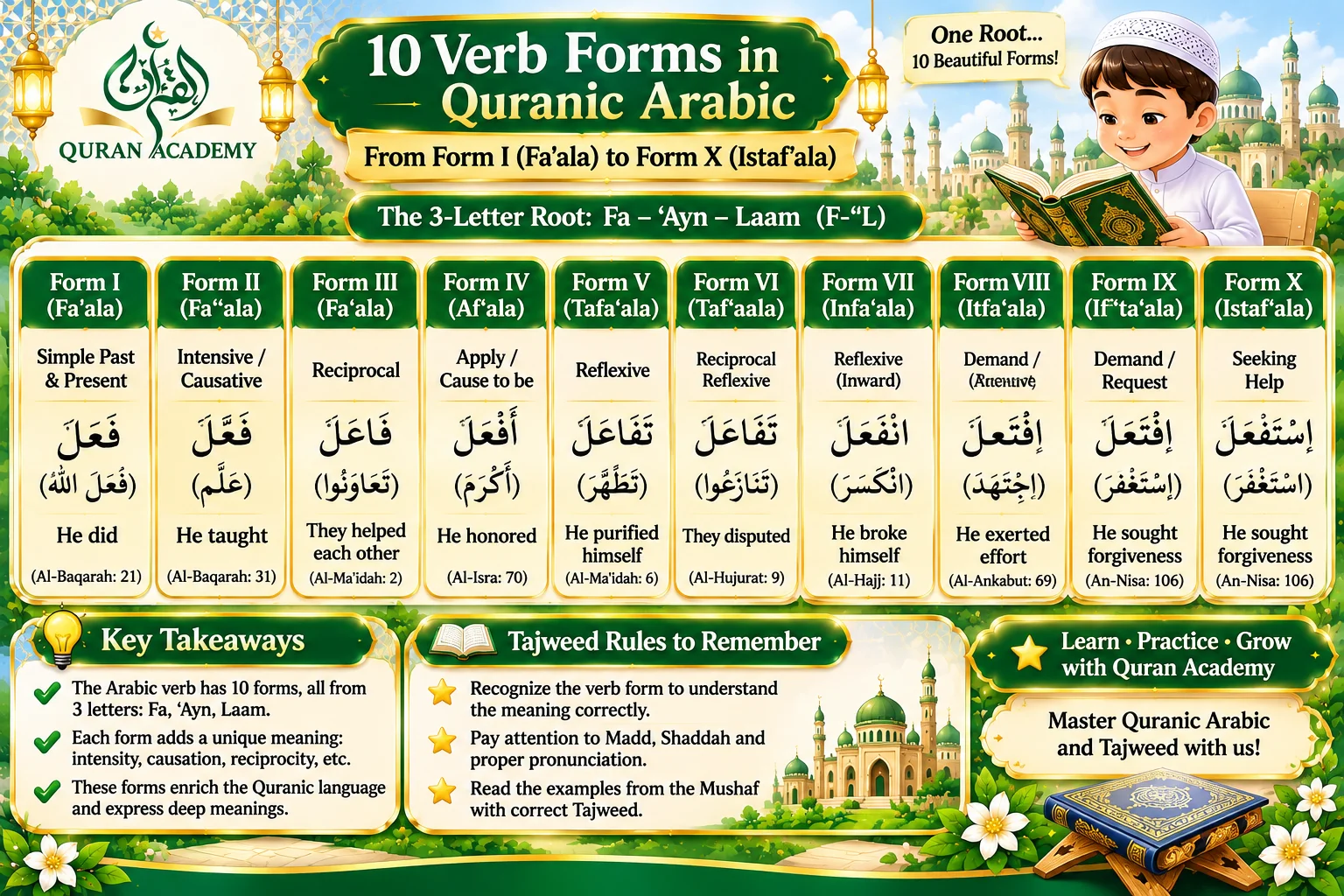
✦ Quick Answer & Key Takeaways: 10 Verb Forms in Quranic Arabic
Mastering the 10 verb forms in Quranic Arabic (الْأَوْزَانُ الْعَشَرَةُ لِلْفِعْلِ الثُّلَاثِيِّ فِي الصَّرْفِ الْقُرْآنِيِّ) is one of the highest-leverage skills in understanding the Holy Quran! In Arabic morphology (Sarf), most verbs grow out of a 3-letter root—represented on the classic pattern scale by the three letters ف - ع - ل (Faa, 'Ayn, Laam). Starting from the bare 3-letter base in Form I (فَعَلَ / فَعِلَ / فَعُلَ), Arabic adds specific letters or a Shaddah in Forms II through X to create rich shades of meaning—such as causation, repetition, mutuality, reflexivity, or seeking! Building upon our Verbs in Quranic Arabic Guide and 50 Most Common Arabic Roots, this pattern chart makes Forms I to X clear and memorable. In our 1-on-1 Online Quranic Arabic & Tafseer Program, students connect verb forms directly to Quranic meaning and Tafseer!
- The "Faa - 'Ayn - Laam" Pattern Scale: Every form is measured against ف - ع - ل so you can spot the exact added letters in any Quranic verb!
- Why Verb Form Matters in Tafseer: Comparing أَنزَلَ (Form IV) with نَزَّلَ (Form II) or عَلِمَ (Form I) with عَلَّمَ (Form II) reveals subtle nuances of revelation and teaching!
- The "Ista-" Signature of Form X: Often means "seeking or requesting" (like ٱسْتَغْفِرُواْ = seek forgiveness)!
- Tajweed + Sarf Synergy: Spotting Form II's Shaddah or Form VIII's infix helps you apply An-Nabr and Qalqalah accurately!
Have you ever wondered how a single 3-letter Arabic root can blossom into a whole family of related Quranic verbs? Take the root ع - ل - م ('A-L-M, related to knowing): from that single three-letter core come عَلِمَ ('Alima — to know), عَلَّمَ ('Allama — to teach, as in Surah Ar-Rahman 55:2: 'Allamal-Qur'aan), تَعَلَّمَ (Ta'allama — to learn gradually), and ٱسْتَعْلَمَ (Ista'lama — to seek knowledge/inquiry)!
For learners of Quranic Arabic, memorizing isolated vocabulary lists one word at a time can feel slow. Once you learn the 10 verb forms in Quranic Arabic—how each pattern is built on the Fa-'Ayn-Laam scale and what general shift in meaning it typically brings—you can recognize hundreds of new Quranic verbs on sight! Continuing Day 4 of Matrix 5 alongside our guides to Demonstrative & Relative Pronouns, Inna & Kana Sisters, and Question & Conditional Particles, this guide presents the Complete Master Chart of Forms I to X, key Tafseer comparisons, and 5 Essential Tajweed Rules.
- 1. How the "Fa - 'Ayn - Laam" Pattern Scale Works in Quranic Morphology
- 2. Master Pattern Chart: Forms I Through X in Quranic Arabic (With Examples!)
- 3. Tafseer Insights: How Switching Between Verb Forms Sharpens Verse Meaning
- 4. Five Essential Tajweed Rules in Quranic Verb Forms
- 5. Frequently Asked Questions (FAQs)
1. How the "Fa - 'Ayn - Laam" Pattern Scale Works in Quranic Morphology
In Arabic grammar and morphology (Sarf), grammarians use the three model letters ف (Faa), ع ('Ayn), and ل (Laam) as a ruler to measure any 3-letter root:
• 1st root letter = ف (Fa'-kalimah)
• 2nd root letter = ع ('Ayn-kalimah)
• 3rd root letter = ل (Laam-kalimah)
When you place a Quranic verb alongside the pattern (Wazn), every extra letter or Shaddah stands out clearly—helping you distinguish the core root letters from the added structural letters (Huroof Az-Ziyadah)!
2. Master Pattern Chart: Forms I Through X in Quranic Arabic
Study the 10 verb forms in Quranic Arabic below (using standard Roman numerals I–X alongside their Arabic patterns and Quranic examples):
| Form & Arabic Wazn | Structural Feature | Typical Meaning Shift & Quranic Example |
|---|---|---|
| Form I: فَعَلَ / فَعِلَ / فَعُلَ ⭐ | Base 3-letter verb (no added letters). | Core action or state → خَلَقَ (Khalaqa = created, 87:2), عَمِلَ ('Amila = worked/did). |
| Form II: فَعَّلَ 🏆 | Doubles the middle letter with a Shaddah. | Causation, intensity, or repetition → سَبَّحَ (Sabbaha = glorified, 57:1), نَزَّلَ (sent down gradually). |
| Form III: فَاعَلَ | Adds a long Alif after the 1st root letter. | Action directed toward or with another → جَاهَدَ (Jaahada = strove earnestly), سَابَقُواْ (Saabiqoo = race/compete in good, 57:21). |
| Form IV: أَفْعَلَ ⭐ | Prefixes أَـ and makes 1st root letter silent. | Causative / bringing about → أَنزَلَ (Anzala = sent down), أَخْرَجَ (Akhraja = brought forth, 99:2). |
| Form V: تَفَعَّلَ | Prefixes تَـ + doubles middle letter (Form II + Ta-). | Reflexive/gradual reception of Form II → تَذَكَّرَ (Tadhakkara = remembered/took heed), تَزَكَّىٰ (Tazakkaa = purified oneself, 87:14). |
| Form VI: تَفَاعَلَ | Prefixes تَـ + long Alif after 1st root letter (Form III + Ta-). | Mutual/reciprocal action → تَوَاصَوْاْ (Tawaasaw = enjoined one another, 103:3), تَنَازَعُواْ (disputed with one another). |
| Form VII: ٱنْفَعَلَ | Prefixes ٱنْـ (Hamzatul Wasl + Noon). | Passive/non-voluntary yielding → ٱنشَقَّتِ (Inshaqqat = split apart, 84:1), ٱنْقَلَبُواْ (returned/turned back). |
| Form VIII: ٱفْتَعَلَ ⭐ | Prefixes ٱـ + inserts ـتَـ after 1st root letter. | Reflexive/earnest effort → ٱجْتَنِبُواْ (Ijtaniboo = avoid/keep apart, 49:12), ٱتَّقَىٰ (Ittaqaa = be mindful of Allah). |
| Form IX: ٱفْعَلَّ | Prefixes ٱـ + doubles final letter with Shaddah. | Acquiring a color or physical state → ٱبْيَضَّتْ (Ibyaddat = turned white, 3:106), ٱسْوَدَّتْ (turned dark). |
| Form X: ٱسْتَفْعَلَ 🏆 | Prefixes ٱسْتَـ (Hamzah + Seen + Taa). | Seeking/asking for or esteeming → ٱسْتَغْفِرُواْ (Istaghfiroo = seek forgiveness), ٱسْتَجَابَ (responded/answered). |
3. Tafseer Insights: How Switching Between Verb Forms Sharpens Meaning
When you compare verb forms in Tafseer, three pairs stand out across the Quran:
• 1. Form IV ("Anzala") vs. Form II ("Nazzala"): Notice how in Surah Al-Qadr (97:1) and Surah Ad-Dukhan (44:3), Allah uses أَنزَلْنَاهُ (Form IV) for the descent of the Quran to the lowest heaven on Laylatul Qadr, whereas in Surah Al 'Imran (3:3) He uses نَزَّلَ (Form II) for sending down the Book stage by stage in wisdom!
• 2. Form I ("'Amila") vs. Form V ("Tazakkaa"): Form I states a straightforward deed, while Form V (تَزَكَّىٰ in 87:14) highlights steady, inward purification of the soul.
• 3. Form X ("Istaghfara") vs. Form IV ("Ghafara"): Allah is Al-Ghafur (The Forgiving), while the believer is called to use Form X—ٱسْتَغْفِرُواْ رَبَّكُمْ—to actively seek His forgiveness!
Crisp Qalqalah in Quranic Verb Forms: "Iqْra'", "Khalaqْ", "Ijْtaniboo" & "Aghْriqoo"!
Many Quranic verbs carry a silent Qalqalah (Echoing) letter (ق ط ب ج د)—such as the imperative ٱقْرَأْ (Iqْra' — 96:1), Form VIII ٱجْتَنِبُواْ (Ijْtaniboo — 49:12), or jussive verbs! Watch Senior Instructor Ustadhah Yasmeen Gamal demonstrate Qalqalah on our Quran Academy YouTube Channel:
Struggling to Perfect Your Recitation?
Join 1,250+ students mastering the Quran 1-on-1 with our Verified Al-Azhar Graduates. Flexible US, UK, Canadian & Australian schedules starting at $8/hr.
Book a Free Evaluation Class →- Sarf + Tajweed Together: Spot root letters and silent consonants accurately!
- 1-on-1 Live Coaching: Study Quranic Arabic & Tajweed with Al-Azhar scholars!
4. Five Essential Tajweed Rules in Quranic Verb Forms
When reciting Quranic verbs across Forms I to X, apply these five Tajweed rules from our 1-on-1 Online Tajweed Course:
- 1. Clear Vocal Stress (Nabr) on Form II Doubled Middle Letters ("Sabbaha", "Qaddara", "Nazzala"):
Applying our An-Nabr (Vocal Stress) Guide, whenever a Form II verb has a Shaddah on its middle letter (like سَبَّحَ in 59:1 or قَدَّرَ in 87:3), press firmly on the doubled letter so its two halves are clear and distinct! - 2. Starting Verbs on "Hamzatul Wasl" (Forms VII, VIII & X):
Using our Hamzatul Wasl & Hamzatul Qat' Guide, when starting directly on a Form VII, VIII, or X verb that begins with a Hamzatul Wasl (like ٱجْتَنِبُواْ in 49:12 or ٱسْتَغْفِرُواْ), check the 3rd letter of the verb: if the 3rd letter has a Damma, start with a Damma; if it has a Fatha or Kasrah (as in Ijtaniboo where the 3rd letter Taa has a Fatha, or Istaghfiroo where the 3rd letter Taa has a Fatha!), start with a Kasrah (Ij-taniboo / Is-taghfiroo)! - 3. Two-Beat Ghunnah on "Anzala" (أَنزَلَ) & "Yunzilu" (يُنَزِّلُ):
According to our Noon Sakinah & Tanween Guide and Matn Tuhfat Al-Atfal, whenever a silent Noon precedes a Zay (ز) or Saaa' (س) in a verb (like أَنزَلْنَاهُ), hold a 2-beat Ikhfaa' Haqiqi Ghunnah! - 4. Two-Count Alif Madd on Form III ("Saabiqoo", "Jaahadoo", "Qaataloo"):
Using our Rules of Madd Guide, stretch the Alif after the 1st root letter in Form III for a full 2 counts (Madd Tabee'i)! - 5. Heavy vs. Light Raa Across Quranic Verb Forms:
Following our Ahkam Al-Raa, Makharij al-Huruf, Sifaat al-Huruf, Heavy & Light Letters, Meem Sakinah Rules, Rules of Waqf, Laam Shamsiyyah & Qamariyyah, 4 Special Words of Hafs, 7 Alifs in the Quran, Idgham Pairs, 10 Qira'at, Hafs vs. Warsh, Iltiqa' As-Sakinayn, Matn Al-Jazariyyah, 25 Common Tajweed Mistakes in Salah, and 15 Sajdah Tilawah Verses guides, check the vowel of the Raa in each verb (e.g., Heavy in نَضْرِبُهَا when Raa has Kasrah? No—in نَضْرِبُهَا, the Raa has a Kasrah, so it is Light [Tarqeeq]; whereas in أَنزَلْنَاهُ, there is no Raa, and in يَغْفِرُ, Raa with Damma is Heavy!). Test your Tajweed skills right now on our Free 3-Minute Tajweed Quiz!
Explore more Quranic Arabic and Surah Tafseer guides across our library: Demonstrative & Relative Pronouns, Inna & Kana Sisters, Question & Conditional Particles, Verbs in Quranic Arabic, 50 Most Common Arabic Roots, and Surah Al-Hashr (using our Interactive Tajweed Encyclopedia and Online Hadith Explorer)! Meet our Al-Azhar Certified Tutors, enroll your child in our 1-on-1 Kids Quran Classes with our Printable Kids Star Chart, and read how families across the US, UK, Canada, and Australia rate our teachers on our Verified Student & Parent Reviews Page.
5. Frequently Asked Questions (FAQs) About the 10 Verb Forms in Quranic Arabic
1. What are the "10 Verb Forms" (Al-Awzan Al-'Asharah) in Quranic Arabic morphology (Sarf)?
In Arabic morphology (Sarf), most Arabic verbs are built upon a 3-letter root—represented on the classic pattern scale by three model letters: Faa (ف), 'Ayn (ع), and Laam (ل). Form I (Fa'ala / Fa'ila / Fa'ula) is the bare 3-letter base verb, while Forms II through X (Al-Af'al Al-Mazeedah) add specific prefixes, infixes, or a Shaddah to expand and refine the core meaning of the root!
2. What is the rhetorical difference between Form IV ("Anzala") and Form II ("Nazzala") in the Quran?
In Quranic Balaghah, Form IV ("Af'ala", like "Anzala" = sent down) often expresses a single, decisive act or sending down as a whole, whereas Form II ("Fa'ala" with a doubled middle letter, like "Nazzala" = sent down bit by bit / repeatedly / intensively) often conveys gradualness, repetition, or intensity—such as how the Quran was sent down gradually over 23 years ("Nazzala 'alaykal-Kitaaba bil-haqqi" in 3:3)!
3. What does Form X ("Istaf'ala", such as "Istaghfara" or "Istajaba") typically add to a root's meaning?
Form X ("Istaf'ala", starting with "Ista-") most commonly carries two meanings: (1) Seeking, asking for, or requesting the quality of the root—such as "Istaghfara" (استغفر — to seek forgiveness/Maghfirah) or "Istasqaa" (استسقى — to ask for rain/water); or (2) Considering or finding something to be a certain way ("Istakbara" = to consider oneself great/arrogant)!
4. What is the difference between Form VI ("Tafa'ala") and Form VIII ("Ifta'ala") in the Quran?
Form VI ("Tafa'ala", like "Tadhaakara" or "Tanaaza'a") often expresses mutual action/reciprocity between two or more parties or gradual effort; whereas Form VIII ("Ifta'ala", like "Ijtanaba" = to keep oneself apart/avoid, or "Iqtadara" = to have power/ability) adds an infix "Taa" after the first root letter and often reflects turning the action back onto oneself or striving earnestly!
5. What is the #1 Tajweed rule when reciting Form II ("Fa'ala" with Shaddah) and Form IV ("Af'ala") verbs?
In Form II verbs (like "Nazzala", "Sabbih", "Qaddara", "Yusabbihu"), always hold the doubled middle letter (Shaddah) with clear vocal stress (Nabr) without dropping or softening it; and in Form IV past-tense verbs starting with a Hamzah (like "Anzala" or "Akhraja"), pronounce the initial Hamzah as a crisp, 1-count glottal stop (Hamzatul Qat'), never stretching it into a long vowel unless followed by a Madd letter!
Understand Quranic Verbs & Tafseer Directly With an Al-Azhar Scholar!
Master Quranic Arabic grammar, root patterns, Tafseer, and Tajweed in live 1-on-1 online lessons tailored to your pace. Book your free diagnostic trial session today!
Book Your Free 1-on-1 Trial Class →