
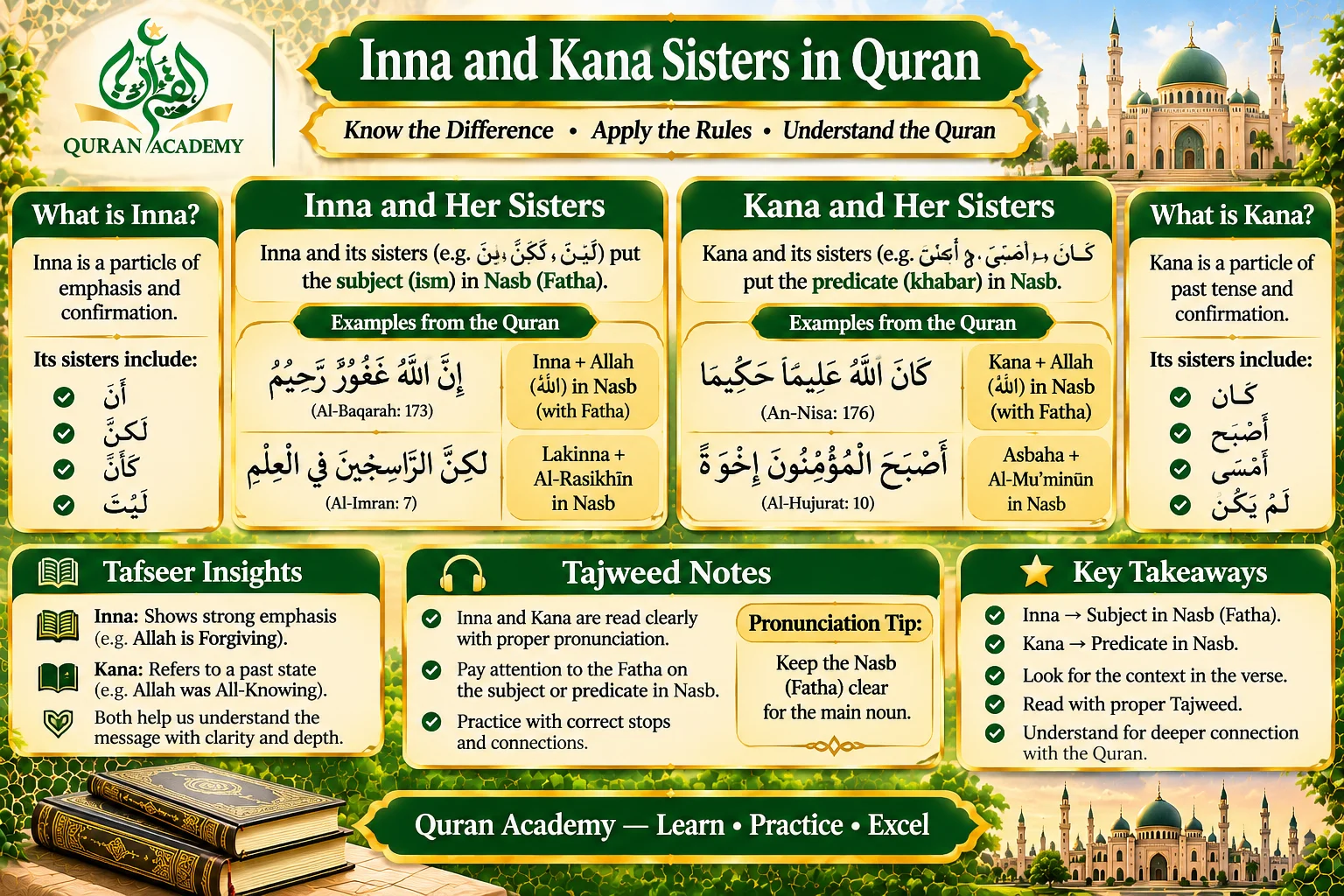
✦ Quick Answer & Key Takeaways: Inna & Kana Sisters in the Quran
Mastering Inna and Kana sisters in the Quran (إِنَّ وَأَخَوَاتُهَا وَكَانَ وَأَخَوَاتُهَا فِي الْقُرْآنِ الْكَرِيمِ) explains the two most important vowel-changing families in all of Quranic Arabic—appearing over 3,500 times across the Mushaf! Both families enter upon a standard Nominal Sentence (Mubtada' + Khabar, both originally ending in Damma) and act as exact mirror opposites: (1) Inna & Her 6 Sisters (Al-Huruf An-Nasikhah) put the Subject into Nasb (Fatha) and keep the Predicate in Raf' (Damma)—e.g., إِنَّ ٱللَّهَ عَلِيمٌ (Innallaaha 'Aleemun); whereas (2) Kana & Her Sisters (Al-Af'al An-Nasikhah) keep the Subject in Raf' (Damma) and put the Predicate into Nasb (Fatha/Fathatayn)—e.g., وَكَانَ ٱللَّهُ عَلِيمًا (Wa Kaanallaahu 'Aleemaa)! Building upon our Demonstrative & Relative Pronouns Chart and Verbs in Quranic Arabic Guide, this visual guide unlocks both families in 10 minutes! In our 1-on-1 Online Quranic Arabic & Tafseer Program, students recognize these patterns effortlessly while reading the Quran!
- The Mirror-Opposite Vowel Formula: Inna =
Fatha + Damma(Innallaaha Ghafuurun) vs. Kana =Damma + Fathatayn(Kaanallaahu Ghafuuran)! - Why "Kaanallaahu" Means Eternal Reality (Not Past Tense!): When Kaana describes Allah's Attributes, it means timeless, unbroken permanence!
- Why "Madd Al-'Iwad" Happens After Kana: Because Khabar Kana ends with Fathatayn (غَفُورًا رَّحِيمًا), stopping on it creates a 2-count Alif Madd!
- #1 Tajweed Rule in Inna, Anna, Ka'anna & Lakinna: Every single one carries a 2-beat nasal Ghunnah on its Noon Mushaddadah (نّ)!
Have you ever paused while reciting the Quran and wondered: "Why does the Quran sometimes say إِنَّ ٱللَّهَ غَفُورٌ رَّحِيمٌ (Innallaaha Ghafoorun Raheem)—with a Fatha on the Name of Allah and Dammatayn on Ghafoorun—and at other times say وَكَانَ ٱللَّهُ غَفُورًا رَّحِيمًا (Wa Kaanallaahu Ghafooran Raheemaa)—with a Damma on the Name of Allah and Fathatayn on Ghafooran?"
That single vowel shift is not random—it is one of the cleanest, most logical rules in all of Arabic grammar! Whenever a regular sentence (ٱللَّهُ غَفُورٌ = Allah is Forgiving, where both words end in Damma) is introduced by either إِنَّ (Inna — "Indeed/Verily") or كَانَ (Kaana — "Eternally Is"), the two tools flip the ending vowels in exact mirror image. Continuing Day 4 of Matrix 5—and building upon our Arabic Personal Pronouns Chart, Harf Al-Jarr Prepositions, and 50 Most Common Arabic Roots—this visual guide gives you the Mirror-Opposite Comparison Chart, the 6 Sisters of Inna, the 13 Sisters of Kana, and 5 Essential Tajweed Rules.
- 1. The Mirror-Opposite Visual Formula: How Inna & Kana Transform a Quranic Sentence
- 2. Part 1 (Al-Huruf An-Nasikhah): Master Chart of Inna & Her 6 Sisters in the Quran
- 3. Part 2 (Al-Af'al An-Nasikhah): Master Chart of Kana & Her Sisters (Kana, Laysa, Asbaha & Ma Zala)
- 4. Part 3: Attaching Pronouns to Inna & Kana (Innahu, Innaa, Kuntum & Kanu!)
- 5. Five Essential Tajweed Rules in Inna & Kana Verses (Ghunnah, Madd 'Iwad & Innaa vs. Ana!)
- 6. Frequently Asked Questions (FAQs)
1. The Mirror-Opposite Visual Formula: How Inna & Kana Transform a Sentence
Before memorizing the lists of sisters, look at this simple 3-row visual diagram showing how a plain Nominal Sentence transforms when إِنَّ or كَانَ steps in front of it:
| Sentence Type | Subject Vowel (Al-Ism) | Predicate Vowel (Al-Khabar) | Quranic Example & Meaning |
|---|---|---|---|
| 0. Base Sentence (No Nasikh) (جُمْلَةٌ اسْمِيَّةٌ أَصْلِيَّةٌ) |
Damma (Raf') ٱللَّهُ (Allaahu) |
Damma (Raf') عَلِيمٌ ('Aleemun) |
﴿ ٱللَّهُ عَلِيمٌ ﴾ — "Allah is All-Knowing." (Both nouns end in Damma!) |
| 1. + Inna & Her Sisters ⭐ (إِنَّ وَأَخَوَاتُهَا — Particles) |
Fatha (Nasb!) إِنَّ ٱللَّهَ (Innallaaha) |
Damma (Raf') عَلِيمٌ ('Aleemun) |
﴿ إِنَّ ٱللَّهَ عَلِيمٌ ﴾ — "Indeed, Allah is All-Knowing!" (Adds certainty & removes any doubt!) |
| 2. + Kana & Her Sisters 🏆 (كَانَ وَأَخَوَاتُهَا — Verbs) |
Damma (Raf') كَانَ ٱللَّهُ (Kaanallaahu) |
Fatha / Fathatayn (Nasb!) عَلِيمًا ('Aleeman) |
﴿ وَكَانَ ٱللَّهُ عَلِيمًا ﴾ — "And Allah is Eternally All-Knowing!" (Expresses timeless permanence!) |
2. Part 1 (Al-Huruf An-Nasikhah): Master Chart of Inna & Her 6 Sisters in the Quran
Every single one of the 6 particles of Inna & Her Sisters adds a distinct rhetorical shade of meaning to a Quranic verse while putting its Subject into Nasb (Fatha):
| # & Particle | Meaning & Rhetorical Purpose | Famous Quranic Verse Example |
|---|---|---|
| 1. إِنَّ (Inna) ⭐ | Indeed / Verily (Emphasis at the start of a sentence or after Qala). | ﴿ إِنَّ ٱلْإِنسَانَ لَفِي خُسْرٍ ﴾ (Surah Al-'Asr 103:2) & ﴿ إِنَّ مَعَ ٱلْعُسْرِ يُسْرًا ﴾ (Ash-Sharh 94:6). |
| 2. أَنَّ (Anna) ⭐ | That (Emphasis appearing in the middle of a sentence after verbs like A'lamu or Ashhadu). | ﴿ وَٱعْلَمُواْ أَنَّ ٱللَّهَ مَعَ ٱلْمُتَّقِينَ ﴾ (Al-Baqarah 2:194 — "And know THAT Allah is with the righteous!"). |
| 3. كَأَنَّ (Ka'anna) | As though / As if (Vivid simile and visual comparison). | ﴿ كَأَنَّهُمْ حُمُرٌ مُّسْتَنفِرَةٌ ﴾ (Al-Muddaththir 74:50) & ﴿ كَأَنَّهُنَّ ٱلْيَاقُوتُ وَٱلْمَرْجَانُ ﴾ (Ar-Rahman 55:58). |
| 4. لَٰكِنَّ (Lakinna) | But / However (Correcting a misconception or contrasting two realities). | ﴿ وَلَٰكِنَّ أَكْثَرَ ٱلنَّاسِ لَا يَعْلَمُونَ ﴾ (Al-A'raf 7:187 — "But most people do not know!"). |
| 5. لَيْتَ (Layta) | Would that / If only (Expressing deep regret or an unreachable wish). | ﴿ يَا لَيْتَنِي كُنتُ تُرَابًا ﴾ (An-Naba' 78:40) & ﴿ يَا لَيْتَنِي ٱتَّخَذْتُ مَعَ ٱلرَّسُولِ سَبِيلًا ﴾ (Al-Furqan 25:27). |
| 6. لَعَلَّ (La'alla) 🏆 | So that / In order that / Hopefully (Purpose & hopeful expectation). | ﴿ لَعَلَّكُمْ تَتَّقُونَ ﴾ (Al-Baqarah 2:21 & 183) & ﴿ لَعَلَّهُمْ يَتَفَكَّرُونَ ﴾ (Al-Hashr 59:21). |
3. Part 2 (Al-Af'al An-Nasikhah): Master Chart of Kana & Her Sisters in the Quran
Unlike Inna (which is a particle), Kana & Her Sisters (كَانَ وَأَخَوَاتُهَا) are incomplete verbs (أَفْعَالٌ نَاقِصَةٌ) that conjugate across past, present, and command tenses—keeping their Subject in Damma (Raf') and putting their Predicate into Fatha (Nasb). Here are the 6 most frequent verbs of the Kana family in the Quran:
| # & Verb (Past / Present) | Meaning & Time / State Aspect | Famous Quranic Verse Example |
|---|---|---|
| 1. كَانَ / يَكُونُ / كُنْ ⭐ (Kaana / Yakoonu / Kun) |
Was / Is / Be / Eternally Is (1,350+ times in the Quran!). | ﴿ وَكَانَ ٱللَّهُ غَفُورًا رَّحِيمًا ﴾ (4:96) & ﴿ كُنتُمْ خَيْرَ أُمَّةٍ أُخْرِجَتْ لِلنَّاسِ ﴾ (3:110). |
| 2. لَيْسَ / لَسْتَ / لَيْسُواْ ⭐ (Laysa — Negation) |
Is not / Are not (Negates the Predicate of a Nominal Sentence). | ﴿ أَلَيْسَ ٱللَّهُ بِأَحْكَمِ ٱلْحَاكِمِينَ ﴾ (At-Tin 95:8) & ﴿ لَيْسَ كَمِثْلِهِۦ شَيْءٌ ﴾ (Ash-Shura 42:11). |
| 3. أَصْبَحَ / يُصْبِحُ (Asbaha / Yusbihu) |
Became / Entered the morning (Transformation or morning state). | ﴿ فَأَصْبَحْتُم بِنِعْمَتِهِۦ إِخْوَانًا ﴾ (Al 'Imran 3:103 — "So you became, by His favor, brothers!"). |
| 4. مَا زَالَ / لَا يَزَالُ (Ma Zaala / Laa Yazaalu) |
Continues to be / Never ceases (Uninterrupted continuity). | ﴿ وَلَا يَزَالُونَ مُخْتَلِفِينَ ﴾ (Hud 11:118 — "And they will not cease to differ"). |
| 5. مَا دَامَ (Ma Daama) | As long as (Duration of an action or state). | ﴿ وَأَوْصَانِي بِٱلصَّلَاةِ وَٱلزَّكَاةِ مَا دُمْتُ حَيًّا ﴾ (Maryam 19:31 — Prophet 'Isa AS!). |
| 6. ظَلَّ / بَاتَ / أَمْسَىٰ (Dhalla / Baata / Amsaa) |
Remained by day / Spent the night / Entered evening. | ﴿ ظَلَّ وَجْهُهُۥ مُسْوَدًّا ﴾ (An-Nahl 16:58) & ﴿ وَٱلَّذِينَ يَبِيتُونَ لِرَبِّهِمْ سُجَّدًا وَقِيَامًا ﴾ (Al-Furqan 25:64). |
4. Part 3: Attaching Pronouns to Inna & Kana (Innahu, Innaa, Kuntum & Kanu!)
Connecting directly to our Arabic Personal Pronouns Chart, whenever a pronoun acts as the Subject of Inna or Kana, it attaches straight onto the end of the word—giving you dozens of high-frequency Quranic words you recognize immediately:
• With Inna (Attached Object/Nasb Pronouns): إِنَّهُۥ (Innahu = Indeed He), إِنَّهَا (Innahaa = Indeed She/It), إِنَّهُمْ (Innahum = Indeed They), إِنَّكَ (Innaka = Indeed You), إِنَّكُمْ (Innakum = Indeed You all), إِنِّي (Innee = Indeed I), and إِنَّا (Innaa = Indeed We — as in إِنَّا أَنزَلْنَاهُ in Surah Al-Qadr 97:1)!
• With Kana (Conjugated Verb Endings): كَانُواْ (Kaanoo = They were), كُنتَ (Kunta = You were), كُنتُمْ (Kuntum = You all were), كُنتُ (Kuntu = I was), and كُنَّا (Kunnaa = We were)!
How "Inna" & "Kana" Pair With Crisp Qalqalah in "Innallaaha Qadeerْ" & "Kaanallaahu 'Azeezan Hakeemaa"!
Notice how hundreds of Quranic verses close with إِنَّ ٱللَّهَ عَلَىٰ كُلِّ شَيْءٍ قَدِيرٌ (Qadeerْ) or وَكَانَ ٱللَّهُ سَمِيعًا بَصِيرًا / عَزِيزًا حَكِيمًا—and in verses like إِنَّ بَطْشَ رَبِّكَ لَشَدِيدٌ (Inna batْsha Rabbika lashadeedْ — 85:12), Inna pairs directly with two crisp Qalqalah (Echoing) bounces (ق ط ب ج د)! Watch Senior Instructor Ustadhah Yasmeen Gamal demonstrate Qalqalah on our Quran Academy YouTube Channel:
Struggling to Perfect Your Recitation?
Join 1,250+ students mastering the Quran 1-on-1 with our Verified Al-Azhar Graduates. Flexible US, UK, Canadian & Australian schedules starting at $8/hr.
Book a Free Evaluation Class →- Combine Arabic Grammar + Flawless Tajweed: Spot Ism and Khabar effortlessly!
- 1-on-1 Live Coaching: Master Quranic Arabic & Tajweed with Al-Azhar scholars!
5. Five Essential Tajweed Rules in Inna & Kana Verses
When reciting verses containing Inna and Kana across the Quran, apply these five Tajweed rules from our 1-on-1 Online Tajweed Course:
- 1. Obligatory 2-Beat Nasal Ghunnah on "Inna, Anna, Ka'anna & Lakinna" (Noon Mushaddadah):
As we mastered in Verse 17 of Matn Tuhfat Al-Atfal and our Noon Sakinah & Mushaddadah Guide, every single time إِنَّ، أَنَّ، كَأَنَّ، or لَٰكِنَّ appears in the Quran, hold the doubled Noon (نّ) for 2 full beats of nasal Ghunnah before pronouncing the Fatha! - 2. Heavy vs. Light Laam of "Allah" After "Innallaaha" vs. "Inna Lillaahi" & "Kaanallaahu":
Applying our Matn Al-Jazariyyah (Line 44) and Heavy & Light Letters Guide:
• In إِنَّ ٱللَّهَ (Innallaaha) and وَكَانَ ٱللَّهُ (Wa Kaanallaahu): the Name of Allah is preceded by a Fatha → 100% Heavy Laam (Tafkhim)!
• In إِنَّ لِلَّهِ مَا فِي ٱلسَّمَاوَاتِ (Inna lillaahi — 10:55): the Name of Allah is preceded by the Kasrah of preposition Li- → 100% Light Laam (Tarqeeq)! - 3. Two-Count "Madd Al-'Iwad" on Fathatayn Verse Endings After Kana ("'Aleeman Hakeemaa"):
Using our Rules of Madd Guide and Rules of Waqf Guide, because Khabar Kana takes Fathatayn (وَكُنَّ لَهُمْ شَاهِدِينَ vs. وَكَانَ ٱللَّهُ عَلِيمًا حَكِيمًا), first merge the Fathatayn of 'Aleeman into the Haa' with Izhar Halqi ('Aleemanْ Hakeemaa), and then stop on Hakeeman with a smooth 2-count Alif Madd 'Iwad (Hakeemaa)! - 4. Never Confuse "Innaa" (إِنَّا = Indeed We) With "Ana" (أَنَا۠ = I):
According to our 7 Alifs in the Quran Guide and 25 Common Tajweed Mistakes in Salah:
• إِنَّا (Innaa = "Indeed We") has a Kasrah under the Hamzah, a 2-beat Ghunnah on the Noon, and a real Alif Madd (2 counts before non-Hamzah, or 4–5 counts before Hamzah, as in إِنَّا أَعْطَيْنَاكَ ٱلْكَوْثَرَ)!
• أَنَا۠ (Ana = "I") has a Fatha on the Hamzah, a 1-count single Noon, and an Oval-Zero Alif that drops completely in continuation! - 5. Heavy Raa on "Kaana" & "Ghafooran" vs. Light Raa on "Baseeran" & "Khabeeraa":
Following our Ahkam Al-Raa, Makharij al-Huruf, Sifaat al-Huruf, Meem Sakinah Rules, Laam Shamsiyyah & Qamariyyah, Hamzatul Wasl vs. Qat', 4 Special Words of Hafs, Idgham Pairs, 10 Qira'at, Hafs vs. Warsh, Iltiqa' As-Sakinayn, An-Nabr (Vocal Stress), and 15 Sajdah Tilawah Verses guides, in وَكَانَ ٱللَّهُ سَمِيعًا بَصِيرًا / لَطِيفًا خَبِيرًا, the Raa in بَصِيرًا and خَبِيرًا carries a Fatha—making it 100% Heavy (Tafkhim) in Hafs (whereas in Riwayat Warsh 'an Nafi', it is pronounced Light because of the Yaa Madd before it)! Test your Tajweed skills right now on our Free 3-Minute Tajweed Quiz!
Explore more Quranic Arabic and Surah Tafseer guides across our library: Demonstrative & Relative Pronouns, Arabic Personal Pronouns Chart, Harf Al-Jarr Prepositions, Singular, Dual & Plural, Verbs in Quranic Arabic, 50 Most Common Arabic Roots, Surah Al-Hujurat, and Surah Al-Hashr (using our Interactive Tajweed Encyclopedia and Online Hadith Explorer)! Meet our Al-Azhar Certified Tutors, enroll your child in our 1-on-1 Kids Quran Classes with our Printable Kids Star Chart, and read how families across the US, UK, Canada, and Australia rate our teachers on our Verified Student & Parent Reviews Page.
6. Frequently Asked Questions (FAQs) About Inna & Kana Sisters in the Quran
1. What is the exact grammatical difference between Inna & Her Sisters and Kana & Her Sisters?
Both families enter upon a Nominal Sentence (Jumlah Ismiyyah: Subject + Predicate) and alter its ending vowels—which is why grammarians call them "An-Nawasikh" (The Vowel-Changers)—but they work in exact mirror opposites: (1) Inna & Her Sisters (6 particles) put the Subject (Ism Inna) into Nasb (Fatha) and leave the Predicate (Khabar Inna) in Raf' (Damma), e.g., "Innallaaha 'Aleemun"; whereas (2) Kana & Her Sisters (13 verbs) leave the Subject (Ism Kana) in Raf' (Damma) and put the Predicate (Khabar Kana) into Nasb (Fatha/Fathatayn), e.g., "Kaanallaahu 'Aleeman"!
2. Why does "Kaanallaahu Ghafooran Raheemaa" mean Allah IS Eternally Forgiving and Merciful—not "was" in the past?
As classical Tafseer authorities (including Ibn 'Abbas, Mujahid, and Imam Ibn Kathir) explain, when "Kaana" (كَانَ) is used in the Quran regarding Allah's Eternal Attributes, it is stripped of temporal past restriction and expresses Timeless Continuity, Permanence, and Eternal Reality (Ad-Dawam wal-Istimrar)—meaning Allah has always been, is now, and will forever remain All-Forgiving and Most Merciful!
3. What are the 6 particles of "Inna and Her Sisters" (Al-Huruf An-Nasikhah) in the Quran?
The 6 particles of Inna & Her Sisters are: (1) Inna (إِنَّ — Indeed/Verily, used at the start of a sentence or after Qala), (2) Anna (أَنَّ — That, used mid-sentence), (3) Ka'anna (كَأَنَّ — As though / As if, for comparison), (4) Lakinna (لَٰكِنَّ — But / However, for contrast), (5) Layta (لَيْتَ — Would that / If only, for impossible or deeply longed-for wishes), and (6) La'alla (لَعَلَّ — So that / Perhaps / Hopefully, for expectation and purpose)!
4. What does "La'allakum Tattaqoon" (لَعَلَّكُمْ تَتَّقُونَ) mean when Allah uses "La'alla"?
When humans use "La'alla" (لَعَلَّ), it means "perhaps" because humans do not know the future. When Allah uses "La'alla" in the Quran (such as "Kutiba 'alaykumus-siyaamu... la'allakum tattaqoon" in 2:183), Ibn 'Abbas (RA) explained it means "Kay" (كَيْ = "In order that / So that you may attain Taqwa")—expressing certainty of purpose when the servant fulfills the means!
5. What is the #1 Tajweed rule shared by Inna, Anna, Ka'anna, and Lakinna?
All four particles—إِنَّ (Inna), أَنَّ (Anna), كَأَنَّ (Ka'anna), and لَٰكِنَّ (Lakinna)—end with a Noon Mushaddadah (نّ), which obligates the reciter to hold a full 2-beat nasal Ghunnah every single time they appear in the Quran!
Unlock the Grammar & Rhetoric of the Quran With an Al-Azhar Scholar!
Learn to read the Holy Quran with direct comprehension of its words, vowels, and rhetorical beauty in personalized 1-on-1 online lessons. Book your free diagnostic trial session today!
Book Your Free 1-on-1 Trial Class →