
✦ Quick Answer & Key Takeaways: Read Arabic Without Tashkeel in the Quran
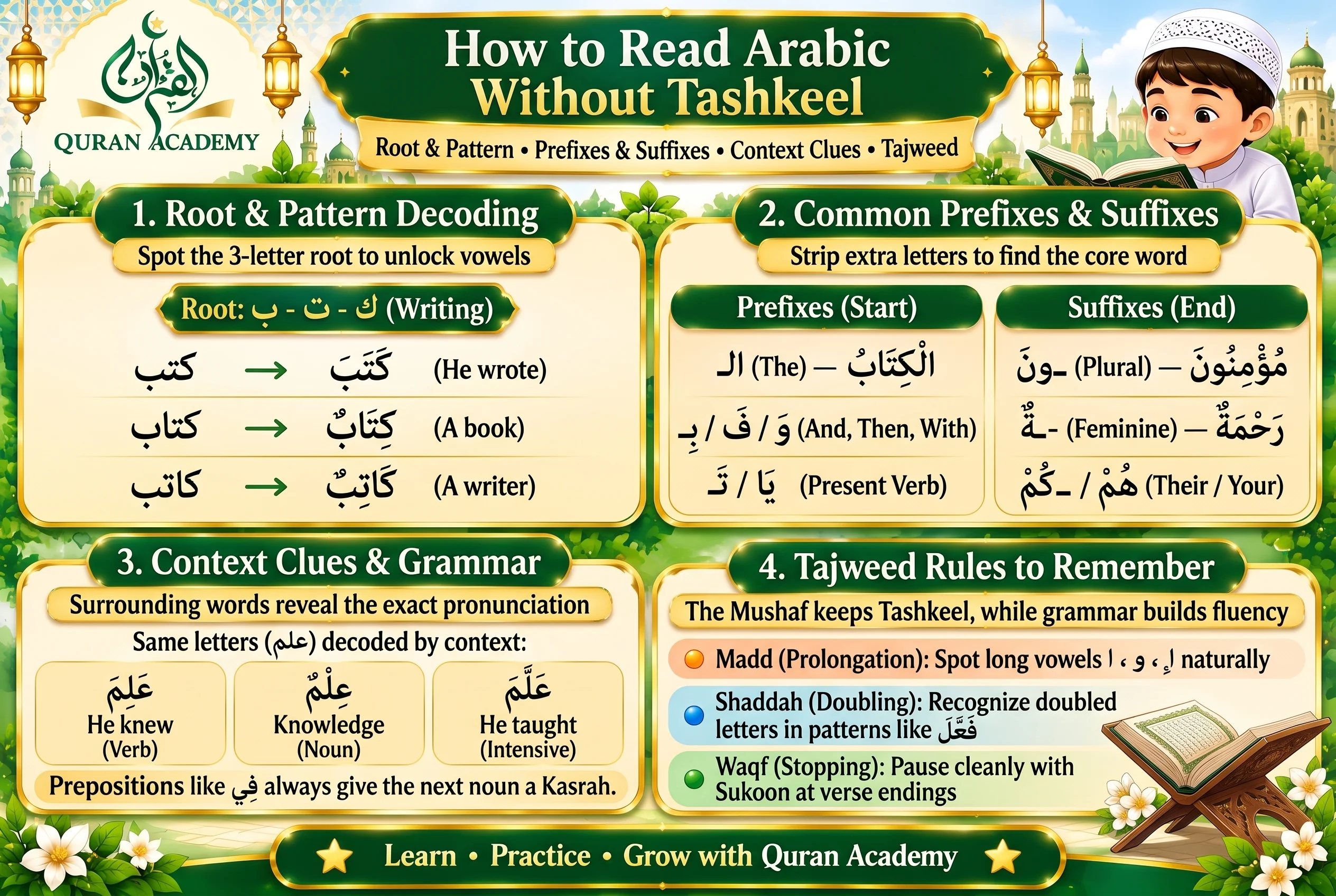
Learning how to read Arabic without Tashkeel in the Quran (قِرَاءَةُ الْعَرَبِيَّةِ وَفَهْمُ كَلِمَاتِ الْقُرْآنِ دُونَ الِاعْتِمَادِ الْأَعْمَى عَلَى التَّشْكِيلِ) is a breakthrough skill for beginners building real Quranic fluency! While vowel marks (Tashkeel / Harakat—Fatha, Kasrah, Damma, and Sukoon) in the Mushaf are a precious blessing that safeguards accurate recitation, Arabic words are built systematically around a 3-letter root, recognizable prefixes and suffixes, familiar word patterns (Awzan), and sentence context. By training your eye to spot roots—such as those in our 50 Most Common Arabic Roots—and sentence structures like Nominal & Verbal Sentences, you stop guessing letter by letter and start reading by meaning! In our 1-on-1 Online Quranic Arabic & Tajweed Program, beginners build strong decoding skills step by step!
- 4-Step Decoding System: Spot the Root → Identify Prefixes/Suffixes → Match Word Pattern → Check Sentence Role!
- Why Context Solves Ambiguity: Many Arabic words look identical without vowels, yet the surrounding sentence makes their exact meaning unmistakable.
- Grammar + Vocabulary Multiplier: Pairing The 10 Verb Forms with Prepositions and Pronouns accelerates reading speed.
- Tajweed Still Governs Recitation: Always apply Qalqalah, Noon Sakinah, and Madd rules accurately when reciting!
Have you ever looked at an unvoweled Arabic phrase—such as a Quranic study note, a Hadith title, or a vocabulary flashcard without vowel marks—and felt your confidence freeze because every letter looked like a guess? That hesitation happens when a learner treats each word as a random string of separate letters instead of seeing its root skeleton, affixes, and grammatical role.
Kickstarting Day 5 of Matrix 5—and building upon our guides to 50 Most Common Arabic Roots, The 10 Verb Forms, and Nominal vs. Verbal Sentences—this guide shows beginners how to decode Arabic words systematically and pair strong reading skills with accurate Tajweed.
1. The 4-Step Decoding Method for Unvoweled Arabic Words
When you encounter a word without Tashkeel in a study exercise or grammar chart, follow these four steps rather than guessing:
• Step 1 — Peel Off Outer Prefixes and Suffixes: Separate connectors like Wa- (و), prepositions like Bi- (ب) or Li- (ل), the definite article Al- (ال), or pronoun endings like -hum (هم) and -kum (كم).
• Step 2 — Locate the 3-Letter Root: Find the core consonants carrying the central meaning (such as ع - ب - د for worship/service or ح - م - د for praise).
• Step 3 — Identify Noun vs. Verb Pattern: Check whether the word fits a verb form (past, present, or command) or a noun/participle pattern (doer, object, place, or verbal noun).
• Step 4 — Check the Grammatical Role in the Sentence: Use Nominal vs. Verbal Sentence clues and Inna & Kana rules to verify the ending!
2. High-Frequency Prefixes & Suffixes That Unlock Word Structure
Recognizing common prefixes and suffixes immediately tells you what kind of word you are looking at:
| Affix Type | Common Quranic Forms | What It Signals to the Reader |
|---|---|---|
| Definite & Preposition Prefixes ⭐ | الـ (Al-), بِـ (Bi-), لِـ (Li-), مِنْ (Min), عَلَىٰ ('Alaa) | Signals a Noun; prepositions (Harf Al-Jarr) put the following noun into Jarr (Kasrah)! |
| Present Verb Prefixes ⭐ | يـ (Ya-), تـ (Ta-), أَ (A-), نـ (Na-) | Often marks a Present/Ongoing Verb (Mudari')—indicating who is acting (he, she/you, I, we)! |
| Plural & Feminine Suffixes | ـُونَ / ـِينَ, ـَاتٌ / ـَاتٍ, ـَةٌ / ـَةٍ | Identifies masculine plurals, feminine plurals, or singular feminine nouns (Singular, Dual & Plural). |
| Attached Pronouns 🏆 | ـهُ (hu), ـهَا (haa), ـهُمْ (hum), ـكَ (ka), ـكُمْ (kum), ـنَا (naa) | Attaches to nouns (possession: "his/their/your") or verbs/particles (object/subject: Pronouns Chart). |
3. Using Sentence Context & Grammar Clues to Confirm Vowels
Even when two words share the same consonants, the surrounding sentence narrows down the exact reading:
• After a preposition like مِنْ or فِي, a following noun takes Jarr (Kasrah).
• After إِنَّ, the subject noun takes Nasb (Fatha), whereas after كَانَ, the subject takes Raf' (Damma) and the predicate takes Nasb (Fatha).
• After a conditional or question particle like In, Man, Hal, or A-, check whether the following word is a verb, noun, or negated verb!
Never Guess Bounces While Reading: Crisp Qalqalah on "Qutb Jadd" (ق ط ب ج د)!
Whether you are practicing root decoding or reciting directly from the Mushaf, always distinguish true silent Qalqalah (Echoing) letters (ق ط ب ج د) from ordinary silent letters! Watch Senior Instructor Ustadhah Yasmeen Gamal demonstrate Qalqalah on our Quran Academy YouTube Channel:
- Root + Tajweed Clarity: Read every Quranic word accurately and meaningfully!
- 1-on-1 Live Coaching: Study with certified Al-Azhar scholars!
4. Five Essential Tajweed Rules When Reading & Reciting Quranic Words
When reciting from the Mushaf, apply these five Tajweed rules from our 1-on-1 Online Tajweed Course:
Struggling to Perfect Your Recitation?
Join 1,250+ students mastering the Quran 1-on-1 with our Verified Al-Azhar Graduates. Flexible US, UK, Canadian & Australian schedules starting at $8/hr.
Book a Free Evaluation Class →- 1. Always Follow the Mushaf's Tashkeel & Tajweed Markings During Recitation:
Root and pattern analysis helps you understand meaning, while the Mushaf's vowel marks and Tajweed signs (like Meem Iqlab, Shaddah, and Madd signs) guide your exact recitation. - 2. Clear Noon Sakinah & Tanween Rules Across Word Boundaries:
Applying our Noon Sakinah & Tanween Guide and Matn Tuhfat Al-Atfal, apply Izhar, Idgham, Iqlab, or Ikhfaa' whenever a silent Noon or Tanween meets the next letter! - 3. Clear Meem Sakinah Rules on Pronouns & Nouns:
Using our Meem Sakinah Rules Guide, apply Ikhfaa' Shafawi before Baa, Idgham Mithlayn before Meem, and Izhar Shafawi before other letters! - 4. Proper Madd Counts & Stopping Rules (Waqf):
According to our Rules of Madd and Rules of Waqf guides, maintain consistent Madd counts and apply Madd Al-'Iwad on Fathatayn stops! - 5. Heavy vs. Light Raa Based on Vowels & Surrounding Letters:
Following our Ahkam Al-Raa, Makharij al-Huruf, Sifaat al-Huruf, Heavy & Light Letters, Laam Shamsiyyah & Qamariyyah, Hamzatul Wasl vs. Qat', 4 Special Words of Hafs, 7 Alifs in the Quran, Idgham Pairs, 10 Qira'at, Hafs vs. Warsh, Iltiqa' As-Sakinayn, Matn Al-Jazariyyah, 25 Common Tajweed Mistakes in Salah, An-Nabr (Vocal Stress), and 15 Sajdah Tilawah Verses guides, apply the exact vowel-based Raa rule! Test your Tajweed skills right now on our Free 3-Minute Tajweed Quiz!
Explore more Quranic Arabic and Surah Tafseer guides across our library: 50 Most Common Arabic Roots, 10 Verb Forms, Nominal vs. Verbal Sentences, Demonstrative & Relative Pronouns, Inna & Kana Sisters, and Question & Conditional Particles (using our Interactive Tajweed Encyclopedia and Online Hadith Explorer)! Meet our Al-Azhar Certified Tutors, enroll your child in our 1-on-1 Kids Quran Classes with our Printable Kids Star Chart, and read how families across the US, UK, Canada, and Australia rate our teachers on our Verified Student & Parent Reviews Page.
5. Frequently Asked Questions (FAQs) About Reading Arabic Without Tashkeel
1. Why do printed Mushafs include Tashkeel (vowel marks) if early Arabic script had no dots or vowels?
As non-Arab Muslims embraced Islam in vast numbers across different regions, scholars of the early generations introduced diacritical dots (I'jam) and vowel marks (Tashkeel / Harakat—Fatha, Kasrah, Damma, and Sukoon) in the Mushaf so that every believer—whether a native Arab speaker or a beginner from anywhere in the world—could recite the exact words of the Quran with precision and zero ambiguity.
2. What is the most effective method for a beginner to read Arabic words without relying on vowel marks?
Experienced teachers recommend a 4-step decoding habit: (1) identify the core 3-letter root (such as ك-ت-ب, ع-ل-م, or ر-ح-م), (2) recognize familiar prefixes and suffixes, (3) recognize common word patterns (Wazn), and (4) use sentence context to confirm the grammatical role and ending!
3. How do prefixes and suffixes help predict vowels in Quranic Arabic?
Prefixes and suffixes give strong structural clues: for instance, a preposition like "Bi-" (بِـ) or "Li-" (لِـ) puts a following noun into Kasrah (Jarr), the definite article "Al-" (الْـ) marks a noun, and plural suffixes like "-oona" or "-eena" identify masculine plurals.
4. Should beginners stop using the voweled Mushaf when reciting the Quran?
No—when reciting the Holy Quran, always follow an accurate, scholarly Mushaf with proper Tajweed and verify your recitation with a qualified teacher. Practicing root, pattern, and context recognition strengthens your Arabic vocabulary and grammar so you understand what you read in the voweled Mushaf!
5. How long does it take a beginner to become comfortable recognizing common Arabic roots and patterns?
With 15 to 20 minutes of daily practice focusing on the highest-frequency roots, pronouns, prepositions, and verb forms alongside a teacher, most beginners notice a major leap in word recognition within 4 to 6 weeks.
Build Confident Quranic Reading & Arabic Comprehension!
Learn Quranic Arabic, Tajweed, and Tafseer in live 1-on-1 online classes with certified male and female Al-Azhar scholars. Book your free diagnostic trial session today!
Book Your Free 1-on-1 Trial Class →