
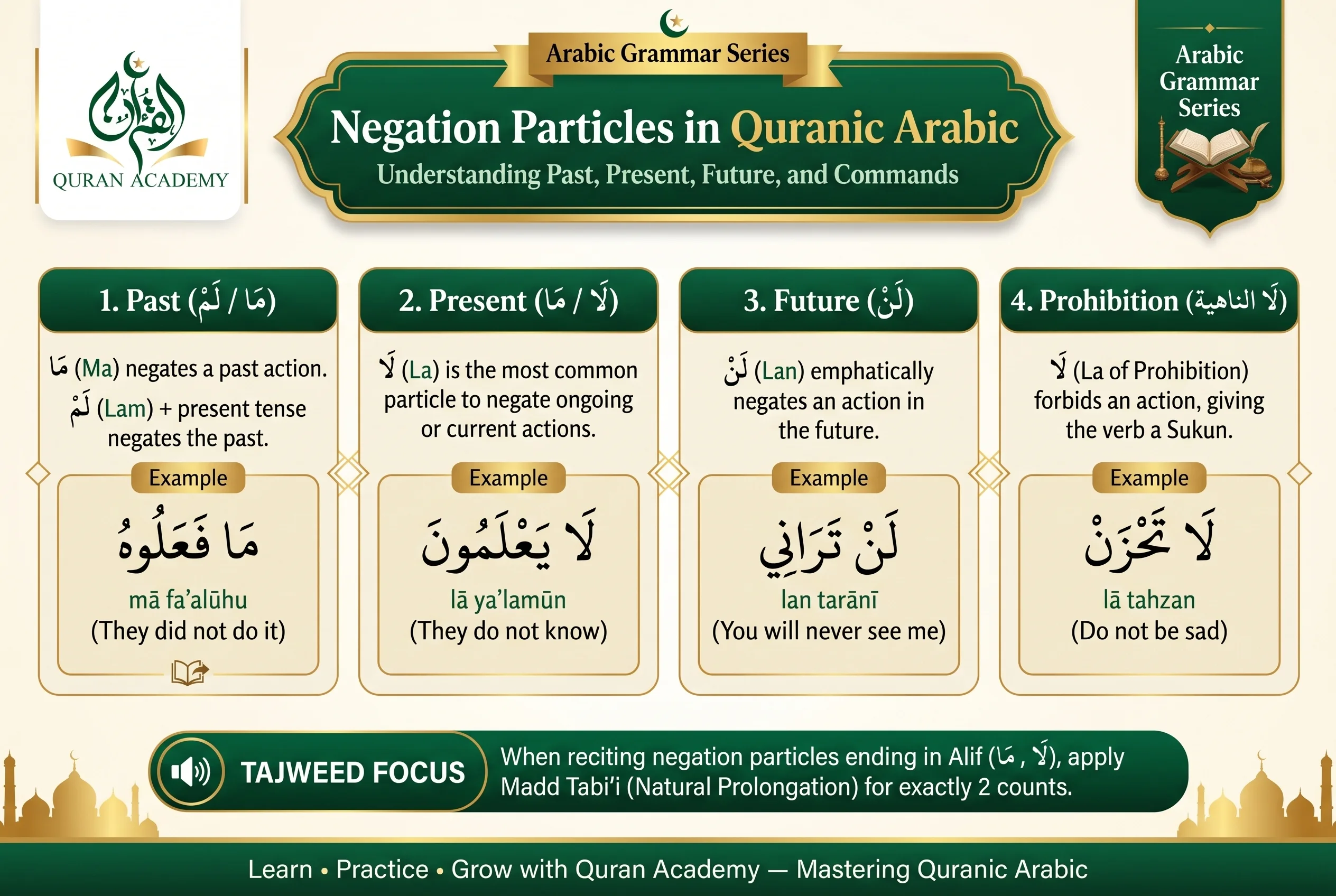
✦ Quick Answer & Key Takeaways: Negation Particles in the Quran
Mastering negation particles in the Quran (أَدَوَاتُ النَّفْيِ فِي الْقُرْآنِ الْكَرِيمِ: مَا وَلَا وَلَنْ وَلَمْ وَلَمَّا وَلَيْسَ) clarifies time, certainty, and command vs. statement across hundreds of verses every day! In Quranic Arabic, different negation tools map to distinct tenses and grammatical effects: لَمْ (Lam) negates a past action with Jazm (e.g., لَمْ يَلِدْ وَلَمْ يُولَدْ in Surah Al-Ikhlas 112:3); لَمَّا (Lammaa) negates up to the present with expectation of what may follow; لَنْ (Lan) strongly negates the future with Nasb (Fatha); لَا (Laa) can negate a statement or prohibit an action ("Do not!"); مَا (Maa) negates statements across tenses; and لَيْسَ (Laysa) negates nominal predications (Kana & Her Sisters)! Building upon our Question & Conditional Particles Guide and Nominal vs. Verbal Sentences, this guide launches Matrix 6! In our 1-on-1 Online Quranic Arabic & Tafseer Program, students read these patterns directly from the Mushaf!
- Lam vs. Lan: لَمْ = past/up to now + Jazm; لَنْ = emphatic future negation + Nasb!
- Laa of Prohibition vs. Laa of Negation: Spot whether a verse commands "Do not!" or states "Does not!"
- Lammaa Nuance: Negates up to now while pointing toward a pending reality or outcome.
- Tajweed Link: Always apply Meem Sakinah after Lam, Noon Sakinah after Lan, and Qalqalah on silent consonants!
In Surah Ash-Sharh (94:1), Allah asks: ﴿ أَلَمْ نَشْرَحْ لَكَ صَدْرَكَ ﴾; in Surah Al-Hujurat (49:11), He commands: ﴿ لَا يَسْخَرْ قَوْمٌ مِّن قَوْمٍ ﴾; and in Surah At-Tin (95:8), He asks: ﴿ أَلَيْسَ ٱللَّهُ بِأَحْكَمِ ٱلْحَاكِمِينَ ﴾. Notice how different negation words shape every one of those statements!
For learners of Quranic Arabic, mixing up لَمْ and لَنْ, or confusing لَا of prohibition with لَا of negation, can obscure verse meaning. Launching Matrix 6 alongside our guides to Question & Conditional Particles, Inna & Kana Sisters, and Verbs in Quranic Arabic, this guide gives you a Complete Negation Chart, practical Tafseer takeaways, and 5 Essential Tajweed Rules.
1. Master Chart: Negation Particles in the Quran
Compare the 6 core negation tools in Quranic Arabic below:
| Negation Tool | Time Frame & Grammar Effect | Quranic Verse Example |
|---|---|---|
| 1. لَمْ (Lam) ⭐ | Negates past/up to now + present verb; puts verb in Jazm. | ﴿ لَمْ يَلِدْ وَلَمْ يُولَدْ ﴾ (Al-Ikhlas 112:3 — "He neither begets nor is born"). |
| 2. لَنْ (Lan) 🏆 | Strong future negation + present verb; puts verb in Nasb (Fatha). | ﴿ لَن تَنَالُواْ ٱلْبِرَّ حَتَّىٰ تُنفِقُواْ مِمَّا تُحِبُّونَ ﴾ (Al 'Imran 3:92). |
| 3. لَا (Laa) ⭐ | Negates statements OR prohibits actions ("Do not!" + Jazm). | ﴿ لَا رَيْبَ ۛ فِيهِ ﴾ (2:2) & ﴿ لَا تُشْرِكْ بِٱللَّهِ ﴾ (Luqman 31:13). |
| 4. مَا (Maa) | Negates nominal or verbal statements (often present/past context). | ﴿ وَمَا تَوْفِيقِي إِلَّا بِٱللَّهِ ﴾ (Hud 11:88 — "And my success is not except through Allah"). |
| 5. لَمَّا (Lammaa) | Negates up to now + Jazm, implying "not yet" / pending expectation. | ﴿ بَل لَّمَّا يَذُوقُواْ عَذَابِ ﴾ (Sad 38:8). |
| 6. لَيْسَ (Laysa) | Verb of the Kana family negating nominal statements ("is not"). | ﴿ لَيْسَ كَمِثْلِهِۦ شَيْءٌ ﴾ (Ash-Shura 42:11 — "There is nothing like unto Him"). |
2. How to Distinguish "Laa" of Prohibition From "Laa" of Negation
When reading a verse starting with لَا followed by a verb addressed to a listener (starting with Ta-):
• If it is a Prohibition (لَا النَّاهِيَةُ = "Do not!"), the verb takes Jazm (e.g., لَا تَخَفْ = "Do not fear", dropping a final weak letter or plural Noon when required).
• If it is a Negation (لَا النَّافِيَةُ = "Does not / Do not [describe a fact]"), a plural present verb keeps its final Noon (e.g., لَا تَعْلَمُونَ = "You do not know").
Crisp Qalqalah in Negation & Command Verses: "Lam Yalidْ", "Laa Yaghtabْ" & "Laa Takhafْ"!
Jussive verbs after لَمْ (Lam) or prohibitive لَا (Laa) frequently end on a silent consonant—including Qalqalah (Echoing) letters (ق ط ب ج د) when isolated or stopped on! Watch Senior Instructor Ustadhah Yasmeen Gamal demonstrate Qalqalah on our Quran Academy YouTube Channel:
- Grammar + Tajweed Precision: Read every verse with clarity and accurate stops!
- 1-on-1 Live Coaching: Study Quranic Arabic & Tajweed with Al-Azhar scholars!
3. Five Essential Tajweed Rules in Quranic Negation Verses
When reciting verses with negation particles, apply these five Tajweed rules from our 1-on-1 Online Tajweed Course:
Struggling to Perfect Your Recitation?
Join 1,250+ students mastering the Quran 1-on-1 with our Verified Al-Azhar Graduates. Flexible US, UK, Canadian & Australian schedules starting at $8/hr.
Book a Free Evaluation Class →- 1. Meem Sakinah Rules After "Lam" (لَمْ):
Applying our Meem Sakinah Rules Guide, apply Ikhfaa' Shafawi before Baa, Idgham Mithlayn before Meem (such as بَل لَّمَّا or لَمْ مَّنْ), and clear Izhar Shafawi before other letters (such as لَمْ يَلِدْ)! - 2. Noon Sakinah Rules After "Lan" (لَنْ):
Using our Noon Sakinah & Tanween Guide and Matn Tuhfat Al-Atfal, apply the exact Noon Sakinah rule before the following letter (e.g., 2-beat Light Ikhfaa' Haqiqi in لَن تَنَالُواْ)! - 3. Two-Count Madd on "Laa" (لَا) & "Maa" (مَا) Before Non-Hamzah Letters:
According to our Rules of Madd Guide, stretch the Alif of لَا or مَا for 2 counts when not followed by a Hamzah or Hamzatul Wasl! - 4. Two-Beat Ghunnah on "Lammaa" (لَمَّا):
Hold a full 2-beat nasal Ghunnah on the doubled Meem (مّ) of لَمَّا! - 5. Heavy vs. Light Raa Based on Vowels & Surrounding Letters:
Following our Ahkam Al-Raa, Makharij al-Huruf, Sifaat al-Huruf, Heavy & Light Letters, Rules of Waqf, Laam Shamsiyyah & Qamariyyah, Hamzatul Wasl vs. Qat', 4 Special Words of Hafs, 7 Alifs in the Quran, Idgham Pairs, 10 Qira'at, Hafs vs. Warsh, Iltiqa' As-Sakinayn, Matn Al-Jazariyyah, 25 Common Tajweed Mistakes in Salah, An-Nabr (Vocal Stress), and 15 Sajdah Tilawah Verses guides, apply the exact vowel-based Raa rule! Test your Tajweed skills right now on our Free 3-Minute Tajweed Quiz!
Explore more Quranic Arabic and Surah Tafseer guides across our library: Question & Conditional Particles, Inna & Kana Sisters, Nominal vs. Verbal Sentences, 10 Verb Forms, Demonstrative & Relative Pronouns, and Daily Quran Habit (15-Minute Routine) (using our Interactive Tajweed Encyclopedia and Online Hadith Explorer)! Meet our Al-Azhar Certified Tutors, enroll your child in our 1-on-1 Kids Quran Classes with our Printable Kids Star Chart, and read how families across the US, UK, Canada, and Australia rate our teachers on our Verified Student & Parent Reviews Page.
4. Frequently Asked Questions (FAQs) About Negation Particles in the Quran
1. What is the grammatical and tense difference between "Lam" (لَمْ) and "Lan" (لَنْ) in the Quran?
Both "Lam" (لَمْ) and "Lan" (لَنْ) enter before a present-tense verb (Mudari') and change its ending, yet they point to opposite time frames and grammatical cases: (1) "Lam" (لَمْ) is a Jussive particle (Jazim) that negates an action from the past up to the present ("Lam yalid wa lam yulad" in Surah Al-Ikhlas 112:3); whereas (2) "Lan" (لَنْ) is an Accusative/Subjunctive particle (Nasib) that negates an action in the future with strong emphasis ("Lan tanaalul-birra..." in Al 'Imran 3:92)!
2. How do you tell the difference between "Laa" of Negation (Laa An-Nafiyah) and "Laa" of Prohibition (Laa An-Nahiyah)?
In Quranic Arabic: (1) "Laa" of Prohibition (لَا النَّاهِيَةُ) is a direct command telling someone "Do not do X!"—it puts the following verb into Jazm (often showing Sukoon or dropping a final weak letter/Noon, as in "Laa takhaf" = Do not fear, or "Laa tushrik billah" in Surah Luqman 31:13); whereas (2) "Laa" of Negation (لَا النَّافِيَةُ) simply states that something does not happen or does not exist ("Laa rayba feeh" in 2:2)!
3. How does "Lammaa" (لَمَّا) differ from "Lam" (لَمْ) as a negative verb particle?
Like Lam, "Lammaa" (لَمَّا) is a Jussive particle (Jazim) placed before a present-tense verb to negate the past—but with a built-in expectation that the action has not happened YET and may still occur or be anticipated ("Bal lammaa yadhooqoo 'adhaab" in Sad 38:8)!
4. How does "Laysa" (لَيْسَ) work in a Quranic sentence?
"Laysa" (لَيْسَ) is one of the verbs of the Kana family used to negate a nominal statement ("is not / are not"). Its subject noun is in Raf' (Damma) and its predicate takes Nasb (Fatha)—often preceded by an extra "Baa" of emphasis ("Bi-") as in "Alaysallaahu bi-ahkamul-haakimeen" (Surah At-Tin 95:8)!
5. What is the #1 Tajweed rule to watch for with "Lam" (لَمْ) and "Lan" (لَنْ) in recitation?
Both "Lam" (لَمْ) and "Lan" (لَنْ) end with a silent consonant (Meem Sakinah مْ in Lam, and Noon Sakinah نْ in Lan)—so always apply the exact Meem Sakinah rule after Lam and the exact Noon Sakinah rule after Lan!
Read & Understand Every Verse With Confidence!
Master Quranic grammar, vocabulary, Tafseer, and Tajweed in personalized 1-on-1 online classes with certified male and female Al-Azhar scholars. Book your free diagnostic trial session today!
Book Your Free 1-on-1 Trial Class →