
✦ Quick Answer & Key Takeaways: Oath Formulas (Al-Qasam) in the Quran
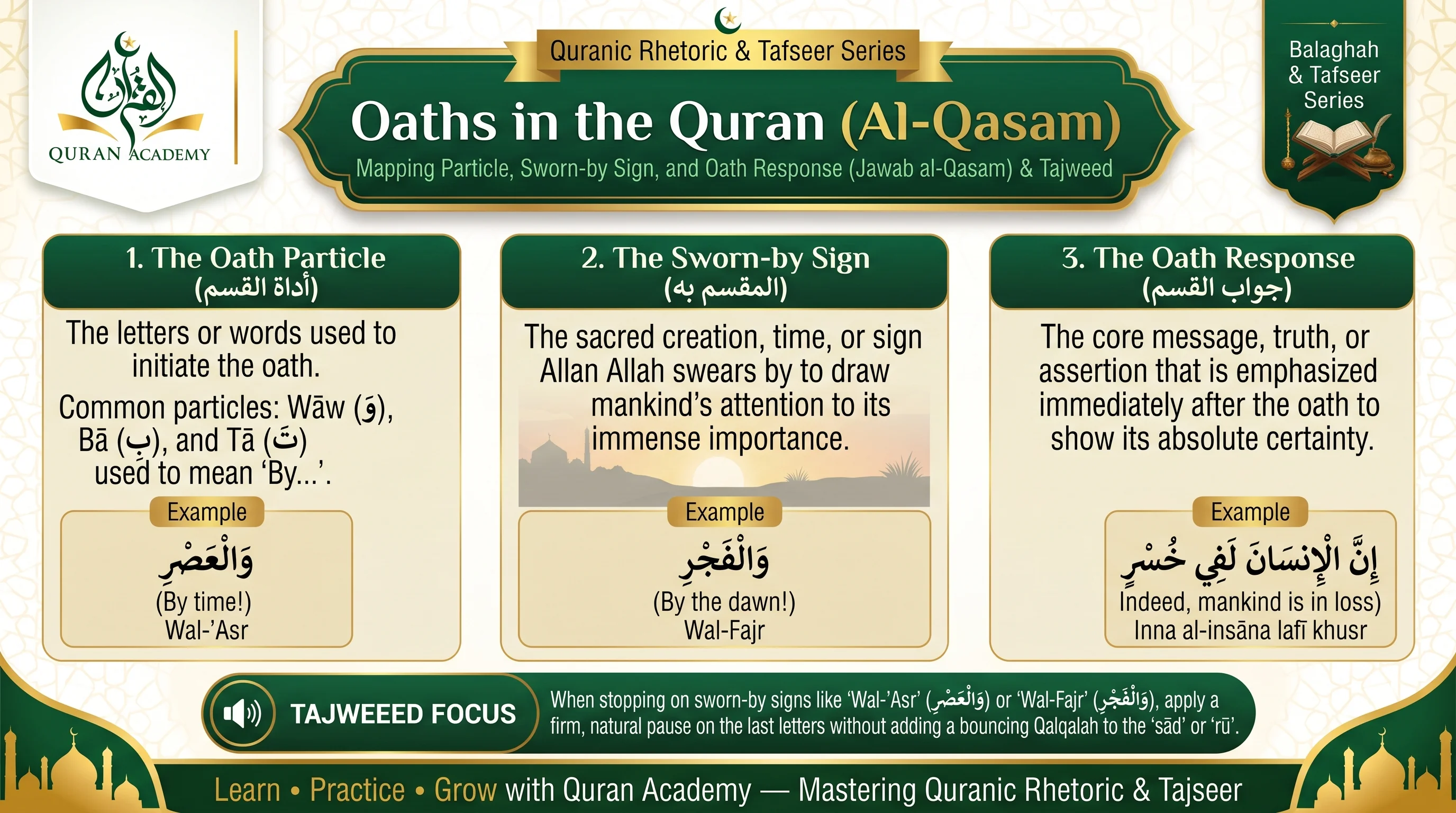
Mastering oath formulas al qasam in quran (أُسْلُوبُ الْقَسَمِ فِي الْقُرْآنِ الْكَرِيمِ: حُرُوفُ الْقَسَمِ، الْمُقْسَمُ بِهِ، وَجَوَابُ الْقَسَمِ) helps you see how the Quran commands attention, highlights signs of creation, and anchors a core truth! In Arabic grammar and rhetoric (Balaghah), an oath uses a particle—primarily وَـ (Wa-), بِـ (Bi-), or تَـ (Ta-)—followed by the sworn-by noun in Jarr (Kasrah) and leading up to Jawab Al-Qasam (جواب القسم — the main message being affirmed), as seen in Surah At-Tin (95:1–4) and Surah Al-'Adiyat (100:1–6)! Building upon our guides to Emphasis Tools in the Quran and Harf Al-Jarr Prepositions, this guide continues Day 2 of Matrix 6. In our 1-on-1 Online Quranic Arabic & Tafseer Program, learners trace oath structures directly in Quran Tafseer!
- Three Oath Particles: وَـ (most frequent), بِـ (often with oath verbs), and تَـ (paired with Allah's Name).
- Jarr Vowel Rule: The noun sworn by (Al-Muqsam Bihi) takes Jarr (typically Kasrah).
- Finding "Jawab Al-Qasam": Identify the central truth or warning that all the oaths build toward.
- Tajweed Connection: Check Sun vs. Moon Laams, Madd, Qalqalah, and Raa weight!
In Surah Al-'Asr (103:1–2), a single oath—﴿ وَٱلْعَصْرِ ﴿١﴾ إِنَّ ٱلْإِنسَانَ لَفِي خُسْرٍ ﴿٢﴾ ﴾—introduces a sweeping truth about human loss unless anchored in faith, good deeds, truth, and patience. In other Surahs, like Surah At-Tin (95:1–4), several consecutive oaths build anticipation before arriving at the core message!
For learners of Quranic Arabic, spotting the oath particle, the sworn-by sign, and the Jawab Al-Qasam keeps you from losing the main thread when multiple oaths appear in a row. Continuing Day 2 of Matrix 6 alongside our guides to Emphasis Tools, Balaghah Rhetoric, and Verse Endings & Hifz, this guide gives you an Oath Structure Chart, Tafseer insights, and 5 Essential Tajweed Rules.
1. Master Chart: Oath Particles, Sworn-By Signs & Oath Responses
Compare the core oath elements in Quranic Arabic below:
| Oath Element | Form & Grammar Rule | Quranic Example |
|---|---|---|
| 1. وَـ (Wa- of Oath) ⭐ | Prefixed particle; puts the sworn-by noun into Jarr (Kasrah). | ﴿ وَٱلْعَصْرِ ﴾ (103:1) & ﴿ وَٱلتِّينِ وَٱلزَّيْتُونِ ﴾ (95:1). |
| 2. بِـ (Bi- of Oath) | Prefixed preposition used with oath verbs or Uqsimu; puts noun in Jarr. | ﴿ لَا أُقْسِمُ بِهَٰذَا ٱلْبَلَدِ ﴾ (Al-Balad 90:1–2). |
| 3. تَـ (Ta- of Oath) | Prefixed particle used specifically with the Name of Allah; puts noun in Jarr. | ﴿ تَٱللَّهِ ﴾ (Surah Yusuf 12:85 & An-Nahl 16:56). |
| 4. Jawab Al-Qasam (Response) 🏆 | The core truth being affirmed—often marked by لَـ or إِنَّ. | ﴿ لَقَدْ خَلَقْنَا ٱلْإِنسَانَ فِي أَحْسَنِ تَقْوِيمٍ ﴾ (95:4). |
2. Reflecting on Sworn-By Signs & "Jawab Al-Qasam" in Tafseer
When Allah swears by a creation or moment in time, ask what attribute or blessing that sign highlights, and then connect it directly to the Jawab Al-Qasam—seeing how the sign and the statement reinforce one another!
Crisp Qalqalah in Oath Verses: "Qutb Jadd" (ق ط ب ج د)!
When reciting oath verses, keep silent Qalqalah (Echoing) bounces (ق ط ب ج د) crisp and bounce-free on non-Qalqalah letters! Watch Senior Instructor Ustadhah Yasmeen Gamal demonstrate Qalqalah on our Quran Academy YouTube Channel:
- Balaghah + Tajweed Together: Recite with solemnity and precision!
- 1-on-1 Live Coaching: Study with certified Al-Azhar scholars!
3. Five Essential Tajweed Rules When Reciting Oath Verses
When reciting oath formulas in the Quran, apply these five Tajweed rules from our 1-on-1 Online Tajweed Course:
Struggling to Perfect Your Recitation?
Join 1,250+ students mastering the Quran 1-on-1 with our Verified Al-Azhar Graduates. Flexible US, UK, Canadian & Australian schedules starting at $8/hr.
Book a Free Evaluation Class →- 1. Sun vs. Moon Laams After "Wa-" + "Al-" ("Wal-'Asr" vs. "Wat-Teen"):
Applying our Laam Shamsiyyah & Laam Qamariyyah Guide, keep the Laam clear before Moon letters (like 'Ayn in Wal-'Asr) and merge it smoothly into Sun letters (like Taa' in Wat-Teen)! - 2. Proper Madd Counts on Oath Nouns ("Wat-Teen", "Waz-Zaytoon", "Wal-Fajr"):
Using our Rules of Madd Guide and Matn Tuhfat Al-Atfal, stretch natural Madd letters for 2 counts in continuation and lengthen consistently (2, 4, or 6 counts in Hafs) when stopping! - 3. Clear Noon & Tanween Rules:
According to our Noon Sakinah & Tanween Guide, apply Izhar, Idgham, Iqlab, and Ikhfaa' cleanly! - 4. Clear Meem Sakinah Rules:
Using our Meem Sakinah Rules Guide, apply Ikhfaa' Shafawi before Baa, Idgham Mithlayn before Meem, and Izhar Shafawi before other letters! - 5. Heavy vs. Light Raa When Stopping on a Final Raa ("Wal-'Asr", "Wal-Fajr"):
Following our Ahkam Al-Raa, Makharij al-Huruf, Sifaat al-Huruf, Heavy & Light Letters, Rules of Waqf, Hamzatul Wasl vs. Qat', 4 Special Words of Hafs, 7 Alifs in the Quran, Idgham Pairs, 10 Qira'at, Hafs vs. Warsh, Iltiqa' As-Sakinayn, Matn Al-Jazariyyah, 25 Common Tajweed Mistakes in Salah, An-Nabr (Vocal Stress), and 15 Sajdah Tilawah Verses guides, apply the exact stopping Raa rule when stopping on a final Raa! Test your Tajweed skills right now on our Free 3-Minute Tajweed Quiz!
Explore more Quranic Arabic and Surah Tafseer guides across our library: Emphasis Tools, Balaghah Rhetoric, Surah At-Tin, Surah Az-Zalzalah & Al-'Adiyat, and Verse Endings & Hifz (using our Interactive Tajweed Encyclopedia and Online Hadith Explorer)! Meet our Al-Azhar Certified Tutors, enroll your child in our 1-on-1 Kids Quran Classes with our Printable Kids Star Chart, and read how families across the US, UK, Canada, and Australia rate our teachers on our Verified Student & Parent Reviews Page.
4. Frequently Asked Questions (FAQs) About Oath Formulas (Al-Qasam) in the Quran
1. What are the 3 main oath particles (Huruf Al-Qasam) in Arabic and the Quran?
The 3 primary prefixed oath particles in Arabic are: (1) "Wa-" (وَـ), (2) "Bi-" (بِـ), and (3) "Ta-" (تَـ)!
2. What are the 3 parts of a complete Quranic oath sentence?
A complete oath structure has three parts: (1) The Oath Particle or Verb, (2) The Sworn-By Entity (in Jarr), and (3) The Oath Statement / Answer (Jawab Al-Qasam)!
3. Why does Allah swear by creations in the Quran when humans are taught in Hadith to swear only by Allah?
Allah is the Creator and Sovereign over all things and may swear by any of His signs to highlight His wisdom and power; whereas humans are creatures who must swear only by Allah.
4. How do you spot "Jawab Al-Qasam" (the main point of the oath) in a Surah opening?
Look for the central truth or warning following the oath chain—often reinforced by "La-" (لَـ) or "Inna" (إِنَّ).
5. What is the #1 Tajweed rule to watch for when reciting oath verses starting with "Wa-" + "Al-"?
Check whether the following Laam is a Moon Laam (pronounced clearly, as in Wal-'Asr) or a Sun Laam (merged with Shaddah, as in Wat-Teen)!
Read & Reflect on the Quran With Deeper Clarity!
Master Quranic Arabic grammar, Tafseer, Hifz, and Tajweed in live 1-on-1 online lessons with certified male and female Al-Azhar scholars. Book your free trial session today!
Book Your Free 1-on-1 Trial Class →