
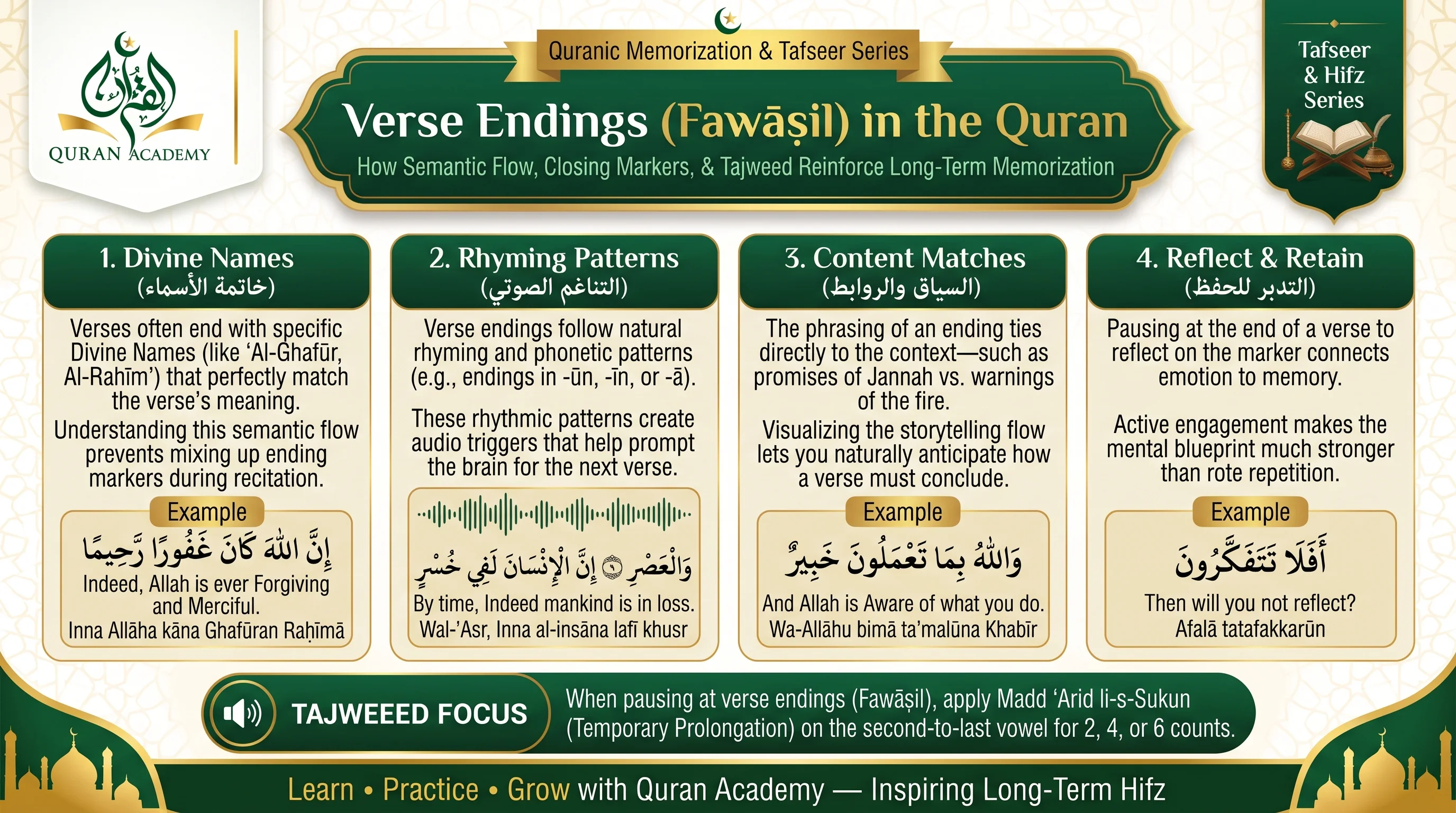
✦ Quick Answer & Key Takeaways: Verse Endings (Fawasil) & Quran Hifz
Using verse endings fawasil quran hifz (تَوْظِيفُ السِّيَاقِ وَالْفَوَاصِلِ الْقُرْآنِيَّةِ فِي تَثْبِيتِ الْحِفْظِ طَوِيلِ الْمَدَى) transforms memorization from fragile rote recall into durable, meaningful mastery! In Quranic sciences ('Ulum Al-Quran), Fawasil (الفواصل) are the closing words or phrases of verses that give recitation its cadence while sealing or reinforcing the verse's message. When Hifz students pair structured repetition—such as our 3x3 Memorization Method and 15-Minute Daily Quran Routine—with attention to context and verse endings, they link each verse to a logical thread instead of guessing similar endings! Building upon our Matrix 6 grammar and Balaghah Rhetoric guides, this article completes Day 1 of Matrix 6. In our 1-on-1 Online Quran Memorization (Hifz) Program, students build rock-solid retention with guided review!
- Meaning Beats Isolated Sound: Linking a verse's ending to its context anchors recall during high-pressure review.
- Fewer Similar-Ending Slips: Understanding why a verse closes a certain way helps separate closely related verses.
- Natural Cadence & Flow: Fawasil create rhythmic signposts that guide both recitation and mental mapping.
- Tajweed at Every Stop: Honor Waqf, Madd, Qalqalah, and Raa rules at the end of every verse!
Every Hifz student knows that familiar moment during review: you recite a verse cleanly, reach the end of the line, and suddenly hesitate between two possible closing phrases because both sound familiar! When memorization relies on sound alone, fatigue or speed can cause two similar endings to trade places.
By paying attention to context and verse endings (Fawasil)—alongside our guides to Juz Amma Memorization, Juz Tabarak Memorization, and Quran Tafseer—you give each verse a distinct reason to end the way it does. Completing Day 1 of Matrix 6 (Articles 151–155), this guide presents a Hifz Anchor Chart and 5 Essential Tajweed Rules.
1. Master Chart: How Context & Verse Endings (Fawasil) Anchor Hifz
Use these 4 anchor strategies during memorization and review:
| Anchor Strategy | What You Look For in the Verse | How It Strengthens Long-Term Hifz |
|---|---|---|
| 1. Thematic Link to Ending ⭐ | How the closing phrase mirrors the core point or emotion of the verse. | Prevents random guessing because the ending feels fitting to the verse's meaning. |
| 2. Contrast & Transition Clues ⭐ | Shifts between warnings, blessings, stories, or commands using connectors (Li-, Kay, Hatta, Negation, Emphasis). | Creates clear mental "chapters" within a page so you know where one idea ends and the next begins. |
| 3. Sound Cadence (Fasilah Rhythm) 🏆 | The natural rhyme, vowel pattern, or closing cadence across consecutive verses. | Helps you spot when a verse breaks a pattern or introduces a distinct closing phrase. |
| 4. Meaning-to-Next-Verse Bridge | How the end of Verse N sets up the opening of Verse N+1. | Eliminates blank spots when transitioning from one verse to the next without looking. |
2. Practical Workflow: Pairing Meaning Anchors With Structured Review
Before memorizing a new set of verses, read their translation or Tafseer note once so you know the storyline and closing emphasis; then repeat each verse with focus and test your recall at verse boundaries and page turns!
Lock In Your Hifz Stops: Crisp Qalqalah on "Qutb Jadd" (ق ط ب ج د)!
When stopping at verse endings or mid-verse pauses during Hifz, keep Qalqalah (Echoing) bounces (ق ط ب ج د) crisp and bounce-free on non-Qalqalah letters! Watch Senior Instructor Ustadhah Yasmeen Gamal demonstrate Qalqalah on our Quran Academy YouTube Channel:
- Context + Tajweed Together: Memorize accurately from day one!
- 1-on-1 Live Hifz Coaching: Guided retention with Al-Azhar scholars!
3. Five Essential Tajweed Rules at Verse Endings (Fawasil)
When stopping on verse endings during memorization and recitation, apply these five Tajweed rules from our 1-on-1 Online Tajweed Course:
Struggling to Perfect Your Recitation?
Join 1,250+ students mastering the Quran 1-on-1 with our Verified Al-Azhar Graduates. Flexible US, UK, Canadian & Australian schedules starting at $8/hr.
Book a Free Evaluation Class →- 1. Two-Count "Madd Al-'Iwad" When Stopping on Fathatayn:
Applying our Rules of Waqf Guide and Rules of Madd Guide, when a verse ending carries Fathatayn (ـًا) and you stop on it, replace the Tanween with a smooth 2-count Alif Madd! - 2. "Madd 'Arid Lis-Sukoon" When Stopping Before a Final Letter After Madd:
Using our Rules of Madd Guide and Matn Tuhfat Al-Atfal, when stopping on a final consonant preceded by a Madd letter, lengthen consistently (2, 4, or 6 counts in Hafs)! - 3. Clear Noon & Tanween Rules When Continuing Across Verse Endings:
According to our Noon Sakinah & Tanween Guide, if you connect one verse directly into the next, apply the exact Noon/Tanween rule before the first letter of the next verse! - 4. Clear Meem Sakinah Rules at Word & Verse Boundaries:
Using our Meem Sakinah Rules Guide, apply Ikhfaa' Shafawi, Idgham Mithlayn, and Izhar Shafawi cleanly! - 5. Heavy vs. Light Raa When Stopping on a Final Raa:
Following our Ahkam Al-Raa, Makharij al-Huruf, Sifaat al-Huruf, Heavy & Light Letters, Laam Shamsiyyah & Qamariyyah, Hamzatul Wasl vs. Qat', 4 Special Words of Hafs, 7 Alifs in the Quran, Idgham Pairs, 10 Qira'at, Hafs vs. Warsh, Iltiqa' As-Sakinayn, Matn Al-Jazariyyah, 25 Common Tajweed Mistakes in Salah, An-Nabr (Vocal Stress), and 15 Sajdah Tilawah Verses guides, apply the exact stopping Raa rule based on the vowel and letter before the Raa! Test your Tajweed skills right now on our Free 3-Minute Tajweed Quiz!
With this guide, we complete Day 1 of Matrix 6 (Articles 151 to 155)—connecting Negation Particles, Emphasis Tools, Ism Al-Fa'il & Ism Al-Maf'ul, Causal & Purpose Connectors, 3x3 Memorization Method, and Daily Quran Habit (15-Minute Routine) (using our Smart Hifz Planner, Interactive Tajweed Encyclopedia, and Online Hadith Explorer)! Meet our Al-Azhar Certified Tutors, enroll your child in our 1-on-1 Kids Quran Classes with our Printable Kids Star Chart, and read how families across the US, UK, Canada, and Australia rate our teachers on our Verified Student & Parent Reviews Page.
4. Frequently Asked Questions (FAQs) About Verse Endings (Fawasil) & Hifz
1. What are "Fawasil" (الفواصل) in Quranic sciences ('Ulum Al-Quran)?
In 'Ulum Al-Quran (Quranic sciences), "Fawasil" (singular: Fasilah) are the ending words or closing phrases of Quranic verses—functioning like cadence markers in recitation and thematic seals that sum up or reinforce the meaning of the verse.
2. How does understanding verse context reduce "Mutashabihat" (similar-verse) mistakes during Hifz?
When a student memorizes purely by sound without attending to context, similar openings or similar endings across verses can easily swap places. Connecting each verse to its surrounding argument, story arc, or attribute of Allah gives the mind a clear semantic anchor so each ending belongs to its exact context.
3. Why do closing phrases in verses often match the surrounding theme?
Closing phrases frequently echo the central lesson of the verse—reinforcing the core point or emotion being conveyed in context.
4. How should a Hifz student combine meaning anchors with daily repetition?
First read the passage's meaning and connection, then apply structured repetition (such as our 3x3 method and short daily routines) and review with a teacher or tracker so both memory and comprehension grow together.
5. What Tajweed rules are especially important at verse endings (Fawasil)?
At verse endings, pay close attention to 2-count Madd Al-'Iwad on Fathatayn, Madd 'Arid Lis-Sukoon when stopping before a final consonant preceded by a Madd letter, and heavy vs. light Raa when stopping on a final Raa!
Build Strong, Lasting Quran Hifz With a Scholar!
Memorize and review the Holy Quran with clarity, meaning, and Tajweed precision in personalized 1-on-1 online lessons with certified male and female Al-Azhar scholars. Book your free trial session today!
Book Your Free 1-on-1 Trial Class →