
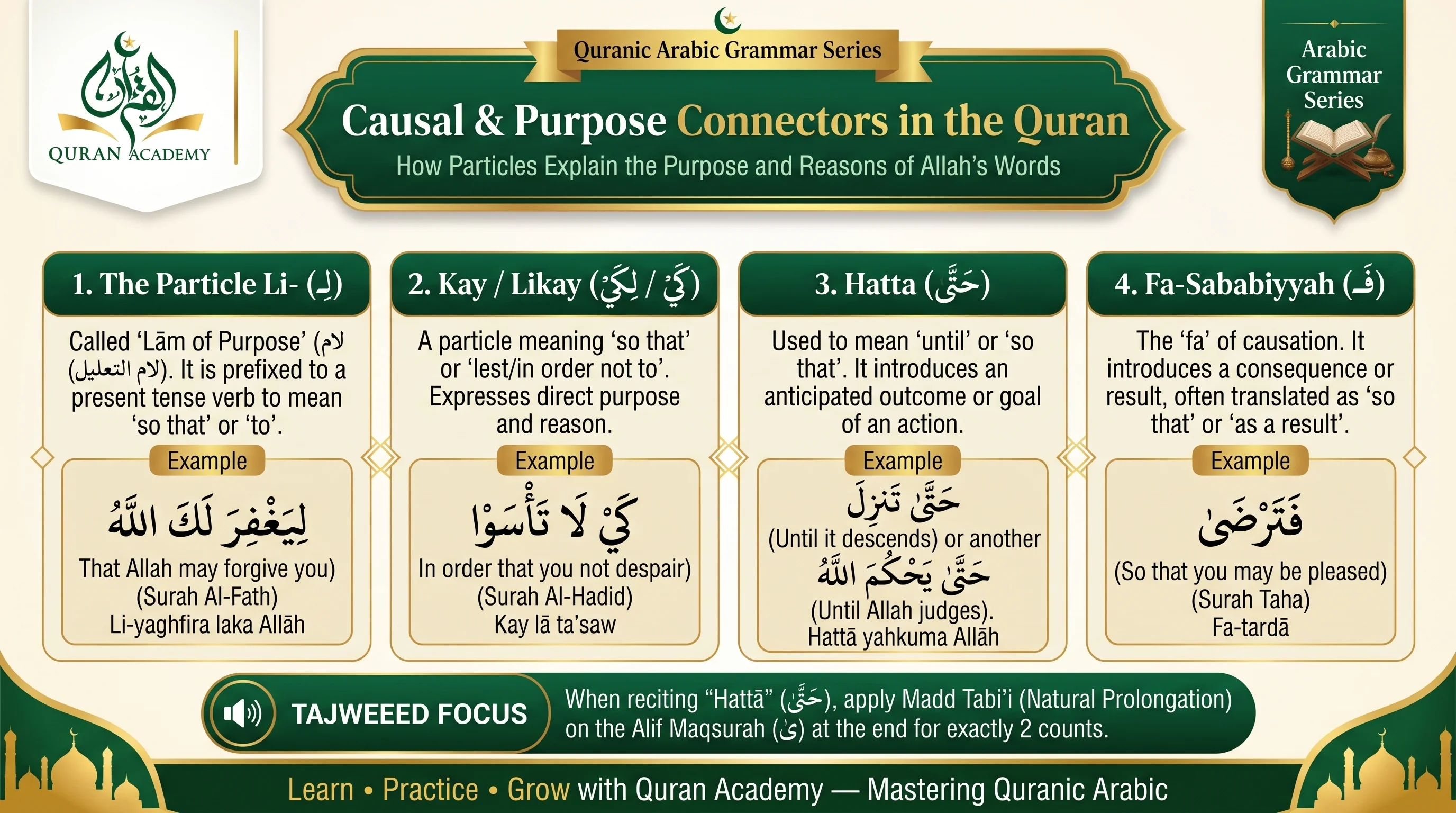
✦ Quick Answer & Key Takeaways: Causal & Purpose Connectors in the Quran
Mastering causal purpose connectors in quran (أَدَوَاتُ التَّعْلِيلِ وَالْغَايَةِ فِي الْقُرْآنِ الْكَرِيمِ: لَامُ التَّعْلِيلِ، كَيْ، حَتَّىٰ، وَفَاءُ السَّبَبِيَّةِ) helps you uncover the purpose, wisdom, and consequence inside Quranic verses! Whenever a verse answers "Why?" or "Toward what goal?"—such as ﴿ وَجَعَلْنَاكُمْ شُعُوبًا وَقَبَائِلَ لِتَعَارَفُواْ ﴾ ("And We made you peoples and tribes so that you may know one another" — Surah Al-Hujurat 49:13)—connectors like لِـ (Li-), كَيْ (Kay), حَتَّىٰ (Hattaa), and فَـ (Fa-Sababiyyah) link an action to its intended reason or outcome! Building upon our guides to Harf Al-Jarr Prepositions, Question & Conditional Particles, and Negation Particles, this guide continues Matrix 6. In our 1-on-1 Online Quranic Arabic & Tafseer Program, learners trace verse purpose directly in Quran Tafseer!
- Purpose Over Randomness: Causal connectors highlight the wise aim (Hikmah) behind commands and creation.
- Verb Mood Clues: Purpose connectors like Li-, Kay, Hatta, and Fa-Sababiyyah often put a following present verb into Nasb.
- Dual Nuance of "Hatta": Can mark an endpoint in time ("until") or an intended purpose/climax ("so that").
- Tajweed Link: Watch Madd counts on connectors like Hattaa, crisp Qalqalah, and accurate Raa weight!
Why did Allah create diverse peoples and tribes across the earth? Surah Al-Hujurat (49:13) gives the answer with a single prefixed connector: لِتَعَارَفُواْ ("So that you may come to know one another")! Why did Allah send down the Quran in clear Arabic? لَعَلَّكُمْ تَعْقِلُونَ / لِتَتَفَكَّرُواْ ("So that you may reflect and understand")!
For learners of Quranic Arabic, spotting causal and purpose markers turns a list of actions into a clear chain of cause → purpose → result. Continuing Matrix 6 alongside our guides to Question & Conditional Particles, Negation Particles, and Ism Al-Fa'il & Ism Al-Maf'ul, this guide gives you a Connectors Comparison Chart, practical Tadabbur tips, and 5 Essential Tajweed Rules.
1. Master Chart: Causal & Purpose Connectors in the Quran
Compare the 4 key causal/purpose connectors in Quranic Arabic below:
| Connector | Core Meaning & Grammar Role | Quranic Example & Takeaway |
|---|---|---|
| 1. لِـ (Li- of Purpose / Cause) ⭐ | So that / In order that / Because (attaches to verbs with Nasb or nouns with Jarr). | ﴿ لِتَعَارَفُواْ ﴾ (49:13 — "So that you may know one another"). |
| 2. كَيْ (Kay) ⭐ | In order that / So that (purpose particle entering before a present verb in Nasb). | ﴿ كَيْ لَا يَكُونَ دُولَةًۢ بَيْنَ ٱلْأَغْنِيَاءِ ﴾ (Al-Hashr 59:7). |
| 3. حَتَّىٰ (Hattaa) 🏆 | Until / So that / Up to the point that (time limit or intended goal/outcome). | ﴿ حَتَّىٰ مَطْلَعِ ٱلْفَجْرِ ﴾ (Al-Qadr 97:5 — "Until the emergence of dawn"). |
| 4. فَـ (Fa-Sababiyyah) | So that / Consequently (links a trigger/cause to its result with a present verb in Nasb). | Shows cause-and-effect flow across commands, questions, and negations. |
2. How Tracing Purpose Connectors Deepens Daily Tadabbur & Tafseer
When you pause on a purpose connector during your daily 15-minute Quran routine and ask "What is the goal stated right here?", the verse turns into a personal compass for gratitude, character, and action!
Crisp Qalqalah in Purpose & Result Verses: "Qutb Jadd" (ق ط ب ج د)!
Alongside purpose and result connectors, keep silent Qalqalah (Echoing) bounces (ق ط ب ج د) crisp and bounce-free on non-Qalqalah letters! Watch Senior Instructor Ustadhah Yasmeen Gamal demonstrate Qalqalah on our Quran Academy YouTube Channel:
- Tadabbur + Tajweed Together: Reflect on purpose while reciting cleanly!
- 1-on-1 Live Coaching: Study with certified Al-Azhar scholars!
3. Five Essential Tajweed Rules With Causal & Purpose Connectors
When reciting verses with causal and purpose connectors, apply these five Tajweed rules from our 1-on-1 Online Tajweed Course:
Struggling to Perfect Your Recitation?
Join 1,250+ students mastering the Quran 1-on-1 with our Verified Al-Azhar Graduates. Flexible US, UK, Canadian & Australian schedules starting at $8/hr.
Book a Free Evaluation Class →- 1. Two-Count Madd on "Hattaa" (حَتَّىٰ) Before Non-Hamzah Letters:
Applying our Rules of Madd Guide and Matn Tuhfat Al-Atfal, stretch the Dagger Alif at the end of حَتَّىٰ for a full 2 counts (or 4–5 counts before a separate Hamzatul Qat')! - 2. Clear Noon Sakinah & Tanween Rules Across Connected Clauses:
Using our Noon Sakinah & Tanween Guide, apply Izhar, Idgham, Iqlab, and Ikhfaa' cleanly! - 3. Clear Meem Sakinah Rules:
According to our Meem Sakinah Rules Guide, apply Ikhfaa' Shafawi before Baa, Idgham Mithlayn before Meem, and Izhar Shafawi before other letters! - 4. Mindful Stopping (Waqf) & Madd Al-'Iwad on Fathatayn:
Using our Rules of Waqf Guide, pause cleanly and apply 2-count Madd Al-'Iwad on Fathatayn endings! - 5. Heavy vs. Light Raa Based on Vowels & Surrounding Letters:
Following our Ahkam Al-Raa, Makharij al-Huruf, Sifaat al-Huruf, Heavy & Light Letters, Laam Shamsiyyah & Qamariyyah, Hamzatul Wasl vs. Qat', 4 Special Words of Hafs, 7 Alifs in the Quran, Idgham Pairs, 10 Qira'at, Hafs vs. Warsh, Iltiqa' As-Sakinayn, Matn Al-Jazariyyah, 25 Common Tajweed Mistakes in Salah, An-Nabr (Vocal Stress), and 15 Sajdah Tilawah Verses guides, apply the exact vowel-based Raa rule! Test your Tajweed skills right now on our Free 3-Minute Tajweed Quiz!
Explore more Quranic Arabic and Surah Tafseer guides across our library: Question & Conditional Particles, Negation Particles, Emphasis Tools, Ism Al-Fa'il & Ism Al-Maf'ul, Harf Al-Jarr Prepositions, and Surah Al-Hujurat (using our Interactive Tajweed Encyclopedia and Online Hadith Explorer)! Meet our Al-Azhar Certified Tutors, enroll your child in our 1-on-1 Kids Quran Classes with our Printable Kids Star Chart, and read how families across the US, UK, Canada, and Australia rate our teachers on our Verified Student & Parent Reviews Page.
4. Frequently Asked Questions (FAQs) About Causal & Purpose Connectors
1. What do causal and purpose connectors (like "Li-", "Kay", "Hatta", and "Fa-Sababiyyah") reveal in Quranic Tafseer?
They answer the "Why?" and "Toward what end?" of a verse—revealing the wisdom, purpose, or outcome behind divine commands, creation, and human choices (such as "Li-ta'aarafoo" in Surah Al-Hujurat 49:13)!
2. How does "Li-" (لِـ) function as a causal/purpose connector in Quranic Arabic?
In Quranic grammar, "Li-" (لِـ — Lam At-Ta'lil / Lam Kay) attaches to a verb to express purpose or reason ("in order that / so that"), putting a following present verb into Nasb (often with a hidden "An" after "Li-")!
3. What does "Hatta" (حَتَّىٰ) mean in Quranic verses—purpose ("until/so that") vs. endpoint ("until")?
Depending on context, "Hatta" (حَتَّىٰ) can mean "until" (marking a time or state limit, as in "Hatta matla'il-fajr" in Surah Al-Qadr 97:5) OR "so that / in order that" (expressing intended outcome or climax)!
4. What is "Fa-Sababiyyah" (فَاءُ السَّبَبِيَّةِ) in Quranic Arabic?
"Fa-Sababiyyah" is a prefixed "Fa-" that links a preceding cause/trigger (such as a command, question, wish, or negation) to its resulting consequence or outcome—putting a following present verb into Nasb!
5. What is the #1 Tajweed rule to watch for with "Hatta" (حَتَّىٰ) in recitation?
At the end of "حَتَّىٰ" (Hattaa), there is a Dagger Alif (Alif Khanjariyyah) written above a Yaa shape—so always stretch it for a full 2-count Madd Tabee'i ("Hattaaa") (or 4–5 counts before a separate Hamzatul Qat')!
Understand the Wisdom & Purpose Behind Every Verse!
Master Quranic Arabic grammar, Tafseer, Hifz, and Tajweed in live 1-on-1 online lessons with certified male and female Al-Azhar scholars. Book your free diagnostic trial session today!
Book Your Free 1-on-1 Trial Class →