
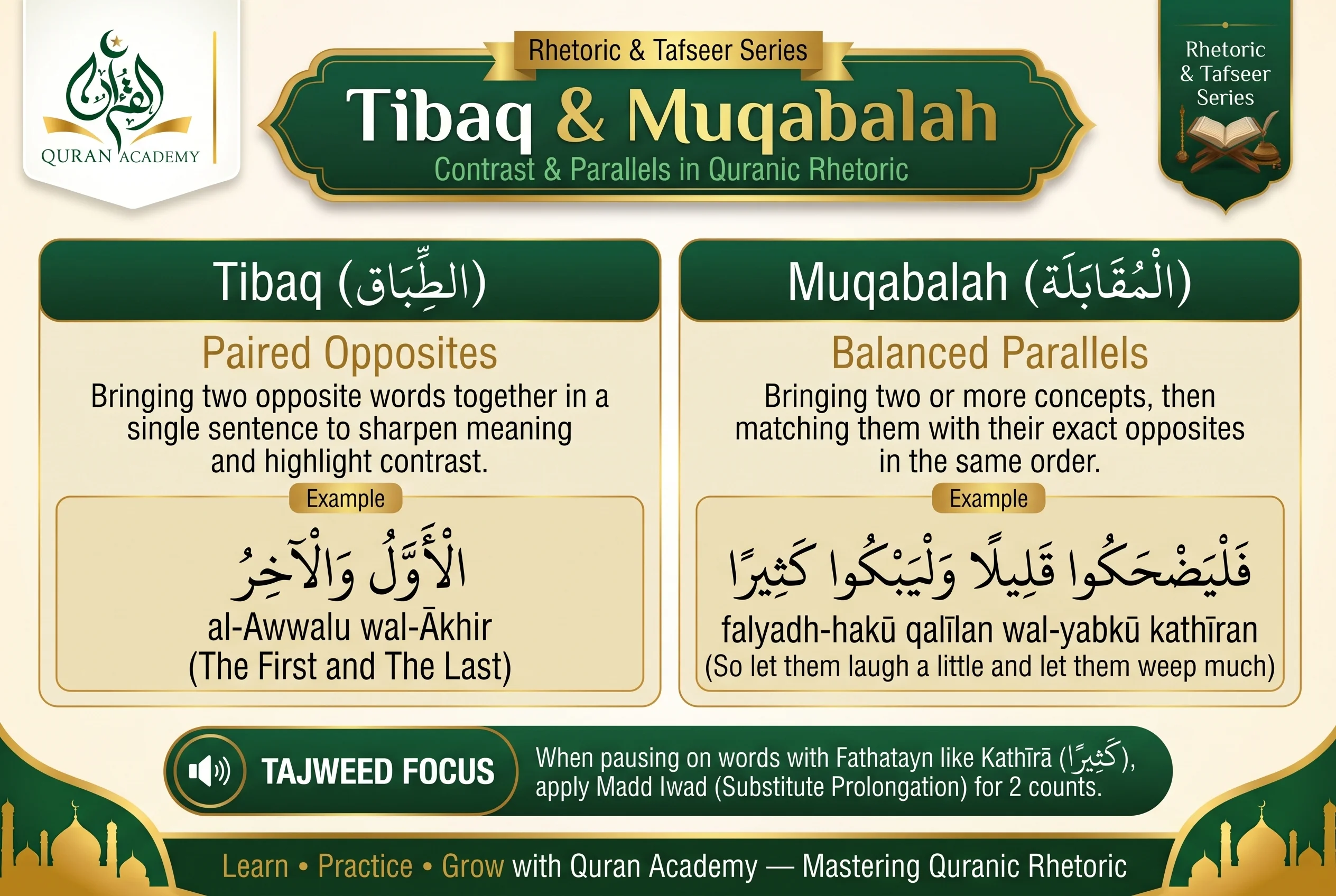
✦ Quick Answer & Key Takeaways: Tibaq & Muqabalah Contrast in the Quran
Exploring tibaq muqabalah contrast in quran (الطِّبَاقُ وَالْمُقَابَلَةُ وَالتَّوَازِي الْبَلَاغِيُّ فِي الْقُرْآنِ الْكَرِيمِ) uncovers one of the clearest ways the Quran makes meaning vivid, balanced, and unforgettable! In Arabic rhetoric (Balaghah), At-Tibaq (الطباق) pairs opposing ideas or words—such as Al-Awwal and Al-Aakhir, or Adh-Dhaahir and Al-Baatin in Surah Al-Hadid (57:3)—while Al-Muqabalah (المقابلة) sets a sequence of multiple meanings against a corresponding sequence of opposites, alongside Parallelism that mirrors structure and cadence! Building upon our guides to Balaghah Rhetoric in the Quran and Verse Endings & Hifz, this article completes Day 2 of Matrix 6 (Articles 156–160)! In our 1-on-1 Online Quranic Arabic & Tafseer Program, learners spot rhetorical contrast directly in Quran Tafseer!
- At-Tibaq (Paired Opposites): Brings contrasting terms together so each shines more clearly.
- Al-Muqabalah (Sequence Contrast): Contrasts two sets of matched meanings side by side.
- Hifz & Tadabbur Boost: Helps learners track verse sequence and avoid mixing similar passages.
- Tajweed Connection: Honor Madd, Ghunnah, Qalqalah, and Waqf cleanly across both sides of a contrast!
In Surah Ash-Sharh (94:5–6), hardship and ease are paired right next to each other—﴿ فَإِنَّ مَعَ ٱلْعُسْرِ يُسْرًا ﴿٥﴾ إِنَّ مَعَ ٱلْعُسْرِ يُسْرًا ﴿٦﴾ ﴾—and in Surah Ad-Dukhan (44:43–57), the bitter ordeal of the arrogant is contrasted vividly with the secure bliss of the people of Taqwa!
For learners of Tafseer and Hifz, noticing contrast and parallelism turns scattered details into a memorable big picture. Completing Day 2 of Matrix 6 alongside our guides to Balaghah Rhetoric, Sigh Al-Mubalaghah & Ism At-Tafdil, and Verse Endings & Hifz, this guide gives you a Rhetorical Contrast Chart and 5 Essential Tajweed Rules.
1. Master Chart: At-Tibaq, Al-Muqabalah & Parallelism in the Quran
Compare these 3 rhetorical patterns in Quranic style below:
| Rhetorical Pattern | Structure & Function | Quranic Example & Effect |
|---|---|---|
| 1. الطِّبَاقُ (At-Tibaq) ⭐ | Pairs two opposing words or concepts within a verse or statement. | ٱلْأَوَّلُ وَٱلْآخِرُ / ٱلظَّاهِرُ وَٱلْبَاطِنُ (57:3) & الْعُسْرِ / يُسْرًا (94:5–6). |
| 2. الْمُقَابَلَةُ (Al-Muqabalah) 🏆 | Contrasts a multi-part group of meanings against a matching group of opposites. | Contrasting states of those who deny vs. those who fear Allah and strive for the Hereafter. |
| 3. التَّوَازِي (Parallelism) ⭐ | Mirrors sentence rhythm, phrasing, or corresponding ideas across verses. | Creates balanced flow and reinforces key themes across consecutive verses. |
2. How Contrast & Parallelism Guide Tadabbur and Long-Term Hifz
When reviewing memorized verses, notice which side of a contrast is presented first and how the parallel phrasing moves forward—giving your mind a natural structure to rely on!
Crisp Qalqalah in Contrasting & Parallel Verses: "Qutb Jadd" (ق ط ب ج د)!
When reciting contrasting or parallel clauses, keep silent Qalqalah (Echoing) bounces (ق ط ب ج د) crisp and bounce-free on non-Qalqalah letters! Watch Senior Instructor Ustadhah Yasmeen Gamal demonstrate Qalqalah on our Quran Academy YouTube Channel:
- Balaghah + Tajweed Together: Recite with balance and precision!
- 1-on-1 Live Coaching: Study with certified Al-Azhar scholars!
3. Five Essential Tajweed Rules in Contrasting & Parallel Verses
When reciting contrasting and parallel passages in the Quran, apply these five Tajweed rules from our 1-on-1 Online Tajweed Course:
Struggling to Perfect Your Recitation?
Join 1,250+ students mastering the Quran 1-on-1 with our Verified Al-Azhar Graduates. Flexible US, UK, Canadian & Australian schedules starting at $8/hr.
Book a Free Evaluation Class →- 1. Consistent Madd Durations Across Parallel & Contrasting Clauses:
Applying our Rules of Madd Guide and Matn Tuhfat Al-Atfal, keep natural and elongated Madd counts steady across both sides of a comparison! - 2. Clear Noon & Tanween Rules:
Using our Noon Sakinah & Tanween Guide, apply Izhar, Idgham, Iqlab, and Ikhfaa' cleanly! - 3. Clear Meem Sakinah Rules:
According to our Meem Sakinah Rules Guide, apply Ikhfaa' Shafawi before Baa, Idgham Mithlayn before Meem, and Izhar Shafawi before other letters! - 4. Mindful Stopping (Waqf) & Madd Al-'Iwad on Fathatayn:
Using our Rules of Waqf Guide, pause cleanly and apply 2-count Madd Al-'Iwad on Fathatayn endings! - 5. Heavy vs. Light Raa Based on Vowels & Surrounding Letters:
Following our Ahkam Al-Raa, Makharij al-Huruf, Sifaat al-Huruf, Heavy & Light Letters, Laam Shamsiyyah & Qamariyyah, Hamzatul Wasl vs. Qat', 4 Special Words of Hafs, 7 Alifs in the Quran, Idgham Pairs, 10 Qira'at, Hafs vs. Warsh, Iltiqa' As-Sakinayn, Matn Al-Jazariyyah, 25 Common Tajweed Mistakes in Salah, An-Nabr (Vocal Stress), and 15 Sajdah Tilawah Verses guides, apply the exact vowel-based Raa rule! Test your Tajweed skills right now on our Free 3-Minute Tajweed Quiz!
With this guide, we complete Day 2 of Matrix 6 (Articles 156 to 160)—connecting Masadir Verbal Nouns, Nouns of Place, Time & Instrument, Sigh Al-Mubalaghah & Ism At-Tafdil, Oath Formulas (Al-Qasam), Balaghah Rhetoric, and Verse Endings & Hifz (using our Interactive Tajweed Encyclopedia and Online Hadith Explorer)! Meet our Al-Azhar Certified Tutors, enroll your child in our 1-on-1 Kids Quran Classes with our Printable Kids Star Chart, and read how families across the US, UK, Canada, and Australia rate our teachers on our Verified Student & Parent Reviews Page.
4. Frequently Asked Questions (FAQs) About At-Tibaq & Al-Muqabalah
1. What is the difference between "At-Tibaq" (الطِّبَاقُ) and "Al-Muqabalah" (الْمُقَابَلَةُ) in Quranic Balaghah?
In Arabic rhetoric ('Ilm Al-Badi'), "At-Tibaq" (antithesis) brings two opposing words or concepts together within a clause, whereas "Al-Muqabalah" (counter-parallelism) contrasts a sequence of multiple meanings against a corresponding sequence of opposites!
2. How does contrast in the Quran sharpen spiritual clarity and moral choice?
When the Quran places guidance beside misguidance, gratitude beside ingratitude, or fleeting worldly life beside the enduring Hereafter, the reader sees the true value and consequence of each path clearly.
3. What is "Parallelism" (التَّوَازِي / التَّنَاسُبُ) in Quranic passages?
Parallelism occurs when verses or clauses mirror one another in structure, cadence, or corresponding ideas—creating symmetry, emphasis, and cohesion across a passage.
4. How can Hifz students use contrast and parallelism to avoid mixing up verses?
By mapping out which side of a contrast comes first and how the sequence progresses, students anchor each verse in its logical flow.
5. What is a key Tajweed habit when reciting contrasting verse pairs?
Maintain steady Madd counts, clear Ghunnah, and accurate stopping (Waqf) so the contrast between clauses is heard cleanly without rushing!
Read & Reflect on the Quran With Deeper Clarity!
Master Quranic Arabic grammar, Tafseer, Hifz, and Tajweed in live 1-on-1 online lessons with certified male and female Al-Azhar scholars. Book your free trial session today!
Book Your Free 1-on-1 Trial Class →