
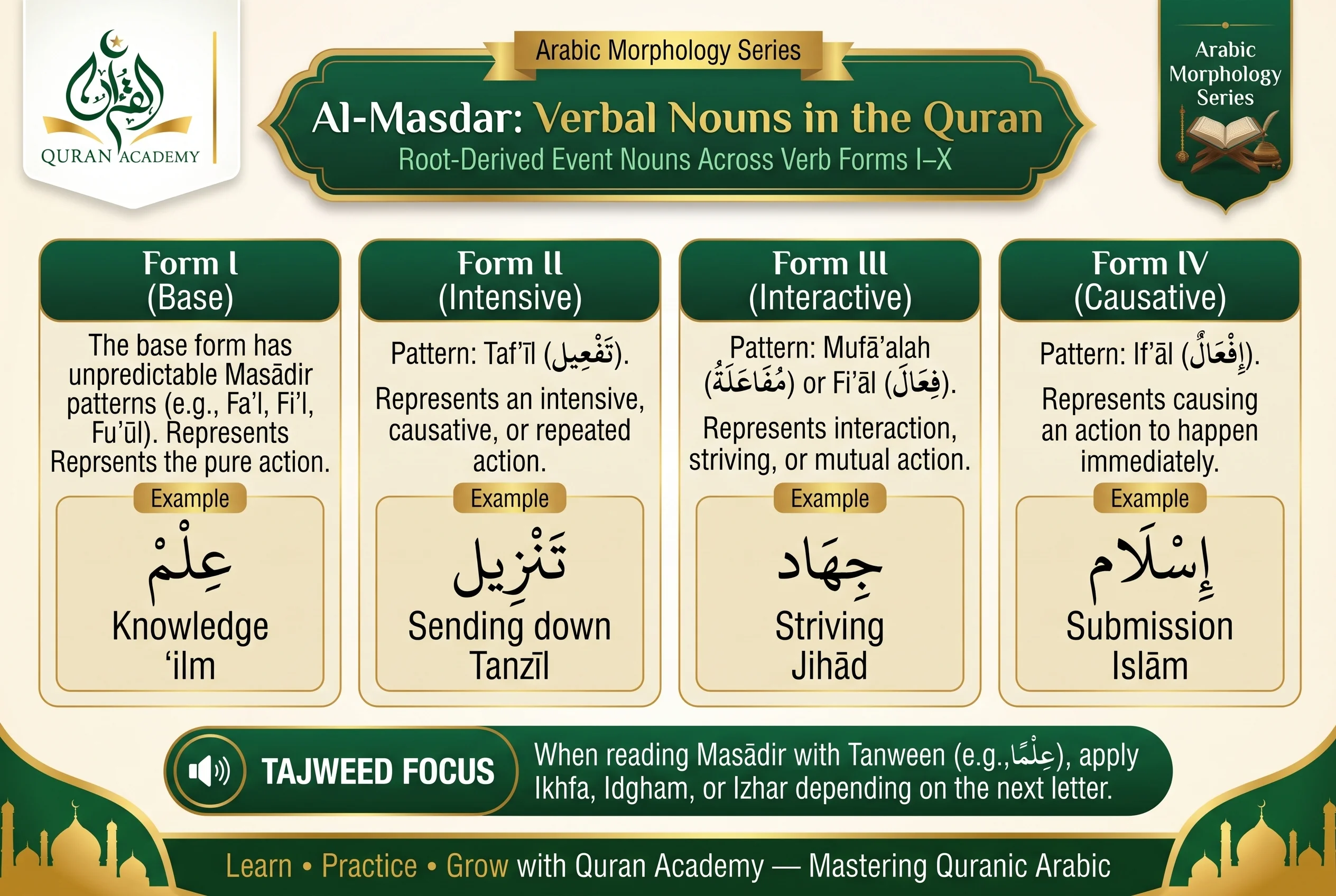
✦ Quick Answer & Key Takeaways: Masadir Verbal Nouns in the Quran
Mastering masadir verbal nouns in quran (الْمَصَادِرُ فِي الصَّرْفِ وَالنَّحْوِ الْقُرْآنِيِّ) unlocks the pure concept of an action or state—free from past, present, or future time limits! While a verb tells you when and by whom an action happens, a Masdar (المصدر — Verbal Noun) names the event or quality itself (such as Sabr = patience, Shukr = gratitude, Tasbeeh = glorification, or Islaah = reform), and when paired with a verb as Al-Maf'ul Al-Mutlaq (المفعول المطلق) it adds vivid emphasis or describes the exact manner of the deed! Building upon our guides to The 10 Verb Forms and Ism Al-Fa'il & Ism Al-Maf'ul, this guide opens Day 2 of Matrix 6. In our 1-on-1 Online Quranic Arabic & Tafseer Program, learners connect Masadir directly to Quran Tafseer!
- Action as a Noun: A Masdar names the essence of the deed itself (e.g., "Sabran Jameelan" = a gracious patience).
- Forms I vs. II–X: Form I Masadir appear across multiple traditional patterns, while Forms II–X follow systematic patterns.
- Maf'ul Mutlaq Power: Placing a Masdar in Nasb after a matching verb emphasizes certainty or describes manner.
- Tajweed Connection: Honor 2-count Madd, crisp Qalqalah, and accurate Waqf on verse endings!
When Surah Luqman (31:12) states ﴿ أَنِ ٱشْكُرْ لِلَّهِ ﴾, gratitude is a command; when Surah Al-Fatihah (1:2) opens with ﴿ ٱلْحَمْدُ لِلَّهِ ﴾, Al-Hamd is a verbal noun naming pure praise itself—establishing praise as an enduring reality belonging to Allah!
For students of Quranic Arabic, recognizing Masadir helps you read abstract spiritual nouns—like Dhikr (remembrance), Tawakkul (trust), Tazkiyah (purification), and Istighfar (seeking forgiveness)—with real precision. Continuing Matrix 6 alongside our guides to The 10 Verb Forms, Ism Al-Fa'il & Ism Al-Maf'ul, and Emphasis Tools in the Quran, this guide gives you a Masdar Patterns Chart, Tafseer takeaways, and 5 Essential Tajweed Rules.
1. Master Chart: Masdar Patterns Across Form I & Derived Forms
Study how verbal nouns (Masadir) relate to the verb forms covered in our 10 Verb Forms Guide:
| Verb Form Group | Common Masdar Pattern(s) | Quranic Example & Meaning |
|---|---|---|
| Form I (Base 3-Letter) ⭐ | Multiple traditional patterns (e.g., فَعْلٌ, فِعَالٌ, فُعُولٌ). | صَبْرٌ (Sabr = patience), ذِكْرٌ (Dhikr = remembrance), شُكْرٌ (Shukr = gratitude). |
| Form II (Doubled Middle) 🏆 | تَفْعِيلٌ (Taf'eelun) (or Taf'ilah). | تَسْبِيحٌ (Tasbeeh = glorification), تَكْلِيمًا (Takleemaa = speaking directly, 4:164). |
| Form III (Long Alif) | مُفَاعَلَةٌ (Mufaa'alah) or فِعَالٌ. | مُحَاسَبَةٌ / جِدَالٌ (disputation/debate). |
| Form IV (Prefixed Hamzah) ⭐ | إِفْعَالٌ (If'aalun). | إِصْلَاحٌ (Islaah = reform/making right), إِكْرَامٌ (Ikraam = honor, 55:78). |
| Forms V & VI (Ta- Prefixed) | تَفَعُّلٌ (Tafa''ulun) & تَفَاعُلٌ (Tafaa'ulun). | تَذَكُّرٌ (mindful remembrance), تَعَاوُنٌ (mutual cooperation). |
| Forms VII, VIII & X (Wasl) 🏆 | ٱنْفِعَالٌ, ٱفْتِعَالٌ, & ٱسْتِفْعَالٌ. | ٱسْتِغْفَارٌ (Istighfaar = seeking forgiveness), ٱجْتِهَادٌ (earnest striving). |
2. How "Al-Maf'ul Al-Mutlaq" Uses Masadir for Emphasis & Quality
In Quranic grammar, when a Masdar appears in Nasb after a verb of the same root—called Al-Maf'ul Al-Mutlaq (المفعول المطلق)—it highlights how truly or how distinctly the action takes place, such as speaking with clarity and honor or enduring with gracious patience!
Crisp Qalqalah Around Quranic Masadir: "Qutb Jadd" (ق ط ب ج د)!
When reciting Masadir and surrounding verses, keep silent Qalqalah (Echoing) bounces (ق ط ب ج د) crisp and bounce-free on non-Qalqalah letters! Watch Senior Instructor Ustadhah Yasmeen Gamal demonstrate Qalqalah on our Quran Academy YouTube Channel:
- Morphology + Tajweed Clarity: Read every Quranic word accurately!
- 1-on-1 Live Coaching: Study with certified Al-Azhar scholars!
3. Five Essential Tajweed Rules When Reciting Masadir in the Quran
When reciting Quranic Masadir, apply these five Tajweed rules from our 1-on-1 Online Tajweed Course:
Struggling to Perfect Your Recitation?
Join 1,250+ students mastering the Quran 1-on-1 with our Verified Al-Azhar Graduates. Flexible US, UK, Canadian & Australian schedules starting at $8/hr.
Book a Free Evaluation Class →- 1. Two-Count Madd on Alif / Yaa / Waw Inside Masadir ("Islaah", "Tasbeeh", "Dhukoor"):
Applying our Rules of Madd Guide and Matn Tuhfat Al-Atfal, stretch natural Madd letters inside Masadir for a full 2 counts (or lengthen on stopping)! - 2. Two-Count Madd Al-'Iwad When Stopping on Fathatayn Masadir:
Using our Rules of Waqf Guide, when stopping on a Masdar ending with Fathatayn on an Alif (such as Takleemaa), apply a smooth 2-count Alif Madd 'Iwad! - 3. Clear Noon & Tanween Rules:
According to our Noon Sakinah & Tanween Guide, apply Izhar, Idgham, Iqlab, and Ikhfaa' cleanly! - 4. Clear Meem Sakinah Rules:
Using our Meem Sakinah Rules Guide, apply Ikhfaa' Shafawi before Baa, Idgham Mithlayn before Meem, and Izhar Shafawi before other letters! - 5. Heavy vs. Light Raa Based on Vowels & Surrounding Letters:
Following our Ahkam Al-Raa, Makharij al-Huruf, Sifaat al-Huruf, Heavy & Light Letters, Laam Shamsiyyah & Qamariyyah, Hamzatul Wasl vs. Qat', 4 Special Words of Hafs, 7 Alifs in the Quran, Idgham Pairs, 10 Qira'at, Hafs vs. Warsh, Iltiqa' As-Sakinayn, Matn Al-Jazariyyah, 25 Common Tajweed Mistakes in Salah, An-Nabr (Vocal Stress), and 15 Sajdah Tilawah Verses guides, apply the exact vowel-based Raa rule! Test your Tajweed skills right now on our Free 3-Minute Tajweed Quiz!
Explore more Quranic Arabic and Surah Tafseer guides across our library: 10 Verb Forms, Ism Al-Fa'il & Ism Al-Maf'ul, Emphasis Tools, Negation Particles, Causal & Purpose Connectors, and Verse Endings & Hifz (using our Interactive Tajweed Encyclopedia and Online Hadith Explorer)! Meet our Al-Azhar Certified Tutors, enroll your child in our 1-on-1 Kids Quran Classes with our Printable Kids Star Chart, and read how families across the US, UK, Canada, and Australia rate our teachers on our Verified Student & Parent Reviews Page.
4. Frequently Asked Questions (FAQs) About Masadir Verbal Nouns in the Quran
1. What is a "Masdar" (Verbal Noun) in Quranic Arabic?
In Arabic grammar and morphology, a "Masdar" (الْمَصْدَرُ — literally "source" or "origin") is a noun that names the action, state, or event itself—abstracted from a specific tense or doer—such as Sabr (patience), Shukr (gratitude), or Tasbeeh (glorification).
2. Why is it called "Masdar" (Source) in Arabic morphology?
Grammarians of the Basran school call it "Masdar" because it expresses the pure, essential concept of the root from which tense-bound verbs derive their action meaning.
3. What is "Al-Maf'ul Al-Mutlaq" (الْمَفْعُولُ الْمُطْلَقُ) and how does it use a Masdar in the Quran?
"Al-Maf'ul Al-Mutlaq" (the Absolute Object) places a Masdar—usually in Nasb (Fathatayn)—alongside a verb from the same root to emphasize the action or describe its manner (such as "Wa kallamallaahu Moosaa takleemaa" in An-Nisa 4:164)!
4. Do Form I Masadir follow just one fixed pattern?
Unlike derived verb forms (Forms II–X), which follow systematic patterns, Form I Masadir appear across multiple traditional patterns, so learning high-frequency Quranic examples alongside a teacher is key.
5. What is the #1 Tajweed rule to watch for when stopping on a Masdar in "Maf'ul Mutlaq" with Fathatayn?
When stopping on a Masdar ending with Fathatayn on an Alif (such as "Takleemaa"), apply a smooth 2-count "Madd Al-'Iwad"!
Deepen Your Quranic Vocabulary & Tafseer With a Scholar!
Master Quranic Arabic morphology, grammar, Tafseer, Hifz, and Tajweed in live 1-on-1 online lessons with certified male and female Al-Azhar scholars. Book your free trial session today!
Book Your Free 1-on-1 Trial Class →