
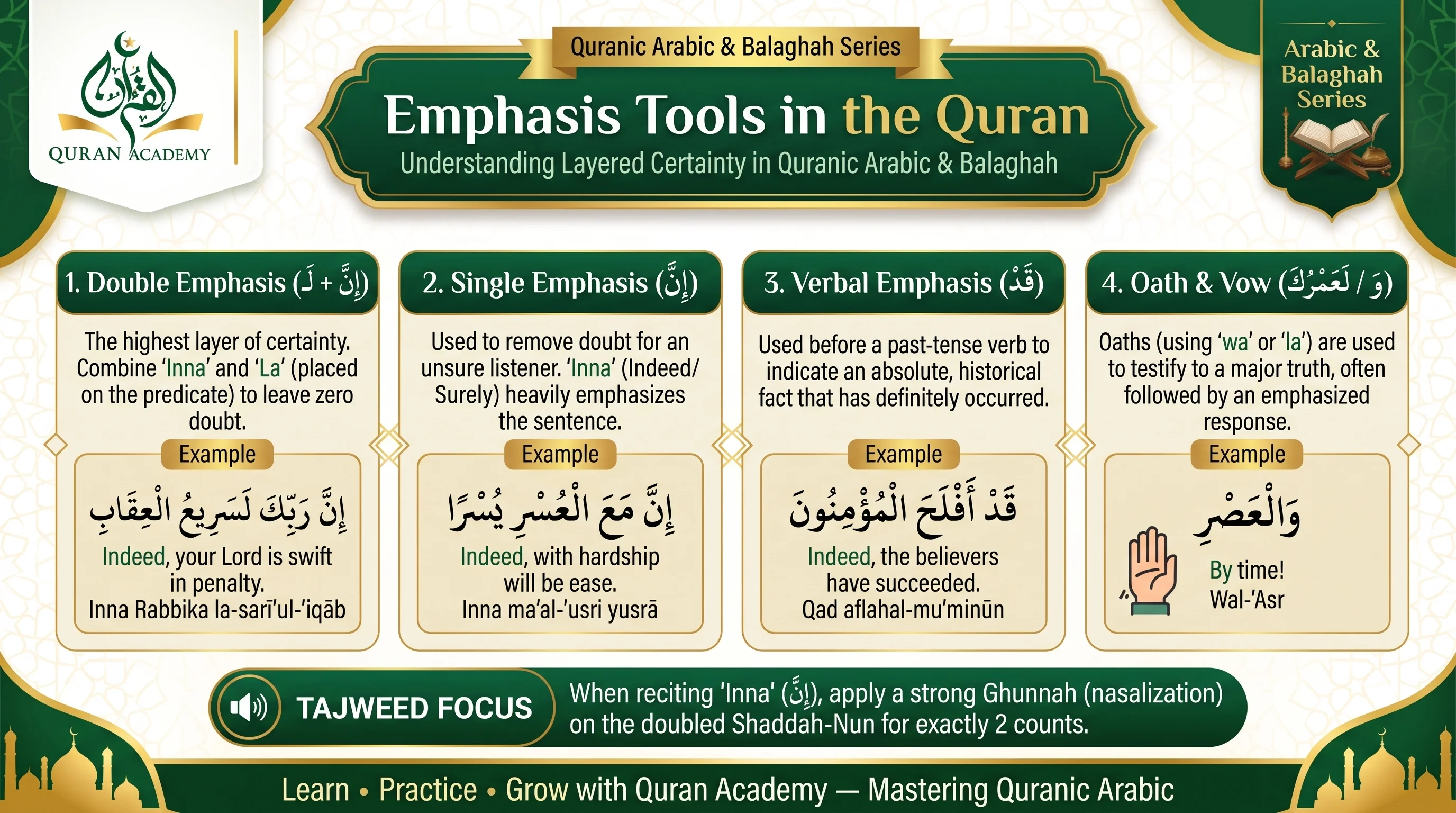
✦ Quick Answer & Key Takeaways: Emphasis Tools in the Quran
Mastering emphasis tools in the Quran (أَدَوَاتُ التَّوْكِيدِ فِي الْقُرْآنِ الْكَرِيمِ: إِنَّ، لَامُ التَّوْكِيدِ، قَدْ، وَنُونُ التَّوْكِيدِ) shows how the Quran builds unmistakable certainty and emotional weight right into its grammar! In Quranic rhetoric (Balaghah), speakers who are neutral, doubtful, or denying require graded levels of emphasis—so the Quran pairs tools like إِنَّ (Inna), the emphatic prefix لَـ (Lam Al-Tawkid / Al-Qasam), قَدْ (Qad), and verb-ending نُونُ التَّوْكِيدِ (Nun Al-Tawkid) (as in لَقَدْ خَلَقْنَا ٱلْإِنسَانَ in Surah At-Tin 95:4 and قَدْ أَفْلَحَ مَن تَزَكَّىٰ in Surah Al-A'la 87:14)! Building upon our guides to Negation Particles, Inna & Kana Sisters, and Nominal vs. Verbal Sentences, this guide continues Matrix 6. In our 1-on-1 Online Quranic Arabic & Tafseer Program, learners spot emphasis patterns right in the Mushaf!
- Graded Certainty: Multiple emphasis tools stack together (such as La-qad or Inna... la-) when a truth is vital or contested.
- Qad Before Past vs. Present: Before a past verb, Qad typically reinforces certainty; before a present verb, context determines nuance.
- Nun Al-Tawkid (Heavy vs. Light): Attached to verbs for strong emphasis—appearing as doubled -nna or single light -n in Uthmani script.
- Tajweed Connection: Hold 2-beat Ghunnah on doubled Noons and crisp Qalqalah on silent letters like Qadْ!
When Surah At-Tin (95:4) declares the dignity of human creation, it does not say simply "We created man in the best stature"—it says ﴿ لَقَدْ خَلَقْنَا ٱلْإِنسَانَ فِي أَحْسَنِ تَقْوِيمٍ ﴾, layering an oath-linked لَـ together with قَدْ to make that truth rock-solid! Similarly, Surah Al-A'la (87:14) opens with ﴿ قَدْ أَفْلَحَ مَن تَزَكَّىٰ ﴾ to underscore that true success belongs to the purified soul.
For learners of Quranic Arabic, recognizing these emphasis markers explains why a verse feels extra firm, solemn, or urgent. Continuing Matrix 6 alongside our guides to Negation Particles, Inna & Kana Sisters, and Balaghah Rhetoric, this guide gives you a Master Chart of Emphasis Tools, practical Balaghah insights, and 5 Essential Tajweed Rules.
1. Master Chart: Core Emphasis Tools in the Quran
Compare the 5 main emphasis tools in Quranic Arabic below:
| Emphasis Tool | Where It Attaches & Function | Quranic Verse Example |
|---|---|---|
| 1. إِنَّ (Inna) ⭐ | Opens a nominal sentence to affirm truth & remove doubt (Inna & Her Sisters). | ﴿ إِنَّ ٱللَّهَ مَعَ ٱلصَّابِرِينَ ﴾ (Al-Baqarah 2:153 — "Indeed, Allah is with the patient"). |
| 2. لَـ (Lam Al-Tawkid / Qasam) ⭐ | Prefixed emphatic La- on predicates, verbs, or oath responses. | ﴿ إِنَّ ٱلْإِنسَانَ لَفِي خُسْرٍ ﴾ (103:2) & ﴿ لَتَرَوُنَّ ٱلْجَحِيمَ ﴾ (At-Takathur 102:6). |
| 3. قَدْ (Qad) 🏆 | Placed before verbs—typically reinforcing certainty before a past verb. | ﴿ قَدْ أَفْلَحَ ٱلْمُؤْمِنُونَ ﴾ (Al-Mu'minun 23:1) & ﴿ لَقَدْ كَانَ لَكُمْ... ﴾ (33:21). |
| 4. نُونُ التَّوْكِيدِ (Emphatic Nun) ⭐ | Attached to the end of a verb (heavy doubled -nna or light -n) for strong stress. | ﴿ لَتَرَوُنَّهَا عَيْنَ ٱلْيَقِينِ ﴾ (102:7) & ﴿ لَنَسْفَعًاۢ بِٱلنَّاصِيَةِ ﴾ (96:15). |
| 5. القسم (Oaths in the Quran) | Swearing by Allah or His signs to elevate and confirm a core truth. | As in Surah At-Tin (95:1–4) and Surah Al-'Adiyat (100:1–6). |
2. How Layered Emphasis Matches Doubt, Denial & Solemnity in Tafseer
In Arabic rhetoric, a single layer of emphasis (such as Inna) suits hesitation or gentle reminder, whereas stacking two or three layers (such as an oath + La- + Qad or Nun Al-Tawkid) leaves zero room for doubt when declaring a foundational truth of faith, accountability, or warning!
Crisp Qalqalah on "Qadْ" & Emphatic Verses: "Qutb Jadd" (ق ط ب ج د)!
Notice how قَدْ (Qadْ) ends with a silent Dal (دْ)—one of the five Qalqalah (Echoing) letters (ق ط ب ج د)—so keep its bounce crisp before a following letter or when stopping! Watch Senior Instructor Ustadhah Yasmeen Gamal demonstrate Qalqalah on our Quran Academy YouTube Channel:
- Grammar + Tajweed Precision: Honor both meaning and articulation!
- 1-on-1 Live Coaching: Study with certified Al-Azhar scholars!
3. Five Essential Tajweed Rules in Emphatic Quranic Verses
When reciting verses with emphasis tools, apply these five Tajweed rules from our 1-on-1 Online Tajweed Course:
Struggling to Perfect Your Recitation?
Join 1,250+ students mastering the Quran 1-on-1 with our Verified Al-Azhar Graduates. Flexible US, UK, Canadian & Australian schedules starting at $8/hr.
Book a Free Evaluation Class →- 1. Two-Beat Ghunnah on "Inna" (إِنَّ) & Doubled "Nun Al-Tawkid" (ـنَّ):
Applying our Noon Sakinah & Mushaddadah Guide and Matn Tuhfat Al-Atfal, hold a full 2-beat nasal Ghunnah on every doubled Noon! - 2. Crisp Qalqalah Sughra on "Qadْ" (قَدْ) Before a Following Letter:
Using our Qalqalah Letters Guide, bounce the silent Dal of قَدْ cleanly (note that in "Qad sami'a" or "Qad ja'a", keep the Dal clear without merging it in Hafs!). - 3. Two-Count Madd Al-'Iwad When Stopping on Light "Nun Al-Tawkid" (e.g., "La-nasfa'aa" in 96:15):
According to our Rules of Waqf Guide and Rules of Madd Guide, stopping on light emphatic Noon marked with Alif/Fathatayn in Uthmani script is read with a 2-count Alif Madd 'Iwad! - 4. Clear Meem Sakinah Rules When Following Letters Carry Silent Meems:
Using our Meem Sakinah Rules Guide, apply Ikhfaa' Shafawi, Idgham Mithlayn, and Izhar Shafawi accurately! - 5. Heavy vs. Light Raa Based on Vowels & Surrounding Letters:
Following our Ahkam Al-Raa, Makharij al-Huruf, Sifaat al-Huruf, Heavy & Light Letters, Laam Shamsiyyah & Qamariyyah, Hamzatul Wasl vs. Qat', 4 Special Words of Hafs, 7 Alifs in the Quran, Idgham Pairs, 10 Qira'at, Hafs vs. Warsh, Iltiqa' As-Sakinayn, Matn Al-Jazariyyah, 25 Common Tajweed Mistakes in Salah, An-Nabr (Vocal Stress), and 15 Sajdah Tilawah Verses guides, apply the exact vowel-based Raa rule! Test your Tajweed skills right now on our Free 3-Minute Tajweed Quiz!
Explore more Quranic Arabic and Surah Tafseer guides across our library: Negation Particles in the Quran, Inna & Kana Sisters, Nominal vs. Verbal Sentences, Question & Conditional Particles, 10 Verb Forms, and Demonstrative & Relative Pronouns (using our Interactive Tajweed Encyclopedia and Online Hadith Explorer)! Meet our Al-Azhar Certified Tutors, enroll your child in our 1-on-1 Kids Quran Classes with our Printable Kids Star Chart, and read how families across the US, UK, Canada, and Australia rate our teachers on our Verified Student & Parent Reviews Page.
4. Frequently Asked Questions (FAQs) About Emphasis Tools in the Quran
1. Why does Quranic Arabic use multiple emphasis tools together—such as "La-qad" (لَقَدْ) or "Inna... la-"?
In Quranic rhetoric (Balaghah), the level of emphasis matches the audience's state of mind—whether neutral, hesitant, or strongly skeptical. Combining tools like an implied or explicit oath, "Lam Al-Tawkid" (لَـ), and "Qad" (قَدْ)—as in "Laqad khalaqnal-insana fee ahsani taqweem" (Surah At-Tin 95:4)—establishes undeniable certainty and solemn weight.
2. What does "Qad" (قَدْ) mean before a Past Verb vs. before a Present Verb in the Quran?
In Quranic Arabic: (1) Before a Past Verb (Fi'l Madi), "Qad" (قَدْ) typically adds emphasis and certainty ("indeed / certainly", as in "Qad aflaha man tazakkaa" in Surah Al-A'la 87:14); whereas (2) Before a Present Verb (Fi'l Mudari'), context determines whether it conveys affirmation or occasional occurrence.
3. What is "Nun Al-Tawkid" (نُونُ التَّوْكِيدِ) at the end of a verb in the Quran?
"Nun Al-Tawkid" is an emphatic Noon attached to a verb to stress certainty or urgency—appearing in the Uthmani Mushaf either as a doubled Noon with Shaddah (Nun Al-Tawkid Ath-Thaqilah) or as a single light Noon (Nun Al-Tawkid Al-Khafifah).
4. What is "Lam Al-Tawkid" (لَامُ التَّوْكِيدِ) in a nominal or verbal sentence?
"Lam Al-Tawkid" is an emphatic prefixed "La-" that reinforces truth and certainty—such as entering on the predicate of an "Inna" sentence ("Innal-insaana la-fee khusrin" in Surah Al-'Asr 103:2) or appearing before a verb.
5. What is the #1 Tajweed rule when stopping on "Nun Al-Tawkid Al-Khafifah" (like "La-nasfa'an" in 96:15)?
In the Uthmani Mushaf, "Nun Al-Tawkid Al-Khafifah" (such as لَنَسْفَعًا in Surah Al-'Alaq 96:15) is written with an Alif and Fathatayn-style marking—so when you STOP on it, you read it with a 2-count Alif Madd 'Iwad ("La-nasfa'aa")!
Read & Reflect on the Quran With Deeper Clarity!
Master Quranic Arabic grammar, Tafseer, Hifz, and Tajweed in personalized 1-on-1 online lessons with certified male and female Al-Azhar scholars. Book your free diagnostic trial session today!
Book Your Free 1-on-1 Trial Class →