
✦ Quick Answer & Key Takeaways: Ism Al-Fa'il & Ism Al-Maf'ul in the Quran
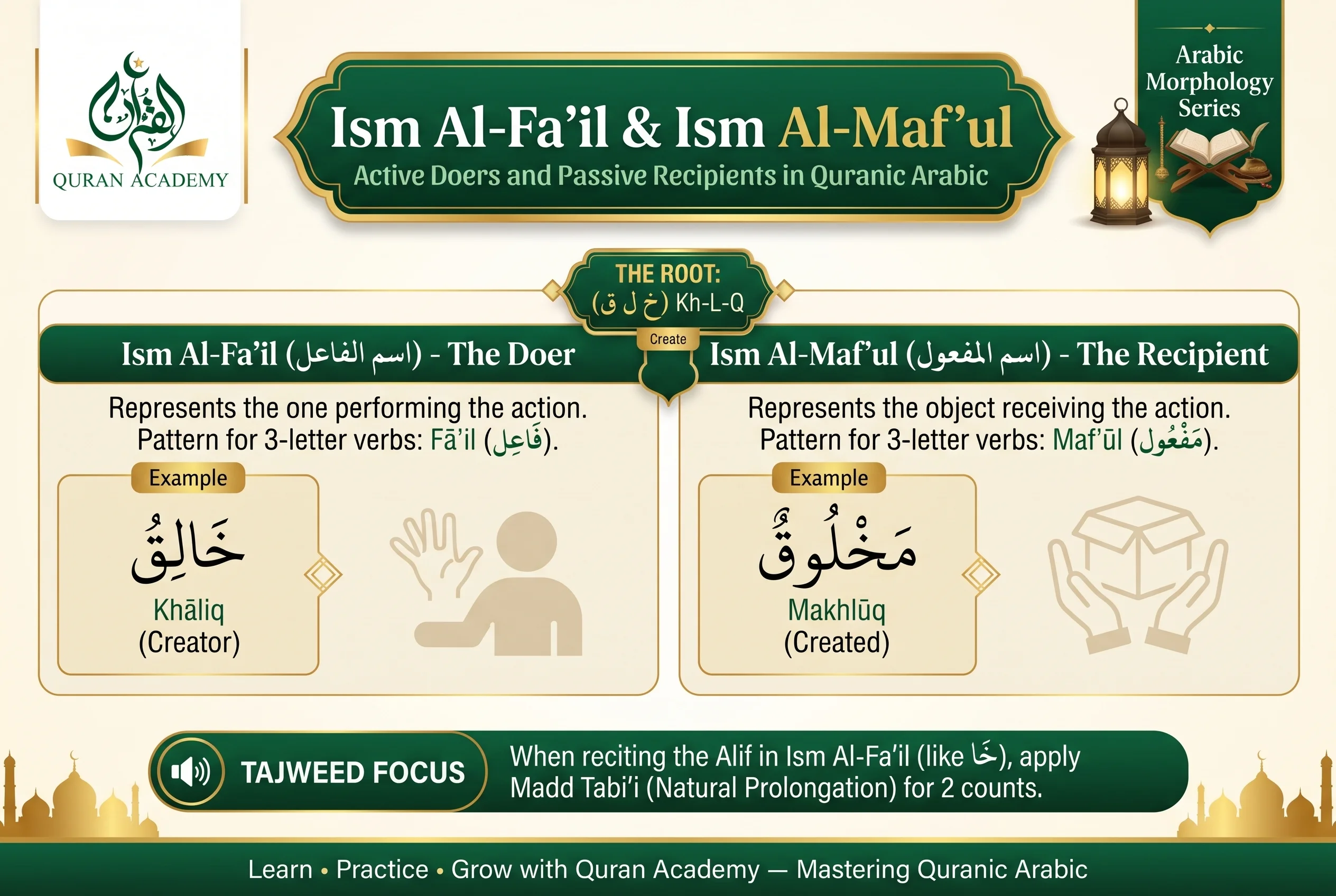
Mastering ism al fail ism al maful quran (اسْمُ الْفَاعِلِ وَاسْمُ الْمَفْعُولِ فِي الصَّرْفِ الْقُرْآنِيِّ) lets you recognize hundreds of descriptive nouns in the Holy Quran by sight! In Arabic morphology (Sarf), Ism Al-Fa'il (the Active Participle) identifies the one who performs or embodies an action—built on the pattern فَاعِلٌ (Faa'ilun) for basic 3-letter roots—while Ism Al-Maf'ul (the Passive Participle) identifies what receives or undergoes an action—built on the pattern مَفْعُولٌ (Maf'oolun) for basic 3-letter roots! In derived verb forms (Forms II–X), both begin with مُـ (Mu-) and are distinguished by the vowel before the final root letter (Kasrah for active vs. Fathah for passive)! Building upon our guides to 50 Most Common Arabic Roots and Emphasis Tools in the Quran, this guide continues Matrix 6. In our 1-on-1 Online Quranic Arabic & Tafseer Program, learners spot participles directly in Quran Tafseer!
- 3-Letter Core Patterns: فَاعِلٌ (doer/experiencer) vs. مَفْعُولٌ (acted-upon/received).
- Derived Forms (Mu- Rule): Both start with مُـ; active has a Kasrah before the last root letter, passive has a Fathah!
- Clarity in Tafseer: Distinguishes human action and responsibility from divine decree and blessing.
- Tajweed Connection: Honor 2-count Madd on Alif/Waw, crisp Qalqalah, and accurate Raa weight!
Every time you recite ﴿ إِيَّاكَ نَعْبُدُ وَإِيَّاكَ نَسْتَعِينُ ﴾ in Surah Al-Fatihah (1:5), think of how close the words are: 'Aabidun (one who worships) vs. Ma'boodun (the One worshipped)—only Allah is worthy of being Ma'bood! And in Surah Ad-Dukhan (44:3), the night is described as مُّبَارَكَةٍ (Mubaarakah = blessed/endowed with goodness) using a passive participle pattern!
For learners of Quranic Arabic, confusing active and passive participles—especially in derived verb forms—can flip who is doing what in a sentence. Continuing Matrix 6 alongside our guides to The 10 Verb Forms, Nominal vs. Verbal Sentences, and Emphasis Tools in the Quran, this guide gives you a Participle Comparison Chart, Tafseer takeaways, and 5 Essential Tajweed Rules.
1. Master Chart: Ism Al-Fa'il vs. Ism Al-Maf'ul in the Quran
Compare the core patterns of Ism Al-Fa'il and Ism Al-Maf'ul below:
| Category | Ism Al-Fa'il (Active Participle) ⭐ | Ism Al-Maf'ul (Passive Participle) 🏆 |
|---|---|---|
| 1. Basic 3-Letter Pattern | فَاعِلٌ (Faa'ilun) — Alif after 1st root letter; Kasrah before last root letter. | مَفْعُولٌ (Maf'oolun) — Prefixed مَـ + Waw Madd before last root letter. |
| 2. 3-Letter Quranic Examples | خَالِقٌ (Creator), عَالِمٌ (Knower), رَاكِعُونَ (those bowing in Salah). | مَكْتُوبٌ (written/prescribed, 2:183), مَشْهُودٍ (witnessed, 85:3). |
| 3. Derived Forms (II–X) | Starts with مُـ + Kasrah before last root letter (e.g., مُصْلِحِينَ = reformers). | Starts with مُـ + Fathah before last root letter (e.g., مُبَارَكَةٍ = blessed, 44:3). |
| 4. Core Meaning Focus | Who performs, holds, or embodies the quality. | What receives, experiences, or is granted the quality. |
2. How Spotting Active vs. Passive Participles Sharpens Tafseer
Participles in the Quran often describe lasting traits or ongoing states rather than a single past moment. Noticing whether a noun is active or passive clarifies agency—helping you see who is acting, who is accountable, or how Allah's mercy and decree rest upon His creation!
Crisp Qalqalah Around Quranic Participles: "Qutb Jadd" (ق ط ب ج د)!
Whether reciting active or passive participles, keep silent Qalqalah (Echoing) letters (ق ط ب ج د) crisp and bounce-free on non-Qalqalah consonants! Watch Senior Instructor Ustadhah Yasmeen Gamal demonstrate Qalqalah on our Quran Academy YouTube Channel:
- Morphology + Tajweed Clarity: Read every noun with accuracy!
- 1-on-1 Live Coaching: Study with certified Al-Azhar scholars!
3. Five Essential Tajweed Rules on Quranic Participles
When reciting active and passive participles in the Quran, apply these five Tajweed rules from our 1-on-1 Online Tajweed Course:
Struggling to Perfect Your Recitation?
Join 1,250+ students mastering the Quran 1-on-1 with our Verified Al-Azhar Graduates. Flexible US, UK, Canadian & Australian schedules starting at $8/hr.
Book a Free Evaluation Class →- 1. Two-Count Madd on Alif ("Faa'ilun") & Waw ("Maf'oolun"):
Applying our Rules of Madd Guide and Matn Tuhfat Al-Atfal, give the Alif of Faa'ilun and the Waw of Maf'oolun a full 2-count natural stretch (or lengthen on stopping as Madd 'Arid Lis-Sukoon)! - 2. Clear Noon & Tanween Rules on Plural & Indefinite Participles:
Using our Noon Sakinah & Tanween Guide, apply Izhar, Idgham, Iqlab, and Ikhfaa' accurately on Tanween endings! - 3. Clear Meem Sakinah Rules:
According to our Meem Sakinah Rules Guide, apply Ikhfaa' Shafawi before Baa, Idgham Mithlayn before Meem, and Izhar Shafawi before other letters! - 4. Mindful Stopping (Waqf) & Madd Al-'Iwad on Fathatayn:
Using our Rules of Waqf Guide, apply 2-count Madd Al-'Iwad when stopping on Fathatayn endings! - 5. Heavy vs. Light Raa Based on Vowels & Surrounding Letters:
Following our Ahkam Al-Raa, Makharij al-Huruf, Sifaat al-Huruf, Heavy & Light Letters, Laam Shamsiyyah & Qamariyyah, Hamzatul Wasl vs. Qat', 4 Special Words of Hafs, 7 Alifs in the Quran, Idgham Pairs, 10 Qira'at, Hafs vs. Warsh, Iltiqa' As-Sakinayn, Matn Al-Jazariyyah, 25 Common Tajweed Mistakes in Salah, An-Nabr (Vocal Stress), and 15 Sajdah Tilawah Verses guides, apply the exact vowel-based Raa rule! Test your Tajweed skills right now on our Free 3-Minute Tajweed Quiz!
Explore more Quranic Arabic and Surah Tafseer guides across our library: 10 Verb Forms, Nominal vs. Verbal Sentences, Emphasis Tools, Negation Particles, 50 Most Common Arabic Roots, and Surah Ad-Dukhan (using our Interactive Tajweed Encyclopedia and Online Hadith Explorer)! Meet our Al-Azhar Certified Tutors, enroll your child in our 1-on-1 Kids Quran Classes with our Printable Kids Star Chart, and read how families across the US, UK, Canada, and Australia rate our teachers on our Verified Student & Parent Reviews Page.
4. Frequently Asked Questions (FAQs) About Ism Al-Fa'il & Ism Al-Maf'ul in the Quran
1. What is "Ism Al-Fa'il" (Active Participle) in Quranic Arabic?
"Ism Al-Fa'il" (اسْمُ الْفَاعِلِ) is a noun derived from a verb to describe the one who performs, experiences, or embodies an action or state—built on the pattern "Faa'ilun" (فَاعِلٌ) for basic 3-letter roots!
2. What is "Ism Al-Maf'ul" (Passive Participle) in Quranic Arabic?
"Ism Al-Maf'ul" (اسْمُ الْمَفْعُولِ) is a noun derived from a verb to describe the person, thing, or place upon which an action falls or that receives a state—built on the pattern "Maf'oolun" (مَفْعُولٌ) for basic 3-letter roots!
3. How do you distinguish Active vs. Passive Participles in derived verb forms (Forms II–X, starting with "Mu-")?
In derived verb forms (Forms II through X), both participles begin with a Damma-voweled "Mu-" (مُـ)—differing by the vowel before the final root letter: Kasrah for active (Ism Al-Fa'il) vs. Fathah for passive (Ism Al-Maf'ul)!
4. Why is recognizing "Ism Al-Fa'il" and "Ism Al-Maf'ul" helpful in Tafseer?
Spotting the difference immediately tells you whether a Quranic word describes someone's active character/choice or something decreed, blessed, or received—deepening precision in translation and reflection.
5. What is the #1 Tajweed rule to watch for on "Faa'ilun" and "Maf'oolun" nouns in the Quran?
Give the Alif of Faa'ilun and the Waw of Maf'oolun a full 2-count Madd Tabee'i (or lengthen on stopping as Madd 'Arid Lis-Sukoon)!
Understand Quranic Words & Tafseer Directly With a Scholar!
Master Quranic grammar, vocabulary, Tafseer, Hifz, and Tajweed in live 1-on-1 online lessons with certified male and female Al-Azhar scholars. Book your free trial session today!
Book Your Free 1-on-1 Trial Class →