
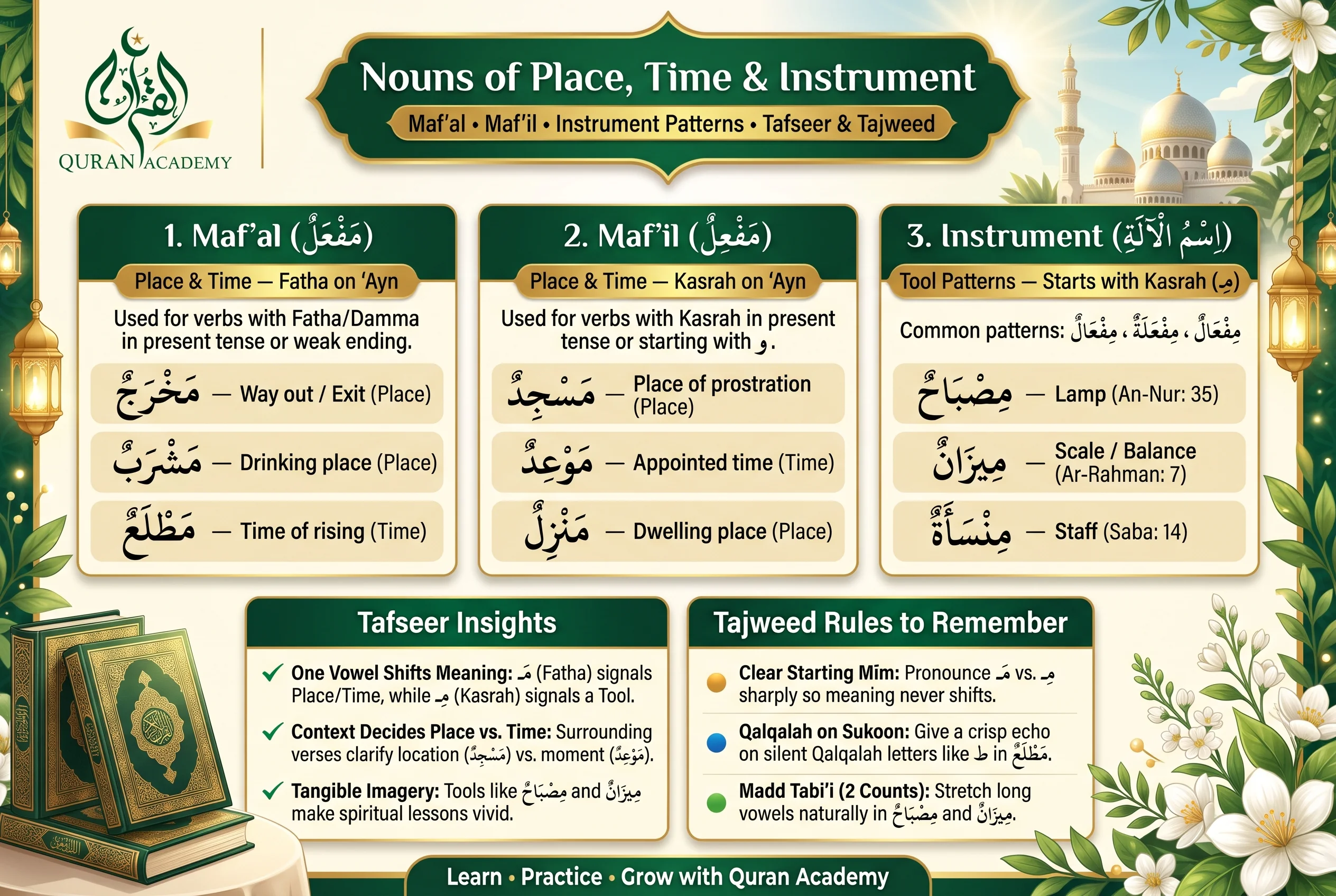
✦ Quick Answer & Key Takeaways: Nouns of Place, Time & Instrument in the Quran
Mastering nouns place time instrument quran (اسْمُ الْمَكَانِ وَاسْمُ الزَّمَانِ وَاسْمُ الْآلَةِ فِي الصَّرْفِ الْقُرْآنِيِّ) lets you spot locations, appointed times, and tools built directly out of 3-letter Arabic roots! In Arabic morphology (Sarf), Ism Al-Makan (اسم المكان) names the place of an action, Ism Al-Zaman (اسم الزمان) names the time of an action—both sharing classic patterns like مَفْعَلٌ (Maf'alun) and مَفْعِلٌ (Maf'ilun)—while Ism Al-Alah (اسم الآلة) names the instrument or tool used to carry out an action! Building upon our guides to The 10 Verb Forms, Ism Al-Fa'il & Ism Al-Maf'ul, and Masadir Verbal Nouns, this guide continues Day 2 of Matrix 6. In our 1-on-1 Online Quranic Arabic & Tafseer Program, learners connect these nouns directly to Quran Tafseer!
- Place & Time Share Templates: مَفْعَلٌ and مَفْعِلٌ serve both place and time; context tells you which one a verse intends.
- Instrument Nouns (Ism Al-Alah): Name the means or tool of an action (like scales/balances for justice in Surah Al-Hadid 57:25).
- Tafseer Clarity: Distinguishes a sacred place or moment (such as dawn in Surah Al-Qadr 97:5) from an action itself.
- Tajweed Link: Apply crisp Qalqalah, 2-count Madd, and accurate Raa weight!
In Surah Al-Qadr (97:5), Allah closes the Surah with ﴿ سَلَامٌ هِيَ حَتَّىٰ مَطْلَعِ ٱلْفَجْرِ ﴾—where مَطْلَعِ (Matla') comes from the root t-l-' (rising/appearing) and points to the rising time/break of dawn! And words like مَسْجِد (Masjid) come from the root s-j-d (prostrating) to name the place of prostration.
For beginners in Quranic Arabic, seeing how place, time, and instrument nouns branch off familiar roots makes reading the Mushaf far more intuitive. Continuing Day 2 of Matrix 6 alongside our guides to The 10 Verb Forms, Ism Al-Fa'il & Ism Al-Maf'ul, and Masadir Verbal Nouns, this guide gives you a Pattern Comparison Chart, Tafseer takeaways, and 5 Essential Tajweed Rules.
1. Master Chart: Nouns of Place, Time & Instrument Patterns
Compare the core patterns for Place (Makan), Time (Zaman), and Instrument (Alah) below:
| Noun Type | Common Morphological Patterns | Quranic & Root Examples |
|---|---|---|
| 1. Ism Al-Makan (Place) ⭐ | مَفْعَلٌ or مَفْعِلٌ (or Maf'alah). | مَسْجِدٌ (place of prostration), مَجْلِسٌ (gathering/sitting place), مَأْوًى (abode/refuge). |
| 2. Ism Al-Zaman (Time) 🏆 | Same مَفْعَلٌ or مَفْعِلٌ pattern as Place. | مَطْلَعِ ٱلْفَجْرِ (dawn rise, 97:5), مَوْعِدٍ (appointed time/meeting). |
| 3. Ism Al-Alah (Instrument) ⭐ | Traditional/classical patterns such as مِفْعَالٌ, مِفْعَلٌ, مِفْعَلَةٌ (and derived forms like مِيزَانٌ). | مِيزَانٌ (balance/scale for justice, 57:25), مِفْتَاحٌ (key, from f-t-h). |
2. How Context Clarifies Place vs. Time in Tafseer
Because Ism Al-Makan and Ism Al-Zaman share the same pattern shape, look at surrounding time words (like Fajr or Yawm) versus location words (like Ard or prepositions of place) to read the exact nuance effortlessly!
Crisp Qalqalah in Place & Time Verses: "Al-Fajْr", "Qutb Jadd" (ق ط ب ج د)!
In verses like حَتَّىٰ مَطْلَعِ ٱلْفَجْرِ (97:5), keep silent Qalqalah (Echoing) bounces (ق ط ب ج د) crisp on the silent Jeem (جْ) of Al-Fajr! Watch Senior Instructor Ustadhah Yasmeen Gamal demonstrate Qalqalah on our Quran Academy YouTube Channel:
- Morphology + Tajweed Precision: Read every verse cleanly!
- 1-on-1 Live Coaching: Study with certified Al-Azhar scholars!
3. Five Essential Tajweed Rules on Place, Time & Instrument Nouns
When reciting verses containing place, time, and instrument nouns, apply these five Tajweed rules from our 1-on-1 Online Tajweed Course:
Struggling to Perfect Your Recitation?
Join 1,250+ students mastering the Quran 1-on-1 with our Verified Al-Azhar Graduates. Flexible US, UK, Canadian & Australian schedules starting at $8/hr.
Book a Free Evaluation Class →- 1. Crisp Qalqalah on Silent "Qutb Jadd" Letters ("Al-Fajْr"):
Applying our Qalqalah Letters Guide, bounce silent Qutb Jadd letters cleanly without vowel coloring! - 2. Proper Madd Counts on Alif / Yaa / Waw ("Meezaan", "Miftaah"):
Using our Rules of Madd Guide and Matn Tuhfat Al-Atfal, give natural Madd letters their full 2-count stretch (or lengthen on stopping)! - 3. Clear Noon & Tanween Rules:
According to our Noon Sakinah & Tanween Guide, apply Izhar, Idgham, Iqlab, and Ikhfaa' cleanly! - 4. Clear Meem Sakinah Rules:
Using our Meem Sakinah Rules Guide, apply Ikhfaa' Shafawi before Baa, Idgham Mithlayn before Meem, and Izhar Shafawi before other letters! - 5. Heavy vs. Light Raa When Stopping on a Final Raa ("Al-Fajr"):
Following our Ahkam Al-Raa, Makharij al-Huruf, Sifaat al-Huruf, Heavy & Light Letters, Rules of Waqf, Laam Shamsiyyah & Qamariyyah, Hamzatul Wasl vs. Qat', 4 Special Words of Hafs, 7 Alifs in the Quran, Idgham Pairs, 10 Qira'at, Hafs vs. Warsh, Iltiqa' As-Sakinayn, Matn Al-Jazariyyah, 25 Common Tajweed Mistakes in Salah, An-Nabr (Vocal Stress), and 15 Sajdah Tilawah Verses guides, when stopping on ٱلْفَجْرِ in Hafs, the Raa has a Kasrah and follows a silent letter, making it Light (Tarqeeq)! Test your Tajweed skills right now on our Free 3-Minute Tajweed Quiz!
Explore more Quranic Arabic and Surah Tafseer guides across our library: Masadir Verbal Nouns, Ism Al-Fa'il & Ism Al-Maf'ul, 10 Verb Forms, Surah Al-Qadr, and Surah Al-Hadid (using our Interactive Tajweed Encyclopedia and Online Hadith Explorer)! Meet our Al-Azhar Certified Tutors, enroll your child in our 1-on-1 Kids Quran Classes with our Printable Kids Star Chart, and read how families across the US, UK, Canada, and Australia rate our teachers on our Verified Student & Parent Reviews Page.
4. Frequently Asked Questions (FAQs) About Place, Time & Instrument Nouns
1. What are "Ism Al-Makan" and "Ism Al-Zaman" in Quranic Arabic morphology?
"Ism Al-Makan" (اسْمُ الْمَكَانِ) names the PLACE where an action occurs (such as Masjid), while "Ism Al-Zaman" (اسْمُ الزَّمَانِ) uses the same morphological patterns to name the TIME when an action occurs (such as Matla'il-Fajr in Surah Al-Qadr 97:5)!
2. How do you tell whether a word on the "Maf'al / Maf'il" pattern means Place or Time in a Quranic verse?
Because Ism Al-Makan and Ism Al-Zaman share the exact same templates (مَفْعَلٌ or مَفْعِلٌ), sentence context and surrounding words clarify whether the verse highlights a location or a time!
3. When does a 3-letter root typically form "Maf'il" (مَفْعِلٌ) vs. "Maf'al" (مَفْعَلٌ)?
When a 3-letter root has a Kasrah on its middle present-verb letter or begins with Waw/certain weak patterns, it commonly takes "Maf'il" (مَفْعِلٌ)—otherwise it commonly takes "Maf'al" (مَفْعَلٌ).
4. What is "Ism Al-Alah" (اسْمُ الْآلَةِ — Noun of Instrument) in Arabic morphology?
"Ism Al-Alah" names the tool or instrument used to perform an action (such as Meezaan = scale/balance or Miftaah = key)!
5. What is the #1 Tajweed rule to watch for when reading "Matla'il-Fajr" in Surah Al-Qadr (97:5)?
In "حَتَّىٰ مَطْلَعِ ٱلْفَجْرِ" (97:5), apply a crisp Qalqalah bounce on the silent Jeem (جْ) of Al-Fajr and a Light Raa (Tarqeeq) when stopping!
Read & Understand Quranic Words With an Al-Azhar Scholar!
Master Quranic Arabic morphology, grammar, Tafseer, Hifz, and Tajweed in live 1-on-1 online lessons with certified male and female Al-Azhar scholars. Book your free trial session today!
Book Your Free 1-on-1 Trial Class →