
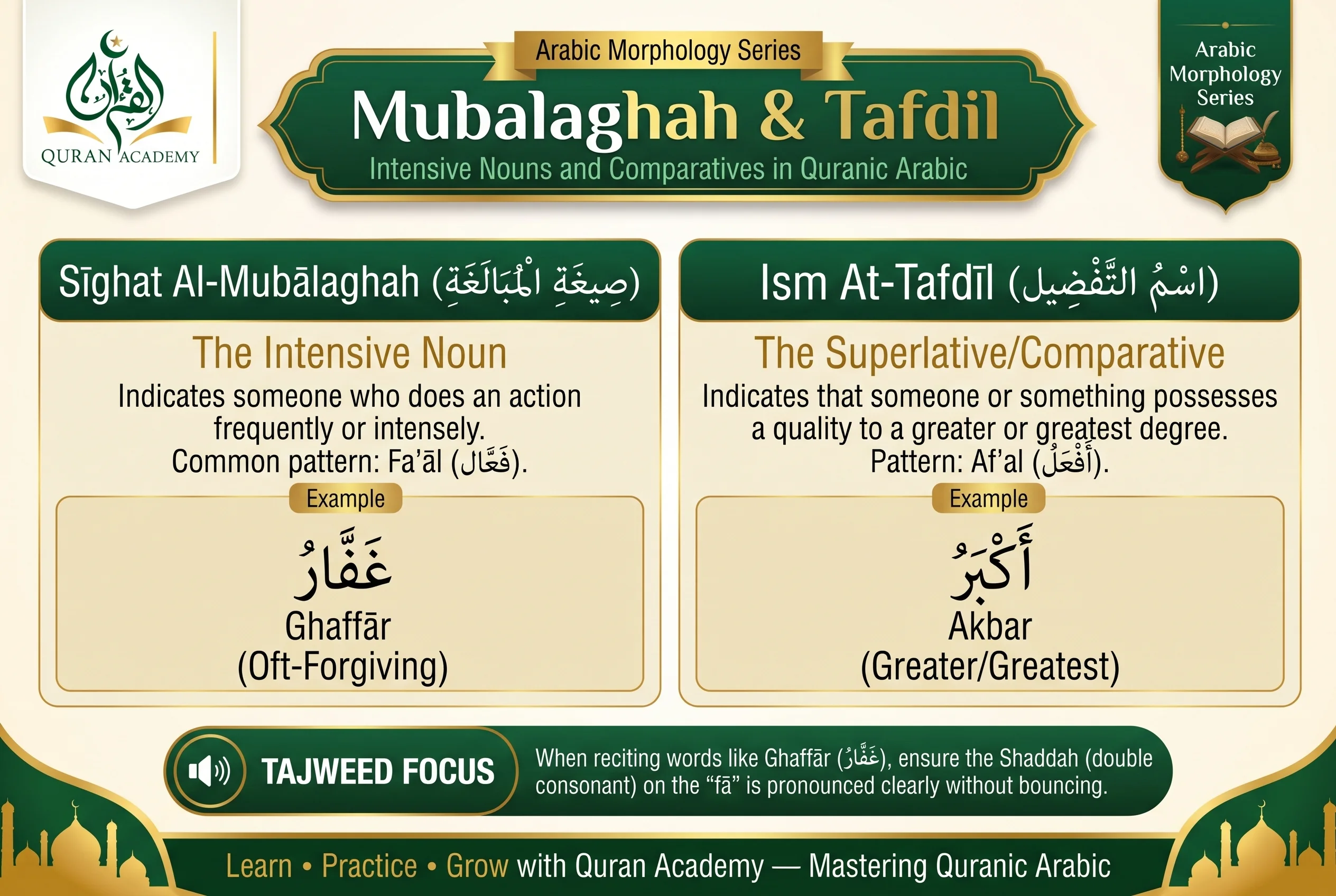
✦ Quick Answer & Key Takeaways: Sigh Al-Mubalaghah & Ism At-Tafdil in the Quran
Mastering sigh al mubalaghah ism at tafdil quran (صِيَغُ الْمُبَالَغَةِ وَاسْمُ التَّفْضِيلِ فِي الصَّرْفِ وَالتَّفْسِيرِ الْقُرْآنِيِّ) deepens how you read Allah's Beautiful Names and descriptive qualities across the Holy Quran! In Arabic morphology (Sarf), Sigh Al-Mubalaghah (صيغ المبالغة — Intensive Nouns) expand an active participle to express abundant, repeated, or deeply rooted intensity (on patterns like فَعَّالٌ, فَعُولٌ, and فَعِيلٌ), while Ism At-Tafdil (اسم التفضيل — Elative Nouns) uses the pattern أَفْعَلُ (feminine فُعْلَىٰ) to express a higher or supreme degree of a quality! Building upon our guides to Ism Al-Fa'il & Ism Al-Maf'ul and Masadir Verbal Nouns, this guide continues Day 2 of Matrix 6. In our 1-on-1 Online Quranic Arabic & Tafseer Program, learners connect these forms directly to Quran Tafseer!
- Intensive Nouns (Mubalaghah): Convey abundance, repetition, or thoroughness beyond a plain participle.
- Elative Nouns (Tafdil): Built on أَفْعَلُ (and feminine فُعْلَىٰ) to express higher or supreme degree.
- Rhetorical & Creed Nuance: Highlights Allah's boundless mercy, wisdom, and supreme majesty.
- Tajweed Connection: Honor Madd counts, An-Nabr on doubled letters, and Raa weight when stopping!
When you recite Surah At-Tin (95:8)—﴿ أَلَيْسَ ٱللَّهُ بِأَحْكَمِ ٱلْحَاكِمِينَ ﴾—or Surah Al-A'la (87:17)—﴿ وَٱلْآخِرَةُ خَيْرٌ وَأَبْقَىٰ ﴾—you encounter elative expressions that lift the heart toward what is best and most enduring! Alongside them, intensive nouns like غَفَّارٌ and غَفُورٌ paint a picture of vast, ongoing forgiveness.
For learners of Quranic Arabic, distinguishing Sigh Al-Mubalaghah from Ism At-Tafdil makes verse meanings clear and memorable. Continuing Day 2 of Matrix 6 alongside our guides to Ism Al-Fa'il & Ism Al-Maf'ul, Masadir Verbal Nouns, and Nouns of Place, Time & Instrument, this guide presents a Master Pattern Chart and 5 Essential Tajweed Rules.
1. Master Chart: Sigh Al-Mubalaghah vs. Ism At-Tafdil Patterns
Compare the core patterns of Sigh Al-Mubalaghah and Ism At-Tafdil below:
| Form Category | Key Patterns | Quranic Examples & Meaning |
|---|---|---|
| 1. Sigh Al-Mubalaghah (Fa'aalun) ⭐ | فَعَّالٌ (doubled middle letter + Alif). | غَفَّارٌ (Oft-Forgiving), تَوَّابٌ (Ever-Accepting of Repentance). |
| 2. Sigh Al-Mubalaghah (Fa'oolun & Fa'eelun) 🏆 | فَعُولٌ & فَعِيلٌ. | غَفُورٌ (All-Forgiving), شَكُورٌ (Most Appreciative), عَلِيمٌ / حَكِيمٌ (All-Knowing / All-Wise). |
| 3. Sigh Al-Mubalaghah (Mif'aalun & Fa'ilun) | مِفْعَالٌ & فَعِلٌ. | Expresses pronounced intensity or habitual readiness in context. |
| 4. Ism At-Tafdil (Elative) ⭐ | أَفْعَلُ (masculine) & فُعْلَىٰ (feminine). | أَحْسَنُ (best/most excellent), أَكْبَرُ (greater/greatest), ٱلْحُسْنَىٰ (the best/most beautiful). |
2. Tafseer & Balaghah Nuances of Intensive & Elative Forms
When reading intensive forms of Allah's Names alongside elative forms, reflect on how each pattern guides the believer's hope, awe, and gratitude: intensive nouns remind us of Allah's vast generosity and wisdom, while elative nouns direct our aspiration toward what is best and most lasting with Him!
Crisp Qalqalah Around Intensive & Elative Nouns: "Qutb Jadd" (ق ط ب ج د)!
When reciting verses featuring intensive and elative nouns, keep silent Qalqalah (Echoing) bounces (ق ط ب ج د) crisp and bounce-free on non-Qalqalah letters! Watch Senior Instructor Ustadhah Yasmeen Gamal demonstrate Qalqalah on our Quran Academy YouTube Channel:
- Morphology + Tajweed Clarity: Recite with reverence and precision!
- 1-on-1 Live Coaching: Study with certified Al-Azhar scholars!
3. Five Essential Tajweed Rules on Intensive & Elative Nouns
When reciting verses containing Sigh Al-Mubalaghah and Ism At-Tafdil, apply these five Tajweed rules from our 1-on-1 Online Tajweed Course:
Struggling to Perfect Your Recitation?
Join 1,250+ students mastering the Quran 1-on-1 with our Verified Al-Azhar Graduates. Flexible US, UK, Canadian & Australian schedules starting at $8/hr.
Book a Free Evaluation Class →- 1. Clear Vocal Stress (Nabr) on Doubled Letters Inside "Fa'aalun" ("Ghaffaar", "Tawwaab"):
Applying our An-Nabr (Vocal Stress) Guide, press firmly on the doubled letter with Shaddah so its intensity is clear! - 2. Proper Madd & "Madd 'Arid Lis-Sukoon" on "Fa'aalun", "Fa'oolun" & "Fa'eelun":
Using our Rules of Madd Guide and Matn Tuhfat Al-Atfal, give natural Madd letters 2 counts in continuation and lengthen consistently (2, 4, or 6 counts in Hafs) when stopping before the final letter! - 3. Clear Noon & Tanween Rules:
According to our Noon Sakinah & Tanween Guide, apply Izhar, Idgham, Iqlab, and Ikhfaa' cleanly! - 4. Clear Meem Sakinah Rules:
Using our Meem Sakinah Rules Guide, apply Ikhfaa' Shafawi before Baa, Idgham Mithlayn before Meem, and Izhar Shafawi before other letters! - 5. Heavy vs. Light Raa When Stopping on a Final Raa ("Ghaffaar", "Ghafoor", "Akbar"):
Following our Ahkam Al-Raa, Makharij al-Huruf, Sifaat al-Huruf, Heavy & Light Letters, Rules of Waqf, Laam Shamsiyyah & Qamariyyah, Hamzatul Wasl vs. Qat', 4 Special Words of Hafs, 7 Alifs in the Quran, Idgham Pairs, 10 Qira'at, Hafs vs. Warsh, Iltiqa' As-Sakinayn, Matn Al-Jazariyyah, 25 Common Tajweed Mistakes in Salah, and 15 Sajdah Tilawah Verses guides, when stopping on a final Raa preceded by Alif or Waw (such as غَفَّارْ or غَفُورْ), pronounce it 100% Heavy (Tafkhim)! Test your Tajweed skills right now on our Free 3-Minute Tajweed Quiz!
Explore more Quranic Arabic and Surah Tafseer guides across our library: Ism Al-Fa'il & Ism Al-Maf'ul, Masadir Verbal Nouns, Nouns of Place, Time & Instrument, 99 Names of Allah, and Surah At-Tin (using our Interactive Tajweed Encyclopedia and Online Hadith Explorer)! Meet our Al-Azhar Certified Tutors, enroll your child in our 1-on-1 Kids Quran Classes with our Printable Kids Star Chart, and read how families across the US, UK, Canada, and Australia rate our teachers on our Verified Student & Parent Reviews Page.
4. Frequently Asked Questions (FAQs) About Sigh Al-Mubalaghah & Ism At-Tafdil
1. What is "Sigh Al-Mubalaghah" (صِيَغُ الْمُبَالَغَةِ — Exaggeration / Intensive Nouns) in Quranic Arabic?
"Sigh Al-Mubalaghah" are derived noun patterns that intensify the meaning of an active participle—conveying abundant, repeated, or deeply established quality (such as Ghaffar, Ghafoor, or Tawwab)!
2. What are the 5 most famous patterns of "Sigh Al-Mubalaghah" in Arabic morphology?
The 5 classic patterns are: (1) "Fa'aalun" (فَعَّالٌ), (2) "Fa'oolun" (فَعُولٌ), (3) "Fa'eelun" (فَعِيلٌ), (4) "Mif'aalun" (مِفْعَالٌ), and (5) "Fa'ilun" (فَعِلٌ)!
3. What is "Ism At-Tafdil" (اسْمُ التَّفْضِيلِ — Elative Noun) in the Quran?
"Ism At-Tafdil" is a noun derived from a 3-letter root on the masculine pattern "Af'alu" (أَفْعَلُ) and feminine "Fu'laa" (فُعْلَىٰ) to express a higher or supreme degree of a quality!
4. Why is "Ism At-Tafdil" often translated as "most / best / greatest" when applied to Allah in the Quran?
Because in Quranic Tafseer and Aqeedah, no creation can ever equal or share in Allah's supreme attributes—so forms like Ahkamul-Haakimeen (95:8) express absolute supremacy and perfection!
5. What is the #1 Tajweed rule to watch for when stopping on "Sigh Al-Mubalaghah" ending with a final Raa?
When stopping on a final Raa preceded by Alif or Waw Madd in Hafs (such as Ghaffaar or Ghafoor), apply a 2, 4, or 6-count Madd 'Arid Lis-Sukoon and pronounce the stopping Raa 100% Heavy (Tafkhim)!
Read & Understand the Quran With Deeper Clarity!
Master Quranic Arabic morphology, grammar, Tafseer, Hifz, and Tajweed in live 1-on-1 online lessons with certified male and female Al-Azhar scholars. Book your free trial session today!
Book Your Free 1-on-1 Trial Class →