
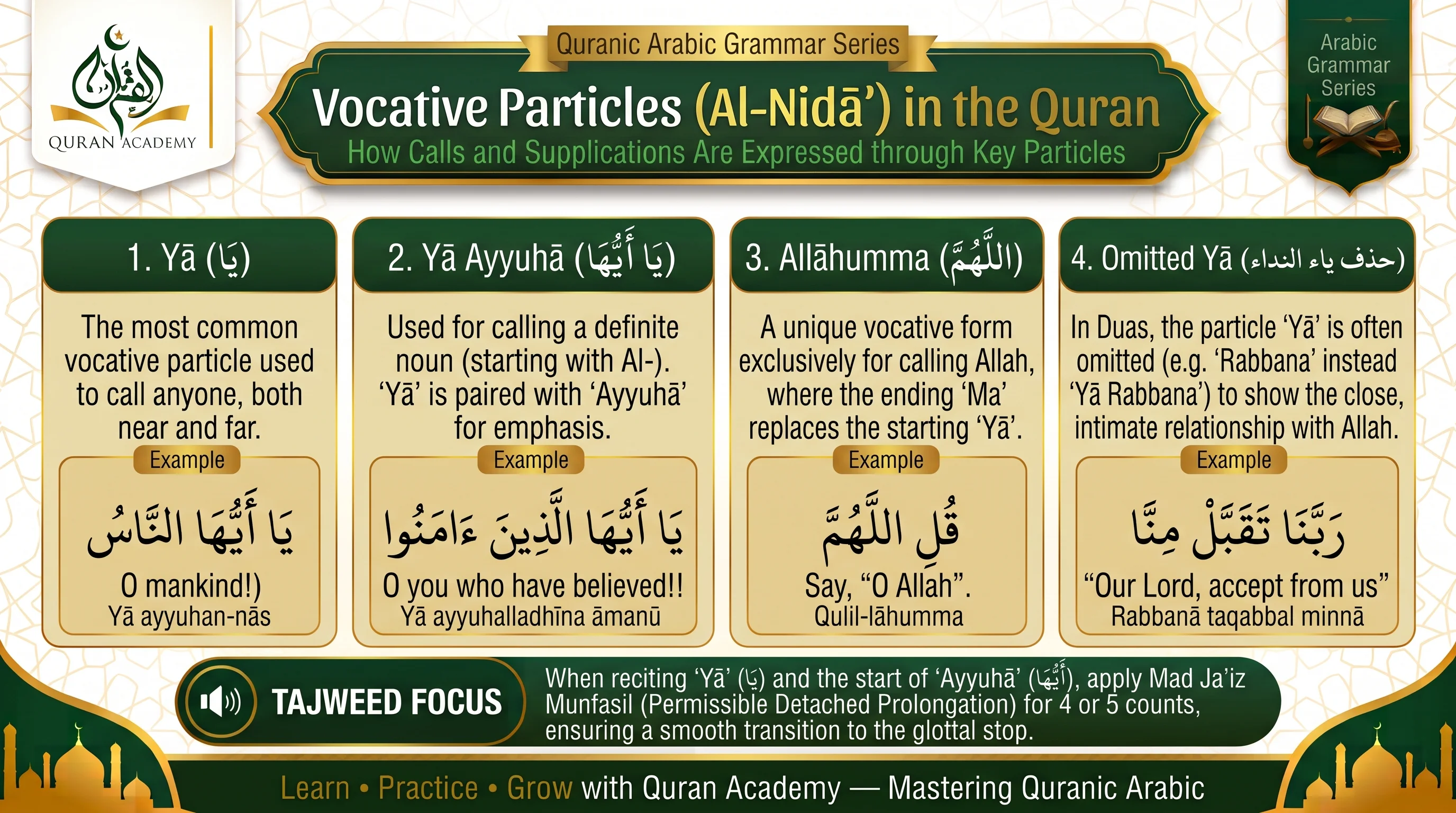
✦ Quick Answer & Key Takeaways: Vocative Particles in the Quran
Mastering vocative particles nida in quran (أُسْلُوبُ النِّدَاءِ فِي الْقُرْآنِ الْكَرِيمِ: يَا، يَا أَيُّهَا، اللَّهُمَّ) reveals the incredible intimacy and majesty of how Allah addresses us—and how He teaches us to call upon Him! In Arabic grammar (Nahw), An-Nida (النداء) is the act of calling someone using a particle like يَا (Yaa). However, the Quran elevates this with profound nuances: using يَا أَيُّهَا (Yaa Ayyuha) as a heavy, attention-grabbing bridge before definite nouns (like Yaa Ayyuhal-ladheena amanoo), inventing the exclusive formula اللَّهُمَّ (Allahumma) for Dua, and beautifully omitting the "Yaa" entirely in Duas like رَبَّنَا (Rabbanaa) to show that there is zero distance between the caller and Allah! Building upon our guides to Parables & Similes and Rhetorical Questions, this guide continues Day 5 of Matrix 6. In our 1-on-1 Online Quranic Arabic & Tafseer Program, learners unlock these majestic calling structures!
- Yaa Ayyuha vs. Yaa: "Ayyuha/Ayyatuha" is a necessary grammatical bridge when calling a noun that starts with "Al-".
- The Closeness of "Rabbanaa": Dropping "Yaa" before "Our Lord" in Duas signifies intense proximity and urgency.
- Allahumma Mystery: The doubled Meem (مَّ) at the end replaces the dropped "Yaa" at the beginning!
- Tajweed Connection: The word يَـٰٓأَيُّهَا triggers a 4–5 count Madd Ja'iz Munfasil, and Allahumma requires a 2-beat Ghunnah!
If you listen closely to the Duas of the Prophets in the Quran, you will notice a striking pattern. Prophet Ibrahim says ﴿ رَبَّنَا تَقَبَّلْ مِنَّا ﴾, Prophet Adam says ﴿ رَبَّنَا ظَلَمْنَآ أَنفُسَنَا ﴾, and the believers say ﴿ رَبَّنَآ آتِنَا فِي ٱلدُّنْيَا حَسَنَةً ﴾. Why do they almost never say "Yaa Rabbanaa" (O our Lord)? Because in Arabic rhetoric, using "Yaa" implies a distance between the caller and the one being called. By dropping it, the Quran paints a picture of a servant whispering directly into the hearing of an Ever-Present, All-Near Creator!
For learners of Tafseer, noticing these delicate shifts in vocative particles transforms how you recite and make Dua. Continuing Day 5 of Matrix 6 alongside our guides to Parables & Similes, Repetition (At-Takrar), and Word Order Inversion, this guide gives you a Nida Structure Chart and 5 Essential Tajweed Rules.
1. Master Chart: Types of Vocative (Nida) Formulas in the Quran
Compare the 4 main vocative structures used in Quranic Arabic below:
| Vocative Structure (Nida) | Grammar & Rhetorical Role | Quranic Example |
|---|---|---|
| 1. يَا أَيُّهَا / يَا أَيَّتُهَا ⭐ | Used to call nouns starting with Al-. Adds solemn weight and grabs attention. | ﴿ يَـٰٓأَيُّهَا ٱلَّذِينَ آمَنُواْ ﴾ (O you who believe) & ﴿ يَـٰٓأَيَّتُهَا ٱلنَّفْسُ ٱلْمُطْمَئِنَّةُ ﴾ (89:27). |
| 2. يَا + Noun / Name 🏆 | Direct calling of a proper name or a noun without Al-. | ﴿ يَا مُوسَىٰ ﴾ (O Musa) & ﴿ يَا أَبَتِ ﴾ (O my father, 31:17). |
| 3. حَذْفُ "يَا" (Dropping Yaa) ⭐ | Omitting the calling particle to show extreme nearness and urgency. | ﴿ رَبَّنَآ آتِنَا ﴾ (Our Lord, grant us...) & ﴿ يُوسُفُ أَعْرِضْ عَنْ هَٰذَا ﴾ (12:29). |
| 4. اللَّهُمَّ (Allahumma) 🏆 | Exclusive formula for Allah; the doubled Meem (مَّ) replaces the omitted Yaa. | ﴿ قُلِ ٱللَّهُمَّ مَالِكَ ٱلْمُلْكِ ﴾ (Say: O Allah, Owner of Sovereignty, 3:26). |
2. Tafseer Nuances: Why "Yaa" is Dropped in Duas of the Righteous
Whenever you see رَبَّنَا (Rabbanaa) or رَبِّ (Rabbi) without "Yaa" in the Quran, it is a lesson in Aqeedah (creed). It teaches us that Allah is closer to us than our jugular vein, requiring no intermediary, no raised voice, and not even a calling particle to reach Him!
Madd Munfasil on "Yaa Ayyuha" & Crisp Qalqalah in Dua!
When reciting يَـٰٓأَيُّهَا, honor the 4–5 count Madd! And when reciting Quranic Duas, keep silent Qalqalah (Echoing) bounces (ق ط ب ج د) crisp on words like Yad'oon! Watch Senior Instructor Ustadhah Yasmeen Gamal demonstrate on our Quran Academy YouTube Channel:
- Grammar + Tajweed Clarity: Stretch the Madd exactly where required!
- 1-on-1 Live Coaching: Study with certified Al-Azhar scholars!
3. Five Essential Tajweed Rules When Reciting "Yaa Ayyuha" & Duas
When reciting vocative particles and Duas in the Quran, apply these five Tajweed rules from our 1-on-1 Online Tajweed Course:
Struggling to Perfect Your Recitation?
Join 1,250+ students mastering the Quran 1-on-1 with our Verified Al-Azhar Graduates. Flexible US, UK, Canadian & Australian schedules starting at $8/hr.
Book a Free Evaluation Class →- 1. "Madd Ja'iz Munfasil" on Yaa Ayyuha (يَـٰٓأَيُّهَا):
Applying our Rules of Madd Guide, although written as one block in the Uthmani Mushaf, Yaa and Ayyuha are two separate words! Thus, the Madd before the Hamzah is a Permissible Separate Madd, stretched for 4 to 5 counts in Hafs! - 2. Two-Beat Ghunnah on "Allahumma" (اللَّهُمَّ):
Using our Noon Sakinah & Mushaddadah Guide and Matn Tuhfat Al-Atfal, hold a full 2-beat nasal Ghunnah on the doubled Meem with Shaddah! - 3. Natural Madd on "Rabbanaa" (رَبَّنَآ) & Duas:
Give the Alif of Rabbanaa its full 2-count stretch (or 4–5 counts if followed by Hamzah, like رَبَّنَآ آتِنَا)! - 4. Dropping the Alif of "Ayyuha" Before a Sun/Moon Letter:
Using our Iltiqa' As-Sakinayn (Meeting of Two Sukoons) Guide, when reading يَـٰٓأَيُّهَا ٱلَّذِينَ, the Alif at the end of Ayyuha drops in pronunciation to connect smoothly to the Laam! - 5. Heavy vs. Light Raa in "Rabbanaa" (رَبَّنَا) vs. "Fir'awn" (فِرْعَوْنَ):
Following our Ahkam Al-Raa, Makharij al-Huruf, Sifaat al-Huruf, Heavy & Light Letters, Rules of Waqf, Laam Shamsiyyah & Qamariyyah, Hamzatul Wasl vs. Qat', 4 Special Words of Hafs, 7 Alifs in the Quran, Idgham Pairs, 10 Qira'at, Hafs vs. Warsh, Matn Al-Jazariyyah, 25 Common Tajweed Mistakes in Salah, An-Nabr (Vocal Stress), and 15 Sajdah Tilawah Verses guides, the Raa in رَبَّنَا is always Heavy (Tafkhim) because of the Fatha! Test your Tajweed skills right now on our Free 3-Minute Tajweed Quiz!
Explore more Quranic Arabic and Surah Tafseer guides across our library: Parables & Similes, Repetition (At-Takrar), Word Order Inversion, Grammatical Shift (Al-Iltifat), and Balaghah Rhetoric (using our Interactive Tajweed Encyclopedia and Online Hadith Explorer)! Meet our Al-Azhar Certified Tutors, enroll your child in our 1-on-1 Kids Quran Classes with our Printable Kids Star Chart, and read how families across the US, UK, Canada, and Australia rate our teachers on our Verified Student & Parent Reviews Page.
4. Frequently Asked Questions (FAQs) About Vocative Particles in the Quran
1. What is "An-Nida" (النِّدَاءُ — Vocation / Calling) in Quranic Arabic?
In Arabic grammar, "An-Nida" is the method of calling or drawing the attention of an addressee using specific vocative particles (Huruf An-Nida), the most common of which is "Yaa" (يَا — O).
2. Why does the Quran use "Yaa Ayyuha" (يَا أَيُّهَا) instead of just "Yaa" when addressing believers?
You generally cannot place "Yaa" directly before a noun starting with the definite article "Al-". "Ayyu" (أَيُّ) acts as a grammatical bridge that also adds solemn emphasis and weight to the call.
3. Why is the word "Yaa" usually dropped when making Dua with "Rabbanaa" (رَبَّنَا) in the Quran?
Dropping the vocative particle indicates immense spiritual closeness and intimacy. It shows that there is absolutely no distance or barrier between the supplicant and Allah!
4. What does "Allahumma" (اللَّهُمَّ) mean, and how does it relate to "Yaa"?
"Allahumma" means "O Allah." Grammatically, the doubled Meem (مَّ) at the end replaces the omitted vocative particle "Yaa" at the beginning, forming a profound, exclusive formula for Dua.
5. What is a major Tajweed rule when reciting "Yaa Ayyuha" (يَـٰٓأَيُّهَا) in the Uthmani Mushaf?
Although written connected, they are structurally two separate words. Therefore, the Madd Alif followed by the Hamzah forms a "Madd Ja'iz Munfasil" (Permissible Separate Prolongation), stretched for 4 to 5 counts!
Read & Reflect on the Quran With Deeper Clarity!
Master Quranic Arabic grammar, Tafseer, Hifz, and Tajweed in live 1-on-1 online lessons with certified male and female Al-Azhar scholars. Book your free trial session today!
Book Your Free 1-on-1 Trial Class →