
✦ Quick Answer & Key Takeaways: Rhetorical Questions in Quran Tafseer
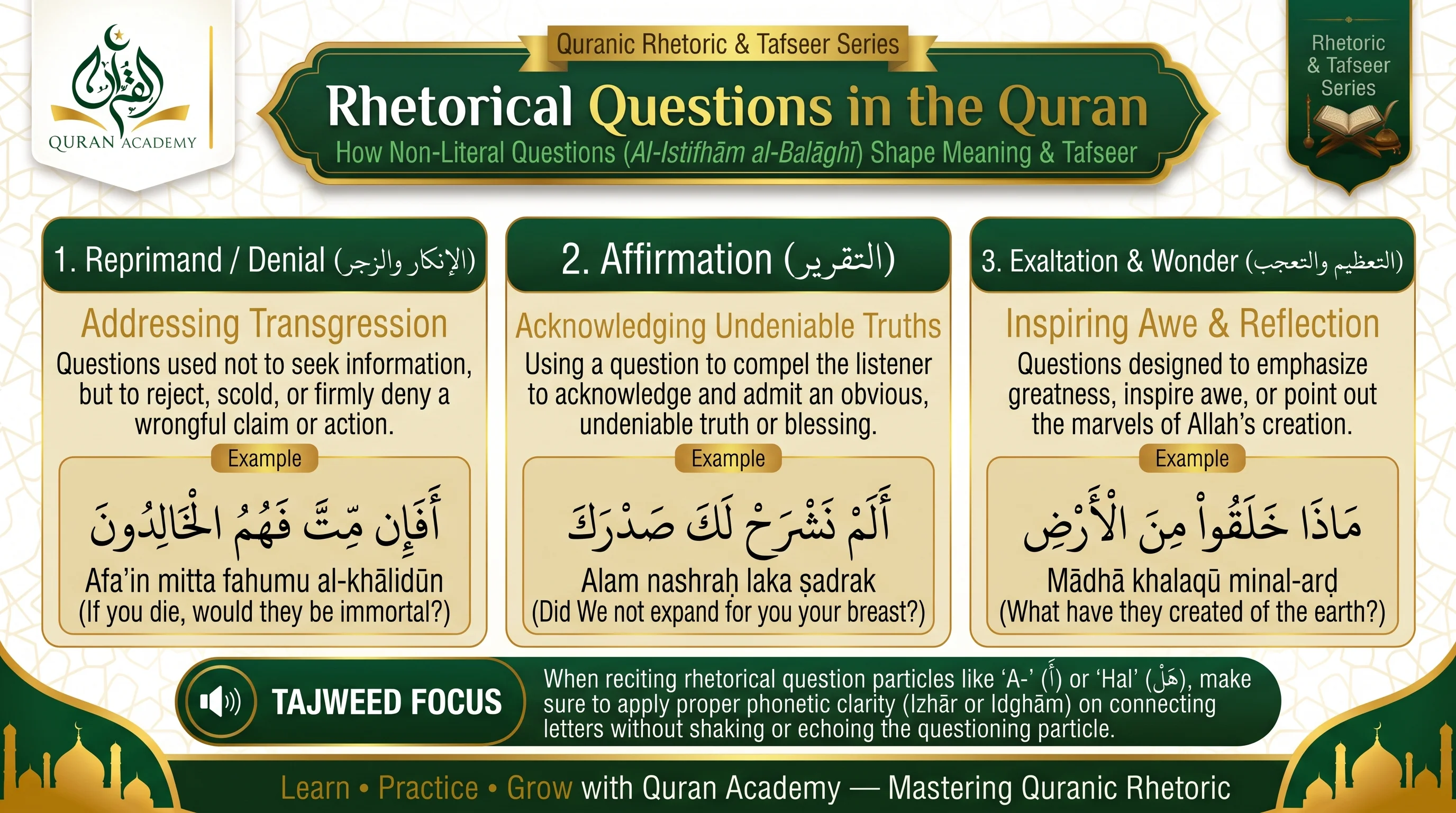
Exploring rhetorical questions in quran tafseer (الِاسْتِفْهَامُ الْبَلَاغِيُّ فِي التَّفْسِيرِ الْقُرْآنِيِّ) shows why questions in the Quran invite reflection, affirm blessings, or awaken the heart rather than seeking missing facts! In Arabic rhetoric (Balaghah), a rhetorical question uses a question word—such as هَلْ, مَا, مَنْ, or prefixed أَـ—to convey meaning through context: affirming a reality (At-Taqrir), rebuking a false claim (Al-Inkar), expressing wonder (At-Ta'ajjub), or arousing attentiveness (At-Tashwiq), as seen in Surah Ash-Sharh (94:1) and Surah At-Tin (95:8)! Opening Day 4 of Matrix 6—and building upon our guides to Question & Conditional Particles and Balaghah Rhetoric—this guide gives you a clear purpose chart and 5 Tajweed rules. In our 1-on-1 Online Quranic Arabic & Tafseer Program, learners read Quranic questions with Quran Tafseer clarity!
- Beyond Information: Rhetorical questions engage the heart and conscience rather than asking for data.
- Context Sets the Purpose: Affirmation, rebuke, wonder, or anticipation comes from verse context.
- Engaging the Reader: A well-placed question makes the listener pause and answer inwardly.
- Tajweed Connection: Apply Meem Sakinah and Noon Sakinah rules, accurate Madd counts, and crisp Qalqalah!
When Surah At-Tin (95:8) asks ﴿ أَلَيْسَ ٱللَّهُ بِأَحْكَمِ ٱلْحَاكِمِينَ ﴾ ("Is not Allah the Most Just of judges?"), the question is an invitation for the heart to declare immediately: "Yes, indeed!" Likewise, Surah Ash-Sharh (94:1) opens with a question that affirms a profound comfort given to the Prophet (ﷺ).
For learners of Tafseer, reading every question as a literal inquiry can miss the emotional and rhetorical force of the verse. Launching Day 4 of Matrix 6 alongside our guides to Question & Conditional Particles, Balaghah Rhetoric, and Tibaq & Muqabalah Contrast, this guide gives you a Rhetorical Question Chart and 5 Essential Tajweed Rules.
1. Master Chart: Common Purposes of Rhetorical Questions in the Quran
Compare 4 common rhetorical functions of questions in Quranic Tafseer below:
| Rhetorical Purpose | What the Question Conveys | Example & Tafseer Effect |
|---|---|---|
| 1. التَّقْرِيرُ (Affirmation) ⭐ | Leads the listener to affirm an established truth or blessing. | ﴿ أَلَمْ نَشْرَحْ لَكَ صَدْرَكَ ﴾ (94:1)—affirms a comforting blessing. |
| 2. التَّشْوِيقُ وَالتَّنْبِيهُ (Anticipation) 🏆 | Prepares the listener's heart for a weighty sign, story, or reminder. | Questions opening with Hal ataa... or Maa adraaka...—draws full attention. |
| 3. الْإِنْكَارُ (Rebuke / Denial) | Challenges an unfounded claim, heedlessness, or denial of truth. | Prompts the reader to examine faulty reasoning or moral choices. |
| 4. التَّعَجُّبُ (Wonder / Awe) ⭐ | Highlights a striking contrast, sign of creation, or unexpected turn. | Invites awe at Allah's power, wisdom, or human behavior. |
2. How to Pause and Respond to Quranic Questions During Tadabbur
When a question appears in your recitation, pause briefly and ask: "Is this affirming a blessing I should thank Allah for, warning me against a habit, or calling me to reflect on the Hereafter?" That brief pause turns passive reading into genuine Tadabbur!
Crisp Qalqalah in Quranic Question Verses: "Qutb Jadd" (ق ط ب ج د)!
When reciting interrogative verses, keep silent Qalqalah (Echoing) bounces (ق ط ب ج د) crisp and bounce-free on non-Qalqalah consonants! Watch Senior Instructor Ustadhah Yasmeen Gamal demonstrate Qalqalah on our Quran Academy YouTube Channel:
- Tadabbur + Tajweed Together: Recite with presence and precision!
- 1-on-1 Live Coaching: Study with certified Al-Azhar scholars!
3. Five Essential Tajweed Rules in Quranic Question Verses
When reciting verses with rhetorical questions, apply these five Tajweed rules from our 1-on-1 Online Tajweed Course:
Struggling to Perfect Your Recitation?
Join 1,250+ students mastering the Quran 1-on-1 with our Verified Al-Azhar Graduates. Flexible US, UK, Canadian & Australian schedules starting at $8/hr.
Book a Free Evaluation Class →- 1. Clear Meem Sakinah Rules After Interrogative "Alam" (أَلَمْ):
Applying our Meem Sakinah Rules Guide, apply Ikhfaa' Shafawi before Baa, Idgham Mithlayn before Meem, and clear Izhar Shafawi before other letters (such as Noon in أَلَمْ نَشْرَحْ)! - 2. Clear Noon & Tanween Rules After Interrogative "Man" (مَنْ):
Using our Noon Sakinah & Tanween Guide and Matn Tuhfat Al-Atfal, apply the exact Noon Sakinah rule before the following letter! - 3. Proper Madd Counts on Question Words ("Hal", "Maa") & Verse Endings:
According to our Rules of Madd Guide, stretch natural Madd letters for 2 counts and lengthen consistently when stopping! - 4. Mindful Stopping (Waqf) & Madd Al-'Iwad on Fathatayn:
Using our Rules of Waqf Guide, pause cleanly and apply 2-count Madd Al-'Iwad on Fathatayn endings! - 5. Heavy vs. Light Raa Based on Vowels & Surrounding Letters:
Following our Ahkam Al-Raa, Makharij al-Huruf, Sifaat al-Huruf, Heavy & Light Letters, Laam Shamsiyyah & Qamariyyah, Hamzatul Wasl vs. Qat', 4 Special Words of Hafs, 7 Alifs in the Quran, Idgham Pairs, 10 Qira'at, Hafs vs. Warsh, Iltiqa' As-Sakinayn, Matn Al-Jazariyyah, 25 Common Tajweed Mistakes in Salah, An-Nabr (Vocal Stress), and 15 Sajdah Tilawah Verses guides, apply the exact vowel-based Raa rule! Test your Tajweed skills right now on our Free 3-Minute Tajweed Quiz!
Explore more Quranic Arabic and Surah Tafseer guides across our library: Question & Conditional Particles, Balaghah Rhetoric, Tibaq & Muqabalah Contrast, Surah Ash-Sharh, and Surah At-Tin (using our Interactive Tajweed Encyclopedia and Online Hadith Explorer)! Meet our Al-Azhar Certified Tutors, enroll your child in our 1-on-1 Kids Quran Classes with our Printable Kids Star Chart, and read how families across the US, UK, Canada, and Australia rate our teachers on our Verified Student & Parent Reviews Page.
4. Frequently Asked Questions (FAQs) About Rhetorical Questions in Tafseer
1. What is a "Rhetorical Question" (Al-Istifham Al-Balaghi — الِاسْتِفْهَامُ الْبَلَاغِيُّ) in Quranic Tafseer?
In Quranic rhetoric (Balaghah), a rhetorical question uses a question word to convey a deeper purpose through context—such as affirmation (At-Taqrir), rebuke (Al-Inkar), wonder (At-Ta'ajjub), or arousing attention (At-Tashwiq)!
2. What does "At-Taqrir" (التَّقْرِيرُ — Affirmation via Question) mean in Quranic verses like "Alam nashrah laka sadrak"?
"At-Taqrir" leads the listener to affirm an established reality or blessing—such as "Alam nashrah laka sadrak" (Surah Ash-Sharh 94:1), affirming that Allah indeed granted this comforting expansion to the Prophet (ﷺ)!
3. How do questions like "Hal ataka..." ("Has there reached you...") function in the Quran?
They stir anticipation and attentiveness so the listener leans in thoughtfully to hear a weighty sign or reminder.
4. How do you know which rhetorical purpose a Quranic question carries?
By reading the surrounding context, the speaker and audience, and whether the verse points to a blessing, a false claim, or a call to reflect.
5. What is a key Tajweed habit when reciting interrogative openings in the Quran?
Keep short vowels crisp, honor Madd counts, and apply exact Meem Sakinah or Noon Sakinah rules on particles like Alam or Man!
Read & Reflect on the Quran With Deeper Clarity!
Master Quranic Arabic grammar, Tafseer, Hifz, and Tajweed in live 1-on-1 online lessons with certified male and female Al-Azhar scholars. Book your free trial session today!
Book Your Free 1-on-1 Trial Class →