
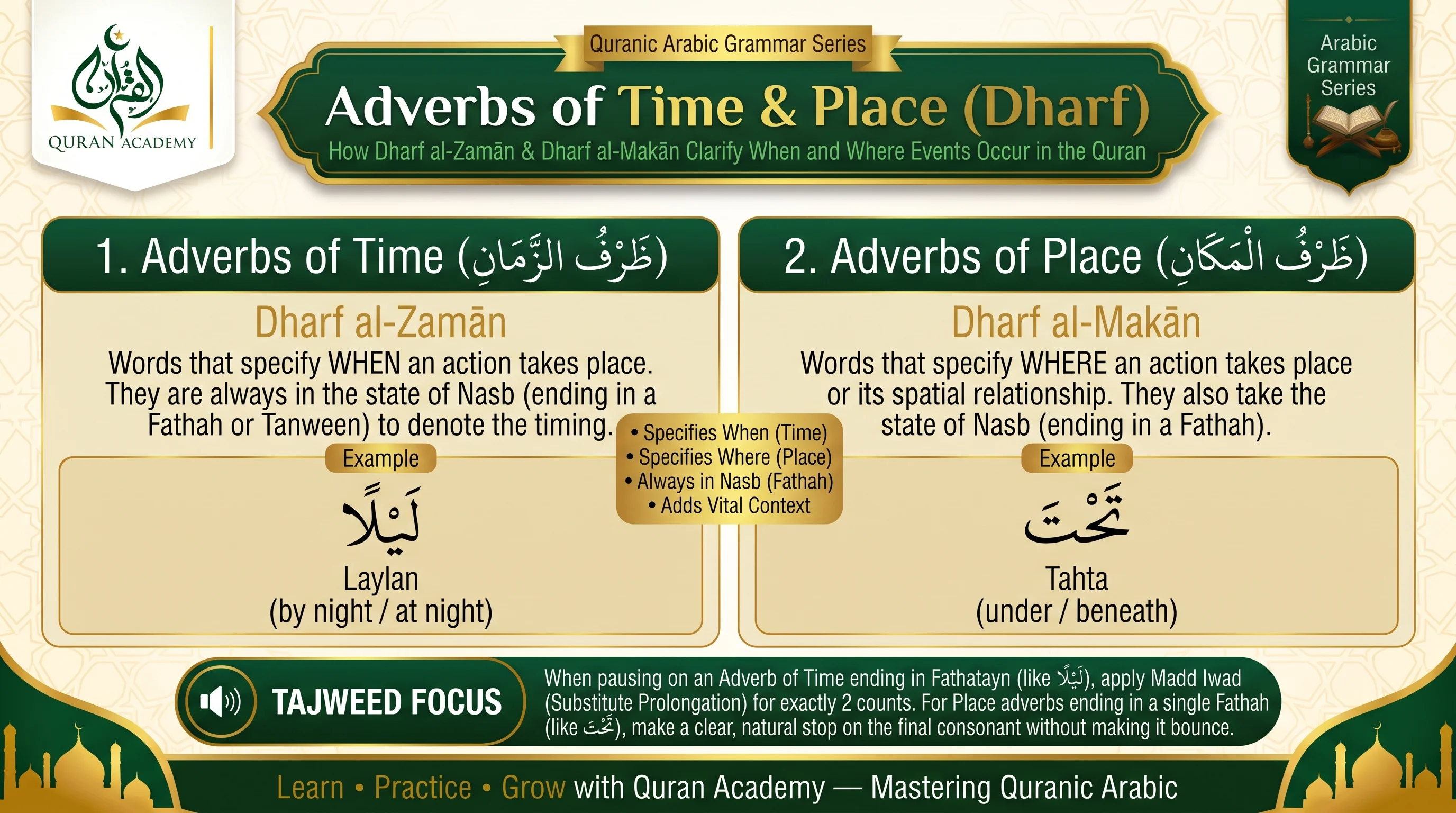
✦ Quick Answer & Key Takeaways: Dharf Al-Zaman & Makan in the Quran
Mastering dharf al zaman makan in quran (ظَرْفُ الزَّمَانِ وَظَرْفُ الْمَكَانِ فِي النَّحْوِ وَالتَّفْسِيرِ الْقُرْآنِيِّ) helps you pinpoint when, where, and alongside whom every Quranic statement unfolds! In Arabic syntax (Nahw), Dharf Az-Zaman (ظرف الزمان) frames time—such as يَوْمَئِذٍ (on that Day), قَبْلُ (before), and بَعْدُ (after)—while Dharf Al-Makan (ظرف المكان) frames space or relational proximity—such as مَعَ (with/alongside), عِنْدَ (with/by/in the presence of), لَدُنْ (from/by way of), بَيْنَ (between/among), and فَوْقَ / تَحْتَ (above/below)! Building upon our guides to Harf Al-Jarr Prepositions and Idafah Possessive Constructions, this guide continues Day 3 of Matrix 6. In our 1-on-1 Online Quranic Arabic & Tafseer Program, learners connect adverbials directly to Quran Tafseer!
- Time vs. Space Frame: Tells you when (Zaman) or where/with whom (Makan) an event takes place.
- Idafah Link: Words like عِنْدَ, مَعَ, and بَيْنَ frequently bind to a following noun or pronoun as Al-Mudaf Ilayhi.
- Tafseer Depth: Allah being "Ma'a" (with) the patient or mindful conveys support, nearness, and care.
- Tajweed Link: Keep short vowels crisp (never over-stretching Ma'a), apply Noon Sakinah / Tanween rules, and watch Raa weight!
In Surah Ash-Sharh (94:6), Allah pairs hardship and ease with a single word of companionship: ﴿ إِنَّ مَعَ ٱلْعُسْرِ يُسْرًا ﴾ ("Indeed, WITH hardship comes ease")! And in Surah Az-Zalzalah (99:4), يَوْمَئِذٍ ("On that Day") sets the scene as the earth tells its news.
For learners of Quranic Arabic, recognizing time and place adverbials prevents confusing them with prepositions or nouns in other roles. Continuing Day 3 of Matrix 6 alongside our guides to Ma'rifah & Nakirah Nouns, Idafah Possessive Constructions, and An-Na't Adjectives, this guide gives you a Time & Place Adverbials Chart and 5 Essential Tajweed Rules.
1. Master Chart: High-Frequency Time & Place Adverbials in the Quran
Compare common Dharf Az-Zaman and Dharf Al-Makan words in Quranic Arabic below:
| Adverbial Type | Common Quranic Words | Meaning & Usage Note |
|---|---|---|
| 1. Dharf Az-Zaman (Time) ⭐ | يَوْمَئِذٍ, قَبْلُ, بَعْدُ, حِينَ, أَبَدًا. | Frames time: "on that Day", "before", "after", "at a time", "forever". |
| 2. Dharf Al-Makan & Proximity 🏆 | مَعَ, عِنْدَ, لَدُنْ, بَيْنَ, فَوْقَ, تَحْتَ. | Frames accompaniment, presence, origin, or spatial position; often followed by Al-Mudaf Ilayhi. |
| 3. Locative / Clause Adverbials ⭐ | حَيْثُ (wherever / where) & place pointers like Thamma. | Connects location or circumstance to the following clause. |
2. Tafseer Nuances of "Ma'a", "'Inda" & "Ladun"
In Quranic Tafseer, spatial/relational words take on rich spiritual meaning from context: مَعَ expresses divine nearness, help, and companionship; عِنْدَ denotes presence, custody, or what rests with Allah; and لَدُنْ highlights direct origination or immediate presence from Him!
Crisp Qalqalah Around Time & Place Phrases: "Qutb Jadd" (ق ط ب ج د)!
When reciting verses with time and place adverbials, keep silent Qalqalah (Echoing) bounces (ق ط ب ج د) crisp and bounce-free on non-Qalqalah letters! Watch Senior Instructor Ustadhah Yasmeen Gamal demonstrate Qalqalah on our Quran Academy YouTube Channel:
- Grammar + Tajweed Clarity: Keep short vowels crisp and accurate!
- 1-on-1 Live Coaching: Study with certified Al-Azhar scholars!
3. Five Essential Tajweed Rules With Time & Place Adverbials
When reciting time and place adverbials in the Quran, apply these five Tajweed rules from our 1-on-1 Online Tajweed Course:
Struggling to Perfect Your Recitation?
Join 1,250+ students mastering the Quran 1-on-1 with our Verified Al-Azhar Graduates. Flexible US, UK, Canadian & Australian schedules starting at $8/hr.
Book a Free Evaluation Class →- 1. Keep Short Fatha Crisp on "Ma'a" (مَعَ) & "Bayna" (بَيْنَ) Without Over-Stretching:
Applying our Rules of Madd Guide and 25 Common Tajweed Mistakes in Salah, pronounce the final Fatha of مَعَ as a crisp 1-count short vowel—never stretching it into a Madd! - 2. Clear Noon & Tanween Rules on "Yawma'idhin" (يَوْمَئِذٍ) & "Abadan" (أَبَدًا):
Using our Noon Sakinah & Tanween Guide and Matn Tuhfat Al-Atfal, apply the exact Tanween rule before the next word (or 2-count Madd Al-'Iwad when stopping on Fathatayn)! - 3. Clear Meem Sakinah Rules:
According to our Meem Sakinah Rules Guide, apply Ikhfaa' Shafawi before Baa, Idgham Mithlayn before Meem, and Izhar Shafawi before other letters! - 4. Sun vs. Moon Laams When Followed by a Definite Noun:
Using our Laam Shamsiyyah & Laam Qamariyyah Guide, keep the Laam clear before Moon letters and merge it smoothly into Sun letters! - 5. Heavy vs. Light Raa Based on Vowels & Surrounding Letters:
Following our Ahkam Al-Raa, Makharij al-Huruf, Sifaat al-Huruf, Heavy & Light Letters, Rules of Waqf, Hamzatul Wasl vs. Qat', 4 Special Words of Hafs, 7 Alifs in the Quran, Idgham Pairs, 10 Qira'at, Hafs vs. Warsh, Iltiqa' As-Sakinayn, Matn Al-Jazariyyah, An-Nabr (Vocal Stress), and 15 Sajdah Tilawah Verses guides, apply the exact vowel-based Raa rule! Test your Tajweed skills right now on our Free 3-Minute Tajweed Quiz!
Explore more Quranic Arabic and Surah Tafseer guides across our library: Harf Al-Jarr Prepositions, Idafah Possessive Constructions, Ma'rifah & Nakirah Nouns, An-Na't Adjectives, and Surah Ash-Sharh (using our Interactive Tajweed Encyclopedia and Online Hadith Explorer)! Meet our Al-Azhar Certified Tutors, enroll your child in our 1-on-1 Kids Quran Classes with our Printable Kids Star Chart, and read how families across the US, UK, Canada, and Australia rate our teachers on our Verified Student & Parent Reviews Page.
4. Frequently Asked Questions (FAQs) About Dharf Az-Zaman & Makan
1. What is "Dharf" (الظَّرْفُ — Adverbial of Time or Place) in Quranic Arabic grammar?
In Arabic syntax (Nahw), "Dharf" is a noun of time (Dharf Az-Zaman) or place/position (Dharf Al-Makan) that frames when or where an action takes place!
2. How does "'Inda" (عِنْدَ) differ from "Ladun" (لَدُنْ) in Quranic Tafseer?
"'Inda" (عِنْدَ) often denotes presence, custody, or proximity, whereas "Ladun" (لَدُنْ) frequently points to something originating directly from a source or immediate presence!
3. What does "Ma'a" (مَعَ) mean in Quranic verses—and why does it take Fatha?
"Ma'a" (مَعَ) means "with / together with / alongside" with a short final Fatha—and in verses about Allah's nearness to the patient or mindful, it conveys divine support, care, and help!
4. What does "Yawma'idhin" (يَوْمَئِذٍ) mean in verses about the Hereafter?
"Yawma'idhin" (يَوْمَئِذٍ) is a compound time adverbial meaning "On that Day [when that event occurs]"—frequently framing scenes of reckoning and recompense!
5. What is the #1 Tajweed rule to watch for with "Ma'a" (مَعَ) and "Yawma'idhin" (يَوْمَئِذٍ)?
Keep the final Fatha of "مَعَ" short (never stretching it into a Madd), and articulate the Kasra-voweled glottal Hamzah in "يَوْمَئِذٍ" cleanly!
Read & Understand the Quran With Deeper Clarity!
Master Quranic Arabic grammar, Tafseer, Hifz, and Tajweed in live 1-on-1 online lessons with certified male and female Al-Azhar scholars. Book your free trial session today!
Book Your Free 1-on-1 Trial Class →