
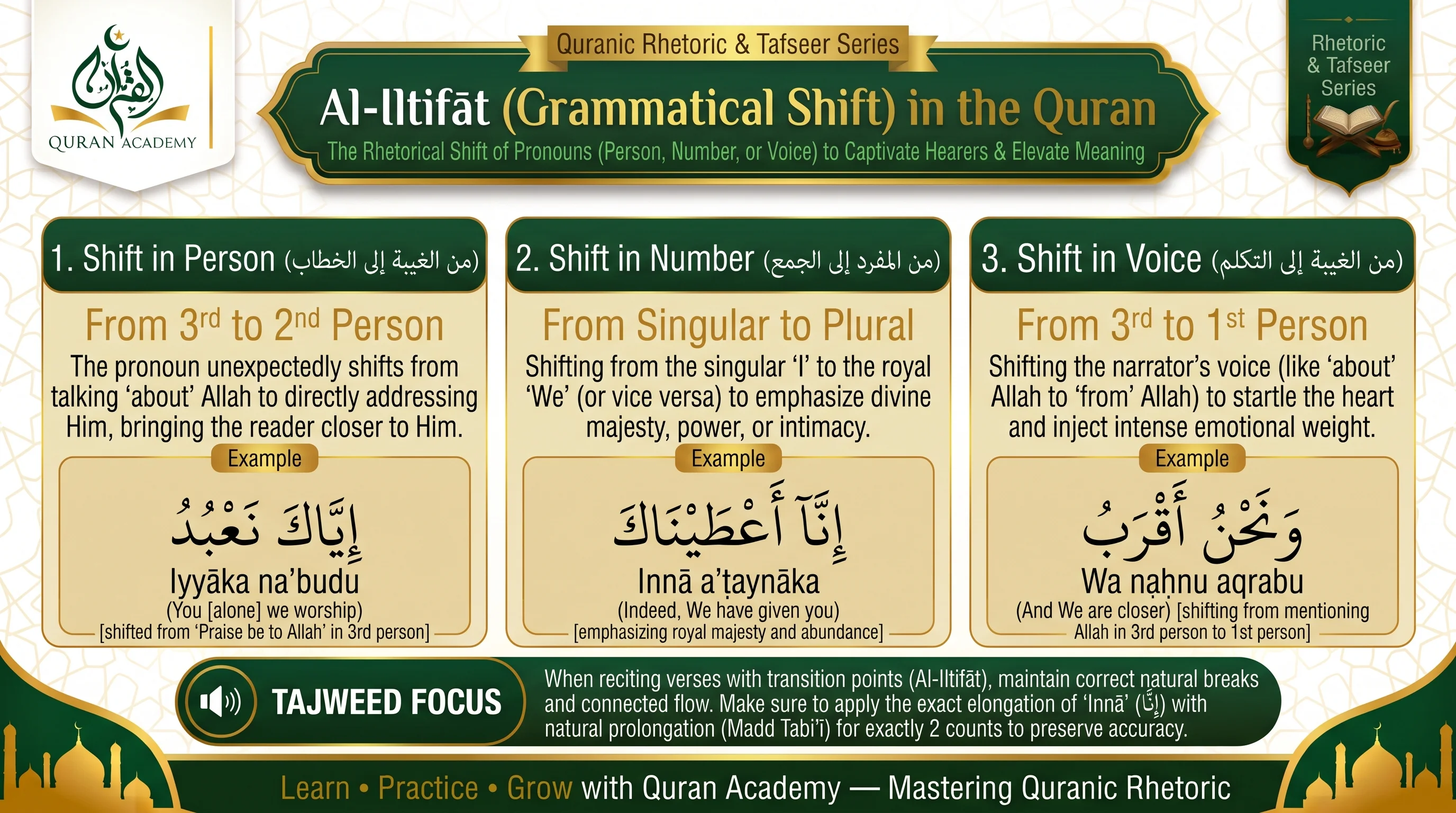
✦ Quick Answer & Key Takeaways: Grammatical Shift (Al-Iltifat)
Mastering al iltifat grammatical shift in quran (الِالْتِفَاتُ فِي الْبَلَاغَةِ وَالتَّفْسِيرِ الْقُرْآنِيِّ) reveals why the Quran's narrative style is so dynamic, captivating, and emotionally powerful! In Arabic rhetoric (Balaghah), Al-Iltifat (الالتفات) is a sudden, intentional shift in grammatical person—such as moving from the 3rd person ("He/They") to the 2nd person direct address ("You"), or changing from singular to plural—to jolt the listener's attention, shift the emotional tone, or signify divine majesty! The most famous example is Surah Al-Fatihah, which shifts from describing Allah (3rd person) to speaking to Him directly (2nd person: إِيَّاكَ نَعْبُدُ)! Building upon our guides to Arabic Pronouns and Ellipsis & Omission, this guide continues Day 4 of Matrix 6. In our 1-on-1 Online Quranic Arabic & Tafseer Program, learners spot these rhetorical shifts in Quran Tafseer!
- Awakening the Listener: A sudden shift prevents passive reading and forces the mind to engage.
- Intimacy vs. Distance: Shifting to "You" creates intimate conversation; shifting to "He/They" can indicate displeasure or distance.
- Majestic Plural: Allah shifting from "I" to "We" highlights absolute authority and the decree of cosmic forces.
- Tajweed Focus: Pronounce attached pronouns clearly and respect Waqf (stopping) rules at transition points!
If you read a translation of the Quran without understanding Arabic rhetoric, a sentence that starts with "He created you" and ends with "so worship Me" might seem grammatically mismatched. Why does the speaker suddenly change? In English, this is often considered a grammatical error. But in Classical Arabic, Al-Iltifat is considered the peak of eloquence!
For learners of Tafseer, realizing that a pronoun shift is a deliberate tool of Balaghah changes how you experience the text. It turns a static reading into a vivid, multi-directional dialogue. Continuing Day 4 of Matrix 6 alongside our guides to Rhetorical Questions, Ellipsis & Omission, and Tibaq & Muqabalah, this guide gives you an Iltifat Master Chart and 5 Essential Tajweed Rules.
1. Master Chart: Types of Grammatical Shift (Al-Iltifat) in the Quran
Compare the 3 main types of rhetorical shifts in Quranic Arabic below:
| Type of Shift | Direction of Change | Quranic Example & Effect |
|---|---|---|
| 1. Shift in Person (Al-Iltifat) ⭐ | From 3rd Person ("He/They") to 2nd Person ("You") or 1st Person ("I/We"). | ﴿ ٱلْحَمْدُ لِلَّهِ... إِيَّاكَ نَعْبُدُ ﴾ (1:2–5)—Moves from praising Allah in absentia to intimate, direct address. |
| 2. Shift in Number (Plural of Majesty) 🏆 | From Singular ("I/He") to Plural ("We") when Allah speaks. | ﴿ إِنَّنِي أَنَا ٱللَّهُ... إِنَّا نَحْنُ نَزَّلْنَا ﴾—Shifts to "We" to show supreme power and mobilization of decree. |
| 3. Shift in Tense (Past to Present) ⭐ | Describing a past event suddenly with a present-tense verb. | Brings a past historical scene to life, making the reader feel as if they are watching it happen right now. |
2. Why the Quran Shifts Pronouns: Intimacy, Anger & Majesty
When the Quran shifts from addressing a group directly ("You") to speaking about them in the third person ("They"), it often signifies divine displeasure—as if turning away from them! Conversely, moving from third person to second person signifies drawing near in mercy, prayer, or revelation.
Crisp Pronouns & Transitions: Watch "Qutb Jadd" (ق ط ب ج د)!
When reading verses with rapid pronoun shifts, do not rush the transition! Keep silent Qalqalah (Echoing) bounces (ق ط ب ج د) crisp and bounce-free on non-Qalqalah letters! Watch Senior Instructor Ustadhah Yasmeen Gamal demonstrate Qalqalah on our Quran Academy YouTube Channel:
- Balaghah + Tajweed Together: Let the meaning shape your pace!
- 1-on-1 Live Coaching: Study with certified Al-Azhar scholars!
3. Five Essential Tajweed Rules When Reciting "Iltifat" Verses
When reciting verses that contain sudden grammatical shifts, apply these five Tajweed rules from our 1-on-1 Online Tajweed Course:
Struggling to Perfect Your Recitation?
Join 1,250+ students mastering the Quran 1-on-1 with our Verified Al-Azhar Graduates. Flexible US, UK, Canadian & Australian schedules starting at $8/hr.
Book a Free Evaluation Class →- 1. Clear Articulation of Attached Pronouns ("-ka", "-kum", "-hu"):
Do not swallow the final vowels of pronouns that mark the shift! Give a crisp Fatha to كَ or Damma to هُ without stretching them into a Madd (unless Madd Silah applies). - 2. Proper "Madd Silah" on the Pronoun "Haa" (ـهُ / ـهِ):
Applying our Rules of Madd Guide, if the 3rd person singular masculine pronoun Haa sits between two voweled letters, stretch it for 2 counts (Silah Sughra) or 4–5 counts if followed by Hamzah (Silah Kubra)! - 3. Clear Meem Sakinah Rules on Plural Pronouns ("-kum", "-hum"):
Using our Meem Sakinah Rules Guide, apply Ikhfaa' Shafawi before Baa, Idgham Mithlayn before Meem, and clear Izhar Shafawi before all other letters! - 4. Mindful Stopping (Waqf) at Transitions:
Using our Rules of Waqf Guide, honor the designated stop marks (like Jeem or Qila) where a shift in person occurs to let the meaning settle! - 5. Heavy vs. Light Raa Based on Vowels:
Following our Ahkam Al-Raa, Makharij al-Huruf, Sifaat al-Huruf, Heavy & Light Letters, Laam Shamsiyyah & Qamariyyah, Hamzatul Wasl vs. Qat', 4 Special Words of Hafs, 7 Alifs in the Quran, Idgham Pairs, 10 Qira'at, Hafs vs. Warsh, Iltiqa' As-Sakinayn, Matn Al-Jazariyyah, 25 Common Tajweed Mistakes in Salah, An-Nabr (Vocal Stress), and 15 Sajdah Tilawah Verses guides, apply the exact vowel-based Raa rule! Test your Tajweed skills right now on our Free 3-Minute Tajweed Quiz!
Explore more Quranic Arabic and Surah Tafseer guides across our library: Arabic Pronouns, Ellipsis & Omission, Rhetorical Questions, Balaghah Rhetoric, and Surah Al-Fatihah (using our Interactive Tajweed Encyclopedia and Online Hadith Explorer)! Meet our Al-Azhar Certified Tutors, enroll your child in our 1-on-1 Kids Quran Classes with our Printable Kids Star Chart, and read how families across the US, UK, Canada, and Australia rate our teachers on our Verified Student & Parent Reviews Page.
4. Frequently Asked Questions (FAQs) About Al-Iltifat
1. What is "Al-Iltifat" (الِالْتِفَاتُ — Grammatical Shift) in Quranic rhetoric?
In Arabic rhetoric (Balaghah), "Al-Iltifat" is a sudden, intentional shift in grammatical person (like moving from "He" to "You") or a shift in number/tense within the same context to grab attention and add emotional intensity.
2. Why does Surah Al-Fatihah shift from the 3rd person to the 2nd person?
It opens by describing Allah in the 3rd person to establish His majesty. Once the heart is filled with awe, the text shifts to direct 2nd person address ("You alone we worship"), marking a transition from distant praise to intimate conversation.
3. How does "Al-Iltifat" help the reader in Quranic Tadabbur?
It prevents passive reading by forcing the mind to ask "Who is speaking now?" and "Why did the tone suddenly change?"
4. Does a shift from singular "I" to plural "We" by Allah mean multiple entities?
No. Shifting to "We" (Plural of Majesty) emphasizes supreme authority and the mobilization of divine forces, while "I" emphasizes intimacy or singular worship.
5. What Tajweed habit is crucial when reciting verses containing "Al-Iltifat"?
Do not rush the transition! Honor all Madd counts, apply clear Waqf (stopping) at designated marks, and articulate attached pronouns cleanly.
Read & Reflect on the Quran With Deeper Clarity!
Master Quranic Arabic grammar, Tafseer, Hifz, and Tajweed in live 1-on-1 online lessons with certified male and female Al-Azhar scholars. Book your free trial session today!
Book Your Free 1-on-1 Trial Class →