
✦ Quick Answer & Key Takeaways: Word Order & Inversion (At-Taqdim)
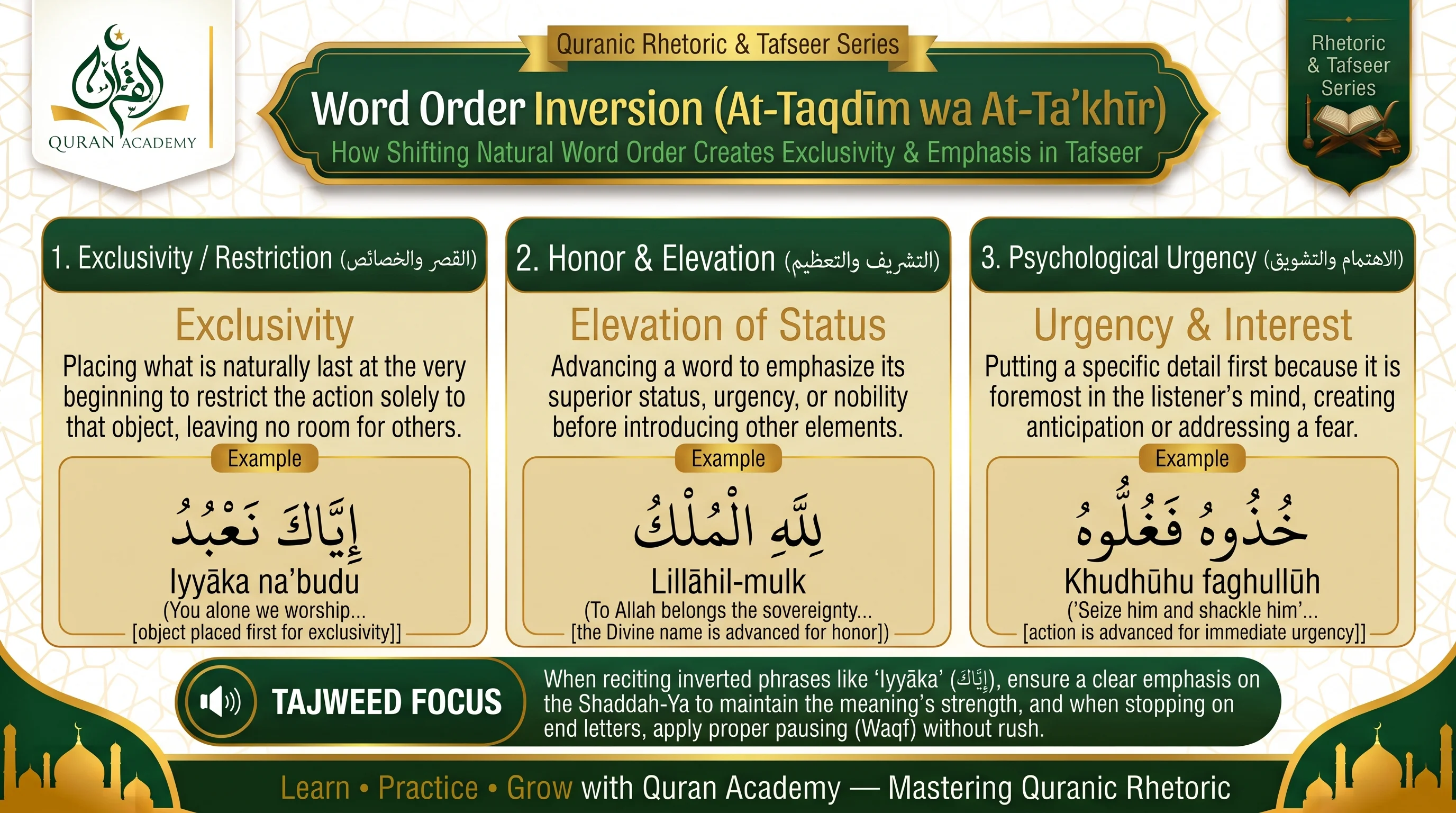
Mastering word order inversion in quran tafseer (التَّقْدِيمُ وَالتَّأْخِيرُ فِي الْبَلَاغَةِ وَالتَّفْسِيرِ الْقُرْآنِيِّ) reveals the hidden precision of every single sentence in the Holy Quran! In Arabic rhetoric (Balaghah), changing the standard grammatical sequence—such as bringing an object before its verb, or a predicate before its subject—is called At-Taqdim wa At-Ta'khir (التقديم والتأخير). This inversion never happens by chance; it intentionally creates Al-Ikhtisas (الاختصاص — Exclusivity) or Al-Ihtimam (الاهتمام — Special Importance)! The greatest example is in Surah Al-Fatihah (1:5): moving the object forward to say إِيَّاكَ نَعْبُدُ (You alone we worship) instead of Na'buduka (We worship You)! Building upon our guides to Grammatical Shift (Al-Iltifat) and Ellipsis & Omission, this guide continues Day 4 of Matrix 6. In our 1-on-1 Online Quranic Arabic & Tafseer Program, learners unlock these majestic sentence structures!
- Exclusivity (Al-Ikhtisas): Preposing an object or prepositional phrase restricts the action entirely to that entity.
- Importance (Al-Ihtimam): Placing a word first honors it, highlights its urgency, or answers the listener's specific anxiety.
- Nominal Inversion: "Lillahi ma fis-samawati" (To Allah belongs what is in the heavens) proves absolute divine ownership.
- Tajweed Connection: Apply Vocal Stress (An-Nabr) on doubled letters like إِيَّاكَ and respect Waqf stops on inverted phrases!
If you tell someone "I asked you for help," it implies they were one of the people you asked. But if you say, "It is YOU I asked for help," it means you turned to them and no one else! In Surah Al-Fatihah, saying Na'buduka (We worship You) would technically allow the worship of others alongside Allah. By inverting the word order to ﴿ إِيَّاكَ نَعْبُدُ وَإِيَّاكَ نَسْتَعِينُ ﴾, the Quran locks out all partners: You, and You alone, we worship!
For learners of Tafseer, missing these inversions means missing the Quran's strict monotheism (Tawheed) woven directly into its grammar. Continuing Day 4 of Matrix 6 alongside our guides to Grammatical Shift (Al-Iltifat), Ellipsis (Al-Ijaz), and Rhetorical Questions, this guide gives you a Word Order Chart and 5 Essential Tajweed Rules.
1. Master Chart: Types of Preposing (At-Taqdim) in Quranic Arabic
Compare the 3 most common types of grammatical inversion in Quranic Tafseer below:
| Type of Inversion | Grammar Shift Structure | Quranic Example & Effect |
|---|---|---|
| 1. Object Before Verb (Maf'ul Bihi) ⭐ | Moving the direct object (or detached pronoun) before its verb. | ﴿ إِيَّاكَ نَعْبُدُ ﴾ (1:5)—Restricts worship exclusively to Allah. |
| 2. Predicate Before Subject (Khabar) 🏆 | Preposing a prepositional phrase (Jarr wa Majrur) before the subject. | ﴿ وَلِلَّهِ ٱلْمَشْرِقُ وَٱلْمَغْرِبُ ﴾ (2:115)—"To Allah [alone] belong the East and West." |
| 3. Importance & Honor (Al-Ihtimam) ⭐ | Mentioning one word first in a sequence because it is more crucial in context. | Mentioning أَمْوَالُكُمْ before أَوْلَادُكُمْ (8:28)—wealth is often a more frequent or pressing trial. |
2. How Exclusivity (Al-Ikhtisas) Anchors Tawheed in Tafseer
Whenever you see لِلَّهِ (Lillahi) pushed to the very beginning of a sentence before what He owns (like Lillahil-amru min qablu wa min ba'd), it is the Quranic grammar of Tawheed: stripping power, ownership, and decree from all creation and returning it exclusively to the Creator!
Vocal Stress (An-Nabr) on "Iyyaka" & Crisp Qalqalah!
When reciting inverted pronouns like إِيَّاكَ, apply An-Nabr (vocal stress) on the doubled Yaa! And keep Qalqalah (Echoing) bounces (ق ط ب ج د) crisp elsewhere! Watch Senior Instructor Ustadhah Yasmeen Gamal demonstrate on our Quran Academy YouTube Channel:
- Balaghah + Tajweed Together: Recite with meaning and precision!
- 1-on-1 Live Coaching: Study with certified Al-Azhar scholars!
3. Five Essential Tajweed Rules When Reciting Inverted Verses
When reciting inverted syntactic phrases in the Quran, apply these five Tajweed rules from our 1-on-1 Online Tajweed Course:
Struggling to Perfect Your Recitation?
Join 1,250+ students mastering the Quran 1-on-1 with our Verified Al-Azhar Graduates. Flexible US, UK, Canadian & Australian schedules starting at $8/hr.
Book a Free Evaluation Class →- 1. Clear Vocal Stress (An-Nabr) on Shaddah ("Iyyaka"):
Applying our An-Nabr (Vocal Stress) Guide, press clearly on doubled letters (like the Yaa in إِيَّاكَ) so the Shaddah is heard without stretching it into a Madd! - 2. Sun vs. Moon Laams in Preposed Prepositional Phrases ("Lillahi"):
Applying our Laam Shamsiyyah & Laam Qamariyyah Guide, remember that the Laam in the Majestic Name merges securely! - 3. Clear Meem Sakinah Rules on Preposed Objects:
Using our Meem Sakinah Rules Guide, apply Ikhfaa' Shafawi before Baa, Idgham Mithlayn before Meem, and clear Izhar Shafawi before all other letters! - 4. Mindful Stopping (Waqf) to Preserve Meaning:
Using our Rules of Waqf Guide, honor designated stop marks so the inverted phrase's exclusivity is understood clearly by the listener! - 5. Heavy vs. Light Raa Based on Vowels & Surrounding Letters:
Following our Ahkam Al-Raa, Makharij al-Huruf, Sifaat al-Huruf, Heavy & Light Letters, Hamzatul Wasl vs. Qat', 4 Special Words of Hafs, 7 Alifs in the Quran, Idgham Pairs, 10 Qira'at, Hafs vs. Warsh, Iltiqa' As-Sakinayn, Matn Al-Jazariyyah, 25 Common Tajweed Mistakes in Salah, and 15 Sajdah Tilawah Verses guides, apply the exact vowel-based Raa rule! Test your Tajweed skills right now on our Free 3-Minute Tajweed Quiz!
Explore more Quranic Arabic and Surah Tafseer guides across our library: Grammatical Shift (Al-Iltifat), Ellipsis & Omission, Rhetorical Questions, Balaghah Rhetoric, and Surah Al-Fatihah (using our Interactive Tajweed Encyclopedia and Online Hadith Explorer)! Meet our Al-Azhar Certified Tutors, enroll your child in our 1-on-1 Kids Quran Classes with our Printable Kids Star Chart, and read how families across the US, UK, Canada, and Australia rate our teachers on our Verified Student & Parent Reviews Page.
4. Frequently Asked Questions (FAQs) About Word Order Inversion
1. What is "At-Taqdim wa At-Ta'khir" (التَّقْدِيمُ وَالتَّأْخِيرُ — Preposing and Postposing) in Quranic rhetoric?
In Arabic rhetoric (Balaghah), it refers to shifting a word from its standard grammatical position (like moving the object before the verb) to serve a specific rhetorical purpose—most notably exclusivity (Al-Ikhtisas) or emphasis!
2. Why does Surah Al-Fatihah say "Iyyaka na'budu" instead of "Na'buduka"?
By moving the object pronoun first (Iyyaka na'budu = You [alone] we worship), the Quran establishes Exclusivity. Na'buduka (We worship You) would grammatically leave open the possibility of worshipping others alongside Allah.
3. What does it mean when a prepositional phrase comes before the subject, like "Lillahi ma fis-samawati"?
When a phrase like Lillahi is moved to the front before the subject, it restricts ownership entirely to Him: "To Allah ALONE belongs whatever is in the heavens."
4. How does "At-Taqdim" show what is most important in a verse?
Bringing a word forward draws the listener's immediate attention (Al-Ihtimam). For example, mentioning "wealth" before "children" highlights that wealth is often the more frequent source of trial.
5. What Tajweed rule is crucial when reciting phrases with "Iyyaka"?
Apply clear vocal stress (An-Nabr) on the doubled Yaa (يَّ) with Shaddah so it does not sound like a single weak Yaa!
Read & Reflect on the Quran With Deeper Clarity!
Master Quranic Arabic grammar, Tafseer, Hifz, and Tajweed in live 1-on-1 online lessons with certified male and female Al-Azhar scholars. Book your free trial session today!
Book Your Free 1-on-1 Trial Class →