
✦ Quick Answer & Key Takeaways: Repetition (At-Takrar) in the Quran
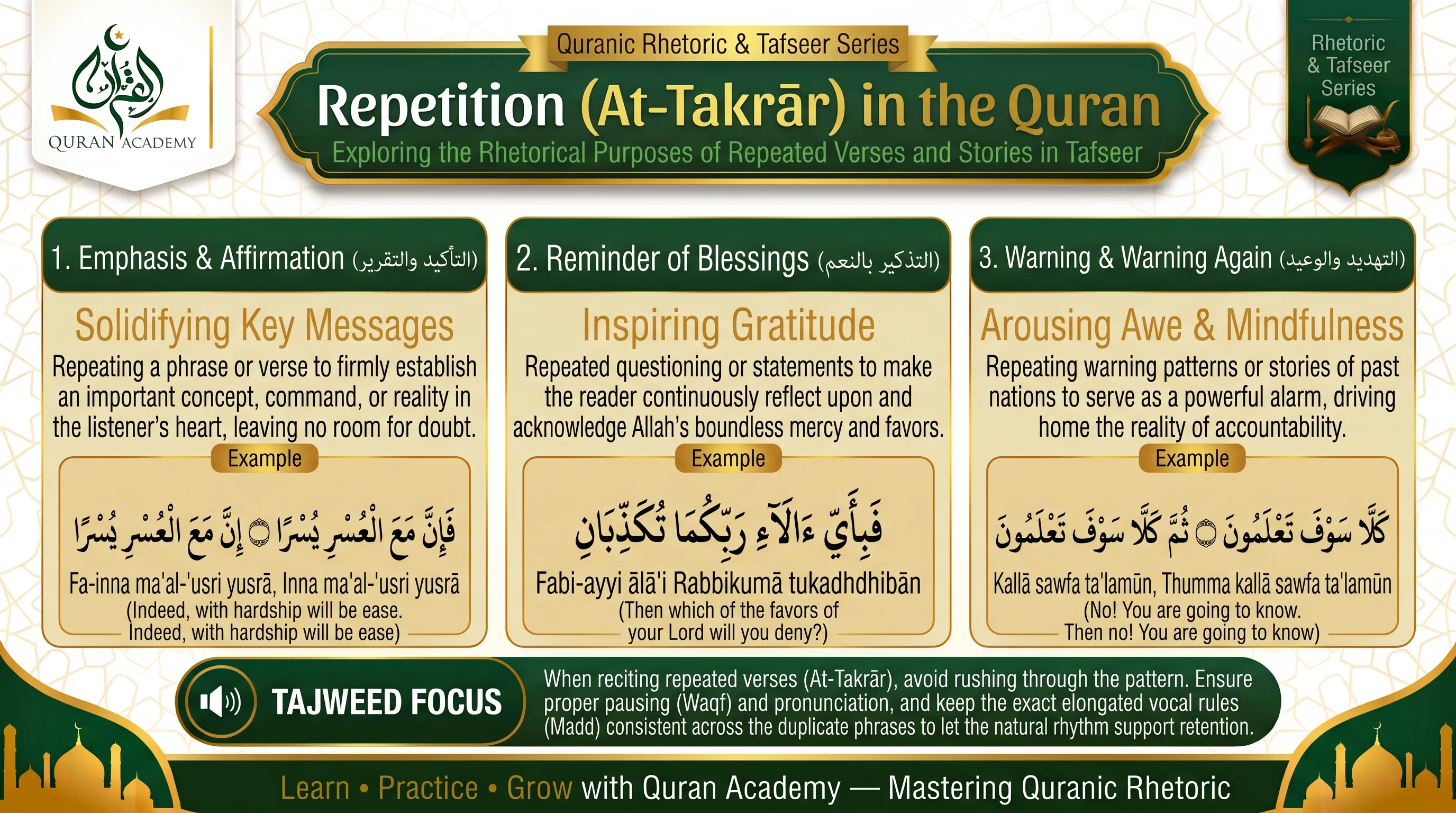
Mastering repetition at takrar in quran (التَّكْرَارُ فِي الْبَلَاغَةِ وَالتَّفْسِيرِ الْقُرْآنِيِّ) reveals how the Quran anchors its most vital lessons deep into the human heart! In Arabic rhetoric (Balaghah), At-Takrar (التكرار) is never mere redundancy; it is an intentional, highly eloquent device used for Emphasis (Tawkid), building emotional climax, renewing a warning, or addressing different facets of a single story! The most famous examples are the 31 repetitions of ﴿ فَبِأَيِّ آلَاءِ رَبِّكُمَا تُكَذِّبَانِ ﴾ in Surah Ar-Rahman and the repeated warnings in Surah Al-Mursalat and Surah Al-Qamar! Building upon our guides to Word Order (At-Taqdim) and Rhetorical Questions, this guide completes Day 4 of Matrix 6 (Articles 166–170). In our 1-on-1 Online Quranic Arabic & Tafseer Program, learners discover how every repeated phrase carries a fresh meaning based on its immediate context!
- Context Refreshes Meaning: A repeated refrain (like in Surah Ar-Rahman) responds directly to the specific blessing mentioned right before it.
- Story Repetition: When the Quran repeats the story of Prophet Musa (AS), it highlights a new angle or lesson tailored to that Surah's theme.
- Psychological Anchoring: Repetition overcomes human forgetfulness and instills awe or comfort.
- Tajweed Connection: Do not rush familiar repeated verses—honor Vocal Stress (An-Nabr) and Waqf consistently every time!
When you read a book and the author repeats a paragraph, you might assume they made a mistake. But when you recite Surah Ar-Rahman, the 31 repetitions of "Fabi-ayyi ala'i rabbikuma tukadhdhiban" do not feel redundant; they feel like the rhythmic beating of a heart, building an overwhelming sense of gratitude and accountability!
For learners of Tafseer, understanding At-Takrar shifts the mindset from "Why is this here again?" to "What new flavor does this repetition bring to this exact spot?" Completing Day 4 of Matrix 6 alongside our guides to Word Order Inversion, Grammatical Shift (Al-Iltifat), and Balaghah Rhetoric, this guide gives you a Rhetorical Repetition Chart and 5 Essential Tajweed Rules.
1. Master Chart: Types & Purposes of Repetition (At-Takrar) in Quranic Balaghah
Compare the 3 main functions of repetition in Quranic Tafseer below:
| Type of Repetition | Rhetorical Purpose & Effect | Quranic Example |
|---|---|---|
| 1. Refrain Repetition (At-Takrar Al-Lafdhi) ⭐ | Creates rhythmic emphasis, directly tying a recurring question or warning to the preceding verse. | ﴿ فَبِأَيِّ آلَاءِ رَبِّكُمَا تُكَذِّبَانِ ﴾ (Surah Ar-Rahman) & ﴿ وَيْلٌ يَوْمَئِذٍ لِّلْمُكَذِّبِينَ ﴾ (Al-Mursalat). |
| 2. Immediate Phrase Repetition 🏆 | Repeats a clause immediately to shatter doubt, affirm a promise, or instill deep awe (Tawkid). | ﴿ فَإِنَّ مَعَ ٱلْعُسْرِ يُسْرًا ﴿٥﴾ إِنَّ مَعَ ٱلْعُسْرِ يُسْرًا ﴿٦﴾ ﴾ (Surah Ash-Sharh). |
| 3. Thematic / Narrative Repetition ⭐ | Recounts a story or historical event across multiple Surahs, highlighting a new lesson each time. | Stories of Prophet Musa (AS) in Al-A'raf, Ta-Ha, and Al-Qasas (each matching the Surah's unique theme). |
2. Why the Quran Repeats Prophetic Stories Across Different Surahs
When the Quran tells the story of Prophet Nuh or Musa (peace be upon them) in five different Surahs, it is not simply repeating history. It acts like a diamond turned to the light: one Surah highlights their patience, another highlights Allah's destruction of the arrogant, and another highlights their intimate Duas—all perfectly harmonized with the surrounding verses!
Stay Present: Crisp Qalqalah in Repeated Refrains!
It is easy to rush through repeated refrains like Fabi-ayyi ala'i rabbikuma. Force yourself to stay present, and keep Qalqalah (Echoing) bounces (ق ط ب ج د) crisp every single time! Watch Senior Instructor Ustadhah Yasmeen Gamal demonstrate on our Quran Academy YouTube Channel:
- Focus Over Speed: Recite every repetition with awe!
- 1-on-1 Live Coaching: Study with certified Al-Azhar scholars!
3. Five Essential Tajweed Rules When Reciting Repeated Verses
When reciting refrains or repeated verses in the Quran, apply these five Tajweed rules from our 1-on-1 Online Tajweed Course without letting familiarity cause you to rush:
Struggling to Perfect Your Recitation?
Join 1,250+ students mastering the Quran 1-on-1 with our Verified Al-Azhar Graduates. Flexible US, UK, Canadian & Australian schedules starting at $8/hr.
Book a Free Evaluation Class →- 1. Consistent Madd Durations Across Every Repetition:
Applying our Rules of Madd Guide, if you lengthen the Madd 'Arid Lis-Sukoon in the first "tukadhdhibaan" to 4 counts, keep it at 4 counts for every subsequent repetition! - 2. Clear Vocal Stress (An-Nabr) on Shaddah ("Fabi-ayyi", "Tukadhdhibaan"):
Applying our An-Nabr (Vocal Stress) Guide, press clearly on doubled letters so the Shaddah is heard crisply every time! - 3. Clear Noon & Tanween Rules:
Using our Noon Sakinah & Tanween Guide, apply Izhar, Idgham, Iqlab, and Ikhfaa' cleanly, resisting the urge to merge letters improperly out of speed. - 4. Clear Meem Sakinah Rules:
Using our Meem Sakinah Rules Guide, apply Ikhfaa' Shafawi before Baa, Idgham Mithlayn before Meem, and clear Izhar Shafawi before all other letters! - 5. Heavy vs. Light Raa Based on Vowels:
Following our Ahkam Al-Raa, Makharij al-Huruf, Sifaat al-Huruf, Heavy & Light Letters, Rules of Waqf, Hamzatul Wasl vs. Qat', 4 Special Words of Hafs, 7 Alifs in the Quran, Idgham Pairs, 10 Qira'at, Hafs vs. Warsh, Iltiqa' As-Sakinayn, Matn Al-Jazariyyah, 25 Common Tajweed Mistakes in Salah, and 15 Sajdah Tilawah Verses guides, apply the exact vowel-based Raa rule! Test your Tajweed skills right now on our Free 3-Minute Tajweed Quiz!
Explore more Quranic Arabic and Surah Tafseer guides across our library: Word Order Inversion, Grammatical Shift (Al-Iltifat), Ellipsis & Omission, Rhetorical Questions, and Balaghah Rhetoric (using our Interactive Tajweed Encyclopedia and Online Hadith Explorer)! Meet our Al-Azhar Certified Tutors, enroll your child in our 1-on-1 Kids Quran Classes with our Printable Kids Star Chart, and read how families across the US, UK, Canada, and Australia rate our teachers on our Verified Student & Parent Reviews Page.
4. Frequently Asked Questions (FAQs) About Repetition in the Quran
1. What is "At-Takrar" (التَّكْرَارُ — Repetition) in Quranic rhetoric (Balaghah)?
In Arabic rhetoric, "At-Takrar" is the intentional repetition of a word, a phrase, a full verse, or a historical story to serve a powerful communicative purpose—such as emphasis (Tawkid), instilling awe, or renewing a reminder.
2. Why is the verse "Fabi-ayyi ala'i rabbikuma tukadhdhiban" repeated 31 times in Surah Ar-Rahman?
The repetition acts as a rhythmic refrain that engages the listener directly. Each time it appears, it follows a newly mentioned blessing or warning—making the question specific to the exact context that precedes it!
3. Why are stories of the Prophets (like Musa or Nuh) repeated across different Surahs?
When the Quran repeats a prophetic story, it highlights a different angle or lesson each time to match the exact theme and emotional tone of that specific Surah.
4. Does repetition in the Quran imply redundancy?
Never. In classical Arabic eloquence, repetition is a sophisticated tool used to anchor meanings in the heart, overcome forgetfulness, and build rhetorical climax.
5. What Tajweed habit is essential when reciting repeated verses or refrains?
Do not let familiarity cause you to rush! Maintain steady Madd counts, clear articulation, and consistent Waqf (stopping) so every repetition carries the same reverence.
Read & Reflect on the Quran With Deeper Clarity!
Master Quranic Arabic grammar, Tafseer, Hifz, and Tajweed in live 1-on-1 online lessons with certified male and female Al-Azhar scholars. Book your free trial session today!
Book Your Free 1-on-1 Trial Class →