
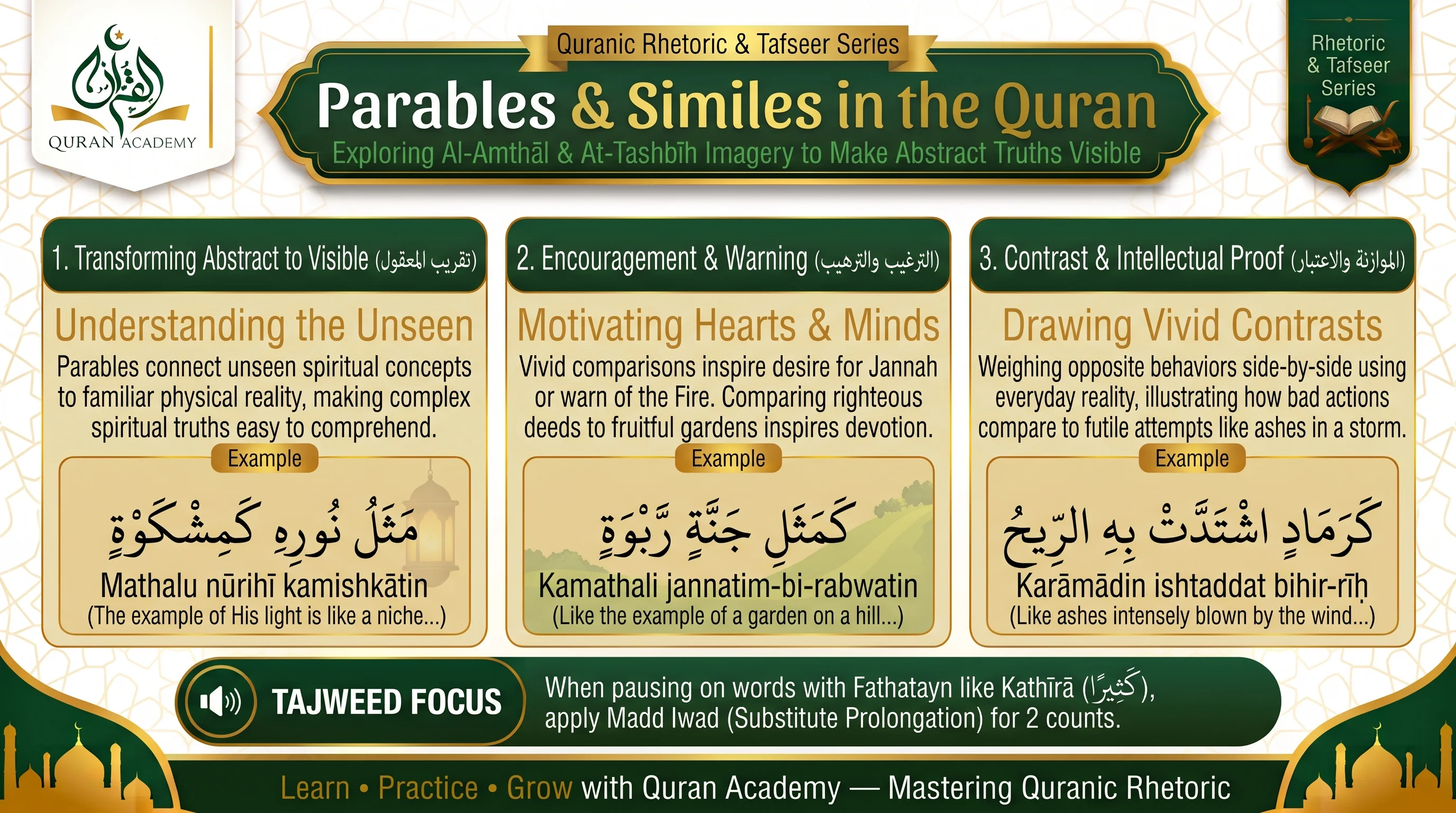
✦ Quick Answer & Key Takeaways: Parables & Similes in the Quran
Mastering parables similes amthal tashbih quran (ضَرْبُ الْأَمْثَالِ وَالتَّشْبِيهُ وَالِاسْتِعَارَةُ فِي الْبَلَاغَةِ الْقُرْآنِيَّةِ) opens your eyes to the most vivid, visual, and emotionally stirring imagery in the Book of Allah! In Arabic rhetoric (Balaghah), abstract truths are made tangible through At-Tashbih (التشبيه — Simile) using words like Ka- (like/as), Al-Isti'arah (الاستعارة — Metaphor) which borrows a word entirely (like calling guidance "Light"), and Al-Amthal (الأمثال — Parables) which paint extended, striking scenarios so the human mind can grasp the unseen! Building upon our guides to Repetition (At-Takrar), Word Order Inversion, and Balaghah Rhetoric, this guide launches Day 5 of Matrix 6! In our 1-on-1 Online Quranic Arabic & Tafseer Program, learners unpack these powerful metaphors directly in Quran Tafseer!
- Making the Unseen Seen: Parables transform abstract faith or disbelief into tangible visual scenes (fires, rainstorms, seeds, trees).
- Similes (At-Tashbih): Look for كَـ (Ka-) or مَثَلُ (Mathalu) to spot the immediate comparison.
- Metaphors (Al-Isti'arah): Words like "Darkness" (Dhulumat) and "Light" (Noor) stand directly for falsehood and truth.
- Tajweed Connection: Pronounce the Thaa (ث) in Mathal correctly, keep short vowels crisp, and apply precise Waqf!
How do you explain the enduring, life-giving power of saying "La ilaha illa Allah"? Instead of an abstract philosophical essay, Surah Ibrahim (14:24) gives us an unforgettable visual: ﴿ مَثَلًا كَلِمَةً طَيِّبَةً كَشَجَرَةٍ طَيِّبَةٍ ﴾—a good word is like a good tree, its roots planted firmly in the earth and its branches reaching into the sky, yielding fruit in every season!
For learners of Quranic Arabic, these parables (Darb Al-Amthal) are not just poetic decorations; they are the core method Allah uses to make mankind reflect. Opening Day 5 of Matrix 6 alongside our guides to Grammatical Shift (Al-Iltifat), Ellipsis & Omission, and Tibaq & Muqabalah, this guide gives you an Imagery & Parable Chart and 5 Essential Tajweed Rules.
1. Master Chart: Simile, Metaphor & Parables in Quranic Rhetoric
Compare the 3 main tools of imagery in Quranic Tafseer below:
| Rhetorical Tool | Structure & Function | Quranic Example & Effect |
|---|---|---|
| 1. التَّشْبِيهُ (Simile) ⭐ | Explicit comparison using كَـ (like), كَأَنَّ (as if), or مَثَلُ (example of). | ﴿ كَأَنَّهُمْ خُشُبٌ مُّسَنَّدَةٌ ﴾ (63:4)—Hypocrites compared to "propped-up timbers" (hollow, lifeless). |
| 2. الِاسْتِعَارَةُ (Metaphor) 🏆 | Borrows a word directly for another without a comparison particle. | ﴿ مِّنَ ٱلظُّلُمَاتِ إِلَى ٱلنُّورِ ﴾ (2:257)—Disbelief called "Darkness"; Faith called "Light". |
| 3. ضَرْبُ الْأَمْثَالِ (Parable) ⭐ | Extended, multi-layered scenario linking a spiritual truth to a vivid, moving scene. | The grain of wheat growing seven ears (2:261) representing the immense multiplication of charity. |
2. Why the Quran Uses Parables (Al-Amthal) for Deep Tadabbur
Abstract concepts like Ikhlas (sincerity) or Nifaq (hypocrisy) can be hard for the human mind to fully weigh. By striking a parable—such as a man lighting a fire only for the wind to blow it out in the dark (Surah Al-Baqarah 2:17)—the Quran lets us "see" the terror and loss of the hypocrite's state!
Crisp Pronunciation in Quranic Parables: "Mathal" & Qalqalah!
When reading parables starting with مَثَلُ, articulate the Thaa (ث) clearly, and keep silent Qalqalah (Echoing) bounces (ق ط ب ج د) crisp! Watch Senior Instructor Ustadhah Yasmeen Gamal demonstrate on our Quran Academy YouTube Channel:
- Imagery + Tajweed Precision: Read with vivid clarity!
- 1-on-1 Live Coaching: Study with certified Al-Azhar scholars!
3. Five Essential Tajweed Rules When Reciting Parables & Similes
When reciting parables and similes in the Quran, apply these five Tajweed rules from our 1-on-1 Online Tajweed Course:
Struggling to Perfect Your Recitation?
Join 1,250+ students mastering the Quran 1-on-1 with our Verified Al-Azhar Graduates. Flexible US, UK, Canadian & Australian schedules starting at $8/hr.
Book a Free Evaluation Class →- 1. Precise Articulation of "Mathal" (مَثَلُ):
Applying our Makharij al-Huruf Guide, place the tip of your tongue gently between your front teeth for the Thaa (ث) so it does not sound like a Seen (س)! - 2. Keep the Prefix "Ka-" (كَـ) Short:
When reading Ka- (like), pronounce the Fatha as a crisp 1-count short vowel; never drag it into an Alif (Kaa-)! - 3. Clear Noon & Tanween Rules in Extended Parables:
Using our Noon Sakinah & Tanween Guide, apply Izhar, Idgham, Iqlab, and Ikhfaa' smoothly across the descriptive clauses! - 4. Proper Madd Counts on Visual Imagery Words:
According to our Rules of Madd Guide, give natural Madd letters their full 2-count stretch to let the imagery resonate! - 5. Heavy vs. Light Raa Based on Vowels & Surrounding Letters:
Following our Ahkam Al-Raa, Sifaat al-Huruf, Heavy & Light Letters, Rules of Waqf, Laam Shamsiyyah & Qamariyyah, Hamzatul Wasl vs. Qat', 4 Special Words of Hafs, 7 Alifs in the Quran, Idgham Pairs, 10 Qira'at, Hafs vs. Warsh, Iltiqa' As-Sakinayn, Matn Al-Jazariyyah, 25 Common Tajweed Mistakes in Salah, An-Nabr (Vocal Stress), and 15 Sajdah Tilawah Verses guides, apply the exact vowel-based Raa rule! Test your Tajweed skills right now on our Free 3-Minute Tajweed Quiz!
Explore more Quranic Arabic and Surah Tafseer guides across our library: Repetition (At-Takrar), Word Order Inversion, Grammatical Shift (Al-Iltifat), Ellipsis & Omission, and Balaghah Rhetoric (using our Interactive Tajweed Encyclopedia and Online Hadith Explorer)! Meet our Al-Azhar Certified Tutors, enroll your child in our 1-on-1 Kids Quran Classes with our Printable Kids Star Chart, and read how families across the US, UK, Canada, and Australia rate our teachers on our Verified Student & Parent Reviews Page.
4. Frequently Asked Questions (FAQs) About Parables & Similes in the Quran
1. What is "At-Tashbih" (التَّشْبِيهُ — Simile) in Quranic Arabic rhetoric?
In Arabic rhetoric (Balaghah), "At-Tashbih" is a direct comparison between two things that share a quality, connected by a particle like Ka- (كَـ — like/as) or Ka'anna (كَأَنَّ — as if)—such as describing hypocrites as "propped-up timbers" in 63:4!
2. What are "Al-Amthal" (الْأَمْثَالُ — Parables) in the Quran?
"Al-Amthal" are extended, vivid scenarios that illustrate abstract spiritual concepts through relatable imagery, making profound truths easily understood.
3. How does "Al-Isti'arah" (الِاسْتِعَارَةُ — Metaphor) differ from "At-Tashbih" in Tafseer?
While At-Tashbih explicitly uses "like" or "as", "Al-Isti'arah" borrows a word directly—such as using "Darkness" and "Light" directly for disbelief and guidance without saying "disbelief is like darkness".
4. Why does Allah strike parables (Darb Al-Amthal) in the Quran?
Parables bridge the gap between the unseen (Ghayb) and the seen (Shahadah), turning abstract moral choices into striking visual scenes that awaken the intellect and the heart.
5. What is a key Tajweed rule when reciting the prefix "Ka-" (كَـ) or the word "Mathal" (مَثَلُ)?
Pronounce the Fatha on Ka- (كَـ) quickly as a 1-count vowel, and articulate the Thaa (ث) in Mathal with the tip of the tongue between the front teeth!
Read & Reflect on the Quran With Deeper Clarity!
Master Quranic Arabic grammar, Tafseer, Hifz, and Tajweed in live 1-on-1 online lessons with certified male and female Al-Azhar scholars. Book your free trial session today!
Book Your Free 1-on-1 Trial Class →