
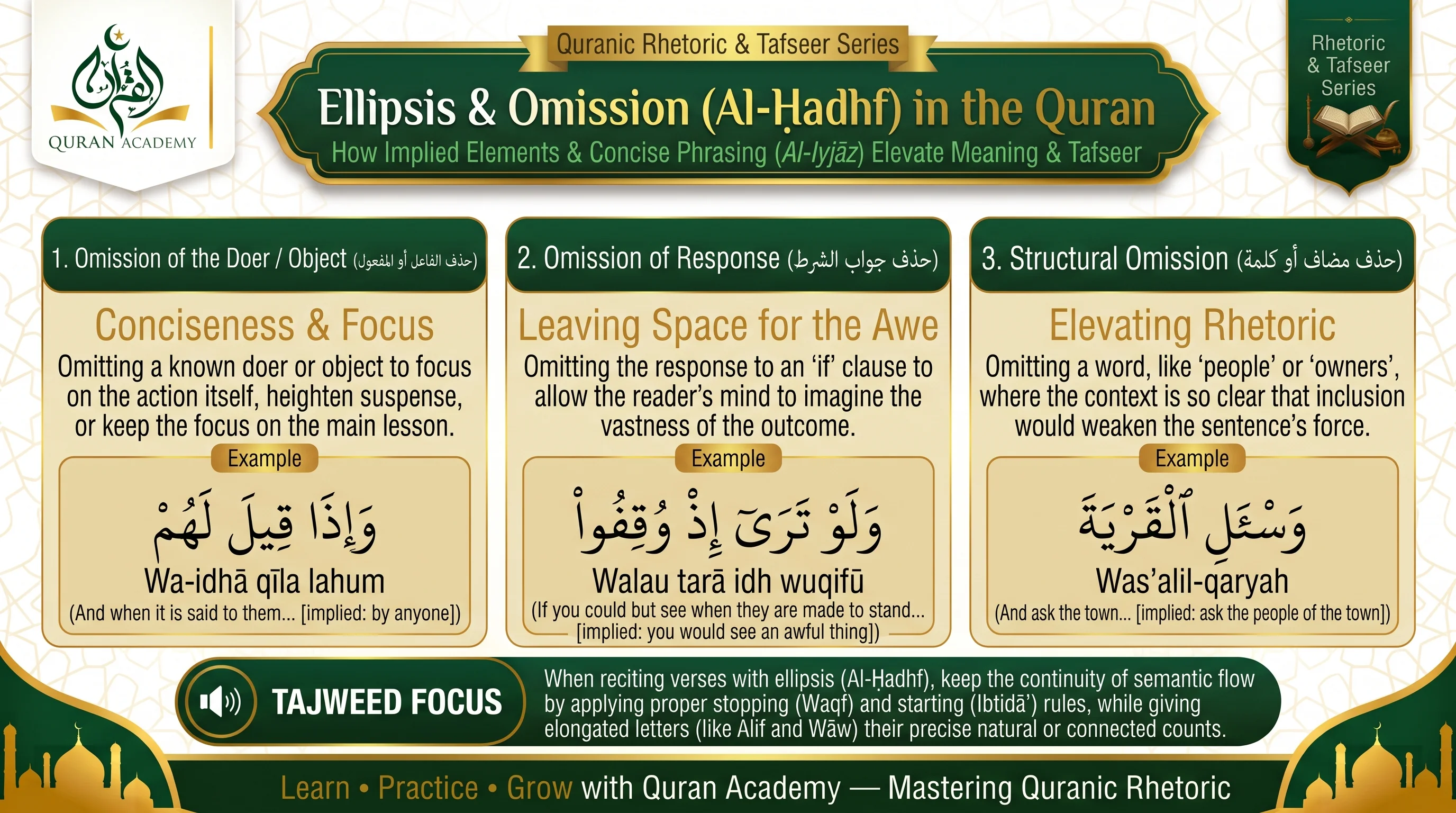
✦ Quick Answer & Key Takeaways: Ellipsis & Omission in Quran Tafseer
Exploring ellipsis omission in quran tafseer (الْإِيجَازُ وَالْحَذْفُ وَالتَّقْدِيرُ فِي التَّفْسِيرِ وَالْبَلَاغَةِ الْقُرْآنِيَّةِ) helps you appreciate how the Quran conveys sweeping wisdom in concise, memorable phrasing! In Arabic rhetoric (Balaghah), Al-Ijaz (الإيجاز) packs rich meaning into brief wording, while contextual omission (Al-Hadbf) leaves clear elements understood from context so the mind reflects actively and the verse retains its cadence! Continuing Day 4 of Matrix 6—and building upon our guides to Rhetorical Questions in Tafseer and Balaghah Rhetoric—this guide gives you a clear framework and 5 Tajweed rules. In our 1-on-1 Online Quranic Arabic & Tafseer Program, learners read compact verses with Quran Tafseer clarity!
- Compact Words, Vast Meaning: Concise Quranic phrasing invites deeper contemplation rather than passive skimming.
- Context Supplies Clarity: Surrounding verses and established Tafseer show what is understood in context.
- Rhythm & Impact: Leaving non-essential repetition aside keeps the verse's focus sharp and resonant.
- Tajweed Link: Never rush short verses—honor Madd counts, Ghunnah, Qalqalah, and Waqf!
In Surah Ash-Sharh (94:5–6), the phrase ﴿ فَإِنَّ مَعَ ٱلْعُسْرِ يُسْرًا ﴾ delivers a sweeping promise of relief in just a few words, while Surah Al-A'la (87:14–15) captures purification, remembering Allah's Name, and prayer in crisp, focused clauses!
For learners of Tafseer, brief or elliptical phrasing can sometimes feel sudden if you read too fast without checking context. Continuing Day 4 of Matrix 6 alongside our guides to Rhetorical Questions in Tafseer, Balaghah Rhetoric, and Tibaq & Muqabalah Contrast, this guide gives you an Ellipsis & Conciseness Chart and 5 Essential Tajweed Rules.
1. Master Chart: How Conciseness & Omission Work in Quranic Style
Compare 3 key dimensions of concise and elliptical phrasing in Quranic Tafseer below:
| Feature | What Happens in the Verse | Tafseer & Reflection Benefit |
|---|---|---|
| 1. الْإِيجَازُ (Conciseness) ⭐ | Broad, multi-layered guidance is expressed in compact wording. | Makes core principles easy to remember, recite, and apply in daily life. |
| 2. Contextual Omission 🏆 | A word or clause is left understood from context rather than repeated. | Prevents wordiness, preserves cadence, and invites thoughtful reflection. |
| 3. التَّقْدِيرُ (Implied Context) ⭐ | Scholars note the grammatically or contextually understood element. | Helps learners see sentence completeness without inventing ungrounded claims. |
2. How to Read Compact Verses Carefully Without Rushing or Over-Guessing
When a verse feels short or leaves something to context, read the verses immediately before and after it first, check trusted Tafseer commentary, and let the verse's natural rhythm settle in your heart before moving on!
Unhurried Recitation on Short Verses: Crisp Qalqalah on "Qutb Jadd" (ق ط ب ج د)!
Short, concise verses are tempting to rush through—so keep Qalqalah (Echoing) bounces (ق ط ب ج د) crisp and every vowel steady! Watch Senior Instructor Ustadhah Yasmeen Gamal demonstrate Qalqalah on our Quran Academy YouTube Channel:
- Precision in Every Syllable: Never rush compact Quranic verses!
- 1-on-1 Live Coaching: Study with certified Al-Azhar scholars!
3. Five Essential Tajweed Rules When Reciting Concise Verses
When reciting concise and elliptical verses in the Quran, apply these five Tajweed rules from our 1-on-1 Online Tajweed Course:
Struggling to Perfect Your Recitation?
Join 1,250+ students mastering the Quran 1-on-1 with our Verified Al-Azhar Graduates. Flexible US, UK, Canadian & Australian schedules starting at $8/hr.
Book a Free Evaluation Class →- 1. Full Madd Durations Without Clipping Short Verses:
Applying our Rules of Madd Guide and Matn Tuhfat Al-Atfal, give natural and elongated Madd letters their exact beat counts even when verses are brief! - 2. Clear Noon Sakinah & Tanween Rules:
Using our Noon Sakinah & Tanween Guide, apply Izhar, Idgham, Iqlab, and Ikhfaa' cleanly! - 3. Clear Meem Sakinah Rules:
According to our Meem Sakinah Rules Guide, apply Ikhfaa' Shafawi before Baa, Idgham Mithlayn before Meem, and Izhar Shafawi before other letters! - 4. Mindful Stopping (Waqf) & Madd Al-'Iwad on Fathatayn:
Using our Rules of Waqf Guide, pause cleanly and apply 2-count Madd Al-'Iwad on Fathatayn endings! - 5. Heavy vs. Light Raa Based on Vowels & Surrounding Letters:
Following our Ahkam Al-Raa, Makharij al-Huruf, Sifaat al-Huruf, Heavy & Light Letters, Laam Shamsiyyah & Qamariyyah, Hamzatul Wasl vs. Qat', 4 Special Words of Hafs, 7 Alifs in the Quran, Idgham Pairs, 10 Qira'at, Hafs vs. Warsh, Iltiqa' As-Sakinayn, Matn Al-Jazariyyah, 25 Common Tajweed Mistakes in Salah, An-Nabr (Vocal Stress), and 15 Sajdah Tilawah Verses guides, apply the exact vowel-based Raa rule! Test your Tajweed skills right now on our Free 3-Minute Tajweed Quiz!
Explore more Quranic Arabic and Surah Tafseer guides across our library: Rhetorical Questions in Tafseer, Balaghah Rhetoric, Tibaq & Muqabalah Contrast, Surah Ash-Sharh, and Surah Al-A'la (using our Interactive Tajweed Encyclopedia and Online Hadith Explorer)! Meet our Al-Azhar Certified Tutors, enroll your child in our 1-on-1 Kids Quran Classes with our Printable Kids Star Chart, and read how families across the US, UK, Canada, and Australia rate our teachers on our Verified Student & Parent Reviews Page.
4. Frequently Asked Questions (FAQs) About Ellipsis & Omission in Tafseer
1. What is "Al-Ijaz" (الْإِيجَازُ — Concise Expression) in Quranic rhetoric (Balaghah)?
In Quranic rhetoric (Balaghah), "Al-Ijaz" expresses rich, wide-ranging meaning in compact, well-chosen words—inviting the mind to reflect deeply without wordiness!
2. How does omission ("Al-Hadbf" / implied elements) work in Quranic Tafseer?
When context clearly points to a word or phrase, leaving it unstated can broaden the meaning, keep the rhythm brisk, and invite thoughtful reflection.
3. What is "At-Taqdir" (التَّقْدِيرُ) when scholars explain an implied element in a verse?
"At-Taqdir" is the scholarly clarification of what is grammatically or contextually understood in a verse so learners see how the statement holds together.
4. Why should students check context carefully before assuming a word is omitted?
Because Quranic phrasing is deliberate; reading surrounding verses and trusted Tafseer ensures accuracy and clarity.
5. What is a key Tajweed habit when reciting concise Quranic verses?
Avoid rushing through short or compact verses—keep every vowel, Madd count, Ghunnah, Qalqalah bounce, and stopping point crisp and unhurried!
Read & Reflect on the Quran With Deeper Clarity!
Master Quranic Arabic grammar, Tafseer, Hifz, and Tajweed in live 1-on-1 online lessons with certified male and female Al-Azhar scholars. Book your free trial session today!
Book Your Free 1-on-1 Trial Class →