
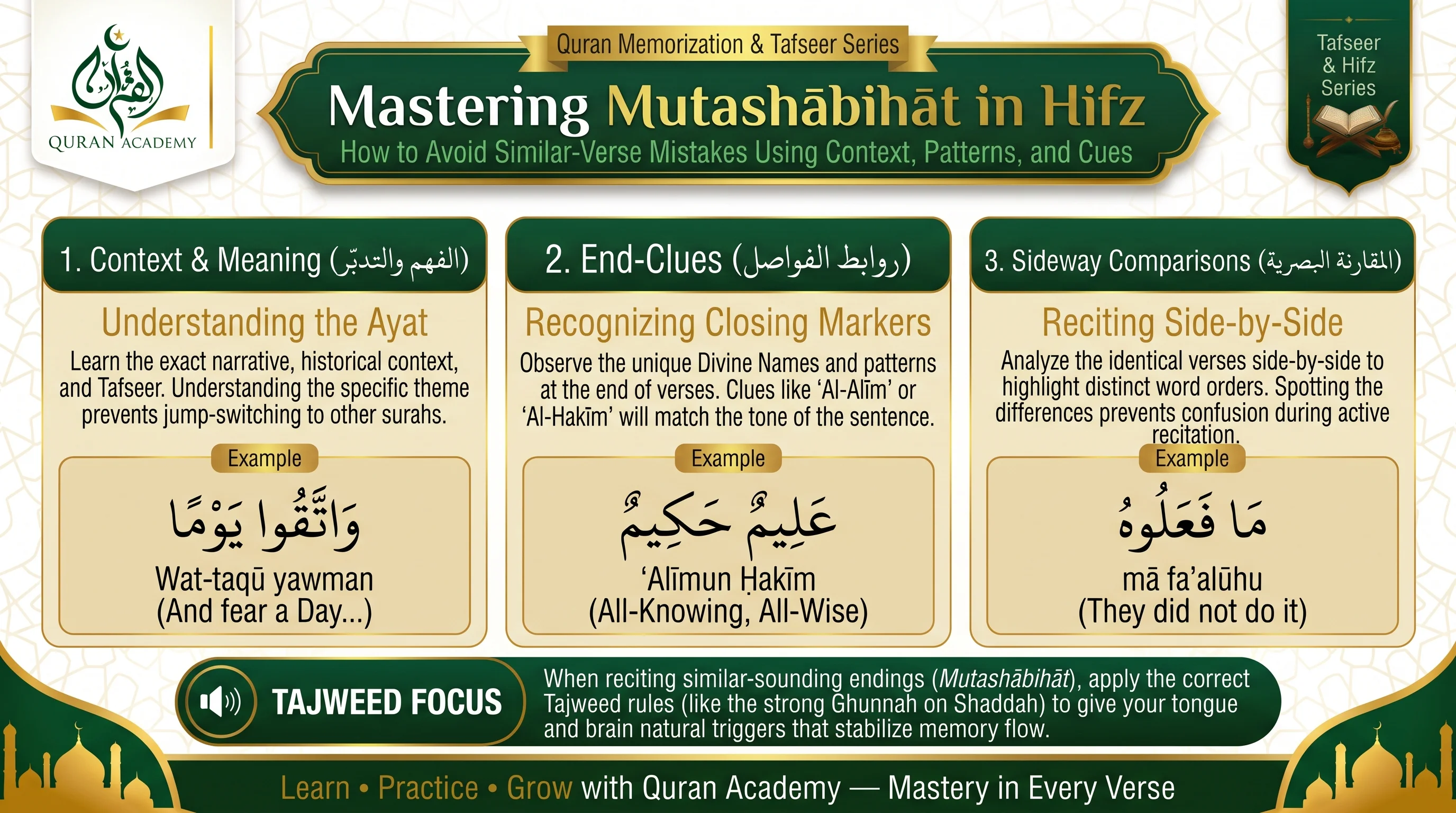
✦ Quick Answer & Key Takeaways: Avoid Mutashabihat Mistakes in Quran Hifz
Learning how to avoid mutashabihat mistakes quran hifz (تَفَادِي أَخْطَاءِ الْمُتَشَابِهَاتِ فِي حِفْظِ الْقُرْآنِ الْكَرِيمِ وَمُرَاجَعَتِهِ) protects your memorization from one of the most common hurdles in Hifz! Similar-looking verses or endings (Mutashabihat) trip up learners mainly when recitation runs on rushed sound rather than meaning. By pairing structured repetition—such as our 3x3 Memorization Method and 15-Minute Daily Quran Routine—with context and verse endings (Fawasil) and Quran Tafseer, you anchor each verse in its true place! Completing Day 3 of Matrix 6 (Articles 161–165), this guide gives you a 4-Step Mutashabihat Fix and 5 Tajweed rules. In our 1-on-1 Online Quran Memorization (Hifz) Program, teachers catch and lock in tricky verse distinctions with you!
- Meaning Stops Auto-Pilot: Knowing why a verse says what it says prevents swapping similar lines.
- Anchor the Closing Word: Tie each verse ending (Fasilah) to the verse's central point or emotion.
- Practice Verse-to-Verse Bridges: Connect the end of one verse to the opening of the next.
- Tajweed Slows the Tongue: Honor Madd, Ghunnah, Qalqalah, and Waqf so you never rush into the wrong verse!
You know the passage well, yet right in the middle of review, two similar verses collide—and suddenly you are unsure which phrase comes in Surah A versus Surah B, or whether the verse ends with one closing phrase or another! That slip happens to almost every Hifz student when speed outpaces awareness.
Treating every repeated slip as a clue rather than a failure turns weak spots into strong anchors. Completing Day 3 of Matrix 6 alongside our guides to Verse Endings & Hifz, Juz Amma Memorization, and Juz Tabarak Memorization, this guide presents a 4-Step Mutashabihat System and 5 Essential Tajweed Rules.
1. Master Chart: 4 Practical Steps to Fix Similar-Verse (Mutashabihat) Slips
Follow these 4 steps whenever two verses keep getting mixed up in your review:
| Step | Action to Take | Why It Works |
|---|---|---|
| 1. Spot the Exact Difference ⭐ | Look at the Mushaf and circle or note the exact word, grammar form, or ending that differs. | Turns a vague "I always mix these up" feeling into a concrete visual/mental check. |
| 2. Anchor Each in Context 🏆 | Read the surrounding verses and check the meaning or situation of each passage. | Context gives each similar verse a distinct story, argument, or theme. |
| 3. Link Preceding & Next Verse | Practice reciting from the verse before into the tricky verse and into the verse after. | Strong transitions prevent jumping sideways into a similar verse from elsewhere. |
| 4. Test Across Separate Days ⭐ | Re-check the pair in your next day's review—not just once in the same sitting. | Spaced recall confirms the distinction is truly stored in long-term memory. |
2. Review Habits That Keep Your Memory Anchored Under Pressure
Review with calm presence rather than racing to finish a quota; when you pause cleanly at verse endings and listen to your own voice, your mind stays alert to subtle differences in phrasing and flow!
Slow Down & Recite Cleanly: Crisp Qalqalah on "Qutb Jadd" (ق ط ب ج د)!
Careful Tajweed—including crisp Qalqalah (Echoing) bounces (ق ط ب ج د)—slows rushed review and keeps every syllable distinct! Watch Senior Instructor Ustadhah Yasmeen Gamal demonstrate Qalqalah on our Quran Academy YouTube Channel:
- Calm Review = Fewer Slips: Clarity protects Hifz accuracy!
- 1-on-1 Live Hifz Coaching: Guided retention with Al-Azhar scholars!
3. Five Essential Tajweed Rules During Hifz & Mutashabihat Review
Keep these five Tajweed rules from our 1-on-1 Online Tajweed Course active in every review session:
Struggling to Perfect Your Recitation?
Join 1,250+ students mastering the Quran 1-on-1 with our Verified Al-Azhar Graduates. Flexible US, UK, Canadian & Australian schedules starting at $8/hr.
Book a Free Evaluation Class →- 1. Steady Madd Counts Across Similar Verses:
Applying our Rules of Madd Guide and Matn Tuhfat Al-Atfal, give natural and elongated Madd letters their exact beat counts without rushing! - 2. Clear Noon Sakinah & Tanween Rules:
Using our Noon Sakinah & Tanween Guide, apply Izhar, Idgham, Iqlab, and Ikhfaa' cleanly! - 3. Clear Meem Sakinah Rules:
According to our Meem Sakinah Rules Guide, apply Ikhfaa' Shafawi before Baa, Idgham Mithlayn before Meem, and Izhar Shafawi before other letters! - 4. Mindful Stopping (Waqf) & Madd Al-'Iwad on Fathatayn:
Using our Rules of Waqf Guide, pause cleanly at verse endings and apply 2-count Madd Al-'Iwad on Fathatayn endings! - 5. Heavy vs. Light Raa Based on Vowels & Surrounding Letters:
Following our Ahkam Al-Raa, Makharij al-Huruf, Sifaat al-Huruf, Heavy & Light Letters, Laam Shamsiyyah & Qamariyyah, Hamzatul Wasl vs. Qat', 4 Special Words of Hafs, 7 Alifs in the Quran, Idgham Pairs, 10 Qira'at, Hafs vs. Warsh, Iltiqa' As-Sakinayn, Matn Al-Jazariyyah, 25 Common Tajweed Mistakes in Salah, An-Nabr (Vocal Stress), and 15 Sajdah Tilawah Verses guides, apply the exact vowel-based Raa rule! Test your Tajweed skills right now on our Free 3-Minute Tajweed Quiz!
With this guide, we complete Day 3 of Matrix 6 (Articles 161 to 165)—connecting Ma'rifah & Nakirah Nouns, Idafah Possessive Constructions, An-Na't Adjectives, Dharf Al-Zaman & Makan, Verse Endings & Hifz, and 3x3 Memorization Method (using our Smart Hifz Planner, Interactive Tajweed Encyclopedia, and Online Hadith Explorer)! Meet our Al-Azhar Certified Tutors, enroll your child in our 1-on-1 Kids Quran Classes with our Printable Kids Star Chart, and read how families across the US, UK, Canada, and Australia rate our teachers on our Verified Student & Parent Reviews Page.
4. Frequently Asked Questions (FAQs) About Mutashabihat in Quran Hifz
1. What are "Mutashabihat" (المُتَشَابِهَاتُ) in the context of Quran memorization (Hifz)?
In Hifz training, "Mutashabihat" refer to similar-looking or closely related verses that share similar openings, phrasing, stories, or verse endings with subtle differences in wording, order, or closing phrases.
2. Why do Hifz students most commonly confuse two similar verses?
The most common cause is memorizing purely by auditory rhythm without attending to the surrounding meaning, narrative progression, or context—especially when reviewing quickly.
3. What is the best way to train your memory on two verses that keep swapping places?
Isolate the two verses side by side, anchor each one to its distinct context or closing word (Fasilah), and recite each verse slowly with its surrounding verses until the difference feels clear.
4. Should a Hifz student memorize every single similar verse in the Quran at once to prevent mistakes?
No—focus first on mastering your current portion accurately with meaning and context, and address specific pairs as they come up in your Hifz or revision.
5. How does slow, accurate Tajweed help prevent Mutashabihat slips during review?
Slowing down to honor Madd counts, Ghunnah, Qalqalah, and stopping rules prevents rushed "auto-pilot" recitation where you jump into the wrong verse.
Build Strong, Error-Free Quran Hifz With a Scholar!
Memorize and revise the Holy Quran with clarity, meaning, and Tajweed precision in personalized 1-on-1 online lessons with certified male and female Al-Azhar scholars. Book your free trial session today!
Book Your Free 1-on-1 Trial Class →