
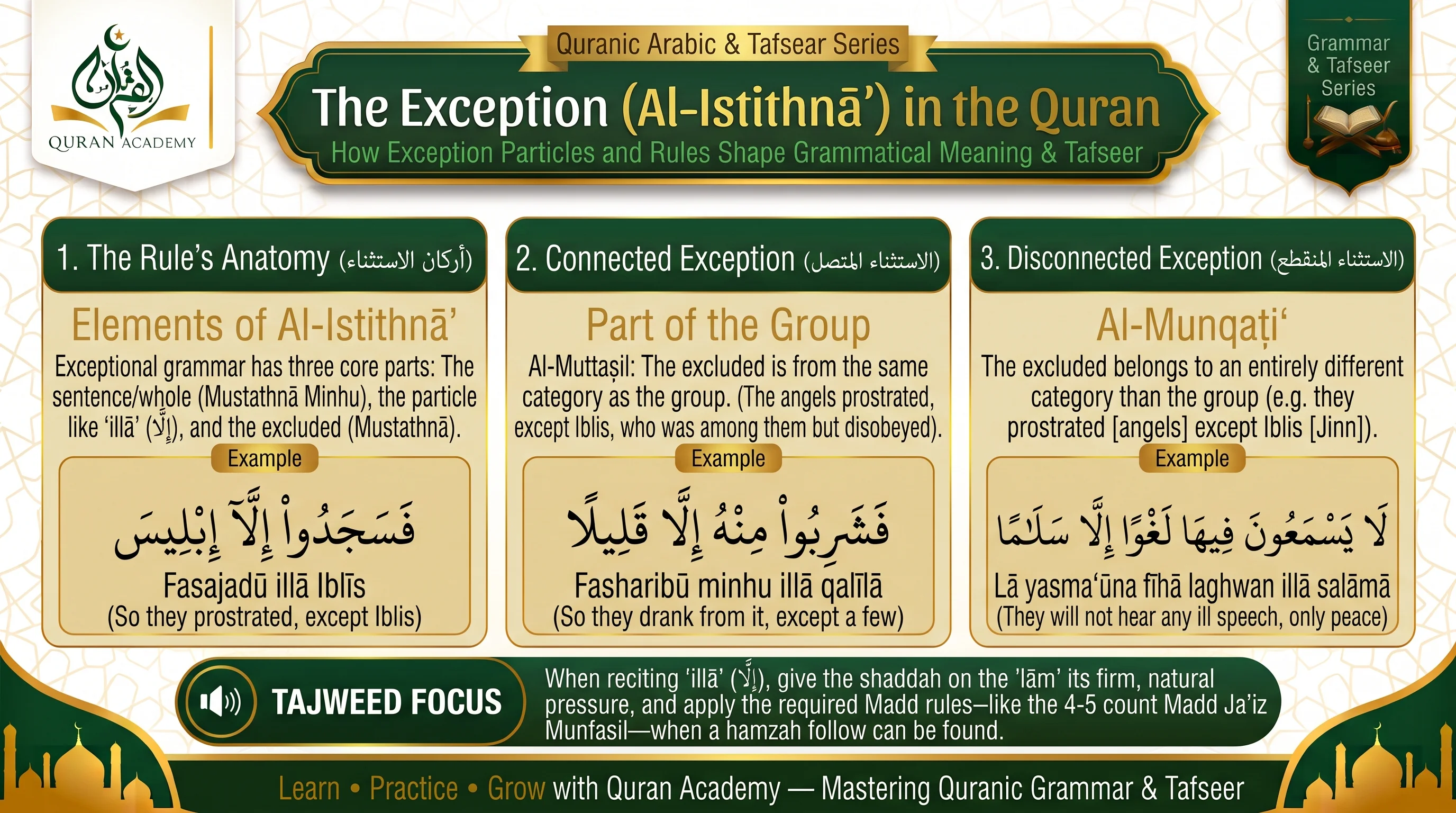
✦ Quick Answer & Key Takeaways: Exceptions (Al-Istithna') in Quran Tafseer
Mastering exceptions istithna in quran tafseer (الِاسْتِثْنَاءُ فِي النَّحْوِ وَالتَّفْسِيرِ الْقُرْآنِيِّ: الْمُتَّصِلُ وَالْمُنْقَطِعُ وَالْمُفَرَّغُ) solves some of the biggest theological questions in the Quran using simple grammar! In Arabic syntax (Nahw), Al-Istithna' (الاستثناء) excludes something from a general rule using tools like إِلَّا (Illa — except) or غَيْر (Ghayr — other than). When the exception belongs to the main group, it is Muttasil (متصل — Connected). When the exception is a completely different species or category, it is Munqati' (منقطع — Disconnected)—which proves why Iblis was never an angel despite being commanded to prostrate with them! Furthermore, Al-Istithna' Al-Mufarragh creates absolute exclusivity (like La ilaha illa Allah). Building upon our guides to Word Order Inversion and Vocative Particles, this guide continues Day 5 of Matrix 6. In our 1-on-1 Online Quranic Arabic & Tafseer Program, learners unlock these majestic boundaries!
- The 3 Pillars: The General Group (Mustathna Minhu), the Tool (Illa), and the Excluded Item (Mustathna).
- Muttasil vs. Munqati': Is the exception part of the original group, or something entirely different?
- Exclusive (Mufarragh): A negative particle + Illa creates absolute restriction (e.g., "Muhammad is not but a Messenger").
- Tajweed Connection: The word إِلَّا often meets a Hamzah in the next word, triggering a 4–5 count Madd Ja'iz Munfasil!
One of the most common questions raised by readers of the Quran is: "If Allah commanded the angels to prostrate to Adam, and Iblis refused, does that mean Iblis was a fallen angel?" The answer lies entirely in the grammar of Exception! Surah Al-Kahf (18:50) explicitly states: ﴿ فَسَجَدُوٓاْ إِلَّآ إِبْلِيسَ كَانَ مِنَ ٱلْجِنِّ ﴾ ("So they prostrated, EXCEPT Iblis; he was of the Jinn"). In Arabic, this is a Munqati' (Disconnected) exception—meaning the item excluded (Iblis) was never part of the original group (the angels) to begin with!
For learners of Quranic Arabic, understanding Al-Istithna' prevents major theological misunderstandings and highlights the sheer precision of Quranic words. Continuing Day 5 of Matrix 6 alongside our guides to Vocative Particles, Parables & Similes, and Repetition (At-Takrar), this guide gives you an Exceptions Chart and 5 Essential Tajweed Rules.
1. Master Chart: Types of Exceptions in Quranic Arabic
Compare the 3 categories of Al-Istithna' used in the Quran below:
| Type of Exception | Grammar & Logical Rule | Quranic Example |
|---|---|---|
| 1. مُتَّصِلٌ (Connected) ⭐ | The excluded item (Mustathna) is naturally part of the main group. | ﴿ فَشَرِبُواْ مِنْهُ إِلَّا قَلِيلًا مِّنْهُمْ ﴾ (2:249)—They drank, except a few of them. |
| 2. مُنْقَطِعٌ (Disconnected) 🏆 | The excluded item is NOT of the same kind/species as the main group. | ﴿ فَسَجَدُواْ إِلَّآ إِبْلِيسَ ﴾ (18:50)—Prostrated [the angels], except Iblis (a Jinn). |
| 3. مُفَرَّغٌ (Exclusive / Empty) ⭐ | A negative sentence where the main group is omitted, creating absolute restriction. | ﴿ وَمَا مُحَمَّدٌ إِلَّا رَسُولٌ ﴾ (3:144)—Muhammad is not but a Messenger. |
2. How the Exclusive Exception (Mufarragh) Anchors Tawheed
The highest form of affirmation in Arabic rhetoric is negation followed by an exception (An-Nafy wal-Istithna'). Saying "Allah is a deity" is a statement of fact, but saying "La ilaha illa Allah" (There is no deity except Allah) completely clears the field of all falsehood before planting the absolute truth of Tawheed!
Madd Munfasil on "Illaa" & Crisp Qalqalah!
When reciting إِلَّآ followed by a Hamzah (like Illaa Iblees), honor the 4–5 count Madd! And keep silent Qalqalah (Echoing) bounces (ق ط ب ج د) crisp elsewhere! Watch Senior Instructor Ustadhah Yasmeen Gamal demonstrate on our Quran Academy YouTube Channel:
- Grammar + Tajweed Clarity: Stretch the Madd exactly where required!
- 1-on-1 Live Coaching: Study with certified Al-Azhar scholars!
3. Five Essential Tajweed Rules When Reciting Exception Verses
When reciting verses with Al-Istithna' in the Quran, apply these five Tajweed rules from our 1-on-1 Online Tajweed Course:
Struggling to Perfect Your Recitation?
Join 1,250+ students mastering the Quran 1-on-1 with our Verified Al-Azhar Graduates. Flexible US, UK, Canadian & Australian schedules starting at $8/hr.
Book a Free Evaluation Class →- 1. "Madd Ja'iz Munfasil" on Illaa (إِلَّآ) Before Hamzah:
Applying our Rules of Madd Guide, if the word after Illaa begins with a Hamzatul Qat' (like إِلَّآ إِبْلِيسَ or إِلَّآ أَن), it forms a Permissible Separate Madd, stretched for 4 to 5 counts in Hafs! - 2. Clear Vocal Stress (An-Nabr) on the Shaddah of Illa (إِلَّا):
Applying our An-Nabr (Vocal Stress) Guide, press clearly on the doubled Laam so the Shaddah is heard crisply! - 3. Two-Count Madd Al-'Iwad When Stopping on Fathatayn ("Qaleelaa"):
Using our Rules of Waqf Guide, when the excluded word ends in Fathatayn (like إِلَّا قَلِيلًا) and you stop, apply a smooth 2-count Alif Madd 'Iwad! - 4. Clear Noon & Tanween Rules on "Ghayr" (غَيْر):
Using our Noon Sakinah & Tanween Guide, if an indefinite noun precedes Ghayr, apply the proper Ikhfaa' or Izhar! - 5. Heavy vs. Light Raa in "Ghayr" (غَيْر):
Following our Ahkam Al-Raa, Makharij al-Huruf, Sifaat al-Huruf, Heavy & Light Letters, Rules of Waqf, Hamzatul Wasl vs. Qat', 4 Special Words of Hafs, 7 Alifs in the Quran, Idgham Pairs, 10 Qira'at, Hafs vs. Warsh, Iltiqa' As-Sakinayn, Matn Al-Jazariyyah, 25 Common Tajweed Mistakes in Salah, and 15 Sajdah Tilawah Verses guides, the Raa in غَيْر depends on its vowel in continuation (like Kasrah in Ghayril-maghdoobi = Light), but if you stop on it, it becomes Light because of the preceding soft Yaa! Test your Tajweed skills right now on our Free 3-Minute Tajweed Quiz!
Explore more Quranic Arabic and Surah Tafseer guides across our library: Vocative Particles (Nida), Negation Particles, Word Order Inversion, Balaghah Rhetoric, and Surah Al-Kahf (using our Interactive Tajweed Encyclopedia and Online Hadith Explorer)! Meet our Al-Azhar Certified Tutors, enroll your child in our 1-on-1 Kids Quran Classes with our Printable Kids Star Chart, and read how families across the US, UK, Canada, and Australia rate our teachers on our Verified Student & Parent Reviews Page.
4. Frequently Asked Questions (FAQs) About Exceptions in the Quran
1. What is "Al-Istithna" (الِاسْتِثْنَاءُ — Exception) in Quranic Arabic?
In Arabic grammar, "Al-Istithna" is the process of excluding an entity from a general ruling using a specific particle, the most common of which is "Illa" (إِلَّا — except/but).
2. What is the difference between a Connected Exception (Muttasil) and a Disconnected Exception (Munqati')?
A Connected Exception means the excluded item is naturally part of the general group. A Disconnected Exception means the excluded item is NOT of the same kind—such as "The angels prostrated, except Iblis", proving Iblis was a Jinn, not a fallen angel!
3. What is "Al-Istithna' Al-Mufarragh" (The Exclusive Exception) in Quranic rhetoric?
This occurs when the sentence starts with a negation and the general group is omitted, leaving only the exception. It creates absolute restriction—such as "La ilaha illa Allah" (There is no deity worthy of worship except Allah).
4. Why does the word after "Illa" (إِلَّا) sometimes take Fathah (Nasb) and sometimes take Dammah (Raf')?
If the sentence is positive and complete, the word after Illa takes Nasb. In an exclusive (Mufarragh) sentence, Illa becomes a mere tool of restriction, and the noun takes whatever vowel its grammatical role demands.
5. What Tajweed rule often occurs when reciting "Illa" (إِلَّا) in the Quran?
Because Illa ends with an Alif Madd, if the next word begins with a Hamzatul Qat' (like Illaa Iblees), it creates a "Madd Ja'iz Munfasil" (Permissible Separate Prolongation), stretched for 4 to 5 counts!
Read & Reflect on the Quran With Deeper Clarity!
Master Quranic Arabic grammar, Tafseer, Hifz, and Tajweed in live 1-on-1 online lessons with certified male and female Al-Azhar scholars. Book your free trial session today!
Book Your Free 1-on-1 Trial Class →