
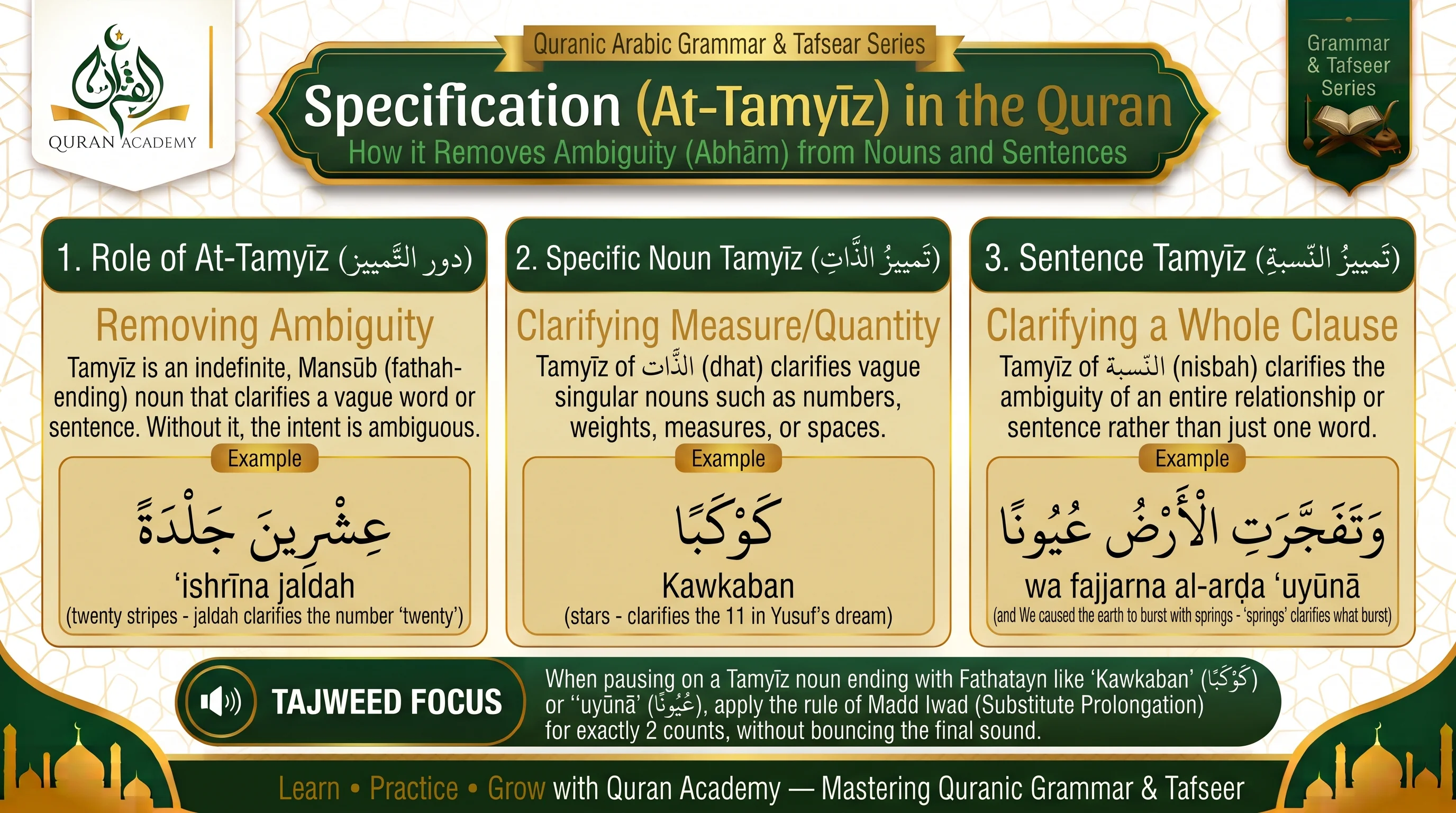
✦ Quick Answer & Key Takeaways: At-Tamyeez (Specification) in the Quran
Mastering at tamyeez specification in quran grammar (التَّمْيِيزُ فِي النَّحْوِ وَالتَّفْسِيرِ الْقُرْآنِيِّ: تَمْيِيزُ الذَّاتِ وَالنِّسْبَةِ) clears away ambiguity and paints sweeping, totalizing imagery! In Arabic syntax (Nahw), At-Tamyeez (التمييز) is an indefinite noun in the Nasb (Accusative/Fatha) case that removes vagueness from a preceding word (like a number) or an entire sentence. It answers the question "In what respect?" For example, when Prophet Zakariyya says in Surah Maryam (19:4) ﴿ وَٱشْتَعَلَ ٱلرَّأْسُ شَيْبًا ﴾ ("And the head has flared up with white hair"), the word Shayban specifies the exact nature of the flare! Building upon our guides to Al-Hal (State & Condition), Exceptions (Al-Istithna'), and Balaghah Rhetoric, this article serves as the grand finale of Matrix 6! In our 1-on-1 Online Quranic Arabic & Tafseer Program, learners unlock these majestic descriptions!
- Always Mansub: Like Al-Hal, At-Tamyeez takes Nasb (typically Fathatayn).
- Tamyeez vs. Hal: Hal answers "How?" (condition), while Tamyeez answers "In what respect?" (substance or specification).
- Rhetorical Power: It turns standard sentences into vivid metaphors (e.g., the earth "bursting with springs").
- Tajweed Connection: Stopping on a Tamyeez noun ending in Fathatayn requires a 2-count Madd Al-'Iwad!
If Surah Al-Qamar (54:12) simply said, "We caused springs to burst from the earth," it would be a standard description of water flowing. But the Quran uses a structural shift: ﴿ وَفَجَّرْنَا ٱلْأَرْضَ عُيُونًا ﴾ ("And We caused the earth to burst forth with springs"). By making the entire "earth" the object of the bursting, and adding Uyoonan (springs) as the Tamyeez, the imagery is magnified! It paints a picture of the earth itself turning into one massive, exploding network of springs!
For learners of Quranic Arabic, recognizing At-Tamyeez helps you distinguish it from Al-Hal and unlocks the dramatic imagery of the text. Concluding Matrix 6 (Articles 151–170) alongside our guides to Al-Hal (State), Word Order Inversion, and Parables & Similes, this guide gives you a Tamyeez Grammar Chart and 5 Essential Tajweed Rules.
1. Master Chart: Tamyeez of Essence (Dhaat) vs. Sentence (Nisbah)
Compare the 2 grammatical categories of Al-Tamyeez used in the Quran below:
| Type of Tamyeez | Grammar & Clarification Rule | Quranic Example |
|---|---|---|
| 1. تَمْيِيزُ الذَّاتِ / الْمُفْرَدِ (Of Essence) ⭐ | Clarifies a vague single word, most commonly a Number (from 11-99), weight, or measure. | ﴿ إِنِّي رَأَيْتُ أَحَدَ عَشَرَ كَوْكَبًا ﴾ (12:4)—Eleven STARS (Kawkaban). |
| 2. تَمْيِيزُ النِّسْبَةِ / الْجُمْلَةِ (Of Sentence) 🏆 | Clarifies the ambiguity of an entire sentence relationship (often shifted from a subject or object). | ﴿ وَٱشْتَعَلَ ٱلرَّأْسُ شَيْبًا ﴾ (19:4)—Flared up WITH WHITE HAIR. |
| 3. بَعْدَ أَفْعَلِ التَّفْضِيلِ (After Elative Noun) ⭐ | Clarifies the aspect in which someone is "more" or "greater" (After Ism At-Tafdil). | ﴿ أَنَا۠ أَكْثَرُ مِنكَ مَالًا وَأَعَزُّ نَفَرًا ﴾ (18:34)—Greater IN WEALTH and mightier IN MEN. |
2. Visualizing Tafseer: How "Tamyeez" Magnifies the Imagery
When the Quran uses Tamyeez An-Nisbah, it often shifts the grammar to create an overwhelming image. In ﴿ وَفَجَّرْنَا ٱلْأَرْضَ عُيُونًا ﴾, instead of the literal "We caused the springs of the earth to burst," the structure makes the whole earth the object of the bursting, with Uyoonan specifying how! It implies the water was so abundant it was as if the earth itself had become one giant spring!
Madd Al-'Iwad on "At-Tamyeez" Stops & Crisp Qalqalah!
Because At-Tamyeez often ends in Fathatayn (ـًا), stopping on it requires a smooth 2-count Madd (Madd Al-'Iwad)! Keep Qalqalah (Echoing) bounces (ق ط ب ج د) crisp elsewhere! Watch Senior Instructor Ustadhah Yasmeen Gamal demonstrate on our Quran Academy YouTube Channel:
- Grammar + Tajweed Clarity: End verses smoothly and accurately!
- 1-on-1 Live Coaching: Study with certified Al-Azhar scholars!
3. Five Essential Tajweed Rules When Reciting "At-Tamyeez"
When reciting verses with specification structures, apply these five Tajweed rules from our 1-on-1 Online Tajweed Course:
Struggling to Perfect Your Recitation?
Join 1,250+ students mastering the Quran 1-on-1 with our Verified Al-Azhar Graduates. Flexible US, UK, Canadian & Australian schedules starting at $8/hr.
Book a Free Evaluation Class →- 1. Two-Count Madd Al-'Iwad When Stopping on Fathatayn ("Shaybaa", "Uyoonaa"):
Applying our Rules of Waqf Guide, when you stop on a Tamyeez noun ending with Fathatayn, drop the "N" sound and stretch the Alif for a smooth 2 counts! - 2. Clear Noon & Tanween Rules in Continuation:
Using our Noon Sakinah & Tanween Guide, if you continue reciting past the Fathatayn into the next verse, apply Izhar, Idgham, Iqlab, or Ikhfaa' based on the following letter! - 3. Proper Madd Counts on Internal Vowels:
According to our Rules of Madd Guide, give natural Madd letters (like the Waw in 'Uyoonan) their full 2-count stretch. - 4. Clear Meem Sakinah Rules:
Using our Meem Sakinah Rules Guide, apply Ikhfaa' Shafawi before Baa, Idgham Mithlayn before Meem, and Izhar Shafawi cleanly! - 5. Heavy vs. Light Raa Based on Vowels & Surrounding Letters:
Following our Ahkam Al-Raa, Makharij al-Huruf, Sifaat al-Huruf, Heavy & Light Letters, Laam Shamsiyyah & Qamariyyah, Hamzatul Wasl vs. Qat', 4 Special Words of Hafs, 7 Alifs in the Quran, Idgham Pairs, 10 Qira'at, Hafs vs. Warsh, Iltiqa' As-Sakinayn, Matn Al-Jazariyyah, 25 Common Tajweed Mistakes in Salah, and 15 Sajdah Tilawah Verses guides, apply the exact vowel-based Raa rule! Test your Tajweed skills right now on our Free 3-Minute Tajweed Quiz!
With this guide, we successfully complete Matrix 6 in its entirety (Articles 151 to 170) and reach a monumental milestone of 170 published articles! Explore the highlights of Matrix 6 across our library: Al-Hal (State), Exceptions (Al-Istithna'), Parables & Similes, Vocative Particles, Word Order Inversion, and Balaghah Rhetoric (using our Interactive Tajweed Encyclopedia and Online Hadith Explorer)! Meet our Al-Azhar Certified Tutors, enroll your child in our 1-on-1 Kids Quran Classes with our Printable Kids Star Chart, and read how families across the US, UK, Canada, and Australia rate our teachers on our Verified Student & Parent Reviews Page.
4. Frequently Asked Questions (FAQs) About Tamyeez in the Quran
1. What is "At-Tamyeez" (التَّمْيِيزُ — Specification / Clarification) in Quranic Arabic grammar?
In Arabic syntax (Nahw), "At-Tamyeez" is an indefinite noun in the accusative case (Nasb) that removes ambiguity or vagueness from a preceding word or entire sentence. It answers the question "In what aspect?"
2. What is the difference between "Tamyeez" (Specification) and "Hal" (State)?
While both are indefinite nouns in Nasb, "Al-Hal" answers the question "How?" (describing a temporary state), whereas "At-Tamyeez" answers "In what respect?" (clarifying substance, measure, or aspect, like "flared up with white hair").
3. What is "Tamyeez An-Nisbah" (Sentence Specification) in the Quran?
This occurs when an entire sentence is structurally complete but logically vague until the Tamyeez clarifies it. For example, "We caused the earth to burst forth..." —burst with what? "...with springs!" (Uyoonan) (54:12).
4. How does "At-Tamyeez" elevate the rhetorical beauty of a Quranic verse?
By shifting the grammar, the Quran creates a totalizing image. Saying "The head flared up with white hair" (19:4) is far more powerful than saying "The hair turned white", as it paints the entire head engulfed in the "flame" of white hair!
5. What Tajweed rule is most important when stopping on a "Tamyeez" noun in the Quran?
Because At-Tamyeez is Mansub and usually ends with Fathatayn on an Alif, stopping (Waqf) on it requires applying "Madd Al-'Iwad"—replacing the "an" sound with a 2-count Alif Madd!
Read & Reflect on the Quran With Deeper Clarity!
Master Quranic Arabic grammar, Tafseer, Hifz, and Tajweed in live 1-on-1 online lessons with certified male and female Al-Azhar scholars. Book your free trial session today!
Book Your Free 1-on-1 Trial Class →