
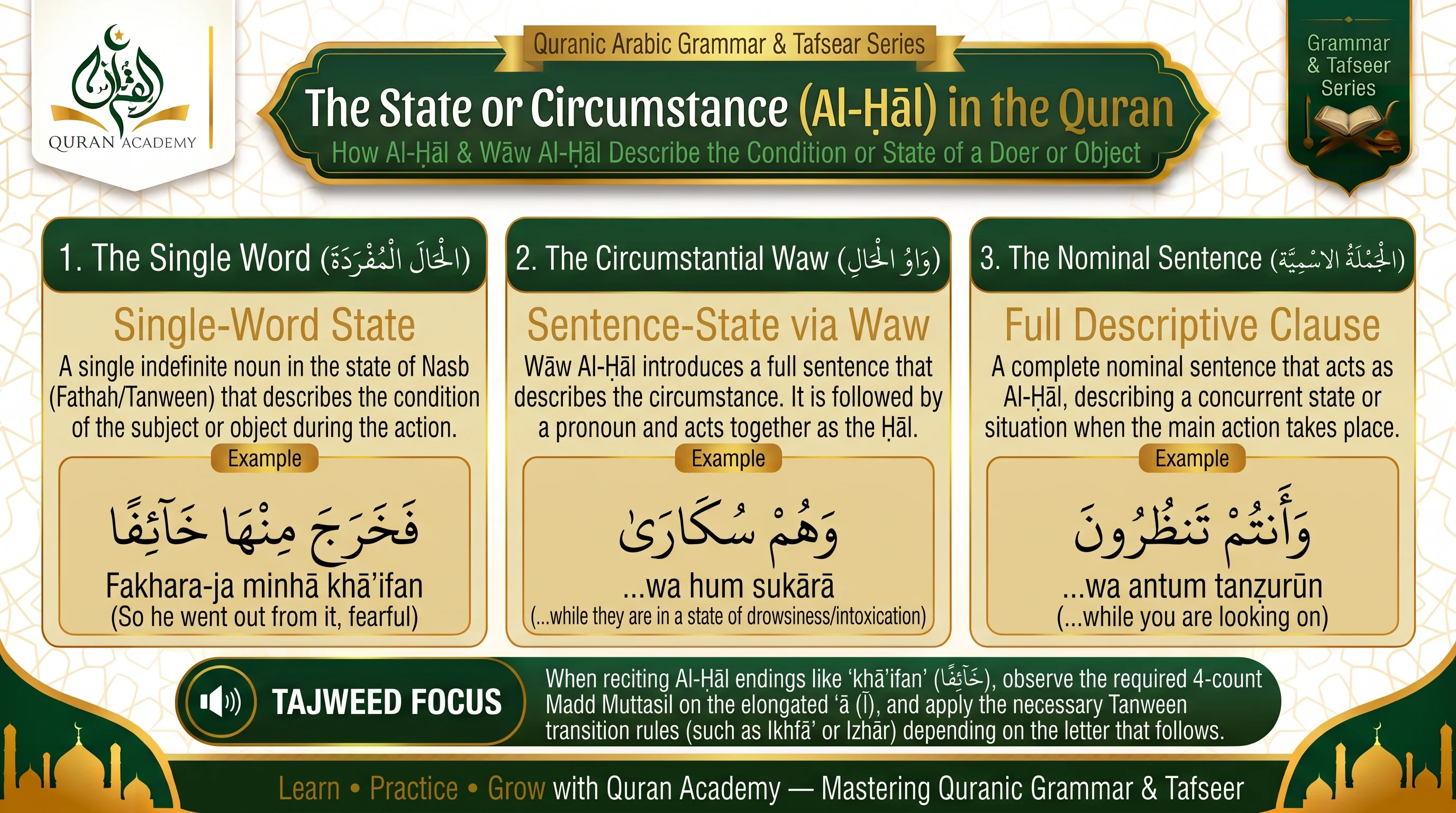
✦ Quick Answer & Key Takeaways: Al-Hal (State) in the Quran
Mastering al hal state condition quran grammar (الْحَالُ وَصَاحِبُ الْحَالِ فِي النَّحْوِ وَالتَّفْسِيرِ الْقُرْآنِيِّ) completely changes how you visualize Quranic scenes! In Arabic syntax (Nahw), Al-Hal (الحال) is a descriptive word or sentence that explains the exact state, emotion, or posture of the subject/object at the moment the action takes place. It answers the question "How?" and is always in the Nasb (Accusative/Fatha) case! For example, when Surah An-Nisa (4:28) states ﴿ وَخُلِقَ ٱلْإِنسَانُ ضَعِيفًا ﴾ ("And mankind was created weak"), the word Da'eefan is the Hal describing humanity's innate state! Building upon our guides to An-Na't Adjectives and Ma'rifah & Nakirah, this guide continues Day 5 of Matrix 6. In our 1-on-1 Online Quranic Arabic & Tafseer Program, learners spot Al-Hal vividly in Quran Tafseer!
- Always Mansub: A single-word Hal always takes Nasb (Fathatayn for singular, -een for plurals).
- Sahib Al-Hal: The entity being described must be definite (Ma'rifah) or a pronoun, while the Hal is usually indefinite.
- Waw Al-Hal: A whole sentence can act as a Hal, introduced by a Waw meaning "while" (e.g., "WHILE you are...").
- Tajweed Connection: Stopping on a singular Hal requires a 2-count Madd Al-'Iwad instead of pronouncing the "N" sound!
If you read a verse like ﴿ فَتَبَسَّمَ ضَاحِكًا ﴾ ("So he smiled, laughing" — An-Naml 27:19), you might wonder why Dahikan ends with Fathatayn rather than matching the verb. Or when believers are described praying, why does it say ﴿ سُجَّدًا ﴾ (Sujjadan) or ﴿ خَاشِعِينَ ﴾ (Khashi'een)? It is because these words do not just name an action; they paint a real-time, emotional picture of how the action is performed!
For learners of Quranic Arabic, mistaking a Hal for a direct object or a regular adjective obscures the vivid imagery the Quran intends to build. Continuing Day 5 of Matrix 6 alongside our guides to An-Na't Adjectives, Exceptions (Al-Istithna'), and Parables & Similes, this guide gives you an Al-Hal Grammar Chart and 5 Essential Tajweed Rules.
1. Master Chart: Types of "Al-Hal" (Single Word vs. Sentence)
Compare the 3 grammatical structures of Al-Hal used in the Quran below:
| Type of Hal | Grammar & Marking Rule | Quranic Example |
|---|---|---|
| 1. الْحَالُ الْمُفْرَدُ (Single Word) ⭐ | An indefinite noun in Nasb (Fathatayn for sing., -een for plurals). | ﴿ وَخُلِقَ ٱلْإِنسَانُ ضَعِيفًا ﴾ (4:28) & ﴿ وَيَخِرُّونَ لِلْأَذْقَانِ يَبْكُونَ ﴾ (sometimes acts as Hal). |
| 2. وَاوُ الْحَالِ (Nominal Sentence) 🏆 | A full nominal sentence introduced by a Waw meaning "while". | ﴿ لَا تَقْرَبُواْ ٱلصَّلَاةَ وَأَنتُمْ سُكَارَىٰ ﴾ (4:43)—Do not approach prayer WHILE you are intoxicated. |
| 3. الْحَالُ الْجُمْلَةُ (Verbal Sentence) | A verb phrase following a definite noun, acting as its real-time state. | ﴿ وَجَآءُوٓاْ أَبَاهُمْ عِشَآءً يَبْكُونَ ﴾ (12:16)—And they came to their father at night, weeping. |
2. Visualizing Tafseer: How "Al-Hal" Paints the Scene
Unlike a regular adjective (which describes a permanent or general trait), Al-Hal describes a temporary state bonded to a specific action. When Allah describes believers entering the prayer خَاشِعِينَ (Khashi'een), it means the very act of entering and standing is enveloped in total, trembling humility!
Madd Al-'Iwad on "Al-Hal" Stops & Crisp Qalqalah!
Because Al-Hal often ends in Fathatayn (ـًا), stopping on it requires a smooth 2-count Madd (Madd Al-'Iwad)! Keep Qalqalah (Echoing) bounces (ق ط ب ج د) crisp elsewhere! Watch Senior Instructor Ustadhah Yasmeen Gamal demonstrate on our Quran Academy YouTube Channel:
- Grammar + Tajweed Clarity: End verses smoothly and accurately!
- 1-on-1 Live Coaching: Study with certified Al-Azhar scholars!
3. Five Essential Tajweed Rules When Reciting "Al-Hal"
When reciting verses with state and condition structures, apply these five Tajweed rules from our 1-on-1 Online Tajweed Course:
Struggling to Perfect Your Recitation?
Join 1,250+ students mastering the Quran 1-on-1 with our Verified Al-Azhar Graduates. Flexible US, UK, Canadian & Australian schedules starting at $8/hr.
Book a Free Evaluation Class →- 1. Two-Count Madd Al-'Iwad When Stopping on Fathatayn ("Da'eefaa"):
Applying our Rules of Waqf Guide, when you stop on a singular Hal like ضَعِيفًا, drop the "N" sound and stretch the Alif for a smooth 2 counts! - 2. Clear Noon & Tanween Rules in Continuation:
Using our Noon Sakinah & Tanween Guide, if you continue reciting past the Fathatayn, apply Izhar, Idgham, Iqlab, or Ikhfaa' based on the next letter! - 3. Proper "Madd 'Arid Lis-Sukoon" on Plural Hal ("Khashi'een"):
According to our Rules of Madd Guide and Matn Tuhfat Al-Atfal, when stopping on a plural Hal ending in -een, lengthen the Yaa Madd for 2, 4, or 6 counts consistently! - 4. Clear Meem Sakinah Rules on Waw Al-Hal Sentences ("Wa-antum"):
Using our Meem Sakinah Rules Guide, apply Ikhfaa' Shafawi before Baa, Idgham Mithlayn before Meem, and Izhar Shafawi cleanly in sentences starting with Wa-antum! - 5. Heavy vs. Light Raa Based on Vowels & Surrounding Letters:
Following our Ahkam Al-Raa, Makharij al-Huruf, Sifaat al-Huruf, Heavy & Light Letters, Laam Shamsiyyah & Qamariyyah, Hamzatul Wasl vs. Qat', 4 Special Words of Hafs, 7 Alifs in the Quran, Idgham Pairs, 10 Qira'at, Hafs vs. Warsh, Iltiqa' As-Sakinayn, Matn Al-Jazariyyah, 25 Common Tajweed Mistakes in Salah, and 15 Sajdah Tilawah Verses guides, apply the exact vowel-based Raa rule! Test your Tajweed skills right now on our Free 3-Minute Tajweed Quiz!
Explore more Quranic Arabic and Surah Tafseer guides across our library: An-Na't Adjectives, Exceptions (Al-Istithna'), Parables & Similes, Vocative Particles (Nida), and Surah An-Nisa (using our Interactive Tajweed Encyclopedia and Online Hadith Explorer)! Meet our Al-Azhar Certified Tutors, enroll your child in our 1-on-1 Kids Quran Classes with our Printable Kids Star Chart, and read how families across the US, UK, Canada, and Australia rate our teachers on our Verified Student & Parent Reviews Page.
4. Frequently Asked Questions (FAQs) About Al-Hal in the Quran
1. What is "Al-Hal" (الْحَالُ — State/Condition) in Quranic Arabic grammar?
In Arabic syntax (Nahw), "Al-Hal" is a descriptive noun or phrase that explains the state or condition of the subject or object at the exact time the action occurs—always in the Nasb (accusative) case.
2. Who is "Sahib Al-Hal" (صَاحِبُ الْحَالِ) in a Quranic sentence?
"Sahib Al-Hal" is the entity whose state is being described. Grammatically, it must be a definite noun (Ma'rifah) or a pronoun, whereas the single-word Hal is usually indefinite (Nakirah).
3. Why do words acting as "Hal" in the Quran typically end in Fathatayn (-an) or "-een"?
Because Al-Hal is always Mansub (Nasb). A singular noun will end in Fathatayn (like Khashi'an), and a sound masculine plural will end in -een (like Khashi'een).
4. What is "Waw Al-Hal" (وَاوُ الْحَالِ) in the Quran?
"Waw Al-Hal" is the conjunction "while" that links the main action to a descriptive nominal sentence—such as "Wa antum sukara" (WHILE you are intoxicated) in Surah An-Nisa 4:43.
5. What Tajweed rule is most important when stopping on a singular "Hal" in the Quran?
If you stop (Waqf) on a Hal ending with Fathatayn on an Alif (like Da'eefan), you must apply "Madd Al-'Iwad"—replacing the "an" sound with a 2-count Alif Madd (Da'eefaa)!
Read & Reflect on the Quran With Deeper Clarity!
Master Quranic Arabic grammar, Tafseer, Hifz, and Tajweed in live 1-on-1 online lessons with certified male and female Al-Azhar scholars. Book your free trial session today!
Book Your Free 1-on-1 Trial Class →