
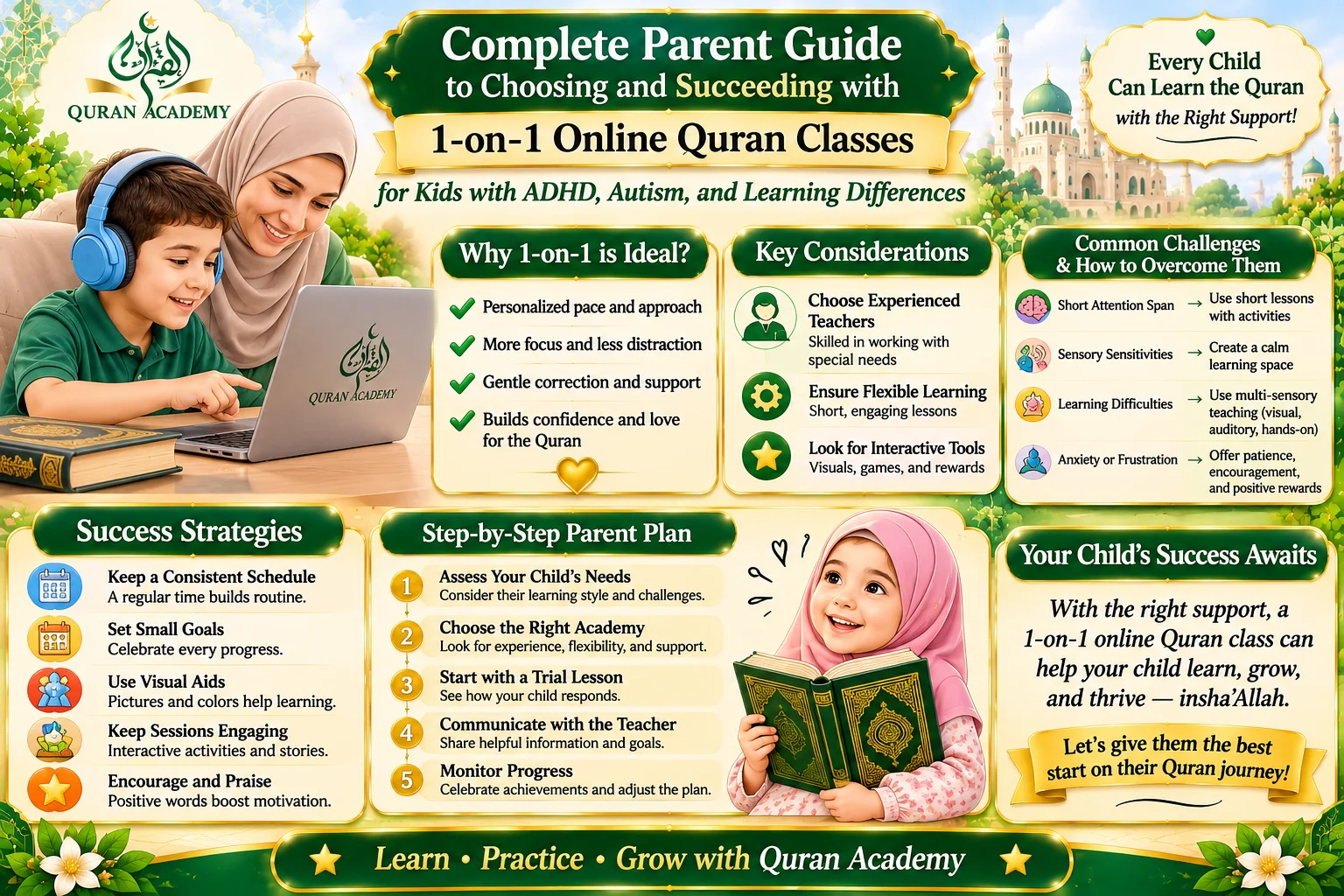
✦ Quick Answer & Key Takeaways: Online Quran Classes for Kids with ADHD & Autism
Choosing online quran classes for kids with adhd or autism works best when the lesson adapts to your child’s real attention window, sensory comfort, and learning pace—not the other way around. Instead of loud 45-minute weekend group halls, live 1-on-1 Zoom sessions let your child learn in calm 15- to 20-minute micro-sessions (or a 30-minute class split into three predictable blocks), move or fidget freely, keep the camera optional when needed, and progress one ayah at a time with a patient Al-Azhar tutor.
- Strictly 1-on-1 Focus: Zero background noise, zero peer comparison, and the same calm male or female tutor every session.
- Predictable, Short Blocks: Structured 3-part lessons with a visual checklist, short rhythmic recitation, a 30-second movement break, and a positive wrap-up.
- 3-Question Parent Intake: Share your child’s focus window, favorite interests, and stress triggers before the first free trial so the tutor is prepared from minute one.
- Transparent & Risk-Free: Same standard tuition ($4 per 30-minute class / $8 per hour, plans from $32/month), a zero-pressure free trial, and a 30-Day Money-Back Guarantee.
If you are raising a child with ADHD, autism, or processing differences in the US, UK, Canada, or Australia, you probably know the quiet ache that comes with Sunday school or local weekend madrasah. You want your child to love the Book of Allah, feel at home in their Muslim identity, and build a steady connection with the Quran. Yet after a few weeks in a crowded classroom, you hear the same exhausting feedback: “He won’t sit still,” “She zones out during recitation,” or “He gets overwhelmed when it’s his turn.”
Too many families end up pulling their children out of Quran classes altogether—not because the child cannot learn, and certainly not because the child does not belong in the Quran, but because traditional group classrooms were never designed for different attention cycles or sensory profiles. When a child has to spend 80% of their mental energy forcing their body to sit still, filtering out fifteen other voices, and worrying about being called on in front of peers, almost no energy is left for reading Arabic letters or memorizing a Surah.
This parent guide is written to give you a clear, honest roadmap. Whether you are evaluating online Quran classes for kids with ADHD and autism for the first time or trying to rebuild confidence after a difficult classroom experience, you will find the exact questions to ask any academy, a minute-by-minute look at how calm 1-on-1 micro-sessions work on Zoom, practical home-support tips, and gentle Tajweed and Hifz strategies that respect how your child actually learns.
- 1. Why Traditional Group Quran Classes Often Overwhelm Neurodivergent Kids
- 2. Six Practical Questions Every Parent Should Ask Any Online Quran Academy
- 3. Inside a Flexible 1-on-1 Session: The 3-Block Routine (15–20 Min or Split 30 Min)
- 4. Adapting Quran Lessons: ADHD vs. Autism vs. Reading & Processing Differences
- 5. Preparing for Day One: The 3-Question Parent Intake & Sensory-Safe Setup
- 6. Gentle Hifz & Tajweed: The “One Ayah at a Time” Method Without Burnout
- 7. The 5-Minute Home Review Routine (Without Turning Home Into a Battleground)
- 8. Frequently Asked Questions From Parents of Kids With ADHD & Autism
1. Why Traditional Group Quran Classes Often Overwhelm Neurodivergent Kids
Before blaming a lack of motivation, it helps to look honestly at what a standard weekend Quran classroom asks a child to tolerate. In most in-person group settings, ten to twenty children sit on the floor or at long tables for 60 to 120 minutes. Multiple students recite out loud at the same time, fluorescent lights hum overhead, and a single teacher rotates from student to student while everyone else is expected to wait quietly.
For a child with ADHD, waiting ten minutes for a two-minute turn is practically an invitation to fidget, talk, or lose the page. For an autistic child, overlapping voices, unpredictable transitions, and sudden corrections in front of classmates can trigger genuine sensory overload. Once a child associates the Mushaf with scolding, embarrassment, or physical discomfort, resistance builds fast—often showing up as tears before class or saying Quran class feels boring or too hard.
Moving to a private 1-on-1 live online class on Zoom removes those environmental barriers immediately. Your child learns from a familiar room at home, uses headphones if they prefer softer audio, never waits in a noisy line, and receives undivided patience from a teacher who only has to focus on one student at a time.
| Learning Factor | Traditional Group Madrasah | Flexible 1-on-1 Online Zoom Class |
|---|---|---|
| Sensory Environment | Echoing room, 15+ voices, bright lights, frequent interruptions. | Quiet home comfort; child controls lighting, seating, and audio volume. |
| Session Length & Pace | Fixed 45–90 minute blocks with rigid weekly page quotas. | 15–20 min micro-sessions or 30-min split into 3 predictable blocks. |
| Movement & Fidgeting | Repeatedly told to “sit still and keep hands down.” | Movement welcomed: wiggle cushion, quiet fidget toy, or 30-second stretch break. |
| Social & Camera Pressure | Reading aloud in front of peers; mistakes feel public. | 100% private; camera-optional if direct eye contact feels overwhelming. |
| Parent Visibility | Drop-off model; parents rarely see how corrections happen. | Parent can sit nearby and receive a 3-line summary for 5-minute home review. |
2. Six Practical Questions Every Parent Should Ask Any Online Quran Academy
Not every online academy that advertises “kids classes” is ready to slow down and adapt for a child with ADHD or autism. Before you sign up anywhere, ask these six practical questions—and pay close attention to how specific the answers are:
- “Is the class strictly 1-on-1 with the same tutor every week?”
Consistency matters deeply for autistic learners and kids who take time to warm up. Rotating substitute teachers forces your child to re-establish trust from scratch. At Quran Academy, every student is paired with one dedicated male or female Al-Azhar tutor for private 1-on-1 sessions. - “Can we do shorter 15- to 20-minute sessions, or break 30 minutes into smaller chunks?”
If an academy insists on 45- or 60-minute slots for a seven-year-old with ADHD, walk away. Short, focused sessions where your child finishes feeling proud beat long sessions that end in tears every single time. - “How will the teacher learn about my child’s triggers and interests before class starts?”
Look for a structured intake process. At Quran Academy, parents complete a quick 3-question Parent Intake before the trial—sharing typical focus length, favorite topics (like animals, space, or Lego), and anything that causes stress—so the tutor enters the Zoom room already prepared. - “Are movement breaks, fidget tools, and camera-off moments allowed without scolding?”
A patient teacher understands that a child bouncing gently on a therapy ball or holding a quiet stress ball may actually be listening better than a child forced to freeze. Similarly, allowing camera-off or screen-only interaction removes eye-contact anxiety. - “Is the free trial a gentle meet-and-greet, or a stressful placement exam?”
Many neurodivergent kids shut down when they feel tested by a stranger. A good trial class focuses on warmth, rapport, and a couple of easy wins on the interactive whiteboard so your child logs off smiling. - “Do you charge extra fees for adapted pacing, and what is your refund policy?”
Parents of neurodivergent kids already face enough extra costs. At Quran Academy, tuition is the exact same transparent rate as all our 1-on-1 programs—starting at $4 per 30-minute class ($8/hour, plans from $32/month)—and every enrollment is backed by our 30-Day Money-Back Guarantee.
3. Inside a Flexible 1-on-1 Session: The 3-Block Routine (15–20 Min or Split 30 Min)
Structure and flexibility might sound like opposites, but together they are the secret to calm Quran lessons. Children with autism feel safer when they can see what is coming next; children with ADHD stay engaged when activities switch before boredom sets in. That is why we organize lessons into three clear, predictable blocks rather than one long stretch of monotonous reading:
| Session Block | What Happens on Screen | Why It Helps Your Child |
|---|---|---|
| Block 1: Warm-Up & Visual Checklist (First 5 Minutes) |
Warm Salam, checking in on your child’s favorite interest, and showing a simple 3-step visual plan on screen (e.g., 1. Letter Warm-Up → 2. One Ayah → 3. Star Win). | Removes transition anxiety. Your child immediately sees how short and manageable the class is. |
| Block 2: Short Recitation + Stretch Break (Middle 5–10 Minutes) |
Zoomed-in, uncluttered text showing just one line or one ayah at a time, gentle rhythmic echoing (Talqeen), followed by a 30-second stand-and-stretch break. | Prevents visual overwhelm and lets restless energy out cleanly before focus drops. |
| Block 3: Visual Activity & Star Wrap-Up (Final 5 Minutes) |
Color-coded letter matching on the interactive whiteboard, a brief 2-minute Prophetic story, and celebrating effort on our Printable Kids Star Reward Chart. | Ends every class on a calm, positive note so your child looks forward to logging in next time. |
4. Adapting Quran Lessons: ADHD vs. Autism vs. Reading & Processing Differences
Every child is unique, and many children have overlapping traits. While our tutors are Quran and Arabic educators—not medical clinicians or therapists—practical classroom adjustments make a world of difference depending on what helps your child feel most comfortable:
⚡ Supporting Kids With ADHD
Keep transitions crisp and interactive. Switching every 5 minutes between reciting, circling letters on the whiteboard, and taking a 30-second movement break works with a fast-moving mind. Praise effort immediately rather than waiting until the end of the week.
🧩 Supporting Autistic Kids
Prioritize predictability and calm tone. Use the exact same opening greeting, display a clear visual checklist, give literal and direct instructions, allow camera-off time when needed, and weave your child’s favorite topics into examples.
🎨 Supporting Reading & Dot Confusion
Arabic letters with similar shapes and dots (ب / ت / ث or ج / ح / خ) can blur on crowded pages. Large, high-contrast, color-coded letter displays and one-line screen zoom inside our Kids Noorani Qaida keep reading uncluttered.
5. Preparing for Day One: The 3-Question Parent Intake & Sensory-Safe Setup
The first ten minutes of a child’s very first online Quran class set the emotional tone for the entire year. When a child with ADHD or autism logs into Zoom and is immediately quizzed by a stranger, their guard goes up. When they log in and the teacher already knows their favorite topic, speaks in a calm voice, and shows them a simple three-step visual checklist, the entire room relaxes.
Whether you are starting early (see our best age to start Quran lessons guide) or rebuilding trust after a discouraging experience (read our guide for kids who want to quit Hifz), here is how our 3-Question Parent Intake and a quick home setup make Day One smooth:
Struggling to Perfect Your Recitation?
Join 1,250+ students mastering the Quran 1-on-1 with our Verified Al-Azhar Graduates. Flexible US, UK, Canadian & Australian schedules starting at $8/hr.
Book a Free Evaluation Class →📋 The 3-Question Parent Intake (Shared Before Your Free Trial)
- Typical Attention Window: Does your child do best in a 15-minute micro-session, a 20-minute block, or a 30-minute class split with a stretch break?
- Favorite Interests & Motivators: What lights your child up—space, dinosaurs, trains, drawing, soccer, or earning star stickers? Our tutors weave these interests into warm-up chats and whiteboard rewards.
- Stress Triggers & Comfort Preferences: Does your child prefer a male or female tutor? Should we keep the camera optional, avoid countdown timers, or skip loud clapping? Your tutor reads these notes before the session begins.
A 2-Minute Sensory-Safe Home Setup Checklist
You do not need an expensive desk or special equipment to make online Quran classes work at home. Four small adjustments before logging into Zoom remove most distractions:
- Use a Larger Screen When Possible: A laptop or tablet displays large, uncluttered Arabic letters far more clearly than a small phone screen.
- Keep One Quiet Fidget Tool Nearby: A silent squeeze ball, textured strip, or wiggle cushion lets restless hands stay busy without noisy clicks near the microphone.
- Try Comfortable Headphones: Soft over-ear headphones block sibling chatter or kitchen noise and help your child hear Arabic letter sounds cleanly.
- Pick a Predictable Time of Day: Avoid scheduling right after an exhausting school day or right before dinner when hunger spikes. Many families find weekend mornings or a calm post-snack afternoon slot works best.
6. Gentle Hifz & Tajweed: The “One Ayah at a Time” Method Without Burnout
Many parents worry that slowing the pace means their child will never read the Mushaf fluently or memorize Surahs for Salah. In practice, the opposite happens. When a child is pushed through half a page in one sitting, they memorize with tension and forget it three days later. When they master one ayah or one short line at a time in a calm, rhythmic flow, retention sticks—and confidence grows every single week.
Inside our 1-on-1 Online Quran Classes for Kids with ADHD & Autism, tutors combine visual clarity with gentle, age-appropriate Tajweed habits so your child builds accurate recitation from the start without memorizing complicated technical jargon:
| Stage | Gentle Classroom Approach | Milestone Goal |
|---|---|---|
| Stage 1: Comfort & Letters | Large, color-coded letter families on screen; 1–2 letters per session with drawing and sound games. | Recognizing Arabic shapes without dot confusion or rushing. |
| Stage 2: Short Vowels & Blending | Rhythmic hand cues for Fatha, Kasra, and Damma; reading one clean line at a time on zoom-in view. | Blending 2- and 3-letter Quranic words calmly. |
| Stage 3: Short Surahs (Juz Amma) | Call-and-response (Talqeen) in 3-word chunks; one ayah per session paired with a short story of its meaning. | Memorizing Al-Fatihah, the 3 Quls, and short Surahs for daily Salah. |
| Stage 4: Calm Mushaf Reading | Zoomed-in Uthmani script on our Interactive Online Quran Explorer with highlighted focus lines. | Steady, independent recitation with natural Tajweed rhythm. |
5 Kid-Friendly Tajweed Habits Taught Through Sound & Rhythm
Instead of lecturing children on abstract terminology, our tutors model these five core Tajweed habits naturally through listening and echoing:
- Smooth 2-Count Stretches (Natural Madd): Using gentle finger-tapping to feel the rhythm of long vowels from our Rules of Madd Guide.
- Crisp Bouncing Letters (Qalqalah): Turning the five echoing letters (ق ط ب ج د) into a fun, memorable rhythm based on our Qalqalah Guide.
- Gentle Humming (Ghunnah): Holding a calm 2-beat nasal hum on doubled Noon and Meem (نّ / مّ) to naturally slow down fast reciters.
- Clean Stopping (Waqf) at Verse Ends: Teaching children to pause and take a calm breath at every ayah circle so they never feel breathless.
- Clear Articulation Without Pressure: Correcting one sound at a time with warmth—never interrupting every two seconds—so recitation stays joyful.
7. The 5-Minute Home Review Routine (Without Turning Home Into a Battleground)
One of the biggest fears parents share with us is homework. After managing schoolwork, therapies, or daily routines, the last thing any family needs is a 45-minute nightly argument over Quran revision. That is why we keep home review intentionally light: after every session, your tutor sends a 3-line parent summary showing the exact ayah or letter practiced, designed for a stress-free 5-minute daily cue:
- Minute 1–2 (Passive Audio While Playing or Driving): Play the single target ayah on repeat in the car or during breakfast. Listening builds familiarity with zero resistance.
- Minute 3–4 (Echo Together Twice): Recite the ayah together out loud two or three times—even while walking or stretching. Stop while it still feels easy.
- Minute 5 (Place a Star on the Chart): Let your child color or stick a star onto their Printable Kids Star Reward Chart to celebrate showing up—not just perfection.
If your child is having a tough sensory day, skip the formal review completely and simply listen to a soothing Surah recitation together at bedtime. Protecting your child’s love for the Quran always matters more than checking off a box on a hard day.
8. Frequently Asked Questions From Parents of Kids With ADHD & Autism
1. What if my child with ADHD cannot sit still for 30 minutes?
They do not have to sit still. We offer focused 15- to 20-minute micro-sessions or split a 30-minute class into three short blocks with a 30-second stretch break. Quiet fidget tools, standing desks, and wiggle cushions are always welcome.
2. Can my autistic child keep their camera off during class?
Yes. Direct eye contact on video can feel uncomfortable for many autistic children. Your child is welcome to keep their camera off—or angled toward their hands or notebook—while following along on our shared interactive screen.
3. Are your tutors medical therapists or special-education clinicians?
No—we believe in being 100% transparent with parents. Our instructors are patient, certified Al-Azhar Quran and Arabic tutors (not medical therapists or clinicians) who adapt lesson pacing, visuals, and routine in private 1-on-1 Zoom classes to support your child’s comfort.
4. Can I sit next to my child during the Zoom lessons?
Absolutely. Many parents sit nearby during the first few weeks to help their child feel secure and assist with screen clicks, then gradually step back once a comfortable routine with the tutor is established.
5. What happens if my child has a meltdown or tough sensory day right before class?
There is never any guilt or scolding. Just let us know—your tutor can either switch that day’s session to a calm 10-minute listening story with zero reading pressure, or we can reschedule smoothly.
6. Do you charge extra fees for adapted pacing or ADHD/autism support?
Never. Tuition is the exact same transparent rate as all our 1-on-1 courses—starting at $4 per 30-minute class ($8/hour, plans from $32/month)—and includes a 100% free trial plus our 30-Day Money-Back Guarantee.
7. Can we choose a female Ustadhah or male Sheikh, and flexible US/UK/Canada/Australia times?
Yes. You choose your preferred male or female tutor and pick days and times that fit your family’s schedule across EST, CST, PST, GMT, and AEST time zones.
8. How do we try a class before committing to a monthly plan?
Simply fill out our quick Free Trial Registration Form (no credit card required), share your 3-question parent notes, or message our team directly on WhatsApp at +20 155 706 5062 to schedule a calm, zero-pressure meet-and-greet.
Ready to Try a Calm, 1-on-1 Quran Class Built Around Your Child?
Share your child’s focus window and favorite interests before class, meet a patient Al-Azhar tutor live on Zoom for free, and explore our Verified Parent Reviews—with zero extra fees and a 30-Day Money-Back Guarantee.
