
Last updated: November 2026 • Written by Ustadhah Yasmeen Gamal, Al-Azhar University Graduate & Early-Years Quran Curriculum Lead at Quran Academy.
Quick Answer: Noorani Qaida or Short Surahs First?
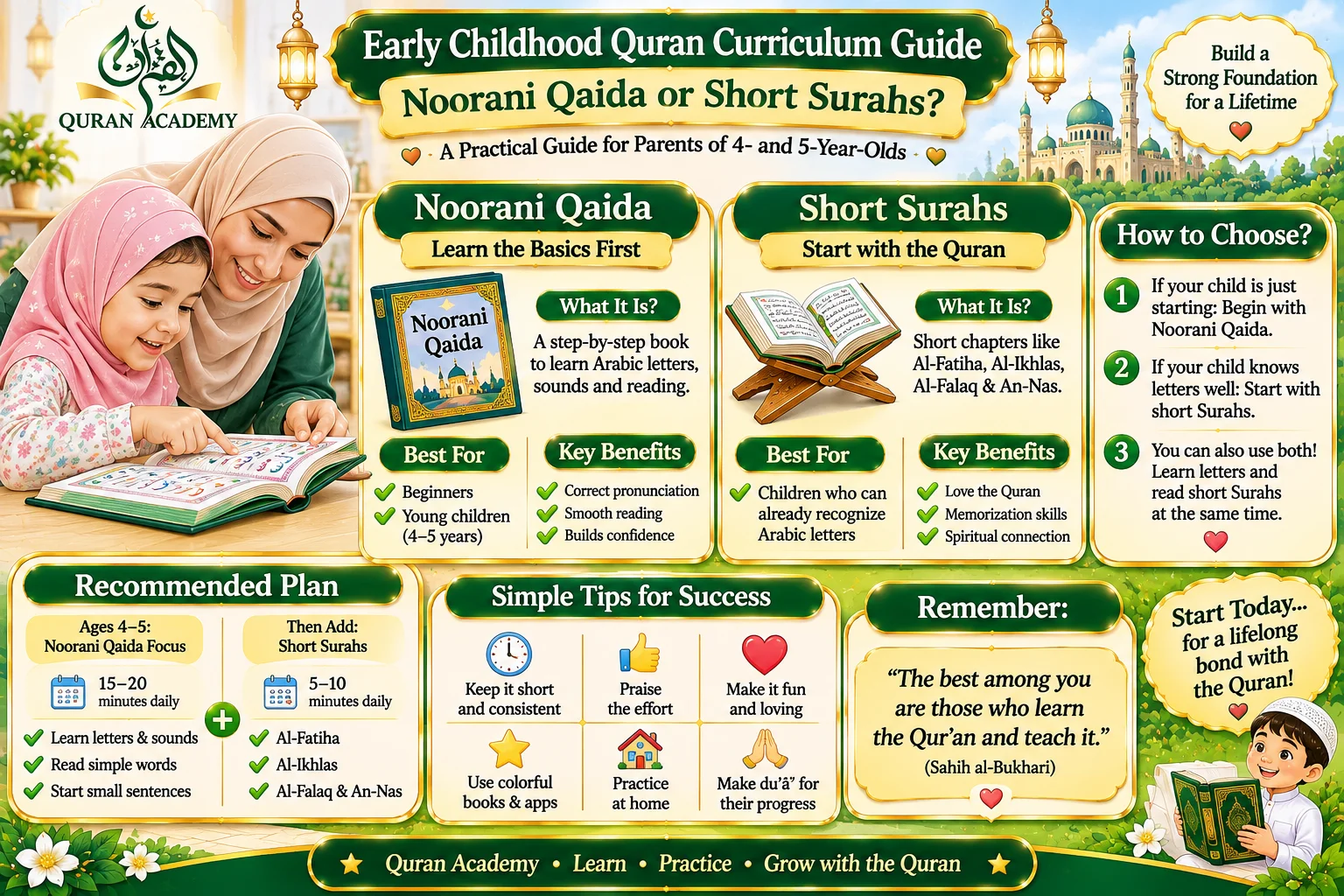
A 4- or 5-year-old should not choose one over the other—they learn fastest using the 10+10 Parallel Method: spend 10 minutes on playful Arabic letter sounds (early Noorani Qaida) and 10 minutes on oral repetition (Talqeen) of short Surahs like Al-Fatihah and the Three Quls.
- Why Qaida alone stalls: Drilling isolated letters for 12 months bores young kids and leaves them unable to recite any Surah in Salah.
- Why Short Surahs alone hit a wall: Memorizing purely by ear works for Juz Amma, but by age 7 or 8 the child still cannot decode a single line of the Mushaf independently.
- The sweet spot: Pairing both inside a 20-minute 1-on-1 session builds accurate Makharij, reading readiness, and daily prayer confidence simultaneously.
When Muslim parents begin planning Quran learning for a 5-year-old (or a bright 4-year-old), the very first curriculum debate comes up immediately: "Should my child start with the Arabic alphabet in Noorani Qaida, or should they memorize short Surahs like Al-Fatihah and Al-Ikhlas first?"
Ask three different relatives and you will hear three different answers. One insists on finishing the entire Noorani Qaida before touching a single Surah. Another says preschoolers are too young for reading books and should only memorize by ear.
In our experience teaching hundreds of English-speaking 4- and 5-year-olds across the US, UK, Canada, and Australia—and as outlined in our main readiness pillar on the best age to start Quran lessons—treating this as an "either-or" choice slows your child down. Here is how both tracks work, how to combine them in 20 minutes, and what realistic 6-month progress looks like.
Noorani Qaida vs. Short Surahs: Side-by-Side Comparison for Ages 4–5
Early Noorani Qaida builds visual letter recognition and exact Arabic articulation points (Makharij), while oral short Surahs build listening memory, spiritual love, and Salah readiness. Comparing both across five early-childhood factors shows why they complement each other in a single 20-minute lesson.
| Curriculum Factor | Early Noorani Qaida (Phonics) | Short Surahs via Talqeen (Oral) |
|---|---|---|
| Primary Skill Developed | Letter shapes, dot patterns, vowel sounds & independent decoding | Auditory memory, Quranic rhythm & recitation confidence |
| Best Starting Age | Ages 4.5 to 5.5 (playful letter games first; full joining at 5.5+) | Ages 3.5 to 5 (echoing short Ayahs line by line) |
| Immediate Payoff for Parents | Child spots Arabic letters in books & pronounces throat letters cleanly | Child recites Al-Fatihah & 3 Quls at bedtime and beside you in Salah |
| Risk If Taught Alone | Can feel repetitive or dry if no Surahs or stories are mixed in | Child memorizes by ear only and struggles to read longer Surahs later |
| Role in 1-on-1 Classes | First 10 minutes (when focus is freshest) | Next 8 minutes + 2-minute Dua or Prophet story |
In our structured Quran classes for ages 4–6, every lesson blends both elements deliberately so young learners never hit a boredom wall or a reading gap.
The "10+10 Parallel Method": Inside One 20-Minute Session
A 4- or 5-year-old's peak focus lasts roughly 8 to 10 minutes per activity. Splitting a 20-minute 1-on-1 lesson into three short, predictable blocks—10 minutes of playful Qaida phonics, 8 minutes of melodic Surah repetition, and 2 minutes of Dua or reward stars—keeps attention high from start to finish.
- Minutes 1–10: Playful Noorani Qaida (Fresh-Mind Block). Because visual recognition takes the most brainpower, the teacher starts here while your child is alert. Using color-coded flashcards and a shared digital whiteboard, the child practices 2 to 3 Arabic letters, traces dots on screen, and copies exact letter sounds (Makharij).
- Minutes 11–18: Melodic Short Surah Talqeen (Joyful Echo Block). Before visual fatigue sets in, the teacher switches to pure listening and echoing. The teacher recites half an Ayah slowly with clear Tajweed, and your child echoes it back three times—building muscle memory for Surah Al-Fatihah, Al-Ikhlas, Al-Falaq, and An-Nas.
- Minutes 19–20: Daily Dua & Star Celebration (Positive Close). Every class ends on a warm emotional note: one short daily Dua (such as before eating or sleeping) and a digital star your child can match on their printable Kids Quran Reward Chart.
Realistic 6-Month Curriculum Roadmap for a 4- or 5-Year-Old
With three 20-minute 1-on-1 sessions per week, most 4- and 5-year-olds master all 28 Arabic letters, recognize basic short vowels (Fathah, Kasrah, Dammah), and memorize 5 to 7 short Surahs from Juz Amma within six months—without tears or heavy homework.
Understand the Quran: Live 1-on-1 Tafseer & Exegesis Course
Explore authentic classical Tafseer (Ibn Kathir & Al-Sa'di), Asbab al-Nuzul, and practical daily reflections in clear English — starting at $4/class.
| Timeline | Noorani Qaida Milestone | Short Surahs & Duas Milestone |
|---|---|---|
| Months 1 – 2 | First 14 Arabic letters (Alif to Saad) with exact Makharij sounds | Surah Al-Fatihah + Surah Al-Ikhlas + Duas for eating & waking up |
| Months 3 – 4 | Remaining 14 letters (Daad to Yaa) + dot-distinction games | Surah Al-Falaq, An-Nas & Al-Kawthar + Dua before sleeping |
| Months 5 – 6 | Connected letter shapes (Lesson 2) & short vowels (Harakat) | Surah Al-Asr, An-Nasr & Al-Masad + confident bedtime review |
Once your child completes these six months comfortably, they are ready to step into full joining rules and Mushaf reading through our Interactive Online Noorani Qaida Course for Kids.
When Should You Lean More Toward One Track First?
While the 10+10 Parallel Method works for most 4- and 5-year-olds, a good 1-on-1 teacher adjusts the ratio based on your child's temperament. Lean 70% toward short Surahs for active 4-year-olds who resist sitting still, and 70% toward Noorani Qaida for 5-year-olds already reading English words.
- Start 70% Short Surahs / 30% Letter Games if: Your child just turned 4, does not yet recognize English letters, or prefers songs and stories over flashcards. Keep letter exposure light (just 1–2 letters per week) while building joy through Surahs.
- Start 70% Noorani Qaida / 30% Short Surahs if: Your 5-year-old already reads basic English phonics at kindergarten, enjoys spotting patterns, and already knows Surah Al-Fatihah and the Three Quls from home.
3 Common Mistakes Parents Make With 4- and 5-Year-Olds
The three biggest mistakes in early Quran learning are using English transliteration instead of real Arabic letters, forcing 60-minute sessions that exhaust preschool attention spans, and skipping daily 3-minute audio review between classes. Avoiding these three habits doubles your child's retention.
- Teaching via English transliteration: Reading "Qul huwallahu ahad" in English letters locks in incorrect pronunciations for Qaf and Haa. Always let your child hear and echo a native Al-Azhar voice instead.
- Booking 45- or 60-minute classes too early: Two or three 20-minute classes per week beat one 60-minute marathon every time. Short sessions end while your child is still smiling.
- Zero review between live lessons: You do not need to teach at home—just play the Surah your child is memorizing in the car for 3 minutes on the way to preschool.
Try the 10+10 Method Live With Your Child — Free
Book a free 1-on-1 evaluation class with a certified Al-Azhar female Ustadhah. We test your 4- or 5-year-old's exact balance of Qaida phonics and short Surahs—with plans starting at $4 per class ($32/month).
Frequently Asked Questions
1. Should a 4-year-old start Noorani Qaida or memorize short Surahs first?
Do both together using the 10+10 Parallel Method: 10 minutes of playful Arabic letter flashcards (early Noorani Qaida) and 10 minutes of oral short Surah repetition (Talqeen) in a single 20-minute 1-on-1 session.
2. Will learning Arabic letters at age 5 confuse my child's English reading?
No. Because Arabic uses a completely distinct script and reads from right to left, young brains store Arabic and English phonics cleanly in separate visual pathways without mixing them up.
3. Which Surahs should a 4- or 5-year-old memorize first?
Start with Surah Al-Fatihah, followed by the Three Quls (Al-Ikhlas, Al-Falaq, An-Nas), and then Surah Al-Kawthar and Surah Al-Asr. These short Surahs prepare your child directly for daily Salah.
4. How long does it take a 5-year-old to finish Noorani Qaida?
With three 20-to-30-minute 1-on-1 classes per week, most 5-year-olds learn all 28 letters and vowels in 4 to 6 months and complete the full 17 lessons of Noorani Qaida within 8 to 12 months.
5. Do I need to sit beside my 4- or 5-year-old during online classes?
Sitting quietly nearby for the first 2 to 3 weeks helps your child feel secure and learn how to look at the screen. Once they bond with their female Al-Azhar Ustadhah, most 5-year-olds participate independently.
