
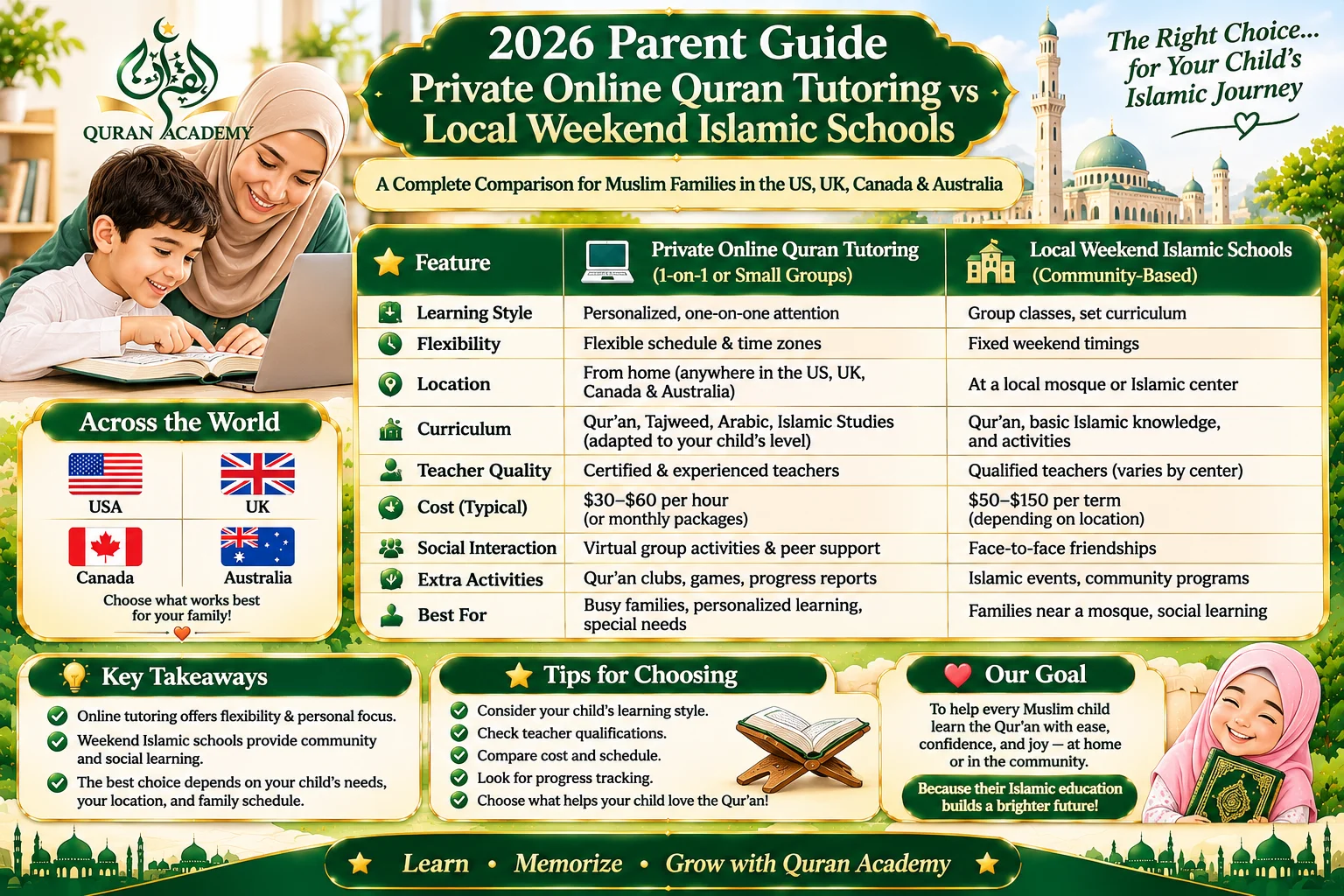
Last updated: November 2026. Editorial disclosure: We run Quran Academy (equranacademy.org), an online 1-on-1 Al-Azhar tutoring platform. Because we also respect the role of local masajid in Western Muslim life, this guide gives weekend Islamic schools full credit where they win and lays out the exact trade-offs so you can choose what fits your child.
- Choose 1-on-1 online Quran classes if your main goal is fluent Quran reading, accurate Tajweed, Hifz (memorization), or support for a shy or neurodivergent child. A single 30-minute private class delivers more direct recitation than a full month at most crowded weekend schools.
- Choose a weekend mosque school if your main goal is Muslim friendships, praying Dhuhr in congregation, and feeling part of a local masjid community.
- Best option for most Western families (Hybrid Model): Use 2–3 short 1-on-1 online classes per week ($32–$48/month) for actual Quran fluency and Tajweed, and attend the local masjid for Jumu'ah, youth programs, and Ramadan/Eid events.
Every September, Muslim parents across the United States, United Kingdom, Canada, and Australia face the same Saturday morning dilemma. You want your child to read the Quran fluently with proper Tajweed, love Islam, and grow up with Muslim friends—without turning every weekend into a stressful race against traffic and exhaustion.
For decades, the local weekend Islamic school (often called Sunday school or Madrassah) was the default answer. Today, live 1-on-1 online Quran tutoring has become a serious alternative. Comparing online Quran classes vs. weekend Islamic school fairly means looking past marketing claims and measuring what actually happens during the hours your child spends learning.
Below, we break down active reading minutes, teacher qualifications, socialization, cost per learning hour, neurodivergent support, and how hundreds of families combine both without burning out.
1-on-1 Online Quran Classes vs. Weekend Mosque School: Side-by-Side Comparison
1-on-1 online Quran classes outperform weekend mosque schools in active recitation time, Tajweed precision, and schedule flexibility, while weekend mosque schools win on in-person Muslim friendships and community belonging. Comparing both across ten practical criteria shows why they solve different parts of a child's Islamic education.
| Comparison Factor | 1-on-1 Online Quran Classes (Quran Academy) | Weekend Mosque / Islamic School (Typical Market) |
|---|---|---|
| Class Size | ✅ 1-on-1 (100% individual attention) | ⚠️ Group (typically 10–25 students per room) |
| Active Quran Reading / Month | ✅ 240–600 minutes (2–5 classes/week) | ❌ 20–40 minutes (5–10 mins per Sunday) |
| Teacher Credentials | ✅ Ijazah-certified Al-Azhar scholars (male & female) | ⚠️ Mixed (dedicated volunteers to trained scholars) |
| Tajweed & Makharij Correction | ✅ Line-by-line immediate audio/visual correction | ⚠️ Limited by classroom noise and time |
| In-Person Muslim Friendships | ❌ No physical peer group | ✅ Strong peer bonding, group Salah & events |
| Monthly Tuition (2026) | ✅ $32–$80/month ($8/hr flat rate, no registration fee) | ⚠️ $40–$120/month (+ annual registration & books) |
| Commute & Logistics | ✅ Zero commute; learn from home in any timezone | ❌ 30–90 mins weekly driving + parking |
| ADHD / Autism Adaptability | ✅ Custom 15–20 min micro-sessions, quiet environment | ❌ Sensory overload in loud classrooms |
| Missed Class Flexibility | ✅ Easy rescheduling around travel, illness & exams | ❌ Missed Sunday means falling behind the group |
| Parent Visibility | ✅ Sit nearby, view portal reports & digital whiteboard | ⚠️ Limited to semester report cards |
Notice a clear pattern in that table: neither option is "bad." They are built for completely different jobs. Problems only start when parents expect a once-a-week group classroom to deliver fluent Quran recitation.
Active Reading Time: The Math Most Parents Never Calculate
A typical 3-hour weekend Islamic school devotes roughly 60 minutes to Quran, split across 12 to 18 students—leaving each child with only 4 to 6 minutes of direct teacher listening per week. By contrast, two 30-minute 1-on-1 online classes provide 60 full minutes of active reading every week.
Let us run the exact numbers over a standard 36-week academic year so you can see why some children attend Sunday school for four years and still struggle to read a single page of the Mushaf independently.
- Weekend Mosque School (60-minute Quran block, 15 students): After taking attendance, quieting the room, and handing out books, the teacher has about 45 usable minutes. Divided by 15 students, your child reads aloud to the teacher for 3 minutes per week. Over 36 weeks, that totals 1.8 hours of individual Quran recitation per year.
- 1-on-1 Online Quran Classes (2 × 30-minute sessions/week): Your child spends the entire 30 minutes reading, repeating Makharij, and practicing Noorani Qaida or Surah memorization. Over 36 weeks, that totals 36 hours of individual Quran recitation per year—twenty times more active practice.
Language acquisition and Quranic recitation follow the same neurological rule as learning a musical instrument or a sport: frequency beats duration. Practicing for 30 minutes three times a week builds muscle memory in the tongue and throat. Waiting seven full days between 4-minute turns forces the child to re-learn the same letters every Sunday.
Mini-Verdict: For reading fluency, Noorani Qaida mastery, and memorization, 1-on-1 online classes win by an overwhelming margin purely on the math of active speaking minutes.
Teacher Qualifications, Tajweed Accuracy, and English Fluency
Certified online academies employ full-time Al-Azhar University graduates who hold an unbroken Ijazah (chain of narration) and teach in fluent English. Weekend mosque schools often rely on generous parent volunteers or part-time community teachers whose formal Tajweed training varies widely from one masjid to another.
This is not a criticism of weekend school volunteers—many of them sacrifice their own weekends out of sincere love for the community. However, teaching Makharij al-Huruf (exact articulation points) and Sifaat (letter characteristics) to English-speaking children requires specialized pedagogical training.
For example, an English-speaking child naturally pronounces the Arabic letter Qaaf (ق) like a hard English "K," or flattens the heavy letter Saad (ص) into an English "S." In a noisy classroom of 18 kids, a volunteer rarely has time to pause for five minutes and coach one child's tongue placement. In a quiet 1-on-1 Zoom session with headphones, an Ijazah-certified teacher hears every subtle slip immediately and corrects it gently before it becomes a permanent habit.
Equally important is English fluency. Many parents hesitate to hire online tutors because they worry about heavy accents or cultural disconnects. When evaluating any online academy, insist on a live trial class to verify that the teacher explains rules like Noon Sakinah or Qalqalah in clear, warm English your child understands effortlessly. You can review the credentials and backgrounds of our faculty directly on our Al-Azhar certified tutors page.
Mini-Verdict: Online academies with verified Al-Azhar scholars provide far more consistent Tajweed precision and structured phonics progression than volunteer-run classrooms.
Socialization and Muslim Identity: Where Weekend Mosque Schools Win
Weekend mosque schools provide something no Zoom screen can replicate: physical belonging inside a Muslim community. Praying Dhuhr shoulder-to-shoulder with peers, sharing snacks during break time, and celebrating Ramadan and Eid at the masjid anchor a child's Muslim identity in a non-Muslim majority country.
For children growing up in public schools across Texas, London, Toronto, or Melbourne, being the only Muslim student in their fourth-grade class can feel isolating. Walking into a weekend Islamic school and seeing fifty other kids who fast, pray, and share the same values sends a powerful emotional message: "I am not alone, and being Muslim is normal."
Weekend schools also shine in group-friendly subjects:
- Seerah and Prophetic Stories: Group discussions, skits, and storytelling work wonderfully with peers.
- Islamic Manners (Adab) and Teamwork: Practicing patience, sharing, and respecting elders in real-time social settings.
- Congregational Prayer: Standing in rows for Wudu and Dhuhr prayer builds lifelong masjid attachment.
When online academies claim that a laptop completely replaces the masjid, they are not being honest with parents. A 1-on-1 tutor is a specialist for mastery and skill-building; the masjid is the home for community and brotherhood.
Mini-Verdict: Weekend mosque schools win decisively on peer friendships, masjid attachment, and group Islamic identity.
Scheduling, Commutes, and Family Burnout
Online Quran classes eliminate weekly driving, parking hassles, and winter weather cancellations, letting families schedule 30-minute sessions on weekdays or weekends in their exact local timezone. Weekend mosque schools lock families into fixed Saturday or Sunday morning blocks that frequently clash with sports, travel, and family rest.
Talk to any parent of three kids in Chicago, Birmingham, or Toronto in January. Getting everyone dressed, fed, and into the car at 8:30 AM on a freezing Sunday morning—after five days of school and work—often turns Islamic education into a source of household tension. When children associate "Quran time" with being rushed, tired, and scolded in the car, resentment builds quietly.
With online 1-on-1 classes, your child finishes breakfast in pajamas, puts on headphones at the kitchen table, and completes a focused 30-minute lesson with zero commute. If you have a family wedding, a school exam week, or a sick day, you reschedule the session instead of falling permanently behind a class syllabus.
For families whose weekdays are packed with homework and athletics, dedicated weekend online Quran classes (Saturday & Sunday) offer the best of both worlds: zero weekday stress and zero weekend driving.
Engaging Online Quran & Arabic Classes for Kids (Ages 4–12)
Interactive Noorani Qaida, short Surahs, and star reward charts with warm, bilingual Al-Azhar tutors — starting at $4/class.
Mini-Verdict: Online 1-on-1 classes win on convenience, consistency, and protecting family peace during busy school months.
Support for Shy, Gifted, and Neurodivergent Learners (ADHD & Autism)
1-on-1 online Quran classes adapt immediately to a child's sensory needs, attention span, and learning pace, making them far more effective for shy, gifted, or neurodivergent students. Large weekend mosque classrooms rely on one fixed pace and noisy group settings that often overwhelm kids with ADHD or autism.
In a standard weekend classroom of 18 children, the teacher has to aim for the middle of the group. That structure leaves three types of children struggling quietly:
- Kids with ADHD or Autism: Sitting still on a carpeted floor for three hours amid background chatter causes sensory overload. At home in a quiet room, a trained tutor can run focused 15-to-20-minute micro-sessions, use visual star charts on a shared digital whiteboard, and build in quick movement breaks. Families looking for this structure can explore our dedicated online Quran classes for kids with ADHD and autism.
- Shy or Anxious Readers: Many children fear mispronouncing an Arabic word in front of classmates. When a child feels embarrassed once, they stop volunteering to read. In a private 1-on-1 session, there is no audience to laugh or stare, so confidence builds naturally within a few weeks.
- Fast Learners and Young Hifz Students: A bright 8-year-old who finishes Noorani Qaida in four months often gets held back for the rest of the school year waiting for classmates to catch up. In a private class, the teacher moves them straight into Surah recitation and structured memorization the very next week.
Mini-Verdict: If your child needs a quieter room, a slower pace, or a faster challenge, 1-on-1 online tutoring is dramatically safer and more productive than a group classroom.
True Cost Comparison: Monthly Fees vs. Cost Per Active Reading Hour
While weekend mosque schools look cheaper on paper ($40 to $120/month), their real cost per active Quran reading hour often exceeds $150 because each child reads aloud for only a few minutes per week. At Quran Academy, 1-on-1 classes cost a flat $8/hour ($32 to $80/month) with zero commute or registration fees.
When budgeting for Islamic education in 2026, look at the full household cost rather than the sticker price alone. Consider a family with one child enrolled for a 9-month school year:
| Cost Category (9-Month School Year) | 1-on-1 Online (2×30 Min/Week) | Weekend Mosque School (Typical) |
|---|---|---|
| Monthly Tuition (9 Months) | $288 ($32/month) | $540 (avg. $60/month) |
| Registration & Textbooks | $0 (Digital PDFs included) | $50 – $120 |
| Fuel & Commute Time | $0 (0 hours driving) | ~$120+ fuel & 30+ hours driving |
| Total Active Quran Reading Hours | 36 full hours of 1-on-1 recitation | ~1.8 – 3 hours of individual listening |
For families with two or three children, the gap widens even further. You can read our complete 2026 Online Quran Classes Pricing Guide for a full breakdown of sibling scheduling, 3-day vs. 5-day plans, and hidden fees to avoid.
Mini-Verdict: 1-on-1 online classes deliver roughly 10 to 20 times more active reading value per dollar spent.
Safety, Privacy, and Parent Visibility
Online 1-on-1 classes happen inside your own home, allowing parents to sit in the same room, hear every word of the lesson, and review written progress reports after each class. Weekend mosque schools rely on closed-door classrooms where parents usually see progress only on semester report cards.
Modern parents rightly prioritize child safety. With online tutoring, you should still apply clear household rules:
- Keep the laptop or tablet in a shared family area (like the living room or kitchen table) rather than behind a closed bedroom door.
- Choose an academy that vets teachers through formal identity checks and offers dedicated female Al-Azhar Ustadhahs for daughters and sisters.
- Use a structured student portal where homework, attendance logs, and whiteboard snapshots are recorded transparently for parents.
Mini-Verdict: Online tutoring gives parents direct daily visibility into both teaching quality and child comfort.
The Hybrid Model: How Western Muslim Families Combine Both Without Burnout
The highest-performing model for Muslim families in the US, UK, Canada, and Australia is a hybrid routine: use 1-on-1 online classes during the week for structured Quran reading and Tajweed, and use the local masjid for Jumu'ah, youth nights, and Ramadan community events.
Instead of forcing a weekend school to do a job it was never designed for, divide the two goals cleanly. Let certified Al-Azhar tutors handle the technical skill of reading Arabic, applying Tajweed rules, and memorizing Surahs. Let your local masjid provide the warmth of Muslim friendships, Eid prayers, and youth halaqahs.
Here is a realistic weekly schedule that hundreds of busy families sustain for years without stress:
| Day | Activity | Time Needed | Primary Goal |
|---|---|---|---|
| Tuesday & Thursday | 1-on-1 Online Quran Class (Zoom) | 30 mins each | Noorani Qaida, Tajweed & new Hifz |
| Friday | Local Masjid Jumu'ah or Youth Night | 1–2 hours | Muslim friendships & community belonging |
| Saturday or Sunday | Short 1-on-1 Revision Class OR Family Seerah Story | 30 mins | Retention & joyful Islamic habits |
Notice what happens to your weekends under this schedule: Saturday and Sunday stay open for family rest, sports, and masjid events, while your child still logs 60 to 90 minutes of focused 1-on-1 Quran instruction every single week. You can explore age-specific tracks on our online Quran classes for kids hub.
Decision Framework: Which Option Should You Choose Right Now?
Choose 1-on-1 online classes if your child cannot yet read the Quran independently, struggles with Tajweed, needs flexible scheduling, or feels overwhelmed in large rooms. Choose a weekend mosque school if your child already reads fluently and mainly needs local Muslim peers.
Use this quick checklist to make the call today:
- Pick 1-on-1 Online Classes First if: Your child is between ages 4 and 14 and still learning Noorani Qaida, mispronounces Arabic letters, is starting a Hifz goal, or lives more than 20 minutes from a strong masjid school.
- Pick Weekend Mosque School First if: Your child attends a school with very few Muslim students, already reads the Mushaf smoothly, and craves weekly in-person social time with Muslim friends.
- Pick the Hybrid Approach if: You want measurable Quran fluency and strong Muslim community roots without sacrificing every Saturday morning to traffic.
See How Much Your Child Learns in One 30-Minute 1-on-1 Session
Book a free 30-minute evaluation class with a certified Al-Azhar male or female tutor. No credit card required, transparent $8/hr tuition ($32/month plans), and a 30-day money-back guarantee.
Book Your Free Trial Class →Frequently Asked Questions
Can online Quran classes replace weekend Islamic school completely?
Online 1-on-1 classes easily replace and outperform weekend schools for Quran reading, Noorani Qaida, Tajweed, Arabic, and Hifz. However, they do not replace in-person Muslim friendships, so we recommend pairing online classes with Jumu'ah prayers, youth programs, or Ramadan events at your local masjid.
At what age can a child start 1-on-1 online Quran classes?
Most children can start gentle 1-on-1 online Noorani Qaida sessions at age 4 or 5, provided the teacher uses short 20-to-30-minute lessons, interactive visuals, and a parent sits nearby for the first few weeks to help build the routine.
Will my child stay focused on Zoom after a full day of school?
Yes, when sessions are kept to 30 minutes and taught 1-on-1. Unlike passive YouTube videos or large online webinars, a private teacher asks your child to read, point, and respond every 30 seconds, which keeps attention high even after school.
How fast do kids learn to read the Quran online compared to Sunday school?
With three 30-minute 1-on-1 classes per week, most beginners complete Noorani Qaida and begin reading short Surahs directly from the Mushaf within 6 to 9 months. In a once-a-week group classroom, the same milestone often takes 2 to 3 years.
Are female Al-Azhar teachers available for young kids and daughters?
Yes. Quran Academy has Ijazah-certified female Al-Azhar Ustadhahs who specialize in teaching young children, daughters, and adult sisters in fluent English, at the exact same $8/hour rate.
What if we already go to weekend Islamic school—can we add just 1 or 2 online classes?
Yes. Many families enroll in our 2-day/week plan ($32/month) specifically to reinforce what their child learns at Sunday school and ensure they actually master Quran recitation and Tajweed.
